
16. Jessie Armstead

Jessie Armstead clawed his way to NFL stardom after he plummeted to the Eighth Round of the 1993 Draft. Armstead was a two-time NCAA Champion at Miami, but a torn ACL as a sophomore was in the minds of many in the NFL, and he had to prove himself all over again.
15. Tiki Barber

The history of Tiki Barber is a little complicated, but even his biggest detractors have to admit that one time he was the best Running Backs in the game.
14. Jimmy Patton

Playing his entire career with the New York Giants (1955-66), Jimmy Patton is one of the most prolific ballhawks in franchise history.
24. Bart Oates

Undrafted from BYU, Bart Oates found a home in the USFL where he played in all three of their seasons, all with the Philadelphia/Baltimore Stars. Oates won two the two championships there and established himself as a player that should have been selected in the NFL all along. The Giants rectified that when he signed with them in 1985.
40. Justin Tuck

There were pro teams that were afraid that Justin Tuck's knee injury would make the Notre Dame player a risky draft pick. As such, he fell to the Third Round, where the New York Giants were more than happy to take him.
18. Y.A. Tittle

Beginning his career in 1948 with the Baltimore Colts of the All-America Football Conference, Y.A. Tittle played for the San Francisco 49ers throughout the 1950s, where he was a UPI MVP in 1957 and a four-time Pro Bowler. The Quarterback was traded straight up to the New York Giants for second-year Lineman, Lou Cordileone. Both players were offended that they were traded for the other. Only one of them was right.
30. George Martin

You could never say that George Martin did not make the most of his opportunity in professional football.
21. Brad Van Pelt

Brad Van Pelt was a two-time All-American at Michigan State, thus bringing a successful resume to the New York Giants who drafted him in the Second Round in 1973.
10. Eli Manning

Eli Manning is one of the most polarizing players in Giants history, but that is predominantly the thought outside of New York. For the most part, Giants fans will always celebrate the Quarterback who was at the helm of two Super Bowls, upsetting Tom Brady and the New England Patriots each time.
2. Emlen Tunnell

Emlen Tunnell took a winding path to the New York Giants. He played at Toledo, spent time in the Coast Guard, and finished his college career at Iowa before signing with New York. He became the first African-American player the Giants ever signed, and the decision proved to be one of the most consequential in franchise history. The defensive back who arrived with little fanfare would spend more than a decade terrorizing quarterbacks and setting records that still stand.
Tunnell blossomed into a ball-hawk from the moment he took the field. From his rookie season through 1957, he never finished a year with fewer than six interceptions, and he peaked with ten in 1949. He earned Pro Bowl selections every season from 1950 through 1957, with four of those years also bringing first-team All-Pro recognition. The consistency was remarkable. Quarterbacks had to account for him on every throw, and the Giants built their secondary around a player who seemed to be in the right place on nearly every deep ball.
He was a vital part of the loaded Giants team that won the 1956 NFL Championship. Tunnell’s range and instincts gave the defense a reliable playmaker in the back end, and his ability to turn interceptions into long returns changed field position in ways that helped the offense. Opposing receivers found him difficult to shake, and his coverage skills and return ability made him one of the most valuable players on the roster throughout the decade.
Tunnell doubled as a return specialist. He twice led the NFL in punt return yards and brought back five punts for touchdowns. With the Giants, he accumulated 2,206 punt return yards, a total that reflected both the volume of returns he handled and the explosiveness he brought once he caught the ball. At the time of his retirement, he was the all-time leader in punt return yards, underscoring how dominant he had been in that phase of the game.
The Giants sold his contract to the Green Bay Packers after the 1958 season. He played three more years under Vince Lombardi, earned another Pro Bowl selection, and helped the Packers win an NFL Championship.
With the Giants, he recorded 72 interceptions, a total that remains the franchise record. He added another seven with Green Bay and was the all-time NFL leader in interceptions when he retired. Those numbers, combined with the return production, captured the dual impact he had on both sides of the ball during his time in New York. Tunnell entered the Pro Football Hall of Fame in 1967. He was also named to the NFL 100th Anniversary Team. The Giants inducted him into their Ring of Honor in 2010.
6. Frank Gifford

Frank Gifford was a standout at USC, and the New York Giants selected him with the 11th overall pick in the 1952 draft. He arrived with the versatility to contribute on both sides of the ball, and the Giants used that ability early in his career. He lined up at halfback, defensive back, and on special teams before settling primarily into an offensive role. His multi-threat skill set made him a valuable piece on a Giants team building toward championship contention in the mid-1950s.
From 1953 through 1959, Gifford earned Pro Bowl selections every season, with four of those years also bringing first-team All-Pro recognition. Playing primarily at halfback, he ran the ball, caught passes out of the backfield, and occasionally threw. The production stayed consistent across that stretch, and defenses had to account for him as both a runner and a receiver. He gave the Giants’ offense a reliable option on the ground and through the air, and his presence helped the unit remain balanced even when the supporting cast changed.
His best season came in 1956. Gifford finished with a career-high 1,422 yards from scrimmage and led the NFL in that category. The Giants won the NFL Championship that year, and Gifford’s production was central to the offense that carried them through the postseason. He continued to contribute at a high level in the years that followed, combining rushing, receiving, and occasional passing to keep defenses guessing. Over his career with New York, he accumulated 9,870 all-purpose yards, a substantial total for the era.
Gifford also threw 14 touchdown passes, the most ever by a non-quarterback. The passing ability added another dimension to the Giants’ offense and forced defenses to prepare for an extra threat whenever he was in the backfield. That versatility was especially useful in an era when halfbacks were expected to contribute in multiple ways, and Gifford excelled at nearly all of them during his peak years with the team.
His career was interrupted by a violent hit from Chuck Bednarik in 1960 that caused a severe concussion. He missed the remainder of that season and all of 1961 while recovering. When he returned in 1962, he shifted to flanker and played three more seasons in that role. The move let him stay on the field without the same physical demands as the halfback position, and he remained a productive receiver during those final years.
Gifford retired after the 1964 season. He left New York after more than a decade as one of the most versatile offensive players in franchise history and as a key contributor to the 1956 championship team. The 11th overall pick, who played both sides of the ball early in his career, became one of the defining skill players of the Giants’ 1950s teams.
Gifford was named to the 1950s All-Decade Team. The Giants retired his number 16 in 2000 and inducted him into their Ring of Honor in 2010 as part of the inaugural class. He was inducted into the Pro Football Hall of Fame in 1977. After his playing days, he became a successful broadcaster, spending 27 years as a commentator on Monday Night Football.
5. Michael Strahan

Michael Strahan was a standout defensive end at Texas Southern, and the New York Giants selected him in the second round of the 1993 draft. The choice looked solid at the time and has since been recognized as one of the franchise’s better picks. He arrived with the tools to rush the passer, yet injuries limited him to six games as a rookie. Once he was healthy the following year, he settled into a productive role on the defensive line and began building the foundation for a longer career in New York.
For the next few seasons, Strahan was a reliable starter who generated pressure and held the edge, but he was not yet viewed as a superstar. That perception changed in 1997. He recorded 14 sacks, earned his first Pro Bowl selection, and was named first-team All-Pro. The breakout confirmed that the second-round pick had become one of the most dangerous edge rushers in the league. He followed that performance with another first-team All-Pro season in 1998, posting 15 sacks and continuing to disrupt quarterbacks on a regular basis.
After a couple of quieter years, Strahan delivered the defining season of his career in 2001. He broke the single-season sack record with 22.5, led the NFL in tackles for loss with 24, and was named Defensive Player of the Year. That production set a new standard for edge rushers and forced offenses to devote extra attention to his side of the line on every snap. He repeated as the league leader in both sacks (18.5) and tackles for loss (23) in 2003, proving the 2001 peak wasn't a one-year spike.
In 2005, he earned his seventh Pro Bowl selection and led the NFL in tackles for loss once more with 18. Even as the raw sack totals dipped from the record-setting year, he remained a consistent source of pressure and a player opponents had to account for in their protection schemes. The combination of power and technique allowed him to win against both tackles and tight ends, and the Giants’ defense played with more stability on his side of the field throughout those middle years of his career.
Even as he aged, Strahan remained a leader on and off the field. He continued to start and generate pressure while younger players developed around him. The Giants leaned on his experience in the locker room and his presence on the edge, and he responded with consistent effort even when the raw production no longer matched his earlier peaks. Fittingly, he closed his career as a Super Bowl champion. In 2007, the Giants stunned the previously undefeated New England Patriots, and Strahan recorded a sack in the title game.
Strahan retired after the 2007 season. He left New York after fifteen years as one of the most productive defensive ends in franchise history and as a player who had helped deliver a championship in his final campaign. The second-round pick from Texas Southern had become a defining figure on the Giants’ defensive line.
With the Giants, he recorded 141.5 sacks and earned seven Pro Bowl selections along with four first-team All-Pro honors. Those totals reflected both the volume of pressure he generated across more than a decade and the sustained recognition that came with it. He finished as the franchise’s all-time leader in sacks at the time of his retirement. Strahan was inducted into the Pro Football Hall of Fame in 2014. He was also part of the inaugural Giants Ring of Honor class in 2010, and the team retired his number 92 in 2021.
4. Mel Hein

Mel Hein was a two-sport standout at Washington State, excelling in both football and basketball, but he pursued a professional career on the gridiron. He signed with the New York Giants in 1931 and never played for another team. Over the next fifteen seasons, he lined up at both center and linebacker, becoming one of the most versatile and dominant players of his era. The Giants reached the NFL Championship Game seven times, and Hein was a central figure in each appearance.
He helped the franchise win titles in 1934 and 1938. In those championship contests, and in the five other title games the Giants reached during his tenure, Hein’s work in the trenches and on defense gave the team a reliable anchor in the middle of the field. He was equally effective snapping the ball and then diagnosing the play on the other side of the line, a dual role that few players of the time handled at such a high level. Opposing offenses had to account for his size and instincts on every snap, whether he was blocking for the run or dropping into coverage.
Hein’s individual recognition matched the team's success. He earned four Pro Bowl selections and five first-team All-Pro honors. His consistency over more than a decade confirmed he was among the best centers and linebackers in the league year after year. He was later named to the 1930s All-Decade Team, recognition that placed him among the defining players of that period. The Giants leaned on him as a leader on both sides of the ball, and his durability let him start for most of his fifteen seasons in New York.
Hein retired after the 1945 season. He left the Giants after a decade and a half as the clear standard at center and one of the most accomplished two-way players of his generation. The two-sport athlete, who signed in 1931, became one of the franchise’s most important figures during its early championship years.
With the Giants, he appeared in seven NFL Championship Games and helped the team win two titles. Those postseason appearances, combined with the Pro Bowl and All-Pro recognition, reflected both the individual excellence and the sustained contribution he brought across fifteen seasons. He remained a starter for nearly his entire career and gave the Giants a reliable presence in the middle of the field in an era when two-way play was still common.
Hein entered the Pro Football Hall of Fame in 1963, the same year the Giants retired his number 7. He was also named to the NFL 75th Anniversary Team and the 100th Anniversary Team. The Giants inducted him into their Ring of Honor in 2010 as part of the inaugural class.
3. Rosey Brown

Rosey Brown arrived in New York as a 27th-round pick out of Morgan State in 1953, a selection that looked ordinary at the time and has since been recognized as one of the greatest values in Giants history. The NFL was still in the early stages of scouting historically Black colleges, and the Giants took a chance on the 6-foot-3 tackle from Baltimore. He spent his entire career at left tackle and quickly proved that the late-round gamble had paid off in spectacular fashion.
Early in his career, Brown was one of only two African-American players on the Giants roster. He helped break racial barriers at a time when many teams still resisted integrating their lineups, and his play on the field made the argument for him. He earned his first Pro Bowl selection in 1955 and then went on a six-year streak of Pro Bowl nods. From 1956 through 1959 he was a first-team All-Pro every season, recognition that confirmed he was among the best left tackles in the league. Brown was a vital piece of the Giants team that won the 1956 NFL Championship, protecting the quarterback and opening lanes for the running game in the championship contest.
His excellence continued into the 1960s. Brown added three more Pro Bowl selections and two more first-team All-Pro honors during that decade. He remained a consistent force on the left side of the line, blending size, technique, and durability in a way that few tackles of the era matched. Offenses had to account for his strength in the run game and his ability to handle speed rushers in pass protection, and the Giants’ offensive line played with more stability whenever he was on the field.
Brown retired after the 1965 season. He left New York after thirteen years as the clear standard at left tackle for the franchise. The 27th-round pick, who arrived with little fanfare, had become one of the most accomplished offensive linemen in Giants history.
In New York, he started for more than a decade and earned nine Pro Bowl selections along with six first-team All-Pro honors. Those numbers reflected both the longevity and the sustained high-level play that defined his career in New York. He was regarded as one of the greatest linemen of his generation by the time he walked away. Brown was named to the 1950s All-Decade Team, the NFL 75th Anniversary Team, and the 100th Anniversary Team. He entered the Pro Football Hall of Fame in 1975. The Giants inducted him into their Ring of Honor in 2010 as part of the inaugural class.
8. Andy Robustelli

Andy Robustelli was already a proven defensive end with the Los Angeles Rams when he forced a trade to the New York Giants before the 1956 season. He had asked for time off after the birth of his child; the request was denied, and he demanded a change of scenery. The Rams complied, and the Giants acquired a 30-year-old pass rusher who still possessed elite ability. The move paid immediate dividends. Robustelli earned first-team All-Pro recognition for the third time in his career and helped New York win the NFL Championship in his first season with the team.
The Giants returned to the Eastern Conference title game five more times during his tenure, yet the 1956 championship remained the only one he won in New York. Even without additional titles, Robustelli continued to produce at a high level. He earned five Pro Bowl selections with the Giants and four first-team All-Pro honors. The recognition confirmed that his skills had not diminished after the move from Los Angeles. He remained a disruptive force on the edge, collapsing pockets and setting the edge against the run, and opposing offenses had to account for him on every snap.
In 1962, Robustelli won the Bert Bell Award, becoming the first defensive player to receive that version of the Most Valuable Player honor. The award underscored the impact he continued to have well into his thirties. He blended power and technique in a way that allowed him to win against both tackles and tight ends, and the Giants’ defense played with more stability on his side of the field throughout those years. Younger teammates looked to him for leadership, and his presence helped the unit remain competitive even as the supporting cast changed.
Robustelli retired after the 1964 season. He left New York after nine years as one of the most accomplished defensive ends in franchise history and as a player who had helped deliver a championship in his first season with the team. The trade acquisition, who arrived at age 30, remained productive and honored throughout his time in a Giants uniform.
With the Giants, he earned five Pro Bowl selections and four first-team All-Pro honors. Those recognitions, combined with his contribution to the 1956 championship and the Bert Bell Award, reflected both his individual excellence and the sustained impact he brought over nearly a decade in New York. He finished as one of the more decorated defensive linemen of his generation.
Robustelli entered the Pro Football Hall of Fame in 1971. The Giants placed him in their Ring of Honor in 2010 as part of the inaugural class.
9. Sam Huff

Sam Huff joined the Giants as a third-round pick from West Virginia in the 1956 draft, though the team wasn’t quite sure where he fit at first. He grew frustrated during training camp, and assistant coach Vince Lombardi stepped in to persuade the team to keep him long enough for defensive coordinator Tom Landry to build a 4-3 scheme largely around him. In a sense, two future Hall of Fame coaches helped create the right opportunity for a third. Huff found his place at middle linebacker and soon became the heart of the Giants’ defense.
He helped New York win the 1956 NFL Championship in his rookie season. The Giants returned to the title game five more times during his tenure, and Huff was a central figure in each appearance. He controlled the middle of the defense with a combination of size, instincts, and range that made it difficult for offenses to run or throw over the middle. Huff diagnosed plays quickly, filled gaps against the run, and dropped into coverage with enough range to disrupt passes that attacked the intermediate areas. From 1958 through 1961, he earned four straight Pro Bowl selections, confirming he was among the best middle linebackers in the league during that stretch. Many viewed him as the face of the Giants’ defense throughout those years.
Huff’s time in New York ended after the 1963 season when he signed with the Washington Redskins. He left after eight seasons as one of the most recognizable defensive players in franchise history and as a key contributor to the 1956 championship team. The third-round pick who had nearly left camp in frustration had become the anchor of a defense that reached the title game six times during his tenure.
While donning the Giants’ blue, he recorded 18 interceptions. Those takeaways, combined with the Pro Bowl recognition and the championship contribution, reflected both the individual excellence and the sustained impact he brought across eight seasons in New York. He finished as one of the defining middle linebackers of his era.
Huff was inducted into the Pro Football Hall of Fame in 1982. The Giants placed him in their Ring of Honor in 2010 as part of the inaugural class.
1. Lawrence Taylor
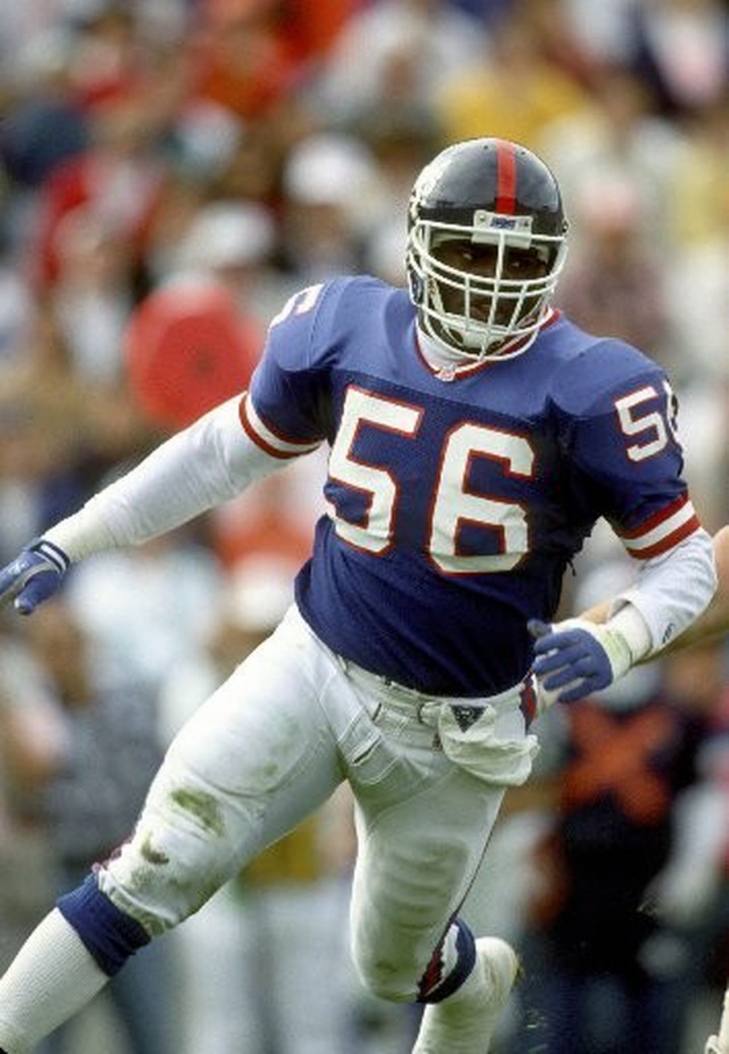
Lawrence Taylor did not simply play the game. He rewrote the rules for what a single defender could do to an offense. The second overall pick in 1981 arrived in New York already larger than the position, and within weeks it became clear that opposing coordinators would have to invent new ways to protect their quarterbacks. He became the face of the Giants and, for a stretch, the face of defensive football itself.
As a rookie, Taylor won both Defensive Rookie of the Year and Defensive Player of the Year. He terrorized the edge from the first snap, combining speed, power, and a relentless motor that few had seen from a linebacker. That debut launched the most dominant six-year run any linebacker has produced. From 1981 through 1986, he was a perennial first-team All-Pro and Pro Bowl selection, and his Approximate Value never dipped below 16 even in the strike-shortened 1982 season, when he captured a second Defensive Player of the Year award in only nine games.
The peak arrived in 1986. Taylor led the NFL with 20.5 sacks, earned his third Defensive Player of the Year honor, and was named the Associated Press MVP, the PFWA MVP, and the Bert Bell Award winner. He was everywhere on the field, collapsing pockets, forcing fumbles, and turning routine plays into disasters for the offense. The Giants rode that dominance to a Super Bowl victory over the Denver Broncos, and Taylor was the most feared player on either side of the ball that season.
He remained elite after the championship. Taylor collected two more first-team All-Pro nods and helped the Giants win a second Super Bowl. His last Pro Bowl selection came in 1990, yet he continued to play through 1993. Mileage and age eventually slowed him, but the impact never fully disappeared. He finished with 141 sacks (132.5 official, since the stat was not kept in his rookie year) and a seven-year streak of double-digit sack totals from 1984 through 1990.
Taylor’s style changed how defenses were built and how offenses had to react. He attacked the quarterback from the outside with a combination of burst and violence that made traditional protection schemes obsolete. He pioneered stripping the ball from opponents’ hands, turning potential completions into turnovers. Coordinators began assigning multiple blockers to him on every snap, yet he still found ways to disrupt the play. The persona matched the production: brash, physical, and impossible to ignore.
As dominant as he was, drug use during his playing days may have kept him from reaching an even higher level. It is fair to wonder what the numbers would have looked like had he stayed clean for longer stretches. Even with those setbacks, the on-field results remain among the most impressive in NFL history.
Taylor retired after the 1993 season. He left New York having rewritten the standard for outside linebackers and having given the Giants two Super Bowl wins during his prime.
With the Giants, he recorded 132.5 official sacks and a career total of 141, including the 1981 total. Those numbers, combined with the All-Pro and MVP recognition, cemented him as one of the most productive defensive players of his era. Taylor was inducted into the Pro Football Hall of Fame in 1999. He was named to the 1980s All-Decade Team, the NFL 75th Anniversary Team, and the 100th Anniversary Team. The Giants retired his number 56 in 1994.
7. Harry Carson

The New York Giants already had a feared linebacker on the roster when they drafted Lawrence Taylor. Harry Carson arrived in 1976 as a fourth-round pick out of South Carolina State, and he quickly claimed the starting middle linebacker job during his rookie season. The former college star brought size, instincts, and a physical style that made him difficult to move in the run game. Within a few years, he had become one of the more reliable defenders in the middle of the Giants’ defense.
Carson earned his first Pro Bowl selection in 1978 and then went to the game eight more times. His consistency over more than a decade confirmed he was among the best middle linebackers in the league year after year. He was also a leader in the locker room. Carson served as a team captain for ten of his thirteen seasons in New York, and younger players looked to him for both on-field direction and off-field example. His production and leadership made him a central figure even before Taylor arrived.
Official tackle totals weren’t kept during most of Carson’s career, yet he was often the Giants’ leading tackler. He excelled at diagnosing run plays, filling gaps, and bringing down ball carriers before they reached the second level. When Taylor joined the defense, Carson became the anchor of the unit that became known as the Big Blue Wrecking Crew. The group helped the Giants win Super Bowl XXI, and Carson’s presence in the middle allowed the edge rushers to attack with less concern about the run. Offenses found it difficult to move the ball consistently against a front seven that featured both his tackling and Taylor’s pass-rush ability.
Carson remained a starter through the 1988 season. He retired after thirteen years, all of them spent in a Giants uniform, and finished with 173 games played. The fourth-round pick who won the middle linebacker job as a rookie became one of the most durable and productive defenders in franchise history. Age and mileage eventually limited his range, but he kept starting and contributing until he walked away.
In New York, he earned nine Pro Bowl selections and was a key contributor to the Super Bowl XXI championship team. Those recognitions reflected both the individual excellence and the sustained impact he brought across more than a decade in New York. He left as one of the franchise’s all-time leaders in games played and as a player who had helped define the defense during its most successful period of the 1980s.
Carson was outspoken about the Pro Football Hall of Fame selection process, arguing that players and coaches should have more influence. He was eventually inducted in 2006. The Giants placed him in their Ring of Honor in 2010 as part of the inaugural class. The middle linebacker, who arrived as a fourth-round pick and anchored the Big Blue Wrecking Crew, became one of the defining defensive players in Giants history.
The Giants will retire Eli Manning and Michael Strahan's number

Regular visitors of Notinhalloffame.com know that we are slowly working on the top 50 of every major team in the NHL, NBA, NFL and MLB. Once that is done, we intend to look at how each team honor their past players, coaches and executives. As such, it is news to us that New York Giants co-owner, John Mara, stated in a recent interview that Eli Manning and Michael Strahan will have their numbers retired.
Sort of.
This is what he said about Eli’s number:
“It’s retired.”
When asked to clarify, Mara responded:
“Not yet. We’ll do Michael’s (Strahan) announcement another day, but Eli’s will be retired.”
As for when that will happen is anyone’s guess.
Wearing #10, Manning announced his retirement this past Friday. Playing at Quarterback, Manning threw for 57,034 Yards and 366 Touchdowns, and led the Giants to two Super Bowl Championships, both over the New England Patriots. He was named the MVP in both of those games, and he is eligible for the Pro Football Hall of Fame in 2025.
As for Strahan, he has already been inducted into Canton, which occurred in 2014. Like Manning, Strahan played his entire career with the Giants and he was the 2001 Defensive Player of the Year. The seven-time Pro Bowl won a Super Bowl in his last game in the league. He wore #92, which has never been issued since his retirement.
At present, the Giants have retired the numbers of Ray Flaherty (#1), Tuffy Leemans (#4), Mel Hein (#7), Phil Simms (#11), Y.A. Tittle (#14), Frank Gifford (#16), Al Blozis (#32), Joe Morrison (#40), Charlie Conerly (#42), Ken Strong (#50) and Lawrence Taylor (#56).
We here at Notinhalloffame.com are looking forward to these events in the future and are hopeful that the Giants will move on this action soon.
298. Bart Oates
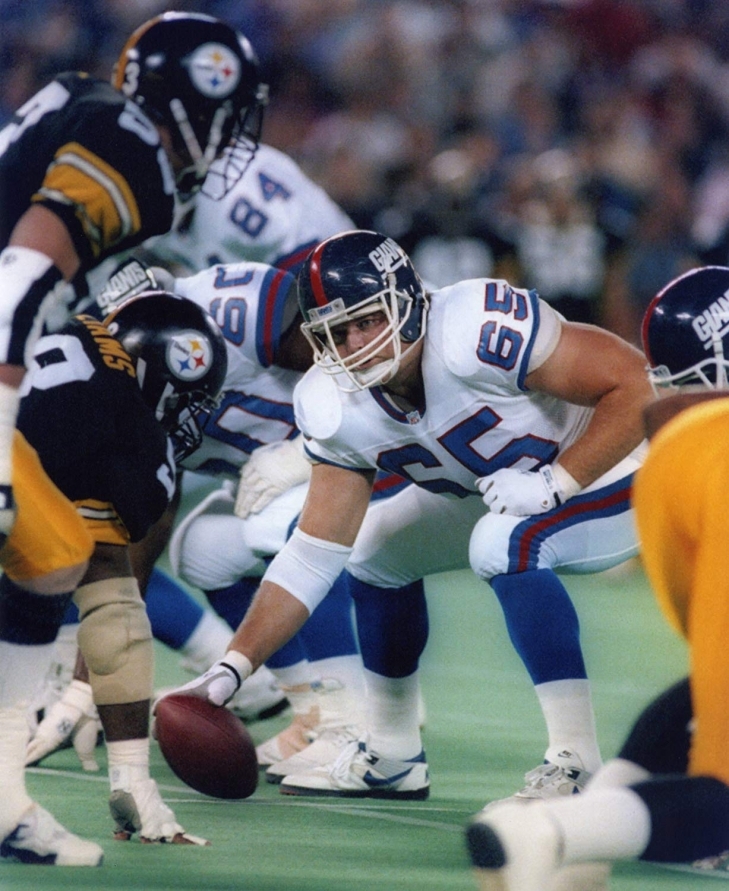
In terms of Centers, there are few Professional Football players who can say that they are as successful as Bart Oates.
After going undrafted out of BYU in 1983, Oates joined the Philadelphia Stars of the USFL and won championships with them in 1984 and 1985. When the USFL folded, he signed with the New York Giants, where he would become their starting Center, and was named an All-Rookie. The following season would see Oates win another title, this time a Super Bowl Ring when the Giants won Super Bowl XXI. In 1990, Oates and the Giants won another Super Bowl (XXV), but for the first time, he made the Pro Bowl.
This began his most successful individual run, as he earned that honor in 1991 and 1993. He would sign with the San Francisco 49ers for 1994, where he played two seasons and went to his fourth and fifth Pro Bowls. He would win another title when he assisted the Niners in their win in Super Bowl XXIX.
Five pro rings are pretty damned good, don’t you think?
