

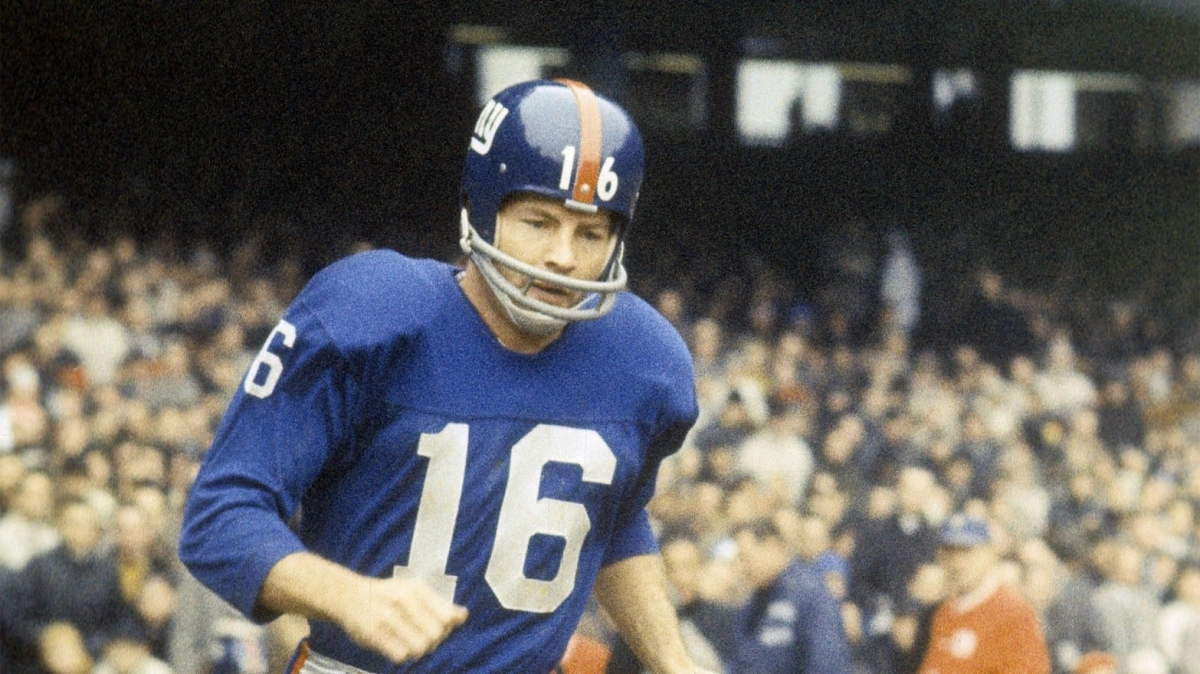
Frank Gifford was a standout at USC, and the New York Giants selected him with the 11th overall pick in the 1952 draft. He arrived with the versatility to contribute on both sides of the ball, and the Giants used that ability early in his career. He lined up at halfback, defensive back, and on special teams before settling primarily into an offensive role. His multi-threat skill set made him a valuable piece on a Giants team building toward championship contention in the mid-1950s.
From 1953 through 1959, Gifford earned Pro Bowl selections every season, with four of those years also bringing first-team All-Pro recognition. Playing primarily at halfback, he ran the ball, caught passes out of the backfield, and occasionally threw. The production stayed consistent across that stretch, and defenses had to account for him as both a runner and a receiver. He gave the Giants’ offense a reliable option on the ground and through the air, and his presence helped the unit remain balanced even when the supporting cast changed.
His best season came in 1956. Gifford finished with a career-high 1,422 yards from scrimmage and led the NFL in that category. The Giants won the NFL Championship that year, and Gifford’s production was central to the offense that carried them through the postseason. He continued to contribute at a high level in the years that followed, combining rushing, receiving, and occasional passing to keep defenses guessing. Over his career with New York, he accumulated 9,870 all-purpose yards, a substantial total for the era.
Gifford also threw 14 touchdown passes, the most ever by a non-quarterback. The passing ability added another dimension to the Giants’ offense and forced defenses to prepare for an extra threat whenever he was in the backfield. That versatility was especially useful in an era when halfbacks were expected to contribute in multiple ways, and Gifford excelled at nearly all of them during his peak years with the team.
His career was interrupted by a violent hit from Chuck Bednarik in 1960 that caused a severe concussion. He missed the remainder of that season and all of 1961 while recovering. When he returned in 1962, he shifted to flanker and played three more seasons in that role. The move let him stay on the field without the same physical demands as the halfback position, and he remained a productive receiver during those final years.
Gifford retired after the 1964 season. He left New York after more than a decade as one of the most versatile offensive players in franchise history and as a key contributor to the 1956 championship team. The 11th overall pick, who played both sides of the ball early in his career, became one of the defining skill players of the Giants’ 1950s teams.
Gifford was named to the 1950s All-Decade Team. The Giants retired his number 16 in 2000 and inducted him into their Ring of Honor in 2010 as part of the inaugural class. He was inducted into the Pro Football Hall of Fame in 1977. After his playing days, he became a successful broadcaster, spending 27 years as a commentator on Monday Night Football.


Comments powered by CComment