


Committee Chairman
13. James Brooks
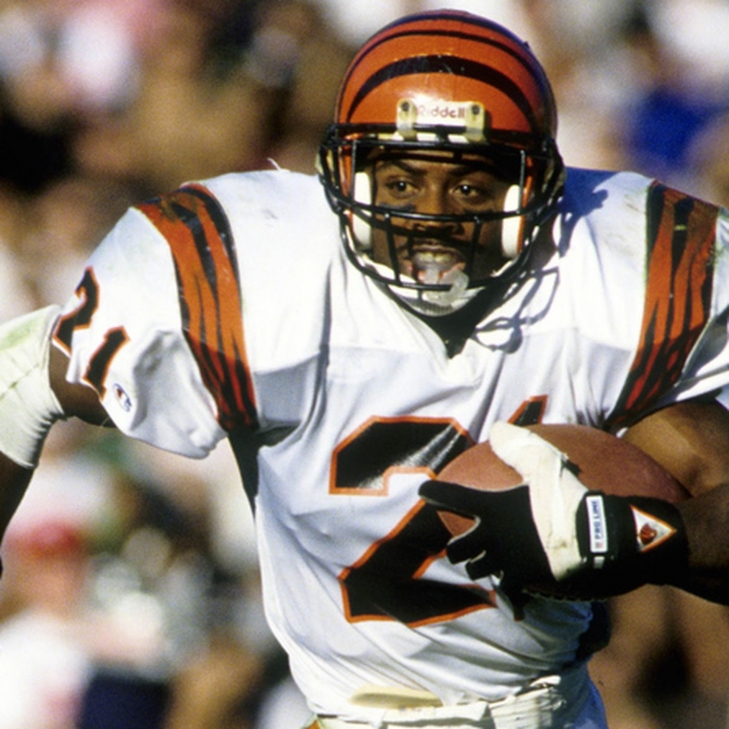
Selected in the first round (24th overall) of the 1981 NFL Draft out of Auburn by the San Diego Chargers, James Brooks joined Cincinnati through a trade in 1984. That transaction proved to be one of the most significant in Bengals history, as the agile running back became the versatile engine of Coach Sam Wyche's innovative "No-Huddle" offense.
Brooks was an exceptionally swift and versatile backfield player who revolutionized the concept of versatility in the late 1980s. Demonstrating remarkable low-center-of-gravity stability, rapid lateral movement, and soft hands when receiving out of the backfield, he was virtually unguardable by linebackers in one-on-one coverage. Serving both as a conventional runner and a flexible receiver, Brooks consistently exploited angles in the secondary to generate substantial, game-changing plays.
Following his initial three seasons in San Diego as a return specialist and rotational running back, Brooks demonstrated significant development upon taking the field at Riverfront Stadium in 1984. His breakthrough year was 1986, during which he delivered an exemplary and versatile performance. Brooks achieved a career-high 1,087 rushing yards and recorded 54 receptions for 658 receiving yards, establishing a franchise record with 1,745 yards from scrimmage. This outstanding performance earned him his first selection to the Pro Bowl.
Following an injury-shortened 1987 campaign, Brooks made a robust return during Cincinnati's remarkable 1988 season. Acting as the pivotal element of the league's most dynamic offense, he accumulated 931 rushing yards and achieved a personal record of 14 total touchdowns (comprising eight rushing and six receiving). These accomplishments garnered him his second selection to the Pro Bowl. He sustained this performance into the postseason, instrumental in advancing Cincinnati through the AFC bracket to reach Super Bowl XXIII.
Brooks executed his most outstanding rushing campaign in 1989, establishing a franchise record at the time with 1,239 rushing yards while maintaining an impressive average of 5.6 yards per carry, thereby earning his third Pro Bowl selection. He concluded his distinguished period in 1990 with 1,004 rushing yards—culminated by a remarkable 201-yard single-game performance against Houston—to attain his fourth Pro Bowl invitation at the age of 32.
Brooks played 118 games (92 starts), becoming the Bengals' all-time leading rusher with 6,447 yards and 37 touchdowns, plus 297 receptions for 3,012 yards and 27 TDs. In 2026, he was inducted into the Bengals Ring of Honor.
12. Reggie Williams
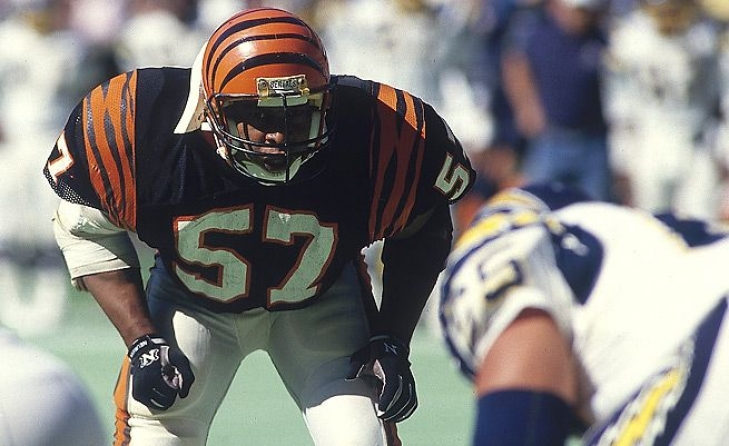
Reggie Williams, a third-round pick (82nd overall) in the 1976 NFL Draft from Dartmouth, arrived in Cincinnati as an extraordinarily intelligent, relentless linebacker. Stepping straight into the lineup, he went on to play his entire 14-year professional career in a Bengals uniform, serving as the dependable anchor on the right side of the defense through two Super Bowl runs.
Williams integrated sharp diagnostic skills with impressive durability and disciplined play at linebacker. As a right-side linebacker in both 4-3 and 3-4 formations, he was adept at anticipating offensive moves before the snap, penetrating blocks to halt the run, and timing blitzes to pressure the quarterback. His intelligent, strategic approach consistently made him a key defensive leader amid scheme and coaching changes.
Williams secured a starting position as a rookie in 1976 and maintained it without pause. Although national award voters often ignored his consistent contributions—resulting in no Pro Bowl selections—his importance to Cincinnati was clear. He was a vital defensive leader for the 1981 AFC Champion Bengals, contributing to the franchise's first Super Bowl XVI appearance. In the strike-shortened 1982 season, Williams topped the NFL with four fumble recoveries and also recorded 2.5 sacks.
As the 1980s progressed, Williams remained a fixture on the field. He compiled 62.5 total career sacks—41.0 of which were officially recorded after the NFL began tracking the stat in 1982—demonstrating a consistent ability to generate edge pressure on third downs. His longevity and leadership capped off another championship run in 1988, when he helped guide the Bengals back to the postseason and to an appearance in Super Bowl XXIII.
In addition to his durability on the field, Williams emerged as a key figure in the Cincinnati community. His wide-ranging philanthropic activities and civic leadership culminated in 1986, when he received the Walter Payton NFL Man of the Year award, originally called the Byron "Whizzer" White Humanitarian Award.
Williams spent 14 seasons with Cincinnati from 1976 to 1989, participating in 206 regular-season games, including 196 starts. He is among a select few in franchise history to surpass 200 games and achieved an Approximate Value (AV) of 92 with the team. During his tenure, Williams recorded 62.5 sacks (41.0 officially credited), recovered 23 fumbles, started in two Super Bowls (XVI and XXIII), and was honored as the 1986 NFL Man of the Year.
10. Andrew Whitworth
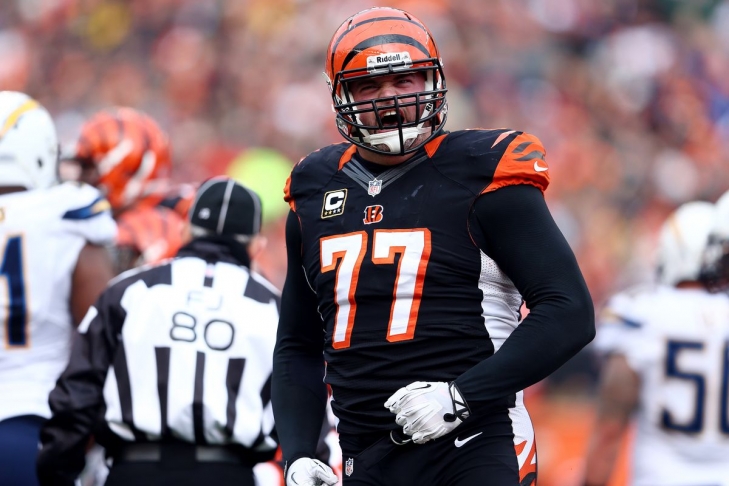
Andrew Whitworth, drafted in the second round (55th overall) of the 2006 NFL Draft from LSU—where he contributed to the 2003 BCS National Championship team—became a key figure on the Ohio River. He quickly secured a starting spot, enabling an 11-year tenure as the Bengals' primary leader and foundation on the offensive line.
Standing at 6 feet 7 inches and weighing 330 pounds, Whitworth was anything but small. He possessed exceptional height combined with quick footwork and a powerful punch. Although some scouts doubted whether his long frame was ideal for interior play, Whitworth proved them wrong when he transitioned to left tackle. He utilized his extensive wingspan and lateral agility to effectively block top-tier edge rushers and shield the blind side of quarterbacks Carson Palmer and Andy Dalton.
Whitworth played 12 games at left tackle as a rookie, but injuries caused Cincinnati to shift their line, moving him to left guard for his second and third seasons. He adapted to the change smoothly, demonstrating his interior strength, before settling back permanently at his natural left tackle position in 2009.
Once established at left tackle, Whitworth began an exceptional second phase of his career, defying usual aging patterns by performing at his peak well into his thirties. In 2012, he gave up only one sack throughout the season and earned his first Pro Bowl invitation.
His career highlight in Cincinnati came in 2015 when he played all 16 games, achieving an Approximate Value (AV) of 19 without allowing any sacks. This performance earned him Consensus First-Team All-Pro honors and his second Pro Bowl selection, helping Cincinnati secure a 12–4 division title. In 2016, he continued his strong play, earning a Second-Team All-Pro recognition and his third Pro Bowl appearance.
In March 2017, the Bengals let the 35-year-old veteran leave in free agency, a decision they soon regretted. Whitworth joined the Los Angeles Rams, where he spent five more outstanding seasons, earning another First-Team All-Pro honor, receiving the Walter Payton NFL Man of the Year Award, and concluding his career with a Super Bowl LVI victory over the Bengals. During his time with the Rams, Whitworth played 168 regular-season games (164 starts), achieved a career AV of 96, and proved to be one of the franchise's best tackle prospects.
9. Lemar Parrish
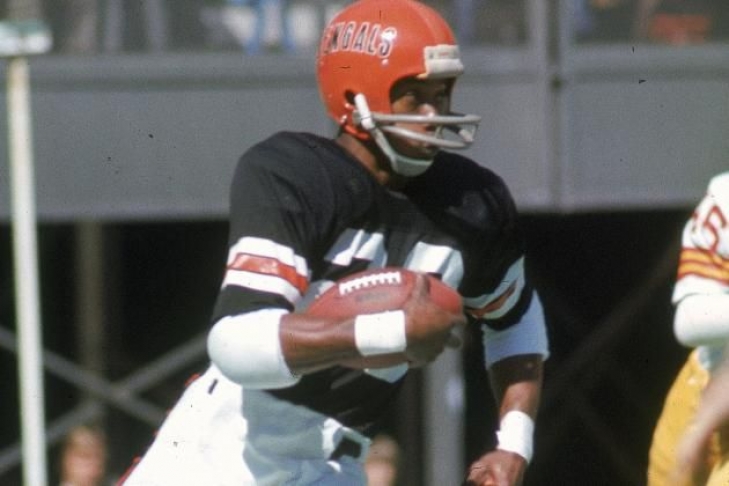
Drafted in the seventh round (163rd overall) of the 1970 NFL Draft out of Lincoln University of Missouri, Lemar Parrish stepped onto the professional scene as an unheralded small-school prospect. It took almost no time for "Leapin' Lemar" to establish himself as one of the most explosive, multifaceted defensive backs and return specialists in the game.
Parrish blended flawless, mirror-like coverage abilities with exceptional speed in open field situations. Playing as a left cornerback, he demonstrated smooth hip movements to turn and track elite receivers, keen instincts for intercepting passes, and superior vision when handling the ball. Each time he intercepted a pass, returned a punt, or recovered a loose ball, Parrish was a constant threat to score a touchdown.
Parrish's rookie year in 1970 was remarkable, as he started 11 games at cornerback, making five interceptions, scoring on a 95-yard kickoff return, and returning a blocked field goal 83 yards for a touchdown. His all-around performance quickly earned him a Pro Bowl selection. In 1971, he continued to excel with seven interceptions and another touchdown, earning his second consecutive Pro Bowl.
Although he had excellent defensive performances in 1972 and 1973, with five interceptions and three non-offensive touchdowns in those two seasons, he was surprisingly not selected for the Pro Bowl.
Parrish responded by achieving an impressive four-year streak of accolades from 1974 to 1977. In 1974, he earned Second-Team All-Pro honors and a Pro Bowl selection after leading the NFL with a remarkable 18.8-yard punt return average, returning two punts for touchdowns. He continued his success with another Second-Team All-Pro and Pro Bowl appearance in 1975, secured a third straight Pro Bowl invite and earned First-Team All-Pro honors in 1976, and concluded his Bengals career with a fourth consecutive Pro Bowl in 1977.
After the 1977 season, contract disagreements resulted in Parrish being traded to the Washington Redskins. He maintained his high level of performance in the capital, intercepting 21 passes over four seasons, earning two further Pro Bowl selections (1979, 1980), and receiving a First-Team All-Pro honor in 1979.
In Cincinnati, Parrish played 105 games (101 starts), with 25 interceptions (fifth in franchise history) and 13 non-offensive touchdowns from interceptions, punts, kickoffs, fumbles, and blocked kicks—a franchise record. In 2024, he was inducted into the Bengals Ring of Honor, cementing his legacy.
