


Committee Chairman
22. David Fulcher
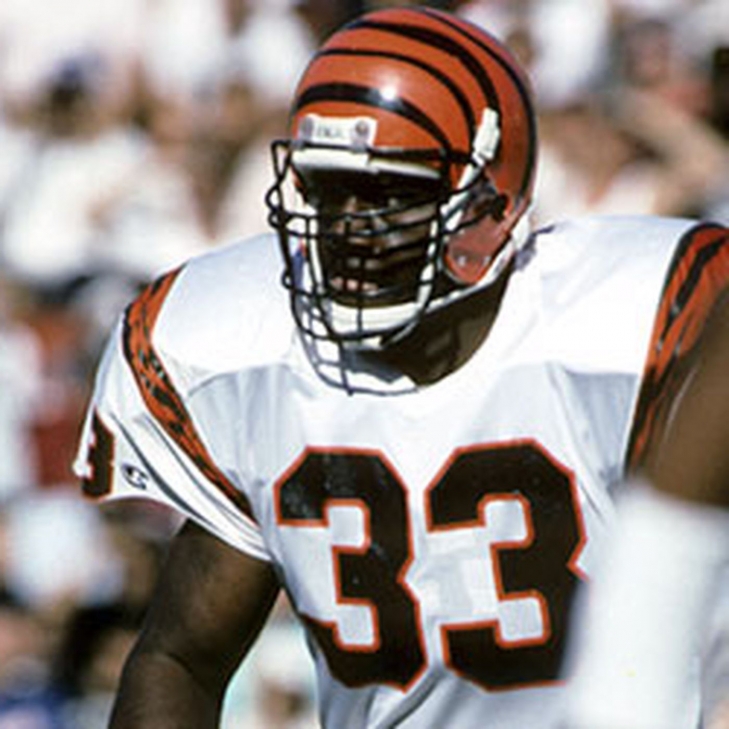
David Fulcher, a rare defensive specimen, arrived in the third round (78th overall) of the 1986 NFL Draft out of Arizona State. Known as "a safety in a linebacker's body," he revolutionized the strong safety position under defensive coordinator Dick LeBeau, using his imposing size and hybrid skill set to anchor the secondary throughout the late 1980s and early 1990s.
Fulcher had the build of a middle linebacker but moved with the fluidity of a defensive back. From his strong safety role, he aggressively supported runs in the alley, using his long reach and ball skills to intercept intermediate passes. LeBeau utilized Fulcher's versatility as a key element in his zone blitz tactics, often shifting him to the line of scrimmage to serve as an additional pass rusher or run-stopper.
Fulcher made a notable impact in his 1986 rookie season by starting all 16 games, recording four interceptions, and earning a spot on the PFWA All-Rookie Team. By 1988, he had established himself as one of the league’s top safeties, with five interceptions and a forced fumble, earning his first Pro Bowl selection and Second-Team All-Pro honors. His aggressive style in the secondary played a key role in Cincinnati's AFC West title and their appearance in Super Bowl XXIII, where he forced a pivotal fumble against San Francisco.
His career truly shined in 1989 when he had an outstanding, career-best season. Fulcher made eight interceptions, achieved a career-high Approximate Value of 16, and received First-Team All-Pro honors along with his second Pro Bowl appearance. He kept up his excellent performance in 1990, with four interceptions and three forced fumbles, earning his third straight Pro Bowl and a Second-Team All-Pro spot. During his last two seasons with Cincinnati (1991–1992), he added seven more interceptions, cementing his reputation as one of the franchise's top ball-hawks.
Fulcher left Cincinnati as a free agent in 1993 to join the Los Angeles Raiders, playing three games before injuries ended his career. In seven seasons there, he had 31 interceptions, 8.5 sacks, and 9 forced fumbles.
21. Cris Collinsworth
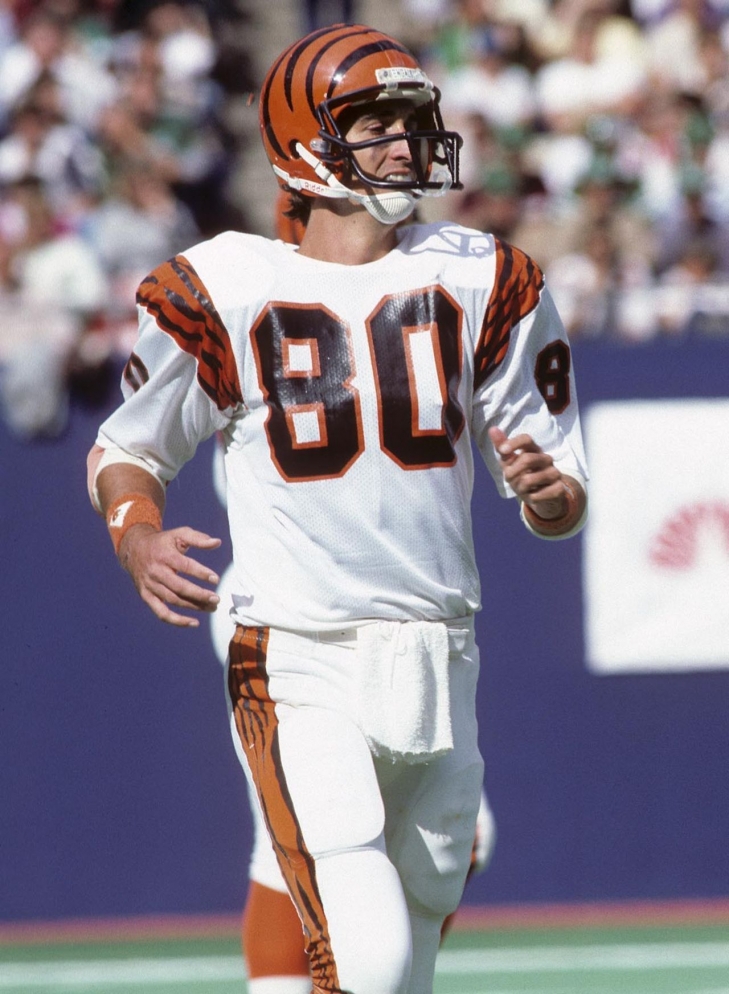
Cris Collinsworth was selected 37th overall in the second round of the 1981 NFL Draft from Florida, where he earned Consensus All-American honors. He arrived in Cincinnati as a unique receiving talent, standing 6’5" with sprinter speed. His exceptional length and vertical ability allowed him to create immediate mismatches against smaller cornerbacks. During his eight-year career in Southwest Ohio, he was the primary target for quarterbacks Ken Anderson and Boomer Esiason, establishing himself as one of the most formidable deep threats of the 1980s.
Collinsworth had a high-end stride length, exceptional body control, and smooth, precise route-running. As Cincinnati’s primary wide receiver, he specialized in intermediate boundary routes and deep seam routes, where his massive catch radius allowed him to pluck throws over defensive backs. His combination of height and open-field speed made him a lethal chunk-play weapon, as evidenced by his career 16.1 yards per reception average.
Collinsworth made an immediate impact during his rookie season in 1981, establishing a franchise record for rookies with 67 receptions, totaling 1,009 yards and eight touchdowns. His outstanding debut earned him his first selection to the Pro Bowl and the Second-Team All-Pro honors, while also contributing significantly to Cincinnati's advancement to the AFC Championship and their inaugural appearance in Super Bowl XVI, where he led all receivers with 107 receiving yards.
He continued his impressive streak of Pro Bowl selections for three years in a row over the next two seasons. Even during the strike-shortened 1982 season, he managed to make a big impact with 49 receptions for 700 yards in just nine games. By 1983, he was back at full strength, hauling in 66 catches for 1,130 yards and five touchdowns, which earned him his third straight Pro Bowl nod and a Second-Team All-Pro honor. In 1984, Collinsworth was so close to reaching 1,000 yards again, finishing just 11 yards shy with 989 yards and six touchdowns. He made a fantastic comeback with two consecutive 1,000-yard seasons in 1985 (1,125 yards) and 1986 (1,024 yards and a career-high 10 touchdowns), truly establishing himself as one of the league's top wide receivers.
In 1988, Collinsworth served as a veteran pass catcher on the Bengals team that secured the AFC Championship and advanced to Super Bowl XXIII. Following this appearance, he retired from professional play, having participated exclusively in all 107 of his career games for Cincinnati, earning the designation of a “Lifer." After his retirement from active competition, Collinsworth transitioned into a career in sports media, where he has achieved remarkable success, including winning 17 Sports Emmy Awards. He has also served as the long-time color analyst for NBC's Sunday Night Football.
Over his career, Collinsworth recorded 417 receptions for 6,698 yards and 36 touchdowns.
20. Tim Krumrie
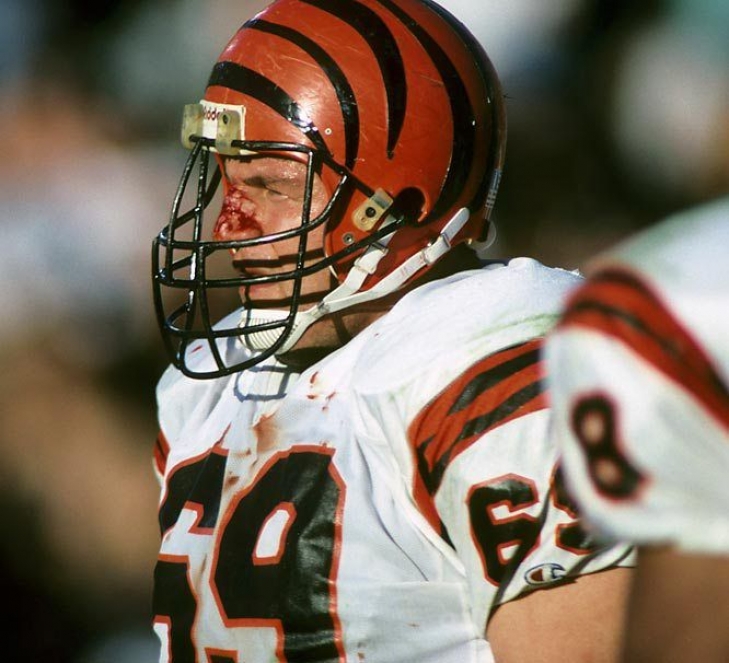
Selected in the tenth round (276th overall) of the 1983 NFL Draft from the University of Wisconsin, Tim Krumrie developed from an overlooked underdog into one of the most productive interior defenders in the history of football. Throughout a 12-year career spent solely with Cincinnati, Krumrie transformed the role of nose tackle, combining exceptional physical resilience with sideline-to-sideline pursuit, thereby establishing himself as a genuine franchise icon.
Krumrie demonstrated intense vigor while operating with a powerful motor, drawing upon his collegiate wrestling background and a keen focus on shedding blocks. Serving as the anchor in Cincinnati's 3-4 defensive scheme, he persistently fought through double-teams to disrupt running plays before their development. His uncommon mobility for an interior lineman allowed him to pursue ball-carriers from behind, converting a position typically dedicated to absorbing blocks into a prolific tackle role.
Krumrie was incorporated into the starting lineup in 1984 and swiftly established himself as a formidable presence, recording 84 tackles and 5.0 sacks. He led the Cincinnati Bengals in tackles for four consecutive seasons from 1985 through 1988, an exceptional achievement for an interior nose tackle. In 1987, he received his initial Pro Bowl selection following the accumulation of 88 tackles and 3.5 sacks over 12 games.
His most distinguished individual campaign occurred in 1988, during which he received First-Team All-Pro honors and was honored with his second Pro Bowl selection. Krumrie accumulated an impressive total of 152 tackles and 3.0 sacks, acting as the defensive pillar for a squad that advanced to the AFC Championship and participated in Super Bowl XXIII. Despite sustaining a severe broken leg early in that Super Bowl, Krumrie undertook a remarkable rehabilitation process, resuming the role of starter in all 16 games of the 1989 season and maintaining an unbroken streak of 96 games following his injury. He continued to be a fundamental figure into the early 1990s, culminating in leading the Bengals in tackles once more at the age of 32 with 97 stops in 1992.
Krumrie retired after the 1994 season, having never missed a non-strike NFL game in 12 years. He then became Cincinnati's defensive line coach for eight seasons. In 2024, he was inducted into the Bengals Ring of Honor as the first defensive lineman to earn this honor. Over his career, Krumrie played 188 games (161 starts), with 1,017 tackles, 34.5 sacks, and 13 fumble recoveries.
18. Isaac Curtis
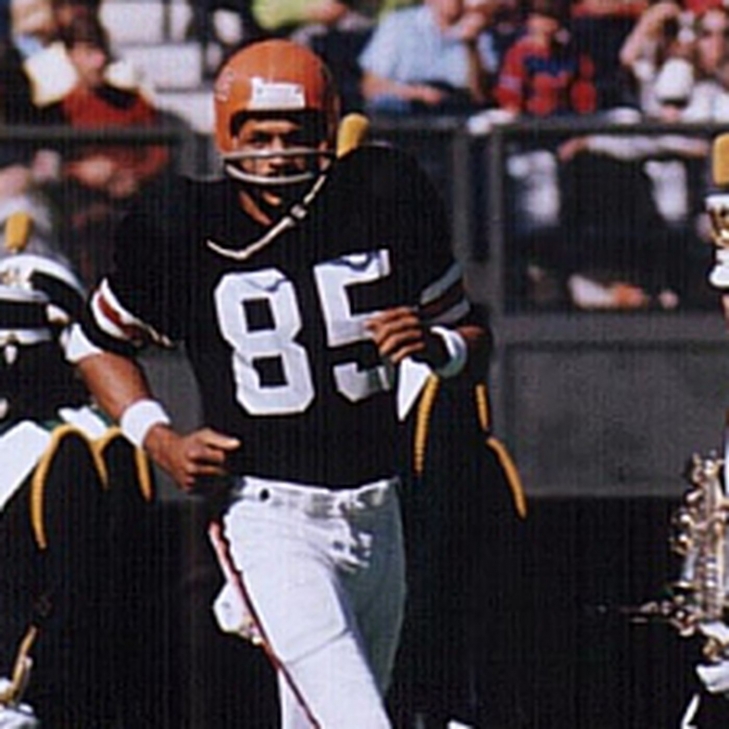
Taken 15th overall in the first round of the 1973 NFL Draft out of San Diego State, Isaac Curtis arrived in Southwest Ohio with Olympic-caliber track speed. Over a 12-season career spent exclusively with the Cincinnati Bengals, Curtis revolutionized deep-threat wide receiver play, forcing NFL defenses to fundamentally change how they covered pass catchers along the boundary.
Curtis had exceptional acceleration, a long stride, and soft hands, making him a formidable downfield threat. As Cincinnati’s main deep target, his speed to outrun physical press coverage was so effective that opponents often grabbed and shoved him, leading to the NFL introducing stricter pass interference rules called the "Isaac Curtis Rule." His ability to track long passes transformed basic post and fly routes into quick scoring opportunities for Ken Anderson.
Curtis entered the professional scene in 1973 with an impressive rookie season, recording 45 receptions for 843 yards and nine touchdowns, which earned him his first Pro Bowl honor. In 1974, he further improved his efficiency, scoring 10 touchdowns from just 30 catches, averaging 21.1 yards per reception, and earning Second-Team All-Pro recognition.
His peak performance continued into 1975, when he led the NFL with an impressive 21.2 yards per catch on 44 receptions for 934 yards and seven touchdowns. In 1976, he earned his fourth straight Pro Bowl selection and third consecutive Second-Team All-Pro honor after accumulating 766 receiving yards and six touchdowns. After knee surgery shortened his 1977 season, Curtis returned in 1978, posting a career-high 47 catches for 737 yards. He stayed a key veteran contributor into the early 1980s, helping Cincinnati reach its first Super Bowl in the 1981 season.
Curtis retired after the 1984 season, ending a 12-year career entirely with Western Ohio. He set franchise records for receptions, yards, and touchdowns. In 2021, the Bengals honored him by inducting him into their first Ring of Honor class. Throughout his career, he achieved 416 receptions, 7,101 yards, 53 touchdowns, and a franchise-best 17.1 yards per catch.
