


Committee Chairman
17. Carson Palmer
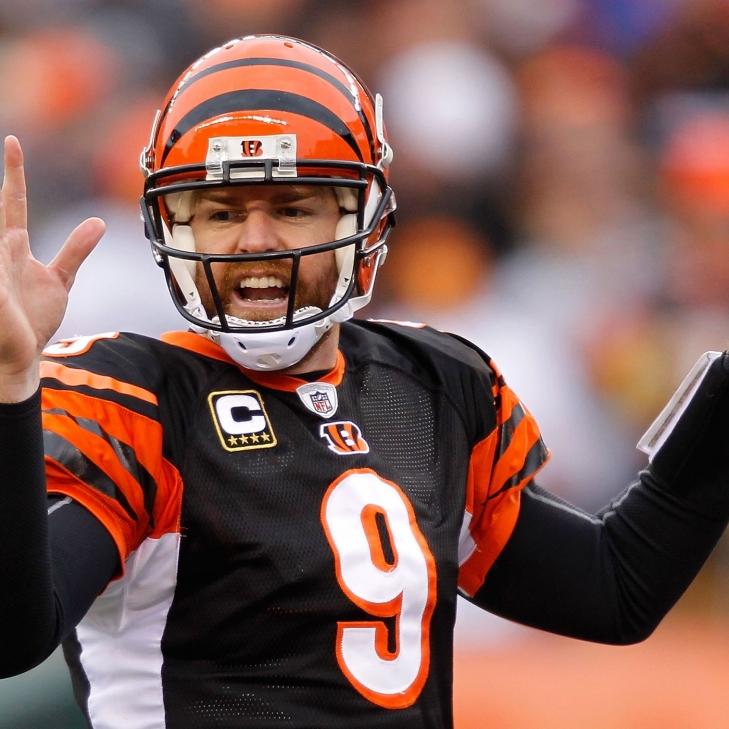
Selected first overall in the 2003 NFL Draft from the University of Southern California—where he secured the 2002 Heisman Trophy—Carson Palmer arrived in Cincinnati as a prospect capable of redefining the franchise. After remaining on the bench throughout his entire rookie season behind Jon Kitna, Palmer assumed the starting role in 2004 and promptly revolutionized the Bengals into one of the most prolific passing offenses in the National Football League.
Standing at 6 feet 5 inches and weighing 235 pounds, Palmer exhibited a quintessential NFL quarterback physique, characterized by a fluid over-the-top release and exceptional arm strength. Primarily operating from conventional dropback passing formations, he demonstrated proficiency in delivering high-velocity throws into narrow intermediate windows and connecting with Chad Johnson and T.J. Houshmandzadeh on deep vertical routes along the boundary. His arm talent enabled Cincinnati to target all three levels of the field; however, his inclination to remain within the pocket rendered him susceptible to significant interior pressure.
Palmer made his long-awaited debut in 2004, starting 13 games and throwing for 2,897 yards and 18 touchdowns while showcasing the raw arm talent that justified his top pick. His true national breakout came in 2005, when he delivered one of the franchise’s greatest individual passing seasons. Palmer led the NFL with a 67.8% completion rate and set a franchise record with 32 touchdown passes, accumulating 3,836 yards and earning his first Pro Bowl selection. He helped Cincinnati achieve an 11–5 record, its first division title, and a playoff spot in 15 years.
Tragedy struck on his first pass attempt in the 2005 AFC Wild Card Game against Pittsburgh, when a low hit caused a severe knee injury that tore both his ACL and MCL. Palmer made a remarkable recovery and returned for the 2006 season, starting all 16 games and earning his second Pro Bowl selection after throwing for 4,035 yards and 28 touchdowns. He maintained that high volume in 2007, setting a career mark with 4,131 passing yards and 26 touchdowns.
The latter part of Palmer's tenure in Cincinnati was hindered by team-wide roster declines and injuries. An elbow injury restricted him to merely four starts in 2008. He returned in 2009 to lead Cincinnati to a 10–6 record and another AFC North division title, passing for 3,094 yards and 21 touchdowns. Following a disappointing 4–12 season in 2010, during which he threw for 3,970 yards and 26 touchdowns, Palmer became profoundly frustrated with the organization's direction and requested a trade. When management initially declined, Palmer threatened retirement and abstained from the start of the 2011 season before being traded to the Oakland Raiders in October 2011.
With the Bengals (2003–2010), Palmer started 97 regular-season games, throwing for 22,694 passing yards, 154 touchdowns, and 100 interceptions,
16. Corey Dillon
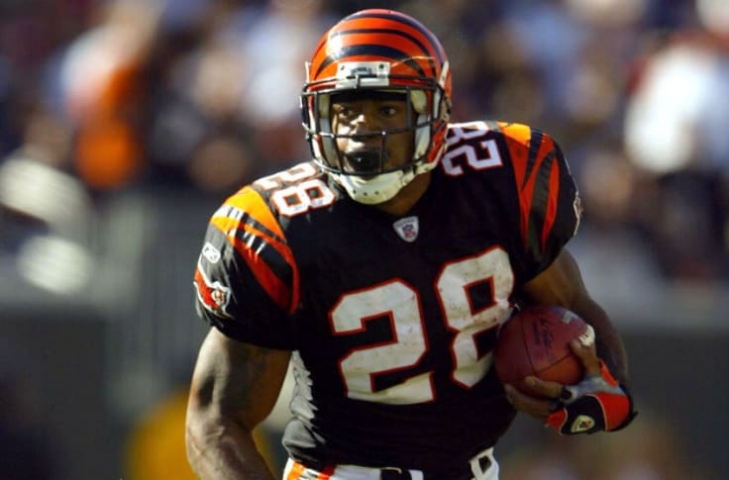
Selected in the second round (43rd overall) of the 1997 NFL Draft out of Washington, Corey Dillon arrived in Cincinnati as a punishing, power-packed running back. Over seven seasons in Southwest Ohio, Dillon served as the undisputed focal point of the Bengals' offense, shouldering a massive workload and establishing himself as one of the most physical ball carriers of his generation.
Dillon unified violent contact, explosive force, and elite balance through contact. Mainly operating from traditional single-back and I-formation formations, he enjoyed running between the tackles, employing a stiff-arm to fend off defensive backs and using churning legs to break arm tackles in the hole. Despite consistently facing stacked defensive boxes, Dillon had enough top-end speed to sprint away once he reached open field.
Dillon made a remarkable impact in his 1997 rookie season, earning PFWA All-Rookie honors after rushing for 1,129 yards and 10 touchdowns. A standout moment was his December game against the Tennessee Oilers, where he ran for 246 yards, breaking Jim Brown's 40-year-old single-game rookie rushing record.
Dillon's debut sparked an extraordinary period of productivity, with over 1,000 rushing yards in each of his first six NFL seasons. On October 22, 2000, he made a legendary showing against the Denver Broncos, rushing for 278 yards and breaking Walter Payton's single-game NFL record. Between 2000 and 2002, he achieved three straight seasons with at least 1,500 yards from scrimmage, with his best year being 2000 when he gained 1,435 rushing yards. His high volume and efficiency led to three consecutive Pro Bowl appearances from 1999 to 2001.
Following a challenging 2003 season affected by injuries, Cincinnati traded Dillon to the New England Patriots in April 2004. In Foxborough, he revived his career, setting a franchise single-season rushing record with 1,635 yards, earning his fourth Pro Bowl, and playing a key role in Patriots’ victory in Super Bowl XXXIX.
Dillon departed Cincinnati as the franchise's all-time leading rusher, with 8,061 rushing yards and 45 rushing touchdowns. In 2024, the Bengals honored his massive impact on the franchise by officially inducting him into the Bengals Ring of Honor.
15. Max Montoya
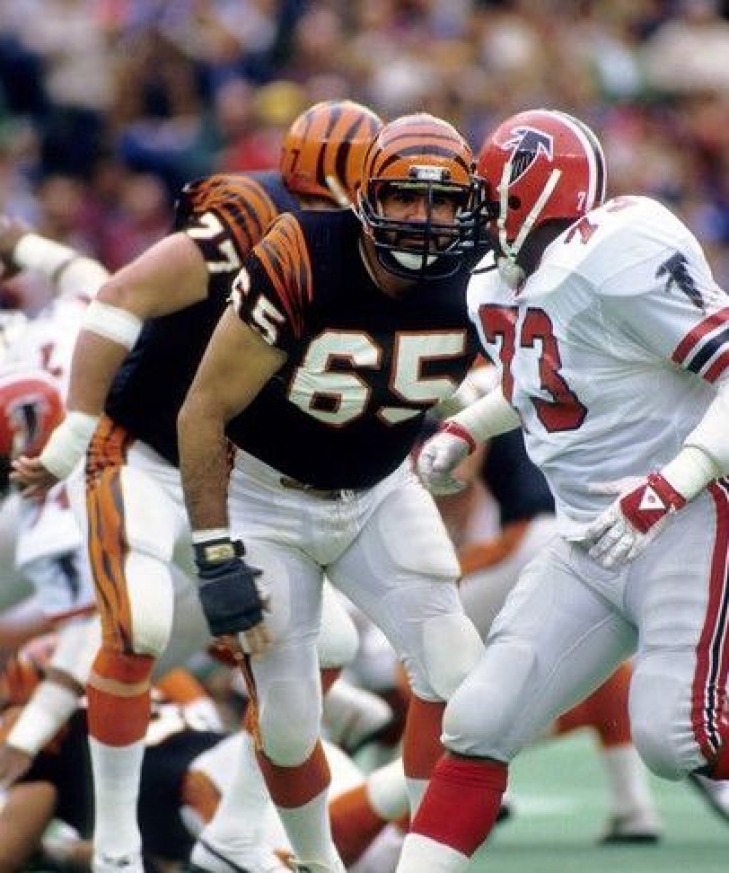
Max Montoya, a seventh-round pick(168th overall in the 1979 NFL Draft from UCLA), became one of the Cincinnati Bengals' greatest late-round steals. During his 11 seasons with the team, he consistently anchored the right guard position with aggressive physicality and reliable technical skill, contributing to one of the top offensive lines of the 1980s alongside Hall of Famer Anthony Muñoz.
Montoya integrated exceptional physical mass with lateral mobility and demonstrated an aggressive finishing ability at the line of scrimmage. Serving as the right guard, he excelled in executing low, powerful drive-blocks that facilitated the creation of significant interior lanes for running backs Pete Johnson and Ickey Woods. In pass protection, his broad frame and substantial hands enabled him to withstand bull-rushes from interior defensive linemen, thereby maintaining a stable pocket for quarterbacks Ken Anderson and Boomer Esiason.
Montoya assumed a position in the starting lineup in 1980 and consistently maintained the right guard position thereafter. He was an integral component of both of Cincinnati's AFC Championship teams during the 1980s. In 1981, he started in every game for an offense that propelled the franchise to Super Bowl XVI. Seven years later, he anchored the line for the league's leading rushing offense in 1988, contributing significantly to Cincinnati's AFC West title and their appearance in Super Bowl XXIII.
His personal accolades exemplify his superior performance on the field. Montoya received three Pro Bowl selections as a Bengal in 1986, 1988, and 1989. In his concluding season with Cincinnati in 1989, he also achieved Second-Team All-Pro recognition and recorded a career-high Approximate Value of 13.
Following the 1989 season, Montoya departed Cincinnati under Plan B free agency to join the Los Angeles Raiders. He spent his final five NFL seasons on the West Coast, starting at right guard for four of those campaigns and earning a fourth career Pro Bowl selection in 1993 at age 37 before retiring after the 1994 season. As a Bengal, Montoya started 144 of his 157 games.
14. Andy Dalton
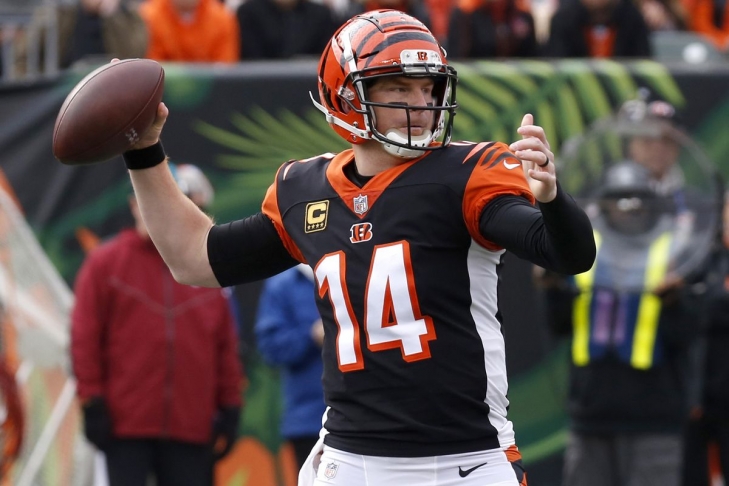
Selected in the second round (35th overall) of the 2011 NFL Draft out of TCU, Andy Dalton stepped straight into the fire in Cincinnati. Winning the starting quarterback job as a rookie, "The Red Rifle" immediately established stability under center and spearheaded one of the most consistent regular-season runs in franchise history.
Dalton depended on rapid decision-making, precise timing, and swift processing capabilities. Excelling in fast-paced, rhythm-oriented passing systems, he demonstrated proficiency in pre-snap diagnostics, efficiently distributing the ball to intermediate targets such as A.J. Green and Tyler Eifert before pass rushers could close in. His mobility within the pocket and acute short-area vision further enabled him to sustain drives through subtle pocket adjustments or opportunistic scrambles into open space.
Dalton made an immediate impact during his 2011 rookie campaign, throwing for 3,398 yards and 20 touchdowns to earn his first Pro Bowl selection while leading Cincinnati to a 9–7 record and a surprise playoff berth. He built on that initial success in 2012 by raising his output to 3,669 yards and 27 passing touchdowns, guiding the Bengals back to the postseason with a 10–6 mark. His finest statistical output came in 2013, when he set Bengals franchise single-season records with 4,293 passing yards and 33 touchdowns, carrying Cincinnati to an 11–5 record and an AFC North division title.
The enduring tradition of success persisted into 2014 as Dalton passed for 3,398 yards and 19 touchdowns, while additionally contributing four rushing scores, thereby earning his second Pro Bowl selection and securing a fourth consecutive playoff appearance. In 2015, he was performing at the peak of his career, achieving a career-best passer rating of 106.2 with 25 touchdowns against only seven interceptions over 13 games, prior to an abrupt interruption of his MVP-caliber season due to a fractured thumb.
Even as the roster around him shifted, Dalton remained productive in 2016, eclipsing the four-thousand-yard mark for the second time with 4,206 passing yards and earning his third career Pro Bowl selection. In 2017, he threw for 3,320 yards and 25 touchdowns, highlighted by a legendary Week 17 touchdown pass to Tyler Boyd that defeated Baltimore and famously snapped the Buffalo Bills' 17-year playoff drought. Injuries limited Dalton to 11 starts in 2018, though he still compiled 2,566 yards and 21 touchdowns before a thumb injury ended his year. He closed out his tenure in Southwest Ohio during a transitional 2019 season under new head coach Zac Taylor, throwing for 3,494 yards and 16 touchdowns in 13 starts.
Following the selection of Joe Burrow as the first overall pick in the 2020 NFL Draft, Cincinnati officially released Andy Dalton in April 2020 after nine seasons of service. He subsequently played for Dallas, Chicago, New Orleans, and Carolina, leaving Cincinnati as the Bengals' all-time franchise leader in completions (2,757), passing yards (31,594), and passing touchdowns (204).
