

Our All Time Top 50 Cincinnati Reds have been updated to reflect the 2025 Season

Yes, we know that this is taking a while!
As many of you know, we at Notinhalloffame.com are slowly generating the top 50 of each major North American sports team. That being said, we maintain and update our existing Top 50 lists annually. As such, we are delighted to present our pre-2026 revision of our top 50 Cincinnati Reds.
As for all of our top 50 players in baseball, we look at the following:
1. Duration and Impact.
2. Traditional statistics and how they finished in the Major League Baseball.
3. Advanced Statistics.
4. Playoff performance.
5. Their respective legacy on the team.
6. How successful the team was when he was there.
7. Respecting the era in which they played.
Criteria 1-4 will make up the lion’s share of the algorithm. Please note that we have implemented this for the first time. This has changed the rankings all throughout the board.
Last year, the Reds won 83 Games, but it was not enough to make it to the playoffs. No active players moved into the Top 50, nor were there any before; the list changed based on the algorithm.
As always, we present our top five, which saw no changes.
1. Pete Rose
2. Johnny Bench
3. Frank Robinson
4. Barry Larkin
5. Joey Votto
You can find the entire here.
We thank you for your continued support of our lists on Notinhalloffame.com.
Our All Time Top 50 Cincinnati Reds have been revised to reflect the 2024 Season.
Yes, we know that this is taking a while!
As many of you know, we at Notinhalloffame.com are slowly generating the top 50 of each major North American sports team. That being said, we have existing Top 50 lists and consistently look to update them when necessary and based on necessity. As such, we are delighted to present our post-2024 revision of our top 50 Cincinnati Reds.
As for all of our top 50 players in baseball, we look at the following:
1. Advanced Statistics.
2. Traditional statistics and how they finished in the National League.
3. Playoff accomplishments.
4. Their overall impact on the team and other intangibles that are not reflected in a stat sheet.
Please note that our algorithm has changed, which yielded minor changes throughout the baseball lists.
Last year, the Reds had a losing record and was unable to make the playoffs. There were no new active players.
As always, we present our top five, which saw a change in the top five based on the new algorithm.
1. Pete Rose
2. Johnny Bench
4. Barry Larkin
5. Joey Votto
You can find the entire list here.
With the new algorithm, Larkin jumped into the top five.
We thank you for your continued support of our lists on Notinhalloffame.com.
Our All-Time Top 50 Cincinnati Reds have been revised
Yes, we know that this is taking a while!
As many of you know, we here at Notinhalloffame.com are slowly generating the 50 of each major North American sports team. That being said, we have existing Top 50 lists out and we always consistently look to update them when we can and based on necessity. As such, we are very happy to present our post 2022/23 revision of our top 50 Cincinnati Reds.
As for all of our top 50 players in baseball we look at the following:
1. Advanced Statistics.
2. Traditional statistics and how they finished in Major League Baseball.
3. Playoff accomplishments.
4. Their overall impact on the team and other intangibles not reflected in a stat sheet.
Last year, the Reds failed to make the playoffs and only had one active player ranked, but he did not move. Nevertheless, we always acknowledge when we look at the latest season.
As always, we present our top five, which obviously saw no changes:
1. Pete Rose
2. Johnny Bench
3. Frank Robinson
4. Joe Morgan
5. Joey Votto
You can find the entire list here.
The only notable think to mention is that the number five player, Joey Votto, did not advance.
We thank you for your continued support for our lists on Notinhalloffame.com.
Our All-Time Top 50 Cincinnati Reds have been updated to reflect the 2022 Season
Yes, we know that this is taking a while!
As many of you know, we here at Notinhalloffame.com are slowly generating the 50 of each major North American sports team. That being said, we have existing Top 50 lists out and we always consistently look to update them when we can and based on necessity. As such, we are very happy to present our post 2022 revision of our top Cincinnati Reds.
As for all of our top 50 players in baseball we look at the following:
1. Advanced Statistics.
2. Traditional statistics and how they finished in the National League.
3. Playoff accomplishments.
4. Their overall impact on the team and other intangibles not reflected in a stat sheet.
Last year, the Reds had a terrible season, and they were no changes on the list, but we need to present it all lists with an update; whether there is a change in it or not.
As always, we present our top five, which was not affected by the last season:
1. Pete Rose
2. Johnny Bench
4. Joe Morgan
5. Joey Votto
You can find the entire list here.
Votto, who is active, did not do enough to supplant Morgan for fourth, but that could happen this year.
We welcome your input and comments and as always, we thank you for your support.
Our All-Time Top 50 Cincinnati Reds have been revised
Yes, we know that this is taking a while!
As many of you know, we here at Notinhalloffame.com are slowly generating the 50 of each major North American sports team. That being said, we have existing Top 50 lists out and we always consistently look to update them when we can and based on necessity. As such, we are very happy to present the pre-2021 update of our top 50 Cincinnati Reds of all-time.
As for all of our top 50 players in hockey we look at the following:
1. Advanced Statistics.
2. Traditional statistics and how they finished in the National League.
3. Playoff accomplishments.
4. Their overall impact on the team and other intangibles not reflected in a stat sheet.
There are no new additions but as always, we announce our top five immediately, but out full list can be found here.
1. Pete Rose
2. Johnny Bench
4. Joe Morgan
5. Barry Larkin
The changes made to advanced stats from Baseball Reference resulted in slight changes through the list, but most dramatically at the bottom, as two former Reds replaced two others. Jake Beckley (#49) and Jay Bruce (#50) now enter in place of Tom Browning and Bronson Arroyo.
We welcome your input and commentsand as always, we thank you for your support.
Our All-Time Top 50 Baltimore Orioles are now up
Yes, we know that this is taking a while!
As many of you know, we here at Notinhalloffame.com are slowly generating the 50 of each major North American sports team. We have a new one to unveil today, that of the Baltimore Orioles.
The Baltimore Orioles were formed as a charter member of the American League in 1901, when they were the Milwaukee Brewers. That only lasted one year, as they relocated to St. louis as the Browns. While in St. Louis, the Browns had limited success, having only won one Pennant (1944), but fortunes changed when they relocated to Baltimore in 1954 and became the Orioles.
With a trade that brought them Frank Robinson, the Orioles won the World Series in 1966, and with a starting rotation based around Jim Palmer, the O’s won it again in 1970. A young Cal Ripken Jr. would lead them to their third World Series in 1983, which is to date their last title.
As for all of our top 50 players in baseball we look at the following:
1. Advanced Statistics.
2. Traditional statistics and how they finished in the American League.
3. Playoff accomplishments.
4. Their overall impact on the team and other intangibles not reflected in a stat sheet.
Remember, this is ONLY based on what a player does on that particular team and not what he accomplished elsewhere and also note that we have placed an increased importance on the first two categories.
This list is updated up until the end of the 2019 Season.
The complete list can be found here, but as always we announce our top five in this article. They are:
2. Jim Palmer
5. Eddie Murray
We will continue our adjustments on our existing lists and will continue developing our new lists.
Look for our more material coming soon!
As always we thank you for your support.
7. Frank Robinson
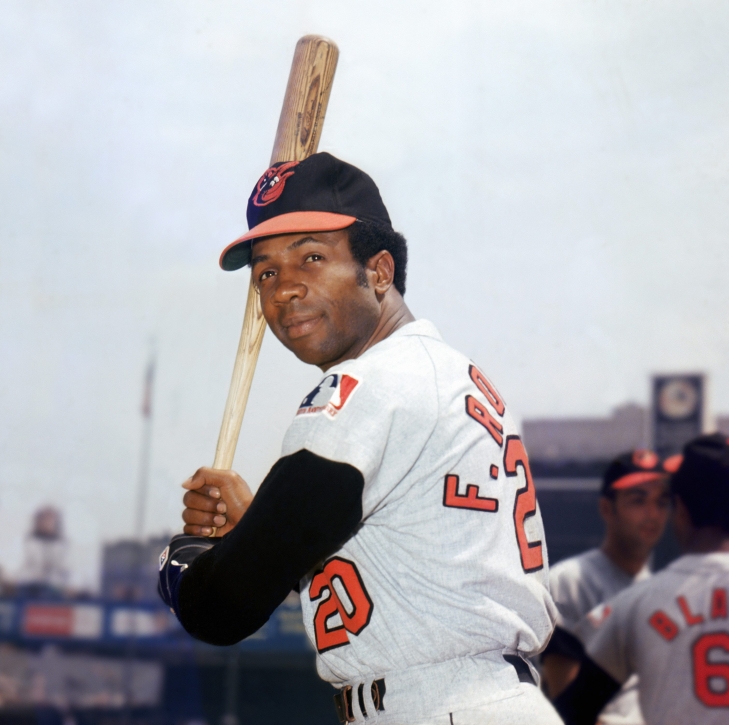
Prior to the 1966 season, the Baltimore Orioles pulled off what remains arguably the most lopsided trade in baseball history. Frank Robinson, a former Rookie of the Year and MVP with Cincinnati, was sent to Baltimore in exchange for Jack Baldschun, Milt Pappas, and Dick Simpson. Defending the move, Reds owner Bill DeWitt infamously labeled Robinson an "old 30." The legendary outfielder responded by authoring the greatest season of his career, instantly transforming the Orioles into a global baseball powerhouse.
In that 1966 debut, Robinson delivered a season for the ages, capturing the American League Triple Crown and becoming the first player to win the MVP award in both leagues. He led the AL in runs (122), home runs (49), and RBIs (122), while posting a devastating slash line of .316/.410/.637. Most importantly, he led Baltimore to its first World Series title, punctuated by his own World Series MVP performance.
Robinson’s arrival signaled the dawn of a dynasty. A five-time All-Star in Baltimore, he proceeded to record three more .300+ seasons and twice more eclipsed the 30-home run mark. He was the veteran heartbeat of the squad that secured the 1970 World Series championship before departing for the Dodgers in 1971. In just six seasons in Baltimore, Robinson maintained a remarkable .300/.401/.543 slash line, accumulating 882 hits and 179 home runs.
His legacy was cemented in 1982 with a first-ballot induction into the National Baseball Hall of Fame. The Orioles retired his iconic #20 and made him—alongside Brooks Robinson—a charter member of the Baltimore Orioles Hall of Fame. To this day, Robinson remains the standard-bearer for peak performance in the history of the franchise.
RIP: Frank Robinson
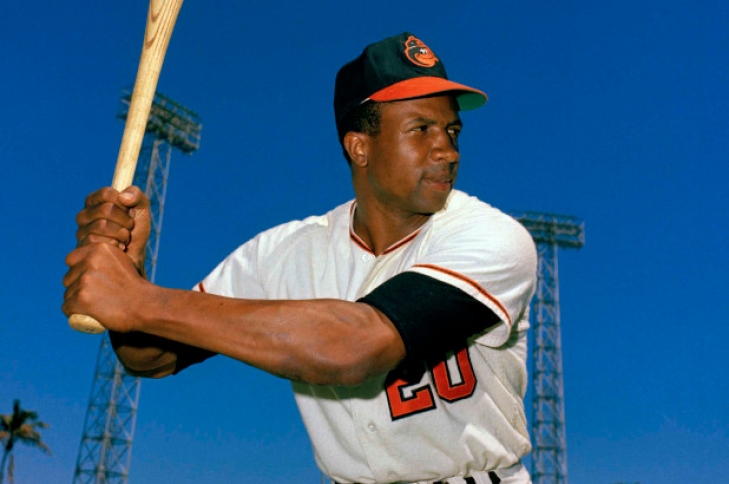
It is a tragic day in the world of Major League Baseball as Hall of Fame legend Frank Robinson passed away today at the age of 83.
Robinson would debut with the Cincinnati Reds in 1956 where he was named the National League Rookie of the Year and was the league leader in Runs Scored. Robinson could do it all, hit for average, power and was good with his glove. In his ten seasons with the Reds, Robinson would lead the NL in Slugging three times, was a six time All Star and was the 1961 National League MVP.
He was traded to the Baltimore Orioles where in his first season there (1966) he would blast a career high 49 Home Runs and would sweep the Slash Line and win the American League MVP making him the first player to win the MVP in both the NL and AL. He would also take the Orioles to their first World Series win since the relocation from St. Louis. Robinson would again take the Orioles to a World Series win in 1970. He would finish his playing career with the Los Angeles Dodgers, California Angels and Cleveland Indians. He would finish with 2,943 Hits and 586 Home Runs.
In 1975, while he was still playing for the Indians, he would become the first African-American Manager. Robinson would later manage the San Francisco Giants (1981-84), Baltimore Orioles (1988-89) and Montreal Expos/Washington Nationals (2002-06).
He would be inducted into the Baseball Hall of Fame in 1982 on his first year of eligibility. The Indians, Reds and Orioles have all retired his #20 and all three franchises have a bronze statue erected in his honor at their respective stadiums.
We here at Notinhalloffame.com would like to extend our condolences to the friends, family and fans of Frank Robinson.
Our Top 50 All-Time Cincinnati Reds are now up
Again, did we ever say this would be fast?
We here at Notinhalloffame.com have completed our next all-time top 50, this time that of the Cincinnati Reds.
As for all of our top 50 players in baseball we look at the following:
- 1. Sabremetric tallies while with that team, mostly WAR.
- 2. Traditional metrics and how they finished in their respective league overall.
- 3. Playoff accomplishment.
- 4. Their overall impact on the team and other intangibles not reflected in a stat sheet.
Remember, this is ONLY based on what a player does on that particular team and not what he accomplished elsewhere and also note that we have placed an increased importance on the first two categories.
Saying all of that, as.
The complete list can be found here, but as always we announce our top five in our news. They are:
- 1. Pete Rose
- 2. Johnny Bench
- 4. Joe Morgan
- 5. Barry Larkin
This is a solid top five with four Hall of Famers and one who should be.
So which team is up next?
We go back to the ice and look at the top 50 Dallas Stars of all time.
Look for that in a couple of months.
As always, we here at Notinhalloffame.com thank you for your support.
3. Frank Robinson
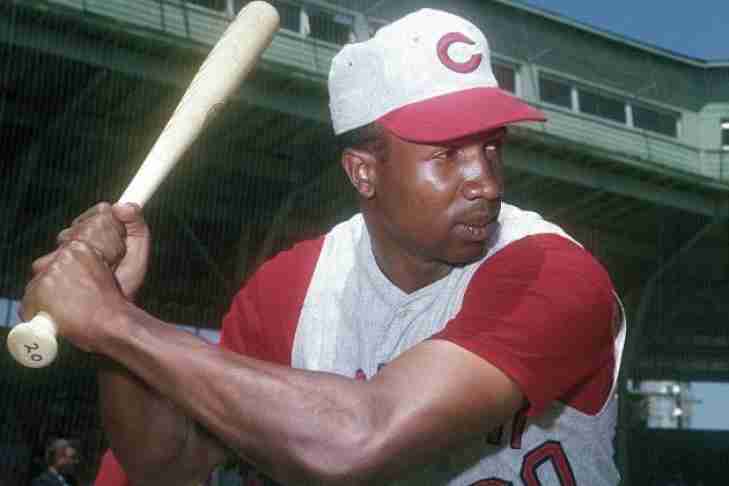
When Frank Robinson arrived in Cincinnati in 1956, he didn't just win the Rookie of the Year award; he staged a league takeover. At just 20 years old, he tied the then-record for home runs by a rookie with 38, signaling the arrival of a player who combined terrifying power with a relentless, aggressive plate presence. Robinson played with a chip on his shoulder, crowding the plate and daring pitchers to come inside—a tactical move that resulted in him leading the league in being hit by pitches seven times as a Red. He was the young, fiery engine of a franchise searching for its identity in the post-war era.
The peak of his Cincinnati tenure arrived in 1961, a season in which he claimed the National League MVP and willed the Reds to their first pennant in over twenty years. Robinson was a statistical titan during this stretch, authoring a slash line of .303/.389/.554 that stands as a masterpiece of offensive efficiency. He captured three slugging titles and was a perennial fixture in the MVP top-ten, blasting 324 home runs in a Reds uniform. He wasn't just a "solid contributor"; he was the premier outfielder in the senior circuit, a five-tool threat who played the game with a ferocious intensity that defined the era.
However, the final chapter of his story in Cincinnati remains one of the most scrutinized exits in sports history. Following the 1965 season, Reds owner Bill DeWitt famously traded Robinson to the Baltimore Orioles, labeling him an "old 30." It was a staggering miscalculation of a superstar's longevity. While the trade's returns failed to move the needle for Cincinnati, Robinson immediately captured the Triple Crown and the American League MVP, leading Baltimore to a world title. For fans in Cincinnati, it was a bitter pill to swallow, imagining how much more terrifying the "Big Red Machine" might have been had Robinson remained to bridge the gap into the 1970s.
Frank Robinson left the Reds as one of the most accomplished players to ever wear the wishbone "C." He was a first-ballot immortal whose legacy was eventually honored with the retirement of his number 20 in 1998 and his induction into the team's Hall of Fame decades earlier. He arrived as a fearless rookie and left as a statistical giant, the man who proved that age is just a number and that greatness, once ignited on the South Side of Cincinnati, could never truly be extinguished.
Awards = HOF? Part Three: The Rookie of the Year (MLB)
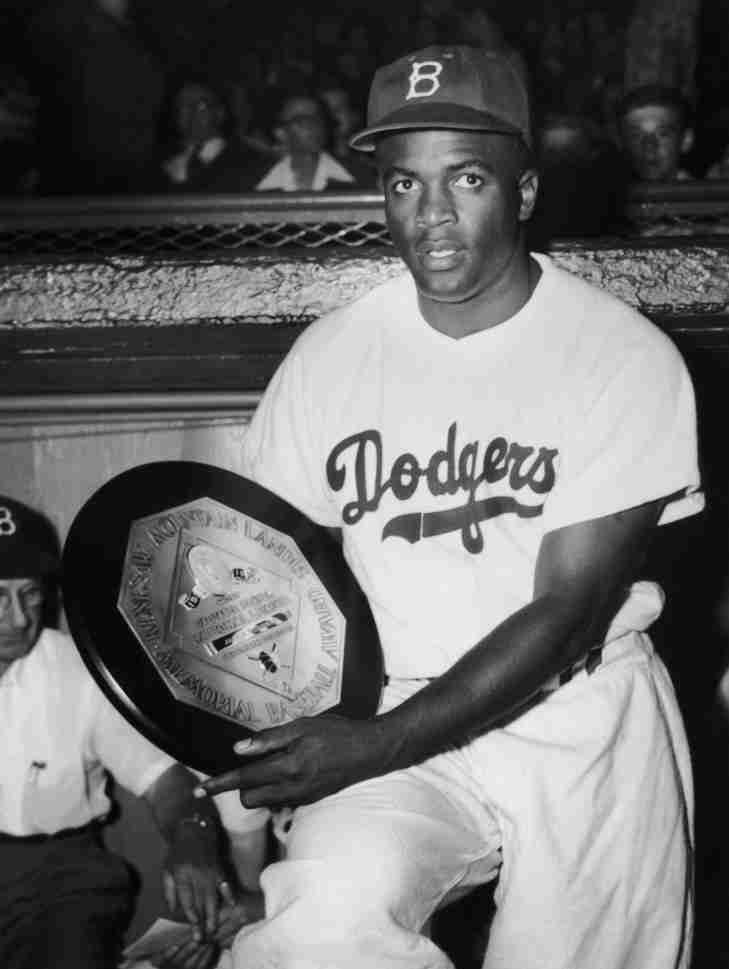
We here at Notinhalloffame.com thought it would be fun to take a look at the major awards in North American team sports and see how it translates into Hall of Fame potential.
