


Site Admin
2. Joe Schmidt
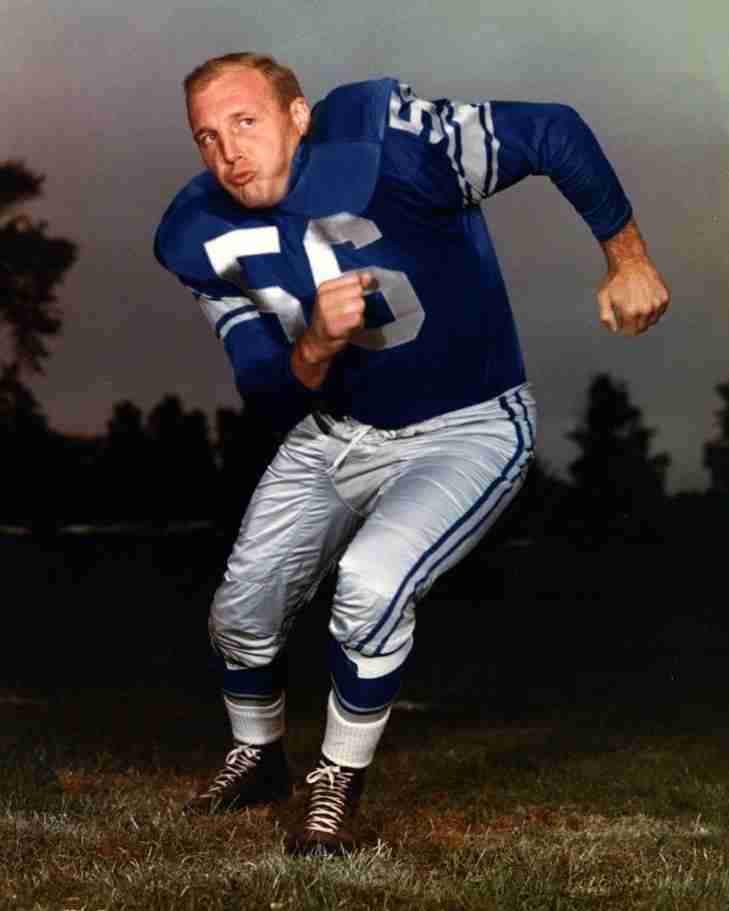
Selected in the seventh round of the 1953 NFL Draft out of Pittsburgh, Joe Schmidt came to the Motor City as an unheralded rookie with an incredible nose for the football. He quickly carved out a starting spot on a defense loaded with future Hall of Famers, making an immediate impact during Detroit's drive to the 1953 NFL Championship. By his second season, Schmidt had established himself as the absolute anchor of the Lions' defense, earning the first of ten consecutive Pro Bowl selections in 1954.
As head coach Buddy Parker installed the newly evolving 4-3 defense, Schmidt revolutionized the middle linebacker position. He brought unprecedented tactical instincts to the middle of the field, dropping seamlessly into pass coverage to blank opposing tight ends while maintaining the speed and instincts to fill run lanes from sideline to sideline. Named defensive captain in 1956—a leadership role he held for nine seasons—he essentially operated as an extension of the coaching staff, calling all defensive audibles at the line of scrimmage with uncanny accuracy.
Physically, Schmidt possessed a rare combination of brute strength and lateral range that set a brand-new prototype for the middle linebacker position. Listed at 6-foot-1 and 220 pounds, he was built like a granite slab, yet he maneuvered through traffic with the footwork of a safety. Rather than absorbing blocks from 250-pound guards, he used his fast hands and quick reads to slip underneath interior linemen, blowing up plays in the backfield before they could even materialize. His signature tackling form was devastating—a chest-to-chest blow that stopped ballcarriers in their tracks—and his sheer physical presence dictated how offenses approached the center of the field.
Schmidt reached the peak of his career in 1957, shining brightly as the defensive leader. He delivered an unforgettable season, with an impressive 157 tackles (80 solo) over 12 games, showcasing his talent and dedication. The United Press honored him with the NFL MVP award—an exceptional achievement for a defensive player—and he was also named to the First-Team All-Pro for the fourth year in a row. His remarkable season culminated in a spectacular performance during the 1957 NFL Championship Game, where he effectively contained rookie Jim Brown and the Cleveland Browns, helping Detroit secure a commanding 59–14 victory.
Opposing offenses really struggled to find an opening against him during his peak. When teams tried to throw over the middle, Schmidt would drop back into zone coverage with ease, grabbing 24 interceptions over his career. If they tried to run around the edges, his relentless energy and quick pursuit along the sidelines often forced runs out of bounds for only short gains. His knack for reading snap counts and spotting play-action fakes gave the Lions a clear strategic edge every time they took the field.
During his prime, Schmidt established one of the most impressive stretches by any NFL defender, earning eight First-Team All-Pro honors over nine seasons (1954–1957, 1958–1962). His strong leadership on defense made him a natural fit for coaching after retiring following the 1965 season. Schmidt joined the Lions' coaching staff as linebackers coach in 1966 and became head coach from 1967 to 1972, leading Detroit to four winning seasons and reaching the 1970 playoffs.
Schmidt played 13 seasons in Detroit (1953–1965), with 155 games, 24 interceptions, and 17 fumble recoveries as a top middle linebacker. He was named to the NFL 1950s All-Decade Team, had his No. 56 jersey retired by the Lions, and joined the Pride of the Lions in 2009. Inducted into the Pro Football Hall of Fame in 1973, he was also selected for the NFL 100th Anniversary All-Time Team.
1. Barry Sanders
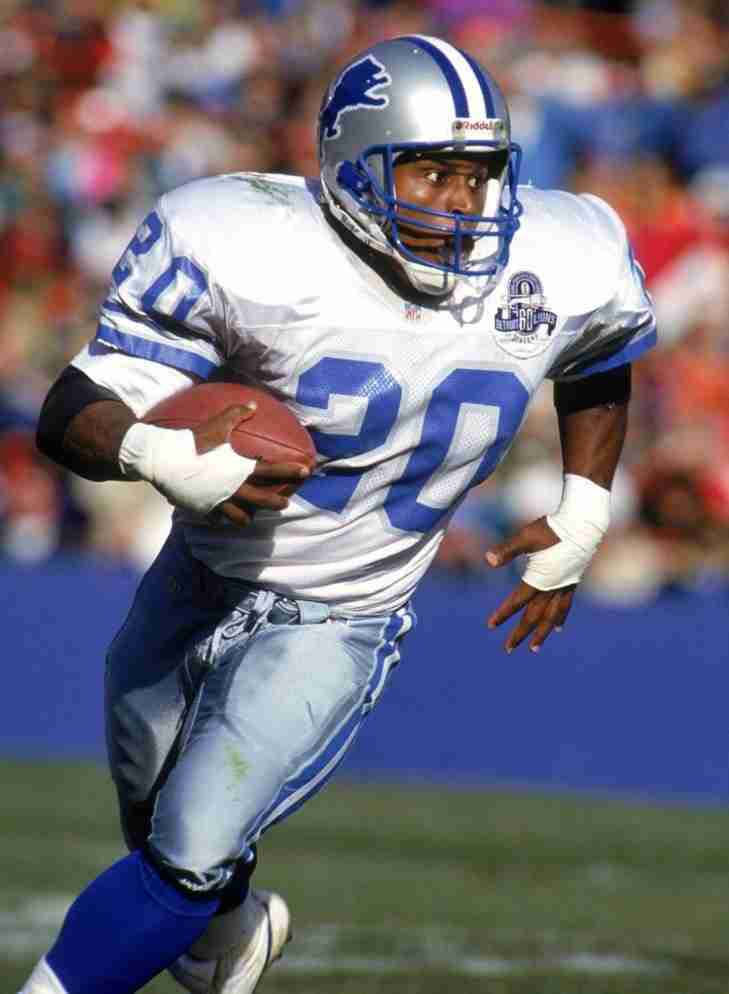
In 1988, Barry Sanders had one of the greatest seasons in college football history, rushing for 2,628 yards and 37 touchdowns, setting 34 NCAA records, and easily winning the Heisman Trophy. In the 1989 draft, Troy Aikman went first (Dallas), and after the Green Bay Packers whiffed on Tony Mandarich with the second pick, the Detroit Lions were blessed to have Barry Sanders as the third pick.
It was clear immediately that Detroit got a steal, even at number three. Barry Sanders took his first NFL handoff for an 18-yard burst, setting the tone for an astounding rookie campaign in which he fell just 10 yards short of the league rushing crown with 1,470 yards, comfortably capturing NFL Offensive Rookie of the Year honors.
What truly set Sanders apart was a movement profile unlike anything the sport had ever seen, making him a walking highlight reel whose playing style bordered on supernatural. Standing 5-foot-8 with a shockingly low center of gravity, massive thighs, and tree-trunk calves, he possessed an unmatched ability to sink his hips, plant a foot in the turf, and cut at right angles at maximum speed without losing momentum. His balance was absurd; where other backs were slowed down by low contact, Sanders simply bounced off arm tackles, spun out of scrums, and regained top speed in a single stride.
This elusive quality made him a nightmare for open-field tacklers, who often reached out in vain. Sanders mastered the rarely-used stop-and-start move, pausing suddenly to let overzealous defenders rush past, then quickly bursting in the opposite direction. He's well known for turning plays around—sometimes transforming a planned left run into a 50-yard dash down the right sideline—defying conventional coaching strategies and leaving defenders looking foolish in front of full stadiums.
This unique style yielded a high-variance, home-run-hitting brand of football that required the Lions to take the bad with the transcendent. Because Sanders refused to settle for a simple three-yard gain into the backs of his blockers, preferring instead to hit the brakes and probe for a seam, he holds the NFL record for the most carries stopped behind the line of scrimmage for negative yardage. Yet that willingness to improvise was precisely what made him unstoppable, as a play that looked destined for a five-yard loss could instantly turn into a jaw-dropping, ankle-breaking touchdown sprint.
That explosive ceiling allowed Sanders to dominate the 1990s as a four-time NFL rushing champion while hitting the 1,000-yard mark in all ten of his professional seasons. He captured his first rushing title in his sophomore year of 1990 with 1,304 yards, claimed his second in 1994 with an incredible 1,883 yards on the ground, and added a third crown in 1996 with 1,553 yards. His presence made the Wayne Fontes-led Lions a perennial playoff contender, famously leading Detroit to a 12–4 record and an appearance in the 1991 NFC Championship Game.
His most outstanding moment was during his legendary 1997 season, often considered one of the greatest individual campaigns in league history. After initially gaining only 53 yards in the first two games, Sanders then achieved an extraordinary streak, setting an NFL record with 14 straight games of 100 yards or more, ending the season with 2,053 rushing yards. He won both the NFL MVP and Offensive Player of the Year awards, joined the exclusive 2,000-yard club, and maintained an impressive 6.1 yards per carry, firmly establishing himself as the leader of Detroit's offense.
In addition to his remarkable production, Sanders was known for his modest, low-key attitude on the field. During a time when elaborate and choreographed touchdown celebrations became common, Sanders distinguished himself by silently handing the ball to the official after each touchdown and calmly returning to the sideline as if it was just another routine moment. This combination of humility and exceptional athleticism garnered widespread respect from teammates, rivals, and fans throughout the sports world.
The football world was knocked flat on its back prior to the 1999 season when Sanders, still at the absolute peak of his powers at age 31, announced his sudden retirement via fax. Frustrated by the organization's trajectory and unwilling to pad stats for another franchise, he walked away just 1,457 yards shy of Walter Payton's all-time NFL rushing record—leaving millions of fans (and this website in perpetuity) wondering just how unreachable his career totals would have been had he played another three or four years.
Over ten unforgettable seasons spent entirely in Detroit (1989–1998), Sanders appeared in 153 games, compiling 15,269 rushing yards, 99 rushing touchdowns, and 2,921 receiving yards while earning 10 Pro Bowl nods and ten All-Pro selections (six First-Team). The Lions retired his iconic No. 20 jersey in 2004, the same year he was enshrined in the Pro Football Hall of Fame in his first year of eligibility. Sanders was also named to the 1990s and NFL 100th Anniversary Team.
Witch Doctor
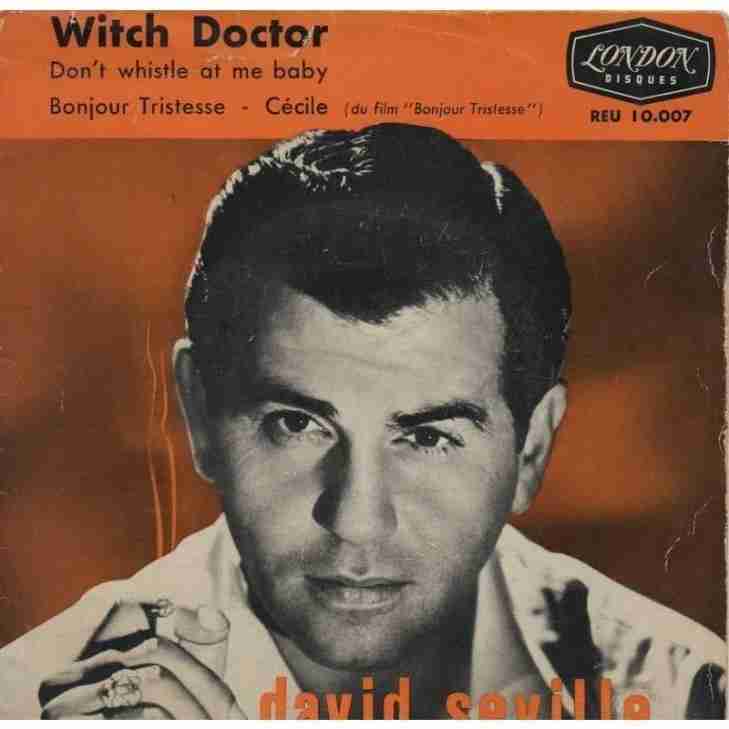
David Seville
Witch Doctor
48. Danny Darwin
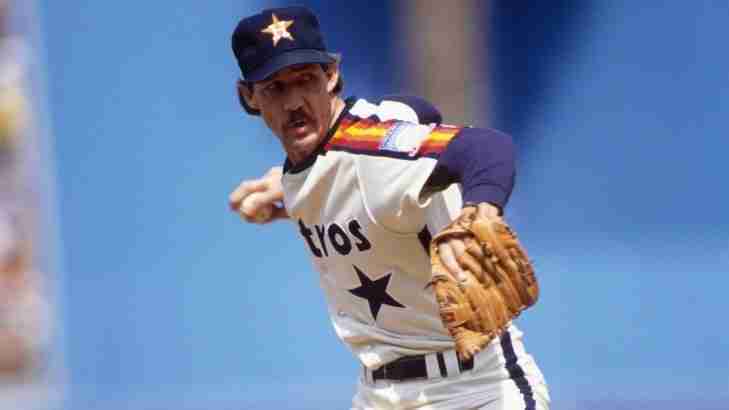
Danny Darwin arrived in the Houston organization via a mid-1986 trade from Milwaukee, providing an immediate spark for the division-winning "Mike Scott Era" staff. Known by the chilling nickname "Dr. Death" for his intense competitive fire and willingness to protect his teammates, Darwin spent six seasons in the Space City across two different stints.
The best season of Darwin’s Astros run was in 1990. That summer, he demonstrated a specialized ability to dominate in any capacity, appearing in 48 games but making only 17 starts. He showed the organization he was a foundational ace by leading the National League with a 2.21 ERA and a major league-best 1.027 WHIP, making him the third Astro in five years to claim the league's ERA crown. This specialized "swingman" dominance earned him the 1990 Houston Astros MVP award.
His first tenure was defined by high-frequency reliability; between 1986 and 1990, he provided the club with nearly 700 innings of quality work while primarily neutralizing right-handed hitters. After leaving for a four-year contract in Boston, everything culminated in a brief, nostalgic return in 1996. Acquired from the Pirates in a July trade, the 40-year-old veteran showed the organization he was still a professional by helping the club during the final two months of the season, recording his final three wins in a Houston uniform to finish his Astros career with a combined 47-35 record.
