


Site Admin
16. Herman Moore
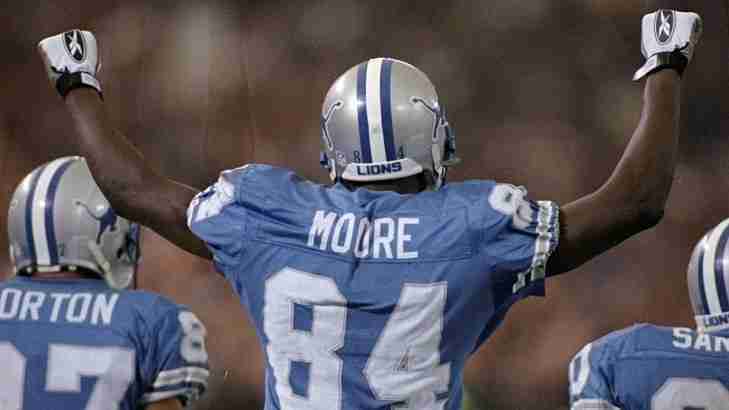
A fine offensive weapon for years, Herman Moore was drafted tenth overall in 1991 out of Virginia, bringing with him a sleek, 6-foot-4 wideout with high-jump athleticism and an extraordinary catch radius. While Barry Sanders commanded the attention of every defensive box in the league, Moore weaponized that single coverage to build one of the most dominant stretches by a wide receiver in 1990s pro football.
After a steady acclimation over his first three seasons, Moore broke out in 1994 with 72 receptions for 1,173 yards and 11 touchdowns, earning his first Pro Bowl nod. That proved to be just the prelude to a historic 1995 campaign. Moore hauled in an NFL-record 123 receptions for 1,686 yards and 14 touchdowns—shattering the league’s single-season catch mark and establishing himself as an absolute First-Team All-Pro superstar.
Moore, alongside Brett Perriman, formed one of the NFL’s most successful wide receiver duos. After a historic 1995 season, he continued with two more outstanding First-Team All-Pro years in 1996 and 1997, once again leading the league in 1997 with 104 catches. Over four seasons, he achieved four straight 1,000-yard campaigns, earned four Pro Bowl selections, and received three consecutive First-Team All-Pro honors (1995–1997). His skill in catching high balls over physical cornerbacks made Detroit’s red-zone offense extremely difficult to defend.
Injuries began to hamper his explosive athleticism in the late 1990s, but Moore departed Motown holding nearly every major receiving record in franchise history—all of which stood for over a decade until Calvin Johnson came along.
With the Lions, Moore compiled 670 receptions, 9,174 receiving yards, and 62 touchdown catches. In 2018, he became a member of the Pride of the Lions.
13. Dick "Night Train" Lane
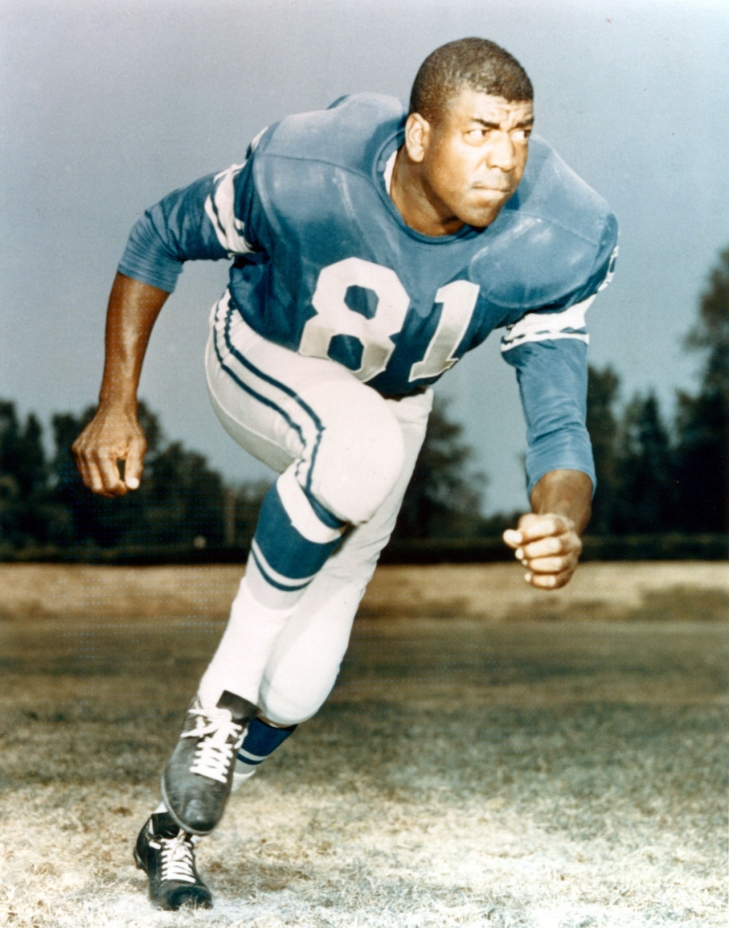
Acquired by Detroit in a trade with the Chicago Cardinals prior to the 1960 season, Dick "Night Train" Lane arrived in Motown at age 32 with his legendary reputation already carved into pro football lore. As an undrafted rookie with the Los Angeles Rams in 1952, he set an NFL single-season record with 14 interceptions in a 12-game schedule—a historic mark that still stands untouched today. Though he was entering the final chapter of his career when he put on the Honolulu Blue, Lane proved he remained the most feared perimeter corner in the game.
Lane brought an uncompromising, terrifying physicality to Detroit's secondary. Famous for his notorious "Night Train Necktie"—a violent clothesline tackle around ball carriers' necks that was eventually outlawed by the NFL—he intimidated receivers long before the ball reached their hands. Slotted at left cornerback alongside Dick LeBeau and Yale Lary, Lane anchored a secondary that made the Lions' defense one of the most punishing units of the 1960s.
His Motown stint yielded immediate elite honors. Lane earned three consecutive Pro Bowl selections from 1960 to 1962 and captured back-to-back First-Team All-Pro nods in 1961 and 1962, snaring 21 interceptions during his six seasons in Detroit. By the time he hung up his cleats following the 1965 campaign, his 68 career interceptions ranked second in NFL history behind only Emlen Tunnell. Named to the NFL's 50th, 75th, and 100th Anniversary All-Time Teams, Lane stands as arguably the greatest cornerback to ever play the game.
In his six seasons in Detroit, Lane played in 66 games for Detroit, compiling 21 interceptions for 272 return yards and one pick-six. A three-time Pro Bowler and two-time First-Team All-Pro in Detroit (seven-time First-Team All-Pro overall), Lane was enshrined in the Pro Football Hall of Fame in 1974 and inducted as a charter member of the Pride of the Lions in 2009.
9. Lou Creekmur
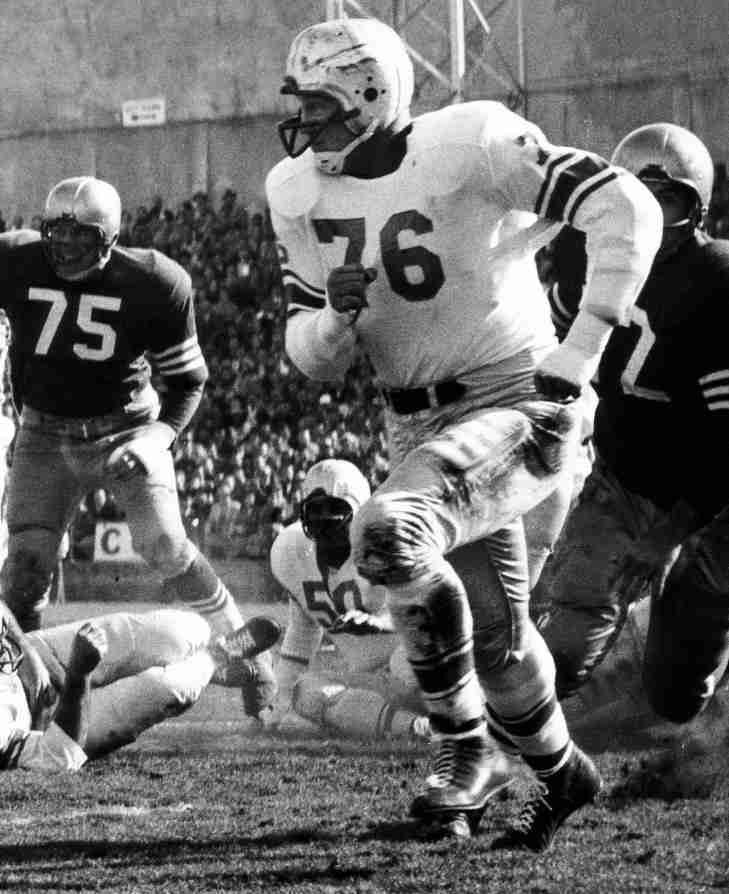
Acquired out of William & Mary in 1950, Lou Creekmur stepped onto the line of scrimmage in Motown and immediately established himself as an immovable force. Standing 6-foot-4 and 250 pounds, Creekmur possessed elite footwork and rare strength, functioning as the primary broad-shouldered bodyguard for backfield legends Bobby Layne and Doak Walker.
Creekmur's rare position-flexing talent anchored Detroit's dominant 1950s dynasty. He began his career as an offensive guard, earning All-Pro nods at the position in 1951 and 1952 while opening running lanes that powered the Lions to an NFL Championship over Cleveland. Shifted out to left tackle in 1953, he proved just as impenetrable on the edge, securing All-Pro honors at his new spot as Detroit captured back-to-back world titles. In fact, during that 1953 campaign, he earned All-League recognition at both guard and tackle—a testament to his incredible flexibility. He even filled in at defensive middle guard during emergency situations in 1955, making impact plays on both sides of the ball.
Beyond his technical leverage, Creekmur was legendary for his ironclad durability. Without the benefit of modern protective gear, he played through dislocated shoulders, severe knee sprains, and famously spent an entire season playing through a crushed sternum with a pad strapped to his chest. From his debut in 1950 through 1958, Creekmur never missed a single game—playing in 165 consecutive exhibition, regular-season, and postseason contests while leading the Lions to four championship game appearances and three world titles (1952, 1953, 1957). Retiring after the 1959 season, his decade-long career included eight Pro Bowls (1950-1957) and six First-Team All-Pros.
Creekmur played in 116 regular-season games with 107 starts and was enshrined in the Pro Football Hall of Fame in 1996 and named a charter member of the Pride of the Lions in 2009
12. Dick LeBeau
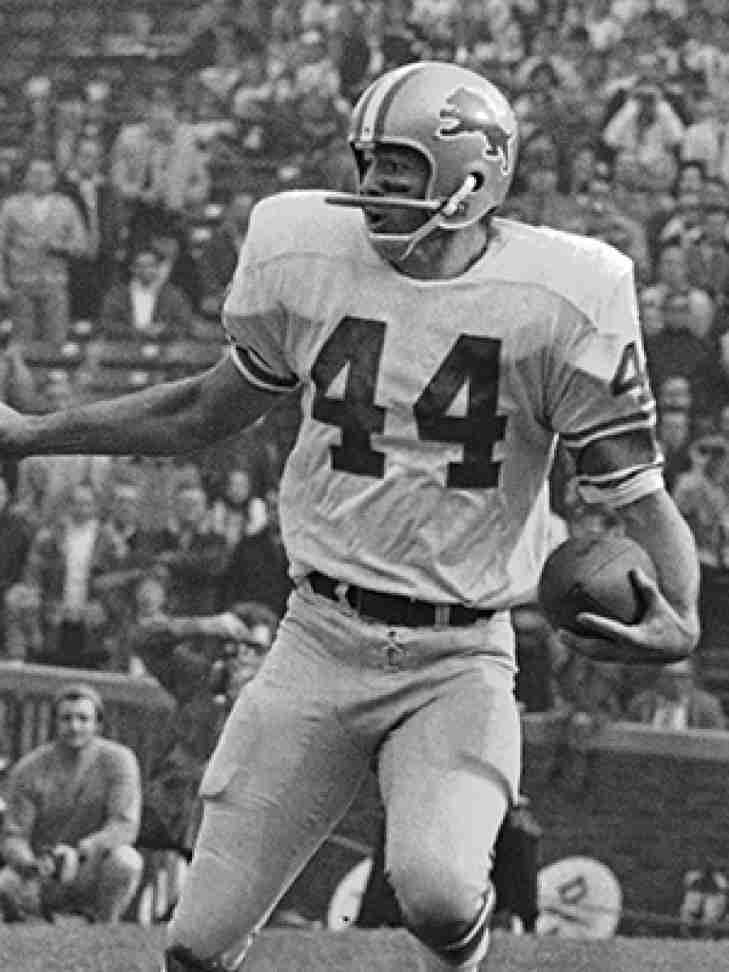
Drafted in the fifth round of the 1959 NFL Draft by Cleveland and promptly waived, Dick LeBeau landed in Detroit as a discarded defensive back with everything to prove. What the Lions acquired was a cerebral cornerback who would spend the next 14 years anchoring the right side of Motown's defense, mastering the intricacies of pass coverage and laying the strategic groundwork for a Hall of Fame career both on the field and on the sideline.
Playing as a secondary alongside Hall of Famer Dick "Night Train" Lane, LeBeau became known as a relentless ball hawk. His key physical ability was exceptional anticipation—predicting quarterback eye movements and route splits to intercept the ball before the throw was completed. Between 1962 and 1971, he achieved at least three interceptions in ten straight seasons. His personal best came during a three-year period from 1968 to 1970, when he earned three consecutive Pro Bowl selections and totaled 21 interceptions, including a career-high nine in 1970, tying for the NFC lead.
LeBeau was not only known for his coverage skills but also for his incredible durability. He set an NFL record for cornerbacks with 171 consecutive games played, demonstrating his toughness during a rough era of football. When he retired after the 1972 season, his 62 career interceptions were the highest in Lions history and ranked third in NFL history, following Paul Krause and Emlen Tunnell.
After retiring his pads, LeBeau made a second major impact on the sport by becoming a legendary defensive coordinator. He created the famous "Zone Blitz" scheme that shaped Pittsburgh's defense for many years. Even before he coached Super Bowl defenses from the sidelines, he was one of the most feared cornerbacks known for his ball-hawking skills.
LeBeau played 185 games, starting 172, with 62 interceptions, 762 return yards, three pick-sixes, and nine fumble recoveries. A three-time Pro Bowler, All-Pro, and Pride of the Lions (2010), he was inducted into the Hall of Fame in 2010.
