


Site Admin
7. Yale Lary
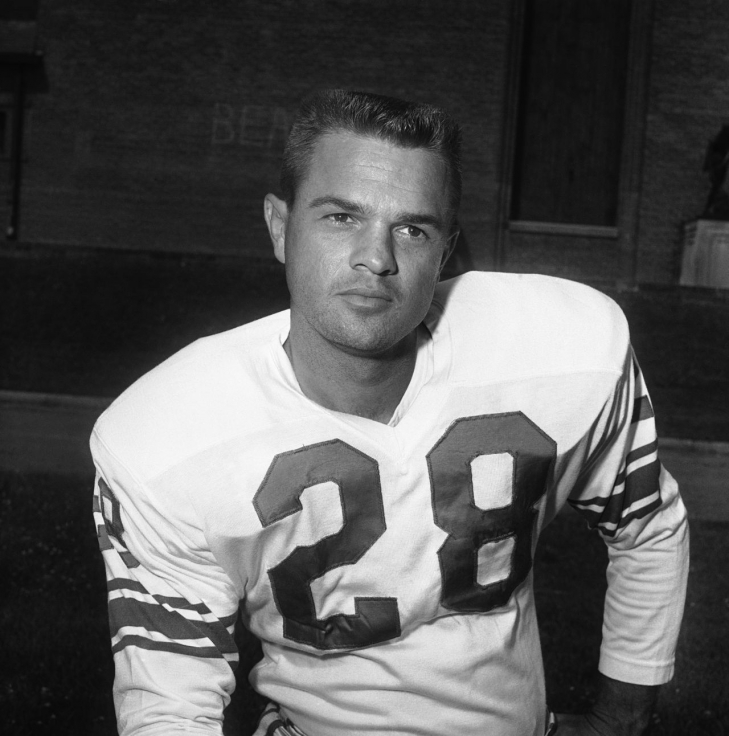
The Lions found a gem in the third round of the 1952 NFL Draft out of Texas A&M. Yale Lary stepped into Motown and instantly became a cornerstone of the finest secondary of his generation. Paired with Hall of Famers Jack Christiansen, Jim David, and later Dick "Night Train" Lane, Lary anchored the right safety spot for "Chris’s Crew," a defensive backfield that demoralized opposing passing attacks.
His rookie season in 1952 set the tone for Detroit’s golden era. Lary intercepted four passes, returned a punt 58 yards for a score against the Dallas Texans, and anchored the deep third as the Lions knocked off Cleveland 17–7 to secure the NFL Championship. He 1953, he continued his success with five interceptions, including a 74-yard punt return for a score against Baltimore, helping Detroit win consecutive world titles by beating the Browns again. Just as his career was soaring, Lary put it on hold in 1954 and 1955 to serve as a U.S. Army second lieutenant in Korea.
Returning seamlessly in 1956, Lary tied for second in the league with eight interceptions and returned a pick-six 73 yards. He picked up his third ring during Detroit's dominant 1957 championship run, sealing the 59–14 title-game blowout over Cleveland with his field-flipping playmaking. By the late 1950s, Lary had also established himself as the premier punter in professional football. He won three NFL punting titles (1959, 1961, and 1963)—highlighted by a staggering 48.9-yard average in 1963—and missed a fourth crown in 1964 by a fraction of an inch. Famous for incredible hang time, he once put together a stretch of six consecutive games without allowing a single punt return yard.
Lary concluded his playing days after the 1964 campaign as a rare three-way weapon who dictated every phase of the game.
Lary played in 133 games, with 50 interceptions for 787 yards, two pick-sixes, 503 punts for 22,279 yards (44.3 avg), and three touchdown returns, earning nine Pro Bowls, five All-Pro selections, and Hall of Fame induction in 1979. He was also a charter member of the Pride of the Lions in 2009.
18. Lomas Brown
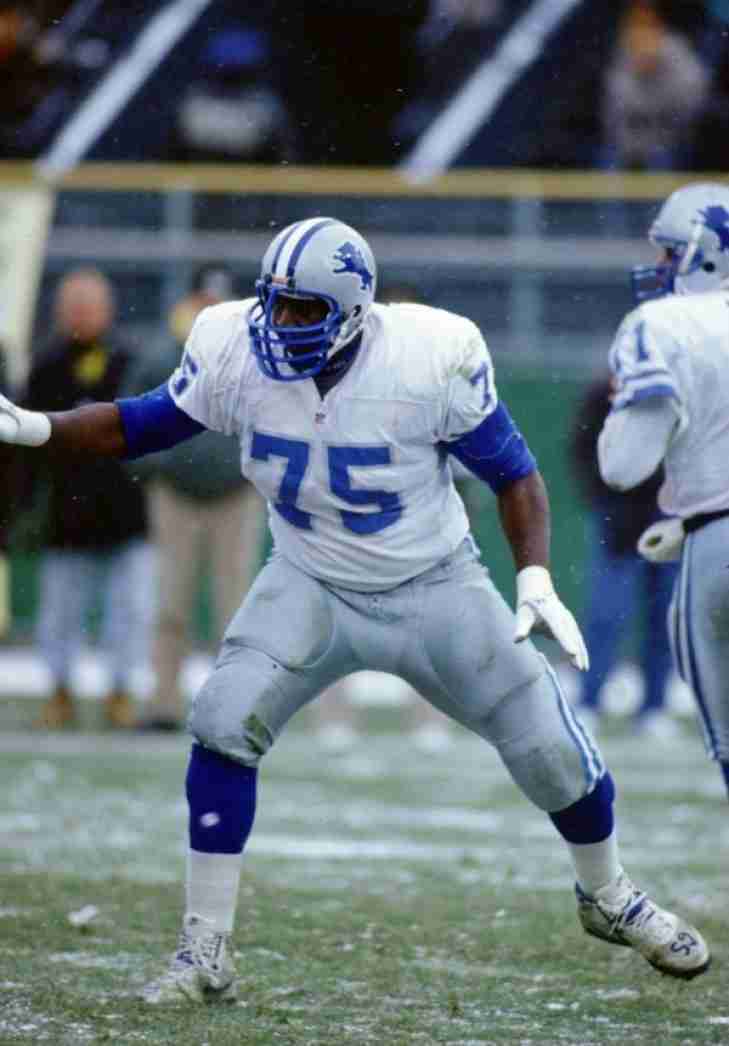
Drafted sixth overall out of Florida in 1985, Lomas Brown stepped into the Motor City as a plug-and-play left tackle and immediately took command of the blind side. A smooth athlete with long arms and ideal footwork, Brown earned a spot on the PFWA All-Rookie Team and established himself as the anchor of Detroit's offensive line for the next decade.
Brown's tenure attained legendary prominence upon the arrival of Barry Sanders in 1989. Over a span of seven seasons, Brown and center Kevin Glover functioned as the primary facilitators both internally and on the perimeter for Sanders' remarkable rushing performances, creating openings for back-side runs and securing edge defenders. Throughout their collaborative efforts, Sanders amassed over 10,000 rushing yards, while Brown secured six consecutive Pro Bowl selections as a Lion (1990–1995) and was honored with a First-Team All-Pro selection in 1995.
Beyond his spatial dominance in Wayne Fontes' run and pass schemes, Brown was an absolute iron man. He started 163 of the 164 regular-season games he played in Detroit, anchoring lines that propelled the Lions to four playoff appearances and the 1991 NFC Championship Game.
After leaving Detroit following the 1995 season, Brown logged stops with Arizona, Cleveland, and New York before capping his 18-year NFL career by capturing an elusive ring with the Tampa Bay Buccaneers in Super Bowl XXXVII. He returned to the franchise post-retirement as its radio color analyst and earned induction into the "Pride of the Lions" ring of honor in 2023. Brown played in 164 regular-season games with 163 starts for the franchise.
10. Alex Karras
“Never mind that shit, here comes Mongo!”
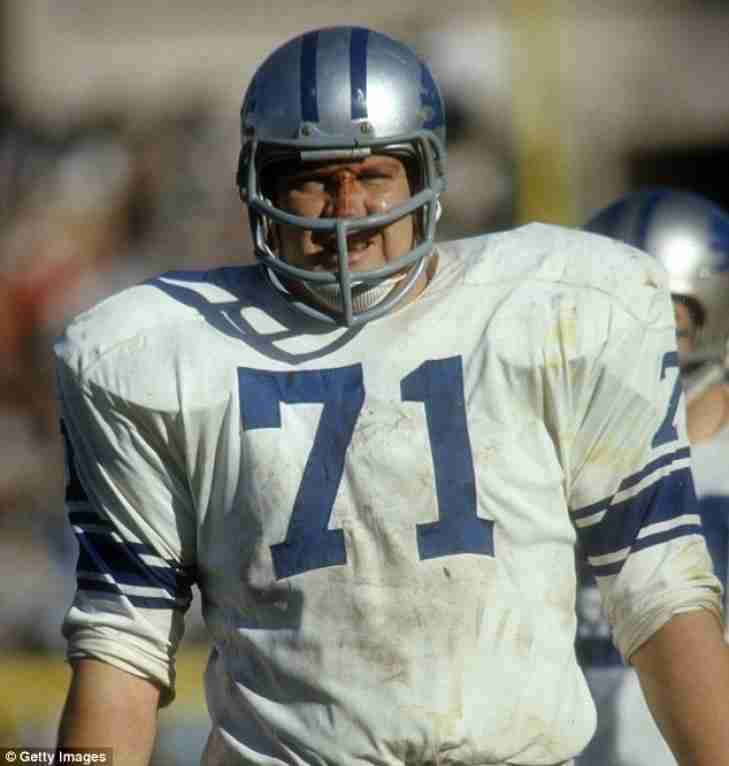
The 1957 Outland Trophy winner, Alex Karras from Iowa, was selected tenth overall in the 1958 NFL Draft and brought immediate star power to Detroit. At 6-foot-2 and 248 pounds, Karras relied on explosive quickness, violent hand usage, and a relentless motor to penetrate opposing backfields. Alongside Roger Brown, Ndamukong Suh-precursor defensive tackle pressure, and a punishing front four, Karras anchored Detroit's defense throughout the 1960s.
When the whistle blew, Karras was pure bedlam for opposing interior linemen. He lacked the towering height of traditional tackles, but he weaponized his lower center of gravity with a devastating bull rush and a lightning-quick arm-over move that left guards lunging at air. In an era before sacks were an official stat, Karras made a habit of living in the backfield, most famously during the 1962 Thanksgiving Day "Thanksgiving Day Massacre" against Green Bay. Karras and the Lions' front four subjected Vince Lombardi’s unbeaten Packers to a brutal afternoon, sacking Bart Starr 11 times—including a safety by Karras—to hand Green Bay its only loss of the season.
Karras established his dominance early, reeling off three consecutive First-Team All-Pro selections and Pro Bowl nods from 1960 to 1962. His trajectory hit a dramatic wall in 1963 when NFL Commissioner Pete Rozelle suspended him for the entire season for gambling on NFL games and placing bets on his own team. Rather than let the controversy define him, Karras spent the year professional wrestling before marching right back onto the field in 1964 without missing a beat. He earned First-Team All-Pro honors again in 1965 while continuing to terrorize quarterbacks, remaining the emotional center of a defense that routinely ranked among the league's most fearsome. Film study research credits him with roughly 100 career sacks, a staggering output for an interior lineman in that era.
After retiring after the 1970 season, Karras seamlessly transitioned into a mainstream media icon. He punched Mongo in Blazing Saddles, spent years as a color commentator on Monday Night Football, and starred as the dad on the hit 1980s sitcom Webster. Yet despite his Hollywood fame, his gridiron legacy remained elite.
Karras played in 161 regular-season games with 155 starts. He compiled an unofficial 100.0 sacks, 18 fumble recoveries, four interceptions, and one safety. A four-time Pro Bowler, nine-time overall All-Pro (four First-Team selections), member of the 1960s All-Decade Team, and Pride of the Lions inductee (2018). His path to Canton was notoriously delayed, but justice finally arrived when he was chosen by the Centennial Slate Committee.
8. Jack Christiansen
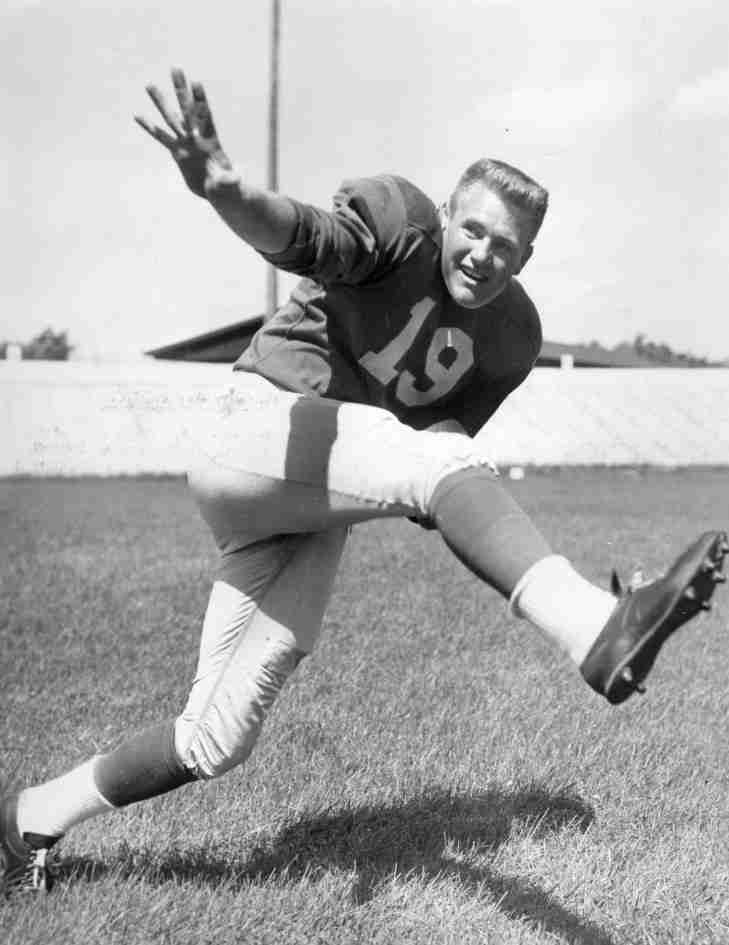
From Colorado A&M, Jack Christiansen was chosen in the sixth round of the 1951 NFL Draft, and he came in as a track-star athlete with game-breaking speed. Operating as the catalyst for Detroit’s secondary—famously nicknamed "Chris's Crew"—Christiansen revolutionized the safety position. His closing speed and instincts forced opposing offenses into a strict game plan: don't throw into his zone, and whatever you do, don't punt the ball anywhere near him.
Christiansen made his debut with an outstanding rookie season in 1951, establishing an NFL record by scoring four touchdowns on punt returns. This included a notable single-game achievement against Los Angeles, where he returned two punts for touchdowns—a feat he impressively replicated six weeks later against Green Bay on Thanksgiving. He maintained this momentum throughout 1952, achieving an NFL-record average of 21.5 yards per punt return along with two additional touchdowns. During this period, he also contributed significantly to the secondary, helping Detroit secure its first world championship in 17 years.
In 1953, Christiansen reached his peak performance, transitioning fully to strong safety and delivering one of the most impressive defensive seasons ever. He topped the league with 12 interceptions, including a 92-yard return for a touchdown, helping the Lions secure consecutive NFL Championships against Cleveland. This outstanding year sparked a six-year run of First-Team All-Pro selections (1952–1957), during which he recorded 8 interceptions in 1954 and again in 1956.
The crown jewel of his career came in 1957. Christiansen once again led the NFL in interceptions with 10 takeaways, serving as the defensive general for a squad that dismantled Cleveland 59–14 in the championship game, securing his third world title ring. By the time injuries prompted his retirement after the 1958 season, his eight career punt return touchdowns remained an NFL gold standard for more than three decades.
Statistically, Christiansen played in 89 regular-season games and amassed 46 interceptions for 717 return yards, three pick-sixes, and 85 punt returns for 1,084 yards (a 12.8 career average) with eight touchdowns, alongside three NFL Championship rings. A six-time First-Team All-Pro, five-time Pro Bowler, two-time NFL interception leader, and member of the NFL’s 1950s All-Decade Team, Christiansen was enshrined in the Pro Football Hall of Fame in 1970 and named a charter member of the Pride of the Lions in 2009.
