

 Not in Hall of Fame News
Yes, we know that this is taking a while! As many of…
 Not in Hall of Fame News
Yes, we know that this is taking a while! As many of…
 Not in Hall of Fame News
2002 SEMI-FINAL RESULTS: Thank you for your participation in the Pro Football…
 Not in Hall of Fame News
Yes, we know that this is taking a while! As many of…
 Not in Hall of Fame News
We are diligently working away at Notinhalloffame on revising our Football lists…
 Not in Hall of Fame News
We are diligently working away at Notinhalloffame on revising our Football lists…
 From the Desk of the Chairman
October baseball often turns individual pitching performances into lasting postseason memories. Strikeout…
 From the Desk of the Chairman
For decades, the sports debate ran on gut feeling. Barstool arguments, call-in…
 From the Desk of the Chairman
Introduction to Private Adult Tennis Camps in Prague Adult club players increasingly…
 From the Desk of the Chairman
Unlike in the case of pre-match betting, where you have to pick…
 From the Desk of the Chairman
Kupu178 builds trust with people by using top-end end-to-end encryption. It checks…
 From the Desk of the Chairman
Sports fans thrive on calculating strategy, reading momentum, and maximizing every tactical…




100 Active Potential Football Hall of Famers
-
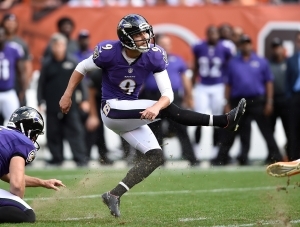 #36 Overall, Justin Tucker: Free Agent, Place Kicker, #1 Kickers & Special Teams2025 Pre-Season Rank #29, 2024 Pre-Season Rank #26, 2023 Pre-Season Rank #22, 2022 Pre-Season Rank #28, 2021 Pre-Season Rank #42, 2020 Pre-Season Rank…
 -
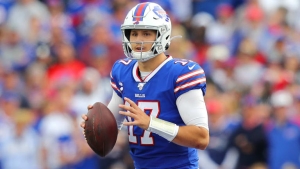 #16 Overall, Josh Allen, Buffalo Bills, #5 Quarterback2025 Pre-Season Rank #17, 2024 Pre-Season Rank #39, 2023 Pre-Season Rank #69, 2022 Pre-Season Rank #98, 2021 Pre-Season Rank #117. Peak Period: 2020-24.…in Quarterbacks
 -
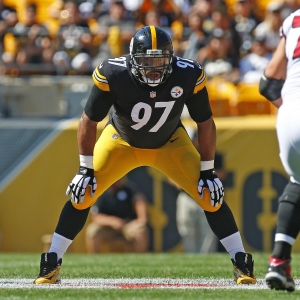 #20 Overall, Cameron Heyward, Pittsburgh Steelers, Defensive End, #9 Defensive Lineman/Linebackers: Pass Rushers2025 Pre-Season Rank #19, 2024 Pre-Season Rank #28, 2023 Pre-Season Rank #33, 2022 Pre-Season Rank #38, 2021 Pre-Season Rank #75, 2020 Pre-Season Rank…
 -
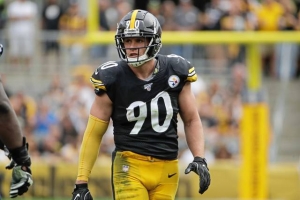 #10 Overall, T.J. Watt, Pittsburgh Steelers, #4 Defensive Lineman/Linebacker Pass Rusher2025 Pre-Season Rank #7, 2024 Pre-Season Rank #11: 2023 Pre-Season Rank #15, 2022 Pre-Season Rank #24, 2021 Pre-Season Rank #68, 2020 Pre-Season Rank…
Visit the Fictitious Halls of Fame!


You May Also Like...
EDITOR’S CHOICE
 DDT's Pop Flies
When the veterans committee (VC), officially convening as the Contemporary Baseball Era…



 Live Music Head
Project/Objectan interview with André Cholmondeleyby Live Music HeadOriginally published at timessquare.com on…

LATEST RANKINGS


MOST POPULAR RANKINGS


Committee Chairman
30 Haywood Jeffires
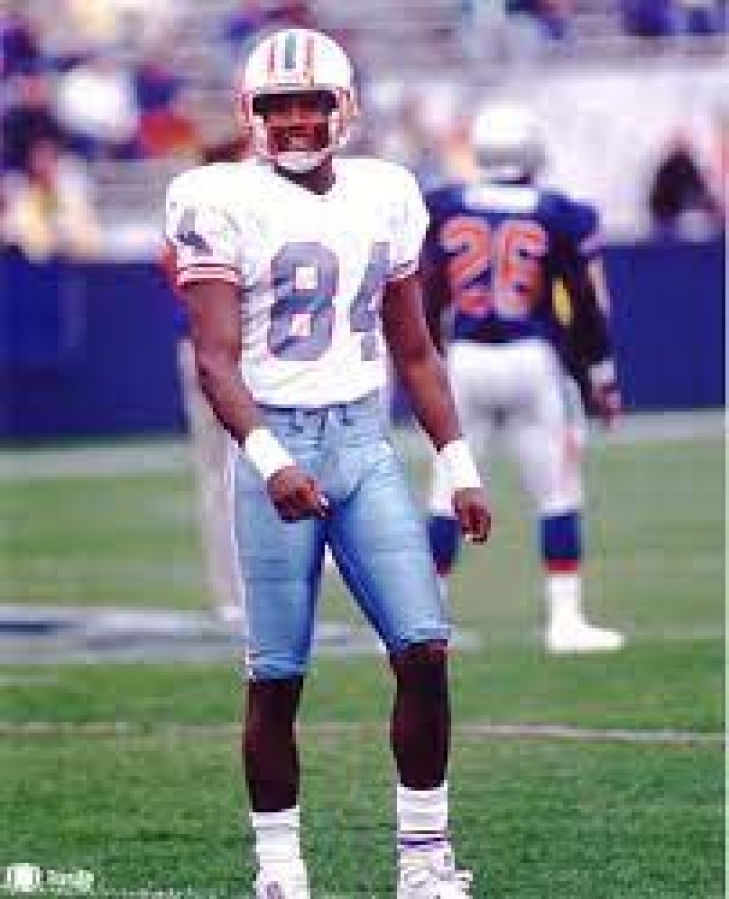
Haywood Jeffires was a First Round Pick (20th Overall in 1987), but injuries and the depth chart held him to only nine Games with 138 Yards in his first two seasons. That changed in his third year.
The Wide Receiver from North Carolina State had 47 Receptions with 619 Yards that year, and he became a top target for Warren Moon afterward, hitting at least 1,000 Yards the next two seasons. In 1991, Jeffires led the NFL in Receptions (100) and was a First Team All-Pro with a Pro Bowl Selection. He would go to the Pro Bowl the next two years, remaining a top wide out for the Oilers, completing seven straight years with at least 600 Yards.
Jeffires signed with New Orleans in 1996 but only played one more year before he retired. With the Oilers, Jeffires totaled 6,119 Yards with 47 Touchdowns.
29. Brad Hopkins
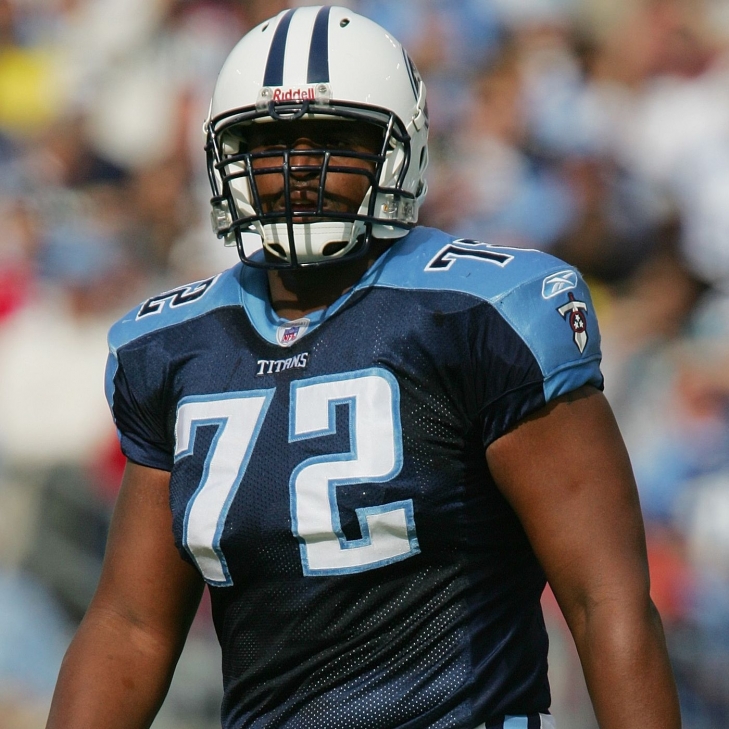
A First Round Pick from Illinois, Brad Hopkins was an All-Rookie for the Oilers in 1993 at Left Tackle. This would be his role for the franchise for the next 12 years.
Hopkins played his entire career with the Oilers/Titans, starting 188 of his 194 Games. Twice named to the Pro Bowl (2000 & 2003), Hopkins was a dependable presence on the left side of the line, allowing the organization to worry about holes elsewhere for a decade-plus.
It is grunt work but necessary.
27. Frank Wycheck
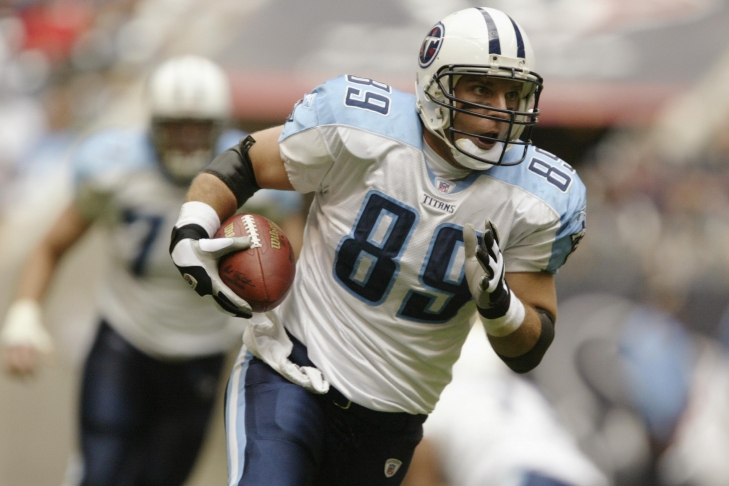
A bust in his first two NFL seasons with Washington, Frank Wycheck signed with the Houston Oilers in 1995, who would soon relocate to Tennessee and become the Titans. It was in the Volunteer State that Wychek would find his groove.
Wychek’s first two years as an Oiler/Titan was good, but his offensive production jumped in 1997, where he began a five-year streak of at least 600 Receiving Yards. A Pro Bowl Selection from 1998 to 2000, Wychek was instrumental in one of the most famous plays in franchise history, "The Music City Miracle." In the 2000 AFC Wild Card Game, the Titans were down 16-15, with 16 seconds left. Wycheck took the handoff from Lorenzo Neal and then passed it to Kevin Dyson, who ran 75 Yards for the winning Touchdown. The play is disputed to this day as to whether it was a backward or forward pass. The Titans made it to the Super Bowl that year, albeit in a losing effort.
Wycheck was extremely popular in Tennessee, and he finished his career for the team, retiring in 2003. With the Titans, Wycheck accumulated 4,958 Yards with 27 Touchdowns. The franchise inducted him to their Hall of Fame in 2008.
5. Lou Groza
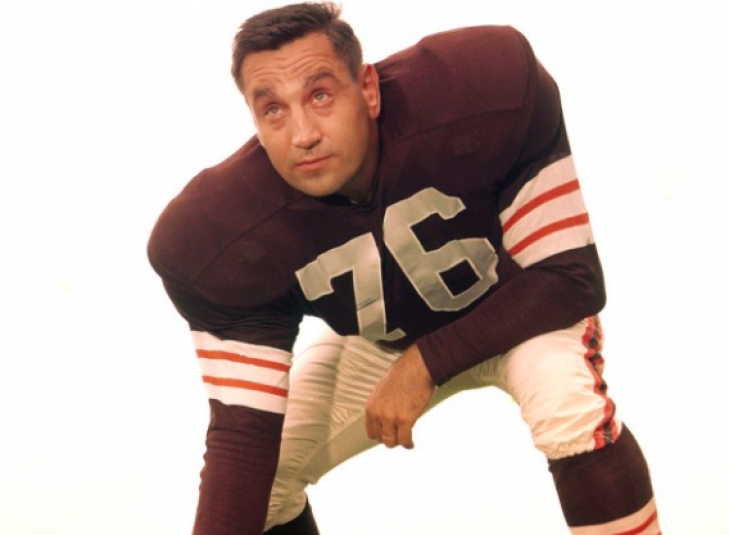
An original Cleveland Brown, Lou Groza was recruited by Paul Brown, primarily to act as the Browns’ Place Kicker. Groza led the AAFC in Points in his rookie year, and after two seasons, Groza also helped out on Cleveland’s Offensive Line, and he would perform a dual-role for the next twelve seasons.
The Browns won the first four AAFC Championships, and Groza helped them win the 1950, 1954, and 1955 NFL Titles. Groza evolved into an above-average Left Tackle, but his kicking talents were ahead of its time. "The Toe" was one of the first Kickers who could regularly get it through the uprights in further distances. Before Groza, Field Goals beyond 40 Yards were rarely attempted, but a new dynamic was added to the game with Groza as a weapon. He would be named a First Team All-Pro four years in a row (1952-55) with nine Pro Bowl appearances. Back issues compounded, and he retired after the 1959 Season.
Groza came out of retirement in 1961, rejoining Cleveland but only as their Kicker. For the fourth and fifth time, Groza led the NFL in Field Goal Percentage and helped the Browns win the 1964 Championship, making him the only player to win seven titles with Cleveland. He retired for good after the 1967 Season.
Graham entered the Pro Football Hall of Fame in 1974, and his number 76 is one of five retired by the team. He was also part of the inaugural Browns Ring of Honor in 2010. Groza is also a member of the 1950s All-Decade Team.
