

Our All Time Top 50 Los Angeles Chargers Have been revised to reflect the 2025 Season
Yes, we know that this is taking a while!
As many of you know, we at Notinhalloffame.com are slowly generating the top 50 of each major North American sports team. That being said, we maintain and update our existing Top 50 lists annually. We are pleased to present our post-2025 revision of our top 50 Los Angeles Chargers.
As for all of our top 50 players in football, we look at the following:
1. Duration and Impact.
2. Traditional statistics and how they finished in the National Football League.
3. Advanced Statistics.
4. Playoff performance.
5. Their respective legacy on the team.
6. How successful the team was when he was there.
7. Respecting the era in which they played.
Criteria 1-4 will make up the lion’s share of the algorithm. Please note that we have implemented this for the first time. This has changed the rankings all throughout the board.
Last year, the Chargers went 11-6 but lost the Wild Card Game to the New England Patriots. There were two elevations based on the season.
As always, we present our top five, which had no changes.
1. Junior Seau
2. LaDainian Tomlinson
3. Lance Alworth
4. Dan Fouts
5. Philip Rivers
You can find the complete list here:
Defensive Back Derwin James rocketed to #25 from #40.
Quarterback Justin Herbert moved to #40 from #45.
We thank you for your continued support of our lists on Notinhalloffame.com.
Rodney Harrison named to the Los Angeles Chargers Hall of Fame

Regular visitors of Notinhalloffame.com know that we are slowly working on the top 50 of every major team in the NHL, NBA, NFL, and MLB. Once that is done, we will examine how each team honors its past players, coaches, and executives. As such, it is important to us that the Los Angeles Chargers announced that Rodney Harrison will be inducted into their franchise Hall of Fame on October 23 during the Chargers' home game against the Minnesota Vikings.
Drafted in the fifth round in 1994 from Western Illinois, Harrison helped the Chargers reach their only Super Bowl as a rookie. The hard-hitter became San Diego’s starting Strong Safety in 1996, and he was selected to two Pro Bowls (1998 & 2001) and was a First Team All-Pro once (1998). Harrison joined the New England Patriots in 2003 (where he won two Super Bowls) and left behind 26 Interceptions and 21.5 Sacks as a Charger.
Harrison is already a member of the Chargers' 40th and 50th Anniversary Teams and is also part of the Patriots' 50th Anniversary Team. He still holds the record for the most Sacks for a Defensive Back in NFL history (30.5).
We here at Notinhalloffame.com would like to congratulate Rodney Harrison for his impending honor.
Our All Time Top 50 Los Angeles Chargers have been revised to reflect the 2025 Season

Yes, we know that this is taking a while!
As many of you know, we at Notinhalloffame.com are slowly generating the top 50 of each major North American sports team. That being said, we maintain and update our existing Top 50 lists annually. As such, we are delighted to present our post-2024 revision of our top 50 Los Angeles Chargers.
As for all of our top 50 players in football, we look at the following:
1. Advanced Statistics.
2. Traditional statistics and how they finished in the National Football League.
3. Playoff accomplishments.
4. Their overall impact on the team and other intangibles that are not reflected in a stat sheet.
Last year, the Chargers had a strong season, finishing 11-6 and advancing to the playoffs, although the Houston Texans defeated them in the Wild Card Round. There were two new additions to the list and one elevation on our Top 50.
As always, we present our top five, which remain unchanged.
1. Junior Seau
2. LaDainian Tomlinson
3. Lance Alworth
4. Dan Fouts
5. Philip Rivers
You can find the entire list here.
Joey Bosa, who is now with the Buffalo Bills and was the 2016 Defensive Rookie of the Year, advanced two spots to #36.
Four-time Pro Bowl Safety Derwin James debuts on the list at #40.
The other new entry is Quarterback Justin Herbert, who comes in at #45.
We thank you for your continued support of our lists on Notinhalloffame.com.
40. Justin Herbert

The Chargers drafted Justin Herbert sixth overall out of Oregon in 2020, hoping the big-armed Duck could eventually carry the franchise to the playoffs and beyond. That breakthrough hasn’t fully arrived yet, but Herbert has settled in as one of the league’s more reliable and productive quarterbacks. He won Offensive Rookie of the Year after throwing for 4,336 yards and 31 touchdowns, then followed it up in 2021 with a Pro Bowl season in which he threw for 5,014 yards and 38 scores—still the high-water mark of his career. Even in seasons that didn’t match those raw numbers, he has consistently kept the Chargers competitive with his combination of arm strength, quick processing, and improving accuracy.
What has stood out in recent years is how cleanly he has handled the ball. After throwing 15 interceptions in that 2021 campaign, he has steadily tightened his decision-making, including a 2024 season in which he was intercepted only three times while still pushing the ball downfield. He has also shown more willingness to use his legs when the pocket collapses, turning designed runs and scrambles into positive gains rather than forcing throws into traffic. The Chargers have yet to win a playoff game with him under center, but the individual production has rarely been the issue.
In 2025, Herbert put together another solid year, throwing for 3,727 yards and 26 touchdowns while guiding the team to an 11-5 record and a return to the postseason. He earned his second Pro Bowl selection in the process, even as the offensive line dealt with significant injuries that forced him to operate under pressure more often than ideal. He still finished with a completion percentage in the mid-60s and added nearly 500 rushing yards, giving the Chargers another example of how he can carry an offense when the supporting cast is uneven.
The playoff result was the same as before—a loss in the wild-card round—but the regular-season body of work reinforced that Herbert remains the clear franchise quarterback. Through 2025, he has yet to post another 30-touchdown season since his second year, but efficiency gains and a willingness to create with his legs have kept his overall value high. Heading into 2026, the Chargers continue to build around a quarterback who has already shown he can produce at a high level for stretches and who still has room to push the offense further if the pieces around him stabilize.
25. Derwin James

When the Chargers selected Derwin James 17th overall in 2018, they bet on a Florida State safety who had already shown he could do almost everything on defense. That bet paid off immediately. As a rookie, he started every game, finished with over 100 combined tackles, 3.5 sacks, and three interceptions, and earned First-Team All-Pro honors while finishing as the runner-up for Defensive Player of the Year. He was the rare safety who could play deep, come down into the box, cover tight ends in man coverage, or blitz off the edge without the Chargers having to dial back the scheme, and his instincts let him diagnose plays quickly enough to create disruption from multiple spots.
Injuries interrupted the early momentum. A stress fracture in his right foot limited him to five games in 2019, and knee problems kept him out for all of 2020. He returned in 2021 and put together a stretch of high-volume seasons, topping 100 combined tackles in each of the next three years while earning Pro Bowl selections in 2021, 2022, and 2024. He continued to move around the formation—sometimes lining up as a deep safety, sometimes in the slot or as a blitzing linebacker—and remained one of the more adaptable pieces on the defense even as the coaching staff and scheme shifted around him.
He enters the 2026 season still the Chargers’ top defensive back. Through 2025, he has stayed healthy enough to play full seasons, collected additional Pro Bowl and All-Pro recognition, and continued to produce as both a run defender and coverage player. If he can maintain that level of availability and impact, he has a realistic path to finishing among the better defensive backs in franchise history by the time his career ends.
What stands out is how consistently he has been asked to fill whatever role the defense needed on a given week, from deep coverage to slot corner to edge blitzing, without the production dropping off for long. That kind of adaptability has made him a constant in the secondary even through coaching changes, and it is the main reason he remains the centerpiece of the Chargers’ back end heading into another season.
Our All-Time Top 50 Los Angeles Chargers Have Been Revised to reflect the 2023 Season

Yes, we know that this is taking a while!
As many of you know, we at Notinhalloffame.com are slowly generating the top 50 of each major North American sports team. That being said, we have existing Top 50 lists and consistently look to update them when necessary and based on necessity. As such, we are delighted to present our post-2023 revision of our top 50 Los Angeles Chargers.
As for all of our top 50 players in football, we look at the following:
1. Advanced Statistics.
2. Traditional statistics and how they finished in the National Football League.
3. Playoff accomplishments.
4. Their overall impact on the team and other intangibles that are not reflected in a stat sheet.
Last year, the Chargers did not accomplish much, and there were no new entrants to the Top 50. There was one elevation.
As always, we present our top five, which saw no changes:
1. Junior Seau
2. LaDainian Tomlinson
3. Lance Alworth
4. Dan Fouts
5. Philip Rivers
You can find the entire list here.
Wide Receiver Keenan Allen climbed to #12 from #14. He is now with the Chicago Bears.
Defensive End Joey Bosa, who has been battling injuries, only moved up spot to #38.
Running Back, Austin Ekeler, who is now with Washington, remained at #40.
We thank you for your continued support of our lists on Notinhalloffame.com.
Alex and Faye Spanos to be inducted into the Los Angeles Chargers Hall of Fame

Regular visitors of Notinhalloffame.com know that we are slowly working on the top 50 of every major team in the NHL, NBA, NFL, and MLB. Once that is done, we will examine how each team honors its past players, coaches, and executives. As such, it is important to us that the Los Angeles Chargers will be inducting former owners, Alex and Faye Spanos to their franchise Hall of Fame.
This will bring a total of 43 members to the Hall.
Alex Spanos bought the San Diego Chargers in 1984 and oversaw the team until his death in 2018. His wife, Faye, died two months later.
The team is now owned and run by their son, Dean Spanos, who credited their parents for the vision of the team and that the team would not have relocated to Los Angeles.
Chargers QB Justin Herbert Extends Contract
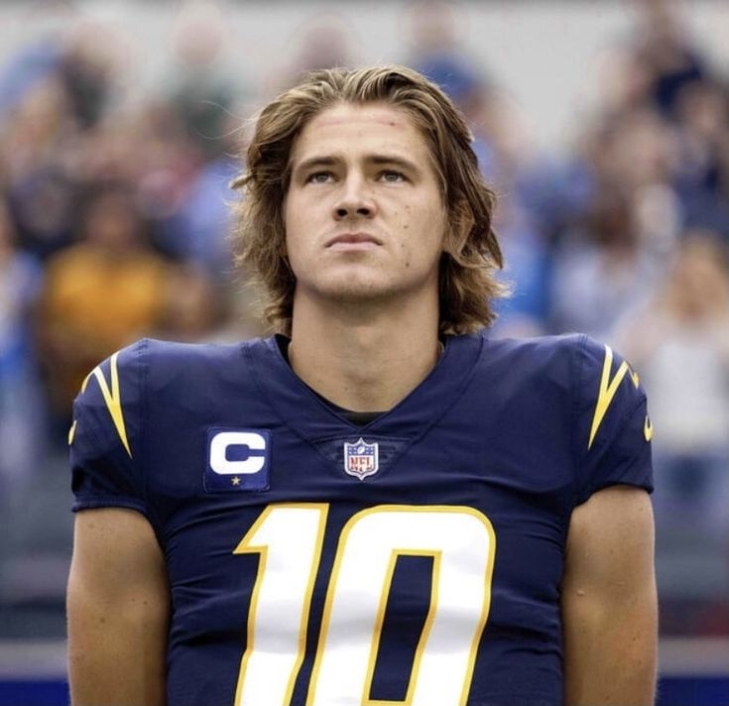
In July, the LA Chargers signed QB Justin Herbert on a five-year contract extension worth $262.5 million, making him the highest paid QB in history – but what is behind this decision, and why do the Chargers have so much pinned on the handsome, reticent player barely out of his rookie season?
If you are looking for another way to play online, and fancy a break from the Eye of Horus slot games, you might want to look at sports betting and the NFL in particular – and knowing the latest news before the start of the season might help you decide on what to bet on.
Before we delve into Herbert, let’s look at the LA Chargers.
Who are the LA Chargers?
The LA Chargers play in the NFL and their home games are played at the SoFi Stadium, which the team shares with the LA Rams in Inglewood, California.
The team was founded in 1959, and played their first season in the American Football League in 1960.
In 1961, the team relocated to San Diego, and played as the San Diego Chargers for decades, winning the AFL Championships in 1963.
One of the best performances of the Chargers was in 194, when they won the AFC Championship and a place in the Superbowl but lost 49-26 to the San Francisco 49ers.
2017 saw the Chargers return to LA, and since then they have worked hard to remain in the top flight of the AFC West, finishing 2nd last year and earning a place in the Wild Card Playoff, which they unfortunately lost to the Jacksonville Jaguars 31-30.
With the contract extension for Justin Herbert, the LA Chargers are showing that they have big plans for the upcoming season, putting their introverted quarterback at the forefront of their plans for domination.
Why Justin Herbert?
Born in March 1998, Justin Herbert developed his amazing throwing arm in his early life, competing in the softball throw tournaments from the age of 7 and winning again and again. The movement into football was almost a no-brainer, and by his senior year of high school, he was named First Team All-State and awarded the Southwest Conference Offensive Player of the Year at Sheldon High School.
College saw him named as QB2 when he started at Oregon, but he soon became a starter, as his freshman season saw him equalling or setting records for things like passing yards and TD passes. While the 2016 season for his college team wasn’t exactly full of glory, it wasn’t for a lack of talent in their QB, at least. The rest of his college career saw him win the Rose Bowl, the Redbox Bowl, and many personal accolades, including Academic All-American for his 4.08 grade point average in Biology.
When it came to the draft, Herbert was picked sixth overall in the first round, and named as backup QB to Tyrod Taylor. His arrival was watched with interest; his play style and movie-star good looks made him seem to be the ultimate sports personality.
This seemed to be spot on for the fans, as he became the starting QB in just the second game of the year. His awesome skills and extensive power in his throw saw him named as Rookie of the Year and Offensive Rookie of the Year in 2020.
It was in 2021 that Herbert really came to life, smashing franchise records across the field – from completing 5014 passing yards, 38 passing touchdowns, 63 carries for 302 rushing yards, three rushing touchdowns, and 15 interceptions in just one season.
What is the secret sauce that makes Herbert so good – and worth so much?
Well, there is that unnaturally good throwing arm. Even his own teammates sometimes are awed by just how far – and how straight - he can throw. Despite this, he is steady and uncomplicated, humble, and quiet.
Unlike some of the other quarterbacks in the NFL, Herbert seems completely disinterested in the trappings of the position. He Is noticeably uncomfortable in front of a microphone, uneasy when put in the spotlight, and often deflecting personal questions to make them about the performance of the team.
Does this make him a better player? Perhaps, he is certainly more focused on his play, running practice drills until they are perfect with that attention to detail that even his teammates are fascinated with.
This ultra focused player looks the part, with his handsome features and good hair – but the only thing that matters is the football. He has no delusions about his position, often the only player who tidies after himself in the locker room and packs his own holdall before away games.
His third season saw Herbert come out of himself a bit more. Maybe through maturity or being more comfortable with his important position – whatever it is, he was more relaxed in interviews, making jokes on camera, and actively encouraging his teammates.
Whatever the secret is, it has transformed Justin Herbert’s career – he was scheduled to earn $4.23 million in his fourth year for the Chargers, and thanks to his new contract that number is about $52.5 million.
Our All-Time Top 50 Los Angeles Chargers have been updated to reflect the 2022 Season

Yes, we know that this is taking a while!
As many of you know, we here at Notinhalloffame.com are slowly generating the 50 of each major North American sports team. That being said, we have existing Top 50 lists out and we always consistently look to update them when we can and based on necessity. As such, we are very happy to present our post 2022 revision of our top 50 Los Angeles Chargers.
As for all of our top 50 players in football we look at the following:
1. Advanced Statistics.
2. Traditional statistics and how they finished in the National Football League.
3. Playoff accomplishments.
4. Their overall impact on the team and other intangibles not reflected in a stat sheet.
Last year, the Chargers returned to the playoffs, but were bounced in the first game. This past season saw one new entrant and one elevation.
As always, we present our top five, which did not change.
1. Junior Seau
4. Dan Fouts
You can find the entire list here.
Wide Receiver, Keenan Allen, climbed from #20 to #13.
Running Back, Austin Ekeler, makes his first appearance at #40.
It is noteworthy that Joey Bosa held the same spot (#39), and that Quarterback, Justin Herbert, just missed out. He should have a huge debut next year.
We welcome your input and comments and as always, we thank you for your support.
42. Austin Ekeler

Austin Ekeler never quite fit the traditional profile of a feature back—he never topped 1,000 rushing yards in a season—but he carved out a different kind of value with the Chargers as a true dual-threat who could hurt defenses as a runner or a receiver. Undrafted out of Western State in 2017, he made the roster as a reserve and special-teams contributor, then gradually worked his way into a larger role. By his third season, he was starting eight games and finishing with more than 1,500 yards from scrimmage, using quickness, vision, and reliable hands to turn short throws and modest holes into productive gains.
Injuries limited him to 10 games in 2020, but he bounced back in a big way over the next two years. In 2021 and 2022, he led the NFL in total touchdowns while combining for nearly 3,200 yards from scrimmage, splitting time between the ground and the passing game and scoring regularly in both. He was especially dangerous on screens and check-downs, where his burst after the catch turned modest targets into big gains, and he remained a capable between-the-tackles runner when the Chargers needed him to grind out yards. The production made him one of the more reliable offensive weapons on the roster even without the gaudy single-season rushing totals that usually define the position.
The numbers dropped in 2023, when he finished with 1,064 yards from scrimmage and six touchdowns. After that season, he left for the Washington Commanders. Across his seven years with the Chargers, he compiled roughly 8,200 yards from scrimmage and 69 touchdowns, production that came from a balanced mix of rushing and receiving work.
He never earned a Chargers Hall of Fame induction, but the undrafted back who arrived as a long shot and became a consistent dual-threat scorer remains one of the franchise’s more productive offensive pieces in recent years.
Our All-Time Top 50 Los Angeles Chargers have been revised to reflect the 2021 Season.

Yes, we know that this is taking a while!
As many of you know, we here at Notinhalloffame.com are slowly generating the 50 of each major North American sports team. That being said, we have existing Top 50 lists out and we always consistently look to update them when we can and based on necessity. As such, we are very happy to present our post-2021 revision of our top 50 Los Angeles Chargers.
As for all of our top 50 players in football we look at the following:
1. Advanced Statistics.
2. Traditional statistics and how they finished in the National Football League.
3. Playoff accomplishments.
4. Their overall impact on the team and other intangibles not reflected in a stat sheet.
Last year, the Los Angeles Chargers failed to make the playoffs but were one of the more exciting teams to watch with several young players on the rise. There were no new entrants in the Top 50, but one jump of an existing player.
As always, we present our top five:
1. Junior Seau
4. Dan Fouts
The only change on the list is Nick Bosa, who climbed from #50 to #39. The 2016 Defensive Rookie of the Year went to his fourth Pro Bowl last season.
You can find the entire list here.
We welcome your input and comments and as always, we thank you for your support.
37. Joey Bosa
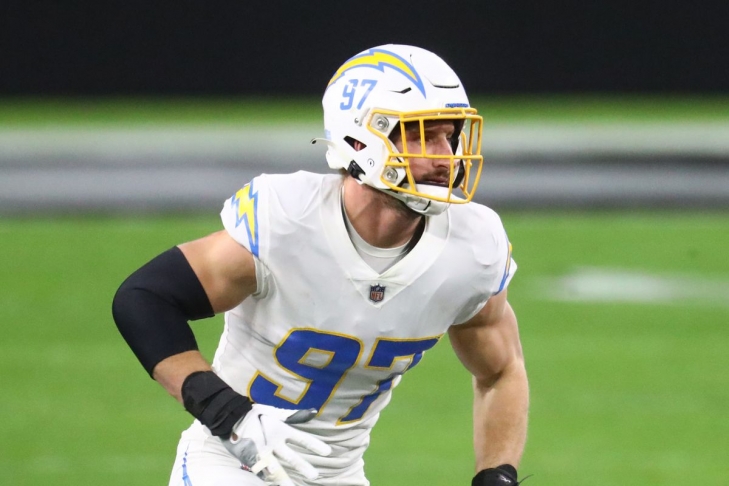
Joey Bosa came to the Chargers as the third overall pick out of Ohio State in 2016 after a dominant college career that included two All-American honors, the Nagurski-Woodson Defensive Player of the Year award, and a national title. The big, explosive edge rusher from the Buckeyes wasted little time proving the selection was right. In a 2016 season that earned him Defensive Rookie of the Year honors, he posted 10.5 sacks and 17 tackles for loss (second in the league) despite a contract holdout that delayed his debut. He was a power-speed hybrid who used violent hands, a quick first step, and relentless effort to collapse the pocket or set the edge against the run. He set an early NFL mark by recording 19 sacks through his first 20 games, giving the Chargers an immediate difference-maker off the edge.
He followed that up with a 12.5-sack season in 2017 and his first Pro Bowl. Injuries limited him to seven games in 2018, but he bounced back with Pro Bowl selections in 2019, 2020, and 2021 while continuing to rank among the league’s better pass rushers when healthy. He teamed with Melvin Ingram for stretches to form one of the more disruptive edge duos in the AFC. In 2022, a groin injury cost him most of the regular season; when he returned for the playoffs, a penalty for removing his helmet helped seal a Wild Card loss to Jacksonville. Injuries kept coming after that, and while he still earned a fifth Pro Bowl nod in 2024, he was no longer the consistent force he had been earlier in his career, finishing as a solid but diminished contributor in his final two seasons. Even so, he remained a reliable presence when available, still capable of generating pressure and forcing offenses to account for him on every snap.
The Chargers released him after the 2024 season. Across nine years with the franchise, he left with 72 sacks and 87 tackles for loss, production that ranks second in team history for sacks and marked him as one of the most productive edge rushers the Chargers have ever had.
He was the last remaining player who had been with the organization continuously from its final years in San Diego through the move to Los Angeles, and his early dominance helped set a standard for the pass rush that the team has been trying to rebuild around ever since.
Our All-Time Top 50 Los Angeles Chargers are now up
Yes, we know that this is taking a while!
As many of you know, we here at Notinhalloffame.com are slowly generating the 50 of each major North American sports team. We have a new one to unveil today, that of the Los Angeles Chargers.
The Los Angeles Chargers came into existence in 1960 as a charter member of the American Football League.
The stay in Los Angeles was brief, as they moved south to San Diego the season after, but this was one of the most successful teams in the AFL. They would make the playoff five times in the upstart league, winning the AFL Title in 1963.
The Chargers would be part of the AFL-NFL merger, and while they have had their share of excellent players, they have only made the Super Bowl once, a losing effort in 1994. In 2016, the Chargers moved back to Los Angeles.
As for all of our top 50 players in football we look at the following:
1. Advanced Statistics.
2. Traditional statistics and how they finished in the NFL.
3. Playoff accomplishments.
4. Their overall impact on the team and other intangibles not reflected in a stat sheet.
Remember, this is ONLY based on what a player does on that particular team and not what he accomplished elsewhere and also note that we have placed an increased importance on the first two categories.
This list is updated up until the end of the 2019 Season.
The complete list can be found here, but as always, we announce our top five in this article. They are:
1. Junior Seau
4. Dan Fouts
We will continue our adjustments on our existing lists and will continue developing our new lists.
Look for our more material coming soon!
Up next, will be the top 50 Cincinnati Bengals.
As always we thank you for your support.
41. Dick Harris

Dick Harris was one of those undrafted long shots who found a home when the AFL opened up new opportunities in 1960. Coming out of McNeese State, he made the inaugural Los Angeles Chargers roster and quickly became a cornerback starter for Sid Gillman. In that first season, he picked off five passes and earned First-Team All-AFL honors, then followed it up the next year with seven interceptions (three returned for touchdowns) and another First-Team selection. He was a ball-hawking corner who played tight man coverage, baited quarterbacks into throws, and then closed on the ball with enough speed and timing to create turnovers.
The production kept coming. He had five more interceptions in 1962 and then a career-high eight in 1963, the year the Chargers won the AFL championship. Across those first four seasons, he totaled 25 interceptions and earned Second-Team All-AFL recognition in 1963 and 1964. He was the kind of defender who could take away half the field and still jump routes when the quarterback tried to force something into his area, giving the early Chargers a reliable presence in the secondary during their most successful stretch. Injuries began to limit him after that. He appeared in only six games in 1964 and saw reduced action in 1965 before retiring following the season.
Over his six years with the Chargers, he finished with 29 interceptions in 76 games, still ranking among the franchise’s all-time leaders in picks and among the better totals for a cornerback from the AFL era. He never earned a Chargers Hall of Fame induction, but the undrafted corner who arrived with the franchise’s first roster and helped it win its only championship remains one of the team's most productive defensive backs in its early years.
47. Chuck Allen

In the second year of the Chargers’ existence, Washington Linebacker, Chuck Allen was a very late Draft Pick (28thRound), so for him just to make the team was a bit of a long shot. Allen would accomplish a lot more than that.
46. Vincent Jackson

Vincent Jackson’s NFL start was slow after the Chargers took the Northern Colorado wide receiver in the second round of the 2005 draft. Injuries limited him to eight games as a rookie, and he barely saw the field, but he gradually earned more snaps and became a serious threat opposite the more established receivers on the roster. By 2008, he posted his first 1,000-yard season (1,098 yards and seven touchdowns), followed by another in 2009 (1,167 yards and nine scores), while earning his first Pro Bowl nod. He was a big, physical target who could win contested catches downfield and run intermediate routes, giving Philip Rivers a reliable option when the offense needed a vertical threat.
A contract dispute and subsequent suspension limited him to just five games in 2010, cutting short what looked like another strong year. He returned in 2011 and put up a third 1,000-yard season (1,106 yards and nine touchdowns) while earning a second Pro Bowl selection with the Chargers. The production was consistent when he was available, but the 2010 holdout left lingering frustration. After that season, he left for the Tampa Bay Buccaneers in free agency.
Across his seven years with the Chargers, he finished with 4,754 receiving yards and 37 touchdowns. He never earned a Chargers Hall of Fame induction, but the second-round pick who developed into a multi-year 1,000-yard receiver remains one of the franchise's most productive outside threats in the Rivers era.
39. Keith Lincoln

Keith Lincoln came out of Washington State and chose the Chargers over the Buffalo Bills, who had also drafted him in 1961, signing with San Diego as a second-round AFL pick. He saw limited action as a rookie, then became a regular the following year and earned AFL All-Star honors for the next four seasons. He was a tough, versatile back who could run between the tackles, catch passes out of the backfield, and even throw the occasional option pass, giving Sid Gillman’s offense another weapon who could move the chains or break a big play.
His peak arrived in 1963, when he rushed for 826 yards and earned First-Team All-AFL honors. That year the Chargers won the AFL championship, and Lincoln was named the game’s MVP after a dominant performance against the Boston Patriots. He carried 13 times for 206 yards (including a 67-yard touchdown), caught seven passes for 123 yards and a score, and even completed a 20-yard pass, finishing with a then-record 329 yards from scrimmage in the 51-10 rout. He repeated as a First-Team All-AFL selection in 1964 and remained a productive dual-threat through the mid-1960s, mixing power runs with receiving production that kept defenses from focusing solely on halfback Paul Lowe or the serious threats outside.
Lincoln stayed with the Chargers until he joined the Bills in 1967. Across his primary stretch in San Diego, he accumulated roughly 7,000 all-purpose yards, making him one of the more complete offensive contributors of the early Chargers era.In 1980, the franchise enshrined him in its Hall of Fame, recognizing the multi-purpose back whose championship-game performance remains one of the most memorable individual efforts in the franchise’s history.
36. Kenny Graham

Kenny Graham became a Charger after the 1963 college season when San Diego selected the Washington State safety in the 13th round of the AFL draft. The Baltimore Colts also selected him in the NFL Draft, but in May 1964 he signed with the Chargers, joining the team the year after it won its only AFL championship. The late-round pick out of the Cougars quickly stepped into a starting role at safety and began producing turnovers right away.
At about 6-foot and 210 pounds, he was a rangy, physical safety who could cover deep and still come up and deliver hits against the run. In his first season, he picked off four passes, then followed with five interceptions in three of the next four years. He was an AFL All-Star four times (1965, 1967, 1968, and 1969) and earned First-Team All-AFL honors in 1966—ironically one of the two years he did not make the All-Star team. He returned five of his interceptions for touchdowns during his Chargers run, including a 68-yarder in 1967 and a pair of scores in 1969. He was the kind of safety who could erase a deep throw one play, then turn a short interception into a big return the next, giving San Diego a reliable playmaker in the back end throughout the mid-to-late 1960s.
After the 1969 season, Graham left for the Cincinnati Bengals, where he played one final year before wrapping up his career. Across his six seasons with the Chargers, he finished with 25 interceptions and five return touchdowns, production that still ranks among the better totals for a safety in franchise history.
He was later named to the AFL All-Time Second Team, recognition for the productive, ball-hawking safety who spent most of the 1960s locking down the back end for San Diego.
50. Ernie Wright

Ernie Wright was one of the original Los Angeles Chargers when the AFL launched in 1960, and the Ohio State tackle took full advantage of the chance. He locked down the starting left tackle job as a rookie and held it through the team’s early years in both Los Angeles and San Diego. Wright earned AFL All-Star nods in 1961, 1963, and 1965, with the 1963 season also bringing an AFL Championship as the Chargers rolled over the Boston Patriots 51-10. Sid Gillman later called the Wright-and-Mix tandem one of the best pairs of offensive tackles in pro football at the time, a nod to the steady pass protection and run support Wright provided for the early Chargers offenses.
He spent his first eight seasons with the franchise before the expansion Bengals selected him in their inaugural draft. Wright played four years in Cincinnati, then returned to San Diego for one final season in 1972 before retiring. He was one of only 20 players who appeared in all ten years of the AFL.
Wright never piled up the individual stats that jump off a page, but he was a durable starter who helped anchor the line during the Chargers’ first decade. He was later named to the franchise’s 50th-anniversary team, recognition for the original tackle who held down the left side for most of the AFL era.
48. Stan Humphries

Stan Humphries is the kind of quarterback who gets overlooked until you remember he’s still the only one who ever got the Chargers to a Super Bowl. He spent his early years as a backup in Washington (including a Super Bowl ring as a spectator in 1991) before the Redskins traded him to San Diego prior to the 1992 season. He won the starting job right away, and even with a rough touchdown-to-interception ratio, he threw for 3,356 yards and helped turn a team that had gone 4-12 the year before into an 11-5 playoff squad—the only NFL team ever to reach the postseason after a 0-4 start.
Two years later he was back in the postseason, and this time he steered the Chargers all the way to Super Bowl XXIX. He wasn’t a flashy passer, but he was tough and competitive enough to keep the offense moving through a couple of gritty playoff wins, including a comeback against Dan Marino’s Dolphins and a road win over the Steelers. The Chargers got run over by San Francisco in the Super Bowl, but Humphries had done something no other San Diego quarterback had managed. He had another solid year in 1995 before concussions started piling up, and he was forced to retire after the 1997 season.
With the Chargers, he finished with roughly 17,000 passing yards, 89 touchdowns, and 84 interceptions. He wasn’t the most polished quarterback the franchise has had, but he got them closest to a championship.
The Chargers put him in their Hall of Fame in 2002, a fitting nod to the backup who showed up, took the hits, and became the only quarterback in team history to reach a Super Bowl.
