

9. Jay Buhner
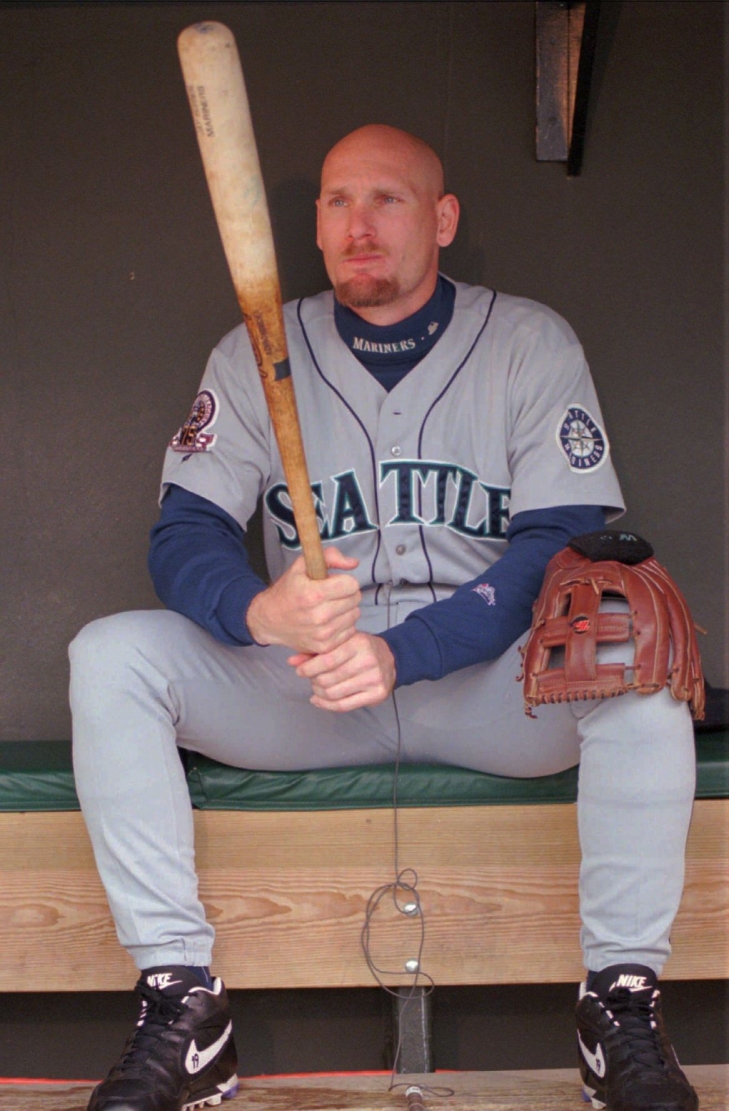
When learning that his son (erroneously) was dead from George Steinbrenner, Frank Costanza’s first response on Seinfeld was:
“What the hell did you trade Jay Buhner for? He had 30 Home Runs, over 100 RBIs last year! He’s got a rocket for an arm! You don’t know what the hell you’re doing!”
How could we not open with this?
Frank Costanza was entirely right. The infamous July 1988 trade that sent Jay Campbell Buhner from the Bronx to the Pacific Northwest in exchange for Ken Phelps—who was out of baseball just two years later—stands as one of the most lopsided structural blunders in modern baseball history. Arriving in Seattle with a fierce, unadulterated competitive edge, the man affectionately known as "Bone" completely transformed his professional identity. Across a celebrated 14-year residency, the charismatic slugger became the raw, emotional heartbeat, the ultimate clubhouse enforcer, and the definitive power anchor of the most iconic era in franchise lore.
His initial period in Seattle did not produce immediate, rapid muscle growth, as he adapted to the demands of major league pitching on a daily basis. The pivotal breakthrough occurred in the 1991 season, when he surpassed the 20-home-run mark for the first time. Buhner consistently engaged in deep counts, turning this approach into a disciplined daily routine, and maintained or exceeded the 20-homer threshold for four consecutive summers. During this time, he established himself as an essential protective presence in the batting lineup for a young Ken Griffey Jr.
The peak of his hardware-certified legacy in evolution unfolded over an impressive three-year period from 1995 to 1997. He systematically dismantled American League pitching during the historic 1995 regular season, hitting 40 home runs and producing 121 RBIs with a commendable .566 slugging percentage, thereby securing a remarkable fifth-place position in the American League Most Valuable Player voting.
He carried that high-leverage devastation directly into the 1995 postseason, smashing another four home runs during the club's legendary "Refuse to Lose" playoff run that saved baseball in Seattle. He followed that up by unleashing even greater raw power during the 1996 schedule, hammering a career-high 44 home runs and driving in a monster 138 runs, before launching another 40 long balls with 109 RBIs in 1997.
The primary area where Buhner encountered substantial challenges under rigorous analytical scrutiny was his high-volume volatility. He was an extraordinarily effortful hitter who twice led the American League in strikeouts, returning to the dugout a remarkable 1,406 times while playing for the Mariners. Defensively, although Frank Costanza was entirely correct regarding his exceptionally strong throwing arm, Buhner displayed limited speed and lateral agility, frequently recording a defensive bWAR with negative values. Notably, during the summer of 1996, when he received his sole Gold Glove Award, he concluded that season with a -0.7 dWAR, demonstrating that his renowned throwing ability often concealed his underlying defensive metrics.
Trying to measure Buhner's legacy only through cold analysis really overlooks why he's such a beloved figure in our local culture. With his iconic shaved head and goatee—a look that was pretty unique in the sport back then—he shared a genuine, mutual love with the fans. The front office beautifully tapped into this natural fan enthusiasm by creating "Buhner Buzz Cut Night," a popular event where thousands of fans got free tickets to the Kingdome just for letting team barbers shave their heads—highlighting the strong connection between him and the community.
Following a series of severe hamstring and knee ailments late in his career, a definitive exit arrived when Buhner retired at the conclusion of the historic 104-win 2001 regular season. He departed from the field, leaving behind a formidable statistical legacy predominantly concentrated in the upper-left region of the map: a robust .494 slugging percentage, 951 hits, and exactly 307 home runs—a total that still ranks third in franchise history behind only Griffey and Edgar Martínez. Buhner retired in 2001, having amassed notable statistics including 307 home runs and a .497 slugging percentage. The Mariners honored the esteemed player by inducting him into their Hall of Fame in 2004.
17. Nelson Cruz
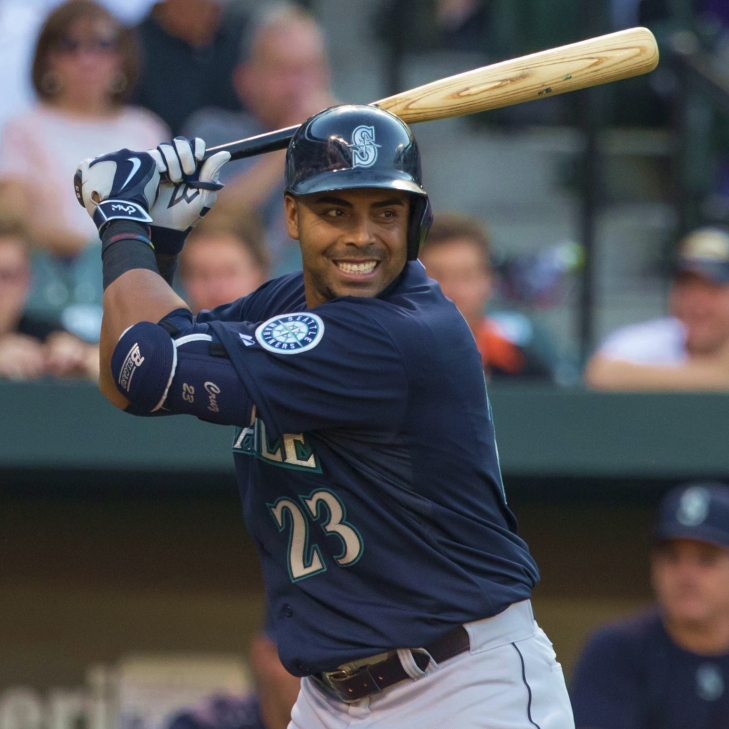
When recounting the history of raw strength in the Pacific Northwest, the story often highlights the early brilliance of players like Ken Griffey Jr. or Alex Rodriguez. However, one of the most formidable displays of power in Safeco Field's history came from a veteran who arrived in Seattle in his mid-30s. After winning the 2014 American League home run title during a remarkable 40-homer season with the Baltimore Orioles, Nelson Cruz signed a lucrative free-agent deal with the Mariners. Known as "Boomstick," this powerful right-handed hitter quickly silenced critics who questioned whether Seattle's large outfield gaps would limit his distance. Instead, he delivered a four-year showcase of explosive power, earning All-Star selections in three of those four seasons.
His first season under the Pacific Northwest clouds instantly shattered expectations, as he surpassed his Baltimore tally by launching a magnificent, career-high 44 home runs while batting a blistering .302.
Cruz made hitting moonshots into a regular nightly habit, consistently sending balls into the left-field stands. He reinforced this with an impressive 2016 season, hitting 43 home runs and driving in 105 RBIs, only the second time in his career he surpassed 100 RBIs.
By 2017, management shifted the veteran primarily to the designated hitter position to safeguard his health. This strategic change enabled an even greater level of offensive efficiency. During that summer, Cruz hit 39 home runs and led the American League with a remarkable, career-high 119 RBIs, earning his second Edgar Martínez Award.
He kept his elite frontline baseline through his final year with the organization in 2018, hitting 37 home runs and driving in 97 runs, which earned him his last of three All-Star selections as a Mariners player.
Facing an organizational rebuild, the 38-year-old left the Mariners to sign with the Minnesota Twins, extending his decorated career. Over four seasons with the Mariners, he totaled 670 hits, 163 home runs, and 414 RBIs, with a .284 batting average.362 on-base, and 546 slugging percentage.
6. Alex Rodriguez
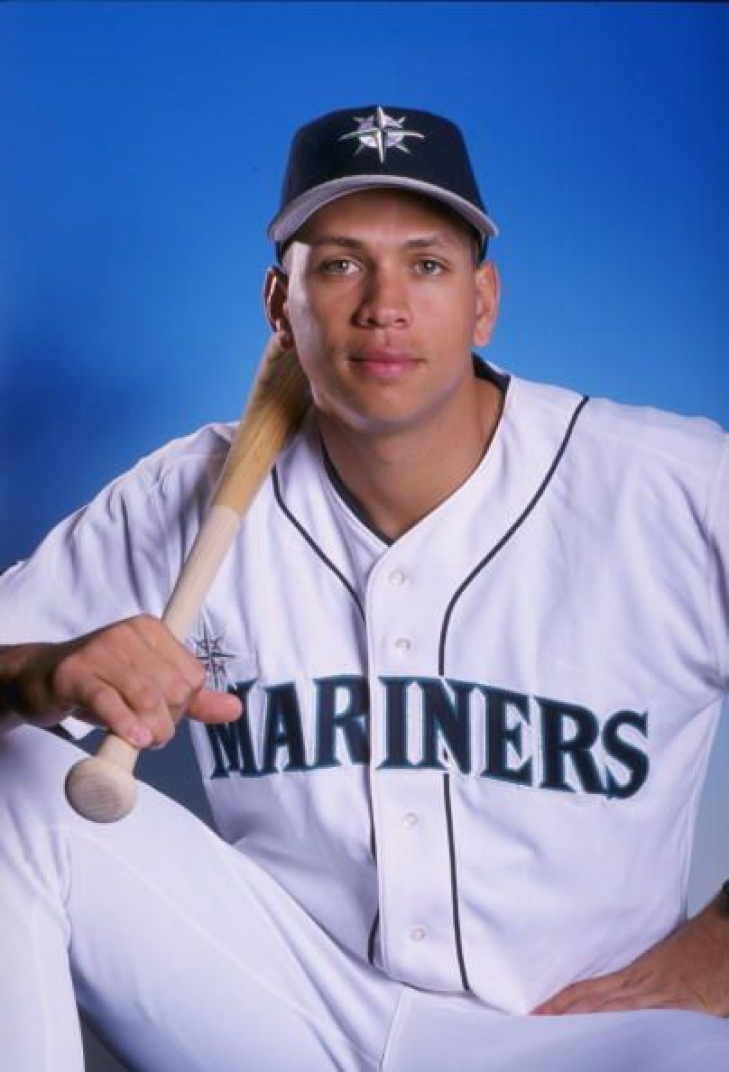
Before the global name recognition, the multi-million-dollar contracts, and the heavy storms of controversy defined his national profile, a generational prodigy in the Pacific Northwest put together arguably the greatest age-indexed start to a career in the sport's history. Selected first overall by the Seattle Mariners in the 1993 amateur draft, Alex Rodriguez was such an advanced physical specimen that he reached the major leagues as an 18-year-old infielder the following summer. Recognizing his immense ceiling, the front office allowed him to refine his daily routine in the minor leagues before unleashing him completely as the everyday starting shortstop in 1996. What followed was a blinding, high-velocity introduction that fundamentally transformed the modern expectation of his position.
His first full summer in Seattle was a remarkable display of offensive power and efficiency. At only 20 years old, Rodriguez dominated American League pitching to win the 1996 batting title with a stunning .358 average, becoming the third-youngest player to earn the title. He set the pace for the entire team, scoring 141 runs, hitting 54 doubles, and hitting 36 home runs while driving in 123 RBIs. This outstanding performance earned him a Silver Slugger Award, an All-Star selection, and a narrow second-place finish in the American League MVP voting.
Although his batting average slightly declined in 1997, he still achieved a .300 average with 23 home runs, earning another All-Star nod. His most notable power boost occurred in 1998, when he combined speed and strength effectively. That year, Rodriguez led the American League with 213 hits, hit 42 home runs, and stole 46 bases—signifying a major development in his game. With these stats, he became only the third player in baseball history to join the 40-40 club, using his sharp spatial awareness to outmaneuver catchers and pitchers. Advanced analytics strongly supported his top-tier status that summer, as he topped the American League in position-player bWAR.
He maintained that frontline authority through an injury-shortened 1999 season, hitting another 42 home runs in just 129 games. His last appearance in a Seattle uniform in 2000 was another exceptional performance; he hit 41 home runs, set a personal best with 100 walks, led the league in bWAR for the second time, and finished third in MVP voting.
To maintain a realistic narrative, Rodriguez faced heavy criticism for his postseason performance, yet his October appearances in the Pacific Northwest proved to be notably clutch. During his three full playoff series with the Mariners, he consistently batted over .300 in each, offering reliable performance during the sport's most significant moments.
Following the 2000 postseason, the inevitable business exit arrived. As a 25-year-old free agent, Rodriguez departed Seattle to sign a historic, record-breaking contract with the Texas Rangers, drawing a definitive curtain on his time in the Emerald City. With Seattle, Rodriguez compiled 966 hits, 189 home runs, and 595 RBIs alongside an exceptional .309/.374/.561 slash line in 794 games.
1. Ken Griffey Jr.
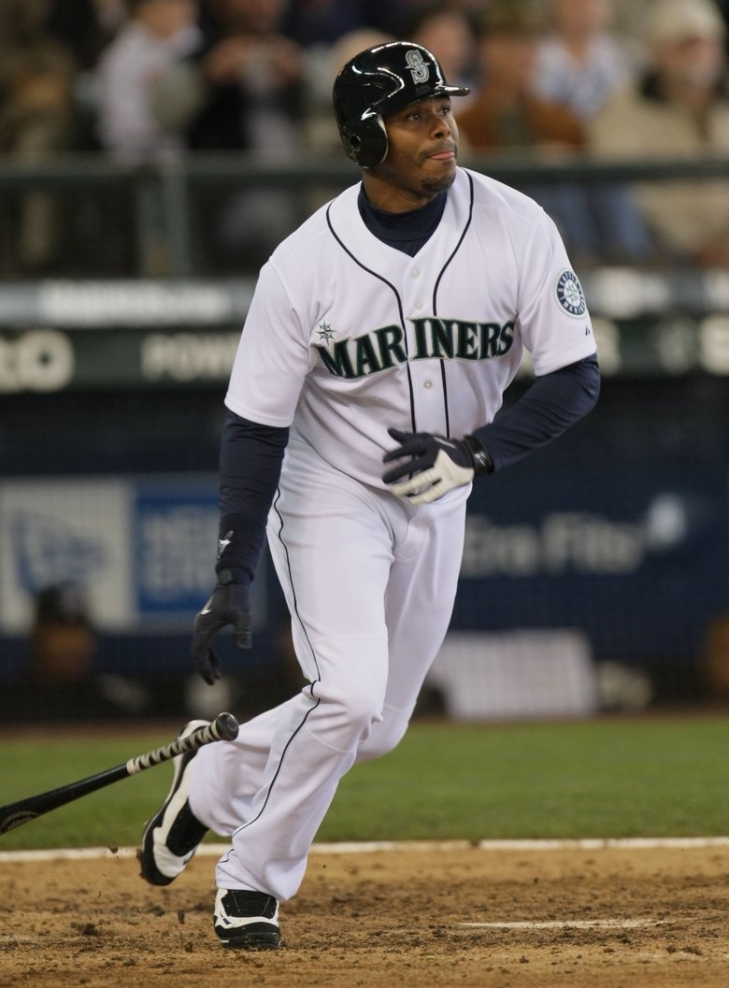
Examining the history of the Seattle Mariners often sparks debate around a trio of legendary figures who shaped different baseball eras in the Pacific Northwest. While Edgar Martinez's consistent drive and Ichiro Suzuki's groundbreaking global influence are notable, the ultimate pinnacle of individual achievement points to one undisputed leader. Ken Griffey Jr. was more than just a Mariners player; he was instrumental in revitalizing baseball in Seattle. As the son of three-time All-Star Ken Griffey Sr., "The Kid" was naturally groomed for greatness, blending a natural talent with a charismatic, backward-cap flair that made the Pacific Northwest a hub of youth culture. With what is arguably the most elegant and fluid left-handed swing in the sport, Griffey was selected first overall in 1987 and made his MLB debut at 19 in 1989. His initial season saw a promising 16 home runs, but it was only the beginning of a decade of nationwide dominance.
The 1990s were dominated by Ken Griffey Jr. During that decade, he transformed the expansive Kingdome into his own stage, earning an All-Star selection each summer. He exemplified the five-tool player.
As a pure hitter, his bat control and spatial awareness led him to surpass the coveted .300 batting average seven times during his time with Seattle. As a power hitter, he consistently overwhelmed American League pitching staffs, winning four home run titles and recording six seasons with at least 40 home runs.
His exceptional run production was extraordinary; he achieved seven 100-RBI seasons, including a renowned four-year period from 1996 to 1999 where he never had fewer than 134 RBIs each season. This consistent offensive performance earned him seven Silver Slugger Awards and made him the most recognizable and universally loved athlete worldwide.
His ultimate evolutionary peak occurred during a stunning 1997 regular season. Griffey showcased pure dominance, leading the majors with 125 runs, 56 home runs, and 147 RBIs, while hitting an impressive .646 slugging percentage, earning him the American League Most Valuable Player Award unanimously. His relentless, high-velocity playmaking carried the Mariners to a division title, and his internal excellence was so consistent that he secured six additional top-ten finishes in the AL MVP balloting over his residency.
However, concentrating solely on his offensive output only tells part of the story. In center field, Griffey transformed defensive play with his exceptional closing speed and a fearless approach to his safety, often leaping over concrete walls to prevent home runs. His defensive skill earned him 10 straight Gold Glove Awards from 1990 to 1999, solidifying his reputation as a versatile and outstanding player.
Furthermore, his high-velocity instincts made him a formidable threat on the basepaths, swiping 167 bases in a Mariners uniform and executing the single most meaningful run in franchise history, sliding across home plate to score from first on Edgar Martinez's "The Double" in Game 5 of the 1995 ALDS.
However, all historical eras eventually reach a definitive career end. Prior to the 2000 campaign, desiring to play closer to his family's hometown, Griffey requested a change of scenery. The front office engineered a landscape-shifting trade to the Cincinnati Reds, and while the Mariners received a package that lacked a superstar of his singular magnitude, Griffey’s physical tools began to undergo an accelerated, injury-hampered decline away from the evergreen state.
He ultimately returned to his true baseball home in 2009, logging two sentimental final seasons in Seattle before executing a quiet walk away from the game in the summer of 2010
You can look at others like Ichiro Suzuki or Edgar Martinez for this top spot, and we did. However, when it was all said and done, nobody on this team was this great for this long. As of this writing, Ken Griffey Jr. is the all-time franchise leader in bWAR (70.6) and Home Runs (417), and he owns a Slash Line of .292/.374/.553.
The Mariners inducted Griffey Jr. into their franchise Hall of Fame in 2013, and three years later, the team retired his number 24. He was also inducted into the Baseball Hall of Fame on his first try that same year.
29. Floyd Bannister
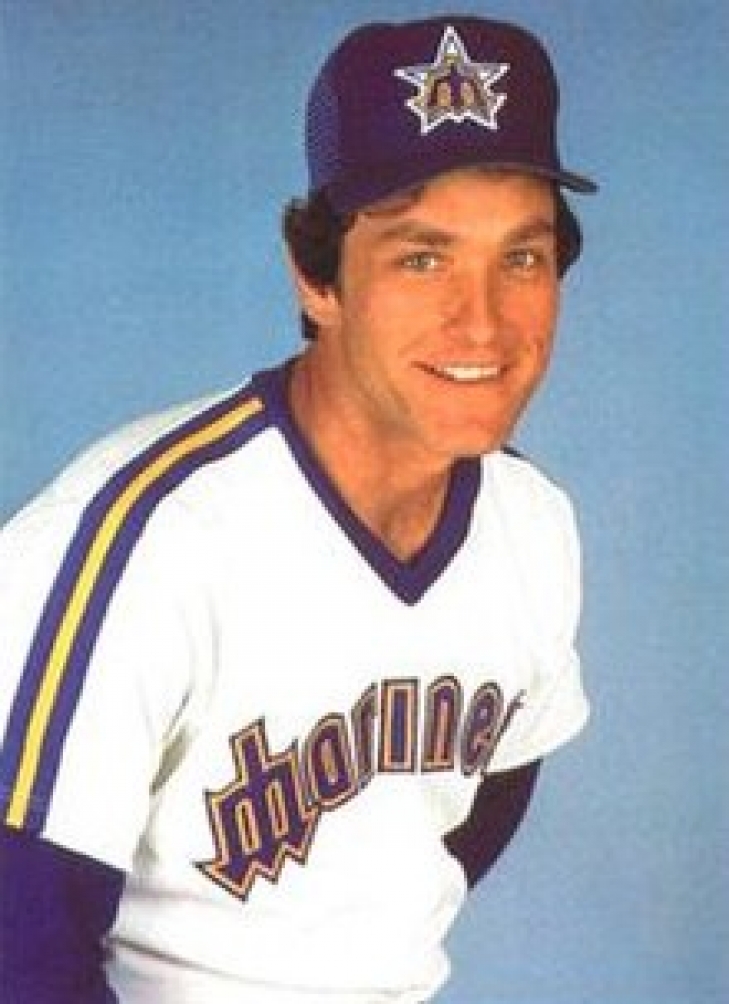
Floyd Bannister had already carried sky-high expectations as the Houston Astros’ number-one overall draft pick in 1976. After two up-and-down developmental seasons in Texas, the Mariners front office made a crucial trade in January 1979 to bring the Seattle-area high school phenom back home to the Pacific Northwest. Stepping directly into the top tier of manager Darrell Johnson’s starting rotation, Bannister instantly provided a struggling, third-year expansion roster with a dynamic power arm that commanded respect around the league.
Bannister’s four-year residency in the Emerald City was defined by a heavy, rising fastball and a sharp, devastating curveball that routinely baffled opposing lineups. Because the early Mariners rosters were plagued by a lack of run support and defensive inconsistencies, his surface win-loss numbers suffered, resulting in a deceptive 40–50 record across his tenure. However, advanced metrics revealed a far different reality; Bannister was a highly competent, high-volume anchor who consistently chewed up frames in the hitter-friendly Kingdome, logging back-to-back seasons of at least 217 innings pitched while maintaining a stingy 3.75 ERA that kept a young team afloat.
His individual masterpiece arrived during the historic 1982 campaign, a summer when his raw potential translated into era-defining dominance. Bannister caught fire under manager Rene Lachemann, taking the ball in 35 high-intensity starts and throwing 247 masterful innings. He weaponized his signature swing-and-miss stuff to lead the entire American League, racking up a career-high 209 strikeouts and securing the league's strikeout crown. That spectacular performance earned him a well-deserved selection to his first and only Major League Baseball All-Star Game, validating his standing as one of the premier left-handed power arms in the junior circuit.
While his high-strikeout efficiency made him a marquee attraction for local fans, the financial realities of a small-market expansion club ultimately cut his hometown stay short. Following his spectacular, award-winning 1982 showcase, Bannister tested the open market as a highly coveted free agent, parlaying his elite Seattle resume into a lucrative multi-year contract with the Chicago White Sox. He would immediately help guide Chicago to a division title the following winter and embark on a highly successful 15-year big-league career across multiple organizations.
Bannister walked away from the Kingdome mound having logged 118 appearances for the organization, accumulating 564 strikeouts and 24 complete games.
22. Dan Wilson
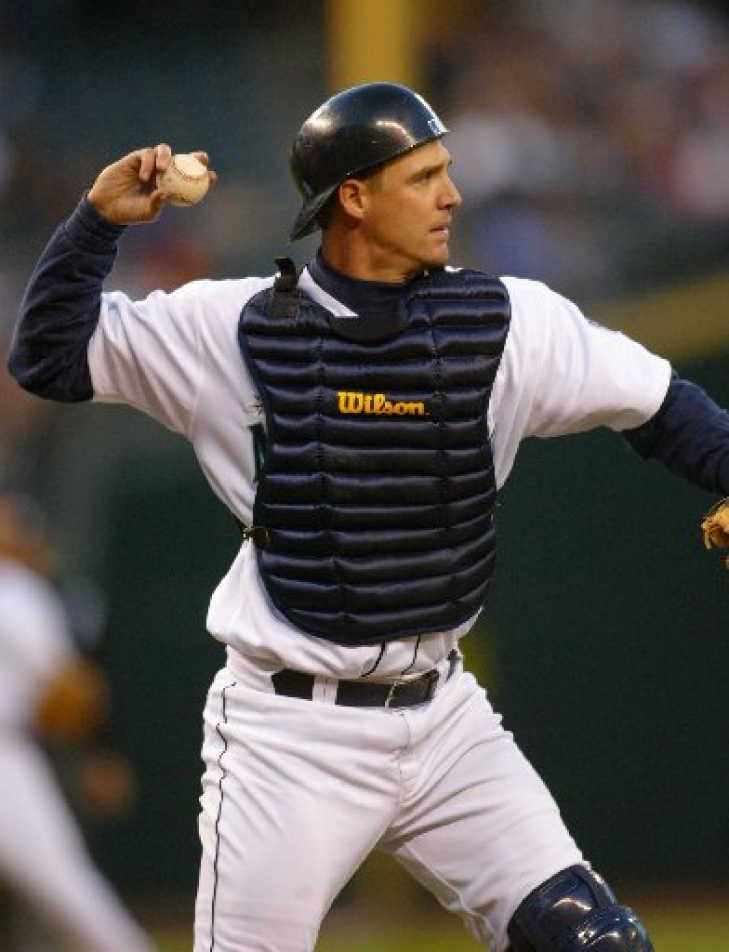
Acquired by the Cincinnati Reds through a strategic trade in December 1993, Daniel Allen Wilson promptly established himself as an indispensable presence in the Pacific Northwest. Widely esteemed for his exceptional game-calling skills, superior footwork, and meticulous preparation, he became the preferred safety net for renowned pitchers such as Randy Johnson and Jamie Moyer, confidently managing the most challenging pitching staffs in the league.
Wilson was openly a contact-focused hitter at the plate, with advanced metrics often limited by a modest .309 career on-base percentage. However, his main value was never about offensive flash; it was rooted in his defensive excellence, which set the standard for his era.
Wilson delivered a standout performance during the regular season by effectively stopping opposing running games. He led the American League in caught stealing twice, with 38 in 1995 and 41 in 1997. Additionally, he frequently ranked among the league's top catchers in defensive range factor per game and fielding percentage. He retired holding the highest career fielding percentage ever recorded by a catcher in American League history at that time.
Although known for his defensive mastery, he also showed he could deliver powerful hits when everything was right. His peak offensive season was in 1996, a year marked by awards and excellence. That summer, Wilson made checking inside fastballs and exploiting mistakes a daily habit, hitting a career-high 18 home runs and 83 RBIs, with a strong .285 batting average. This outstanding performance earned him his only Major League All-Star selection, confirming his status as a comprehensive and elite catcher.
He demonstrated remarkable durability during his 12 summers in the Emerald City, playing in 1,251 games and earning exactly 1,071 hits for the franchise. His career was ultimately cut short by a severe knee injury in 2005, ending his highly decorated playing journey.
Wilson’s legacy with the organization has culminated in a significant second act. As a proud Hall of Famer with the Seattle Mariners alongside Randy Johnson, he made a striking return to the big leagues as the club's manager in August 2024.
26. John Olerud
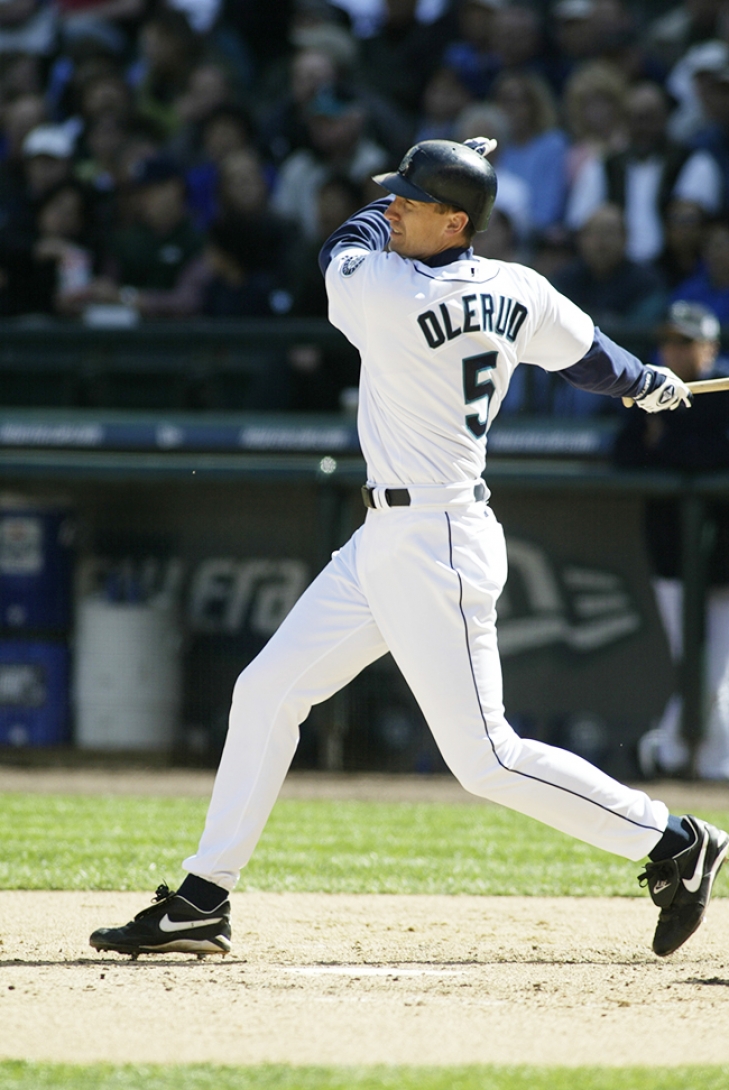
By December 1999, when John Olerud became a free agent, his achievements were already outstanding. He had secured an American League batting title and earned two consecutive World Series championships with Toronto, followed by three highly effective seasons with the New York Mets. However, the pull of returning to his roots in the Pacific Northwest—where he had established himself as a legendary, multi-talented All-American at Washington State University—was too strong. The Seattle Mariners signed the graceful first baseman to a three-year deal, aligning his arrival to replace star Ken Griffey Jr., and to help stabilize a franchise nearing an unprecedented competitive phase.
Olerud’s homecoming immediately yielded defensive dividends that national writers had long overlooked during his time on the East Coast. Standing a flexible 6-foot-5, his pristine positioning, soft hands, and uncanny ability to scoop off-target throws turned the Seattle infield dirt into an absolute clinic. In his inaugural summer with the club in 2000, he captured his first career Gold Glove Award, an accolade he would win twice more in 2002 and 2003. He transformed first base defense into an art form, providing a vital safety net for a star-studded coaching staff and a young pitching core that relied heavily on his level-headed execution.
Olerud's impeccable glove established a perfect baseline, but his flawless left-handed swing remained a powerful weapon in Lou Piniella's lineup. His technique reached a remarkable peak during the notable 2001 and 2002 seasons. In those summers, he consistently maintained above a .300 batting average while displaying a top-tier, walk-focused approach that kept his on-base percentage over .400. He combined disciplined plate discipline with an unexpected increase in raw power, hitting exactly 21 home runs in 2001 and 22 in 2002.
His outstanding 2001 regular season was the driving force behind a historic roster that captivated the baseball world. Olerud played all 159 games, driving in 95 runs and achieving a remarkable 136 OPS+, leading a lineup that set an American League record with 116 wins. That summer, he received his only career American League All-Star nod, reinforcing his role as the steady, professional core of the most dominant regular-season team of the modern era.
The veteran finally faced the effects of aging and ongoing lower-body problems during the 2004 season. His offensive stats declined sharply, and as the Mariners shifted to a younger roster, the front office decided to release the popular first baseman in July. He had brief stints with the Yankees and Red Sox before retiring, ending a highly successful 17-year Major League career.
Olerud walked away from Safeco Field having compiled 709 hits, 72 home runs, and a phenomenal .285/.388/.439 slash line across his 717 games in a Mariners uniform.
25. Mike Cameron
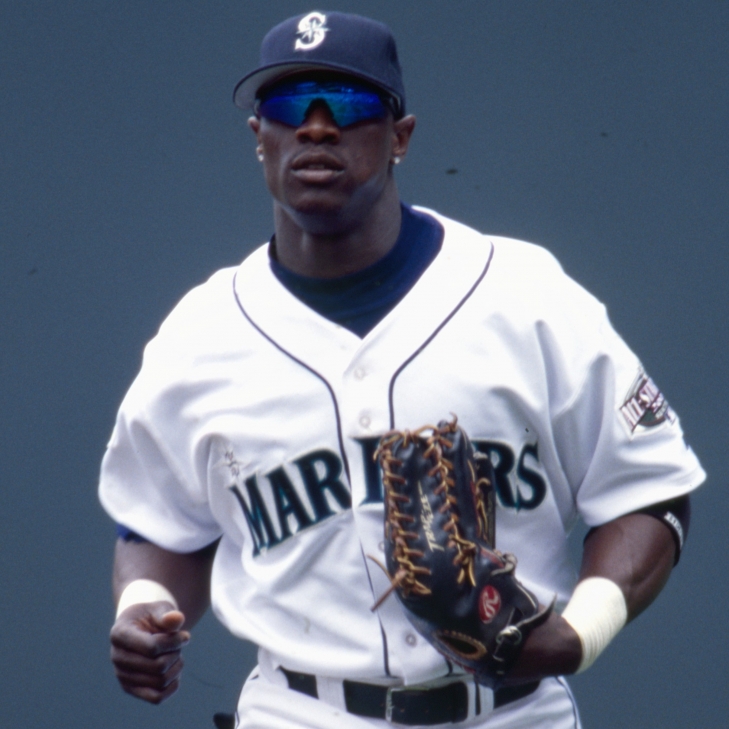
The February 2000 trade of Ken Griffey Jr. from the Seattle Mariners to the Cincinnati Reds is remembered as a major emotional moment. The team faced the challenge of replacing a legend central to Pacific Northwest baseball. The deal included four players, with an athletic center fielder given the keys to Safeco Field's gaps. While Mike Cameron couldn't replicate the iconic style or star power of his predecessor, he reassured critics by providing top-tier defense and power at the plate. Over four seasons, he delivered a highly productive, award-winning tenure, fueling the best regular-season team in American League history.
Cameron adjusted to his fresh surroundings by turning in a highly consistent offensive display, racking up 145 hits, 19 home runs, and 24 stolen bases.
He followed that achievement by creating a remarkable, career-defining masterpiece during the historic 2001 regular season, which saw 116 wins. That summer, Cameron made hitting line drives and driving in runs a routine part of his daily practice. He systematically challenged junior circuit pitching, hitting 25 home runs, stealing 34 bases, and amassing a career-high 110 RBIs along with scoring 99 runs. This outstanding performance secured his only Major League All-Star selection, establishing him as a complete, top-tier catalyst.
He consistently delivered dependable production over the next two summers, hitting another 25 home runs with 31 stolen bases in 2002. He then hit 18 home runs in the 2003 season. Notably, he made history on a memorable May afternoon in 2002 by becoming only the 13th player in major league history to hit four home runs in a single game. This remarkable feat included back-to-back home runs with Bret Boone twice in the first inning against the Chicago White Sox.
While his power was an important asset, his true value was rooted in his elite defensive skills on the grass. Cameron patrolled center field with remarkable lateral agility and an excellent sense of timing, earning two American League Gold Glove Awards(2001 and 2003) with the Mariners, establishing himself as one of the top outfielders of his time.
To be fair, analyzing his profile requires acknowledging severe contact leaks from his aggressive approach. He was strikeout-prone, with more whiffs (601) than hits (554) during his time in the Pacific Northwest.
Following the 2003 campaign, the veteran hit free agency and signed a multi-year deal with the New York Mets. In 610 games with the Mariners, he recorded 554 hits, 115 doubles, 87 home runs, 344 RBIs, and 106 stolen bases.
21. Harold Reynolds
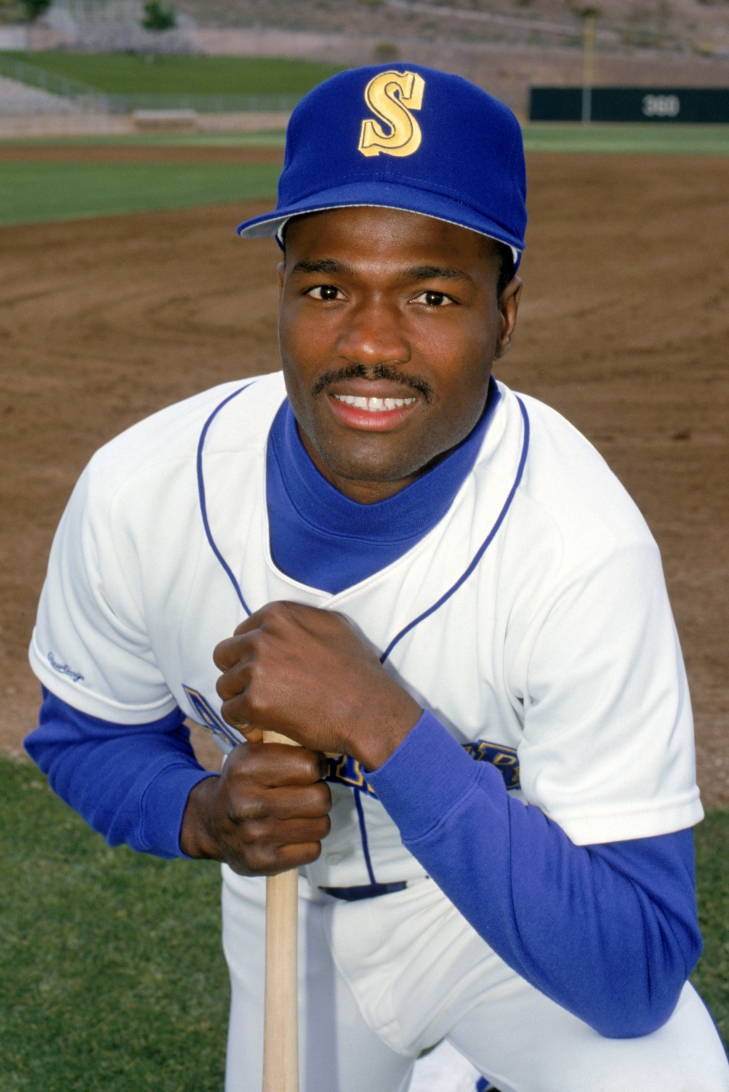
Creating a historical profile of the early, pre-Pennant era of the Seattle Mariners typically highlights the fluid roster changes inside the Kingdome. However, well before the franchise became a mid-90s cultural phenomenon centered on Ken Griffey Jr. and Edgar Martinez, a charismatic and energetic second baseman had already become the team's spirited and competitive core.
The front office clearly saw great potential when they chose Harold Reynolds with the second overall pick in the secondary phase of the 1980 draft. Although his early years involved a careful, gradual development, his full-time spot in the starting lineup by 1986 truly changed the team’s speed and defensive strength. He wasn't a power hitter, but his quick reactions and smart base-stealing made him a beloved and iconic figure in the Pacific Northwest.
His genuine national breakthrough came during the 1987 campaign, marking the beginning of an era where he regularly set the pace for top-of-the-order speed. Reynolds made tracking pitches and outrunning typical infield throws look effortless. That summer, he led the American League with an impressive, career-high 60 stolen bases—becoming the only player other than Rickey Henderson to win an American League stolen base crown during the entire 1980s decade.
He exemplified this achievement in 1988 by leading the junior circuit with 11 triples, thereby earning his second consecutive selection to the All-Star Game. His offensive development culminated during the 1989 season, where he refined his technique to achieve a batting average of exactly .300 with a personal record of 184 hits.
His impressive speed constantly kept opposing catchers on their toes, but it was his outstanding defensive range at second base that truly defined his value. Reynolds combined remarkable lateral agility with exceptional hand-eye coordination, turning second base into his own fortress. He earned three straight American League Gold Glove Awards from 1988 to 1990, showing his dedication and hard work by leading all junior circuit second basemen in assists five times and putouts three times. Advanced defensive metrics strongly support the high quality of his coverage, highlighting him as a two-time league leader in Total Zone Runs among second basemen.
Beyond the lines, his pure character and unwavering dedication to public service truly left a lasting mark in the local community. Reynolds was loved and respected by his peers and fans alike, earning a glowing reputation that reached worldwide when he was proud to receive the prestigious Roberto Clemente Award in 1991.
A business departure after the 1992 campaign marked a shift to a youth movement. The veteran infielder became a free agent, played for the Orioles and Angels, then moved into a notable broadcasting career. Across ten seasons with the Mariners, he had 1,063 hits, 186 doubles, 44 triples, and 228 stolen bases.
16. Bret Boone
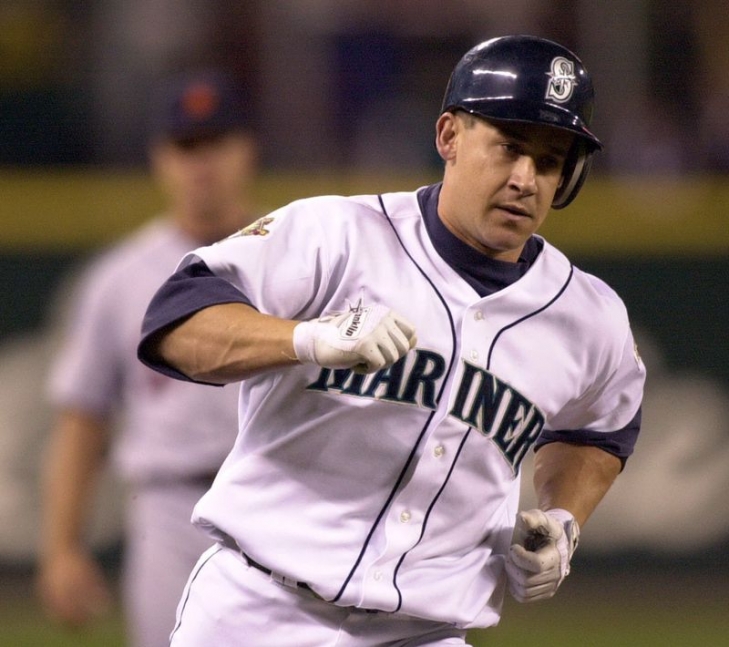
When family history is closely linked to the story of a sport, reaching the top level comes with its own special set of expectations. Bret Robert Boone didn’t just build a career in professional baseball; he made history the moment he stepped onto the field, becoming the game's first-ever third-generation Major League player after his grandfather Ray and his father Bob. Drafted by the Seattle Mariners in 1990 from USC, the passionate and intense second baseman had a strong, muscular build and a powerful right-handed swing. Although his early days in the Pacific Northwest were brief and like a short learning experience before he moved on, his return nearly a decade later sparked an incredible offensive outburst — one of the most remarkable for a middle infielder in recent times.
His 1992-1993 seasons with the Mariners showed flashes of power, with a then-record 12 home runs by a second baseman in 1993, but he lacked defensive polish and consistency to secure a regular role. The team traded him to Cincinnati, where he became a regular and a 1998 All-Star. After brief stops in Atlanta and San Diego, Boone hit the market before 2001 and made a dramatic free-agent return to Seattle, significantly impacting the junior circuit.
That unforgettable 2001 season truly marked the peak of his career on the field. With his team on the verge of tying the Major League record with 116 wins, Boone delivered an incredible offensive display that was a true joy to watch. He swept through American League pitching, setting personal bests in every category- 206 hits, 37 doubles, and 37 home runs across 158 games. Consistently driving in runs, he led the league with 141 RBIs and posted a impressive .331/.372/578 line. His outstanding performance earned him a spot in the All-Star Game in front of the cheering home crowd at Safeco Field, along with a Silver Slugger Award and a third-place finish in the AL MVP voting.
Boone proved he wasn't just a flash in the pan, sustaining his powerful presence in the middle of the lineup over the next two seasons. His strength was undeniable as he crushed 24 home runs and drove in 107 RBIs in 2002. He continued to shine in 2003, earning his third All-Star selection and his second Silver Slugger award, thanks to his impressive 35 home runs, 111 runs scored, and 117 RBIs — making him only the third second baseman in modern baseball to achieve three straight 100-RBI seasons. On the defensive side, Boone also excelled, earning three straight American League Gold Glove Awards from 2002 to 2004.
Advanced analytical filters heavily dispute those raw golden accolades—noting that his limited lateral range and poor positioning often yielded a negative defensive bWAR—but his high-profile positioning and flawless fielding percentage routinely swayed the voters.
After his power dropped to 24 home runs in the 2004 season, he experienced a severe mechanical breakdown in the first half of 2005. Struggling through a painful .221 batting average with only seven home runs over 74 games, the front office decided to move on in July, trading the veteran to the Minnesota Twins.
Boone would collect 863 hits, 152 doubles, 143 home runs, and 534 runs batted in over his Mariners career.
23. Erik Hanson
Drafted by the front office in the second round of 1986 from Wake Forest, Erik Hanson was a tall 6'6" right-hander who appeared to be a true frontline pitcher. With a powerful fastball and a sharp, effective 12-to-6 curveball, he quickly advanced through the minors to join a notable group of young Seattle pitchers. Although his major-league career experienced significant ups and downs, his peak performance provided local fans with an extended view of an elite starting pitcher.
His introductory seasons, as a regular rotation member across 1988 and 1989, offered promising hints of his raw stuff, but everything finally aligned to produce a regular-season masterpiece in 1990. Hanson turned freezing American League hitters with his signature breaking ball into a nightly routine. That summer, he put on an unadulterated clinic in durability, finishing with a brilliant 18–9 record, a sparkling 3.24 ERA, and a career-high 211 strikeouts over 236.0 heavy frames. Advanced efficiency metrics strongly validate the frontline quality of this peak, as his superb 5.0 pitching bWAR ranked seventh among all junior circuit moundsmen, while his 1.16 WHIP placed him fourth in the league.
Maintaining that elite standard was very difficult as he encountered major performance problems and physical setbacks in the subsequent summers. Hanson was named the club's Opening Day starter in 1991, but his control issues resulted in an 8–8 record. The lowest point of his time in Seattle came during a frustrating 1992 season, when his effectiveness declined sharply under a heavy workload, culminating in a tough 17 losses compared to only 8 wins in the American League.
Although he delivered an impressive comeback in 1993 with 11 wins and a solid 3.47 ERA over 215.0 innings, the front office became more concerned about the long-term financial commitments.
Seeking a structural reset for the staff, management initiated a definitive business exit that winter, trading the 28-year-old starter to the Cincinnati Reds in exchange for a package centered around infielder Bret Boone. With Seattle, he accumulated a 56–54 record, 143 starts, and 614 strikeouts,
7. Jamie Moyer
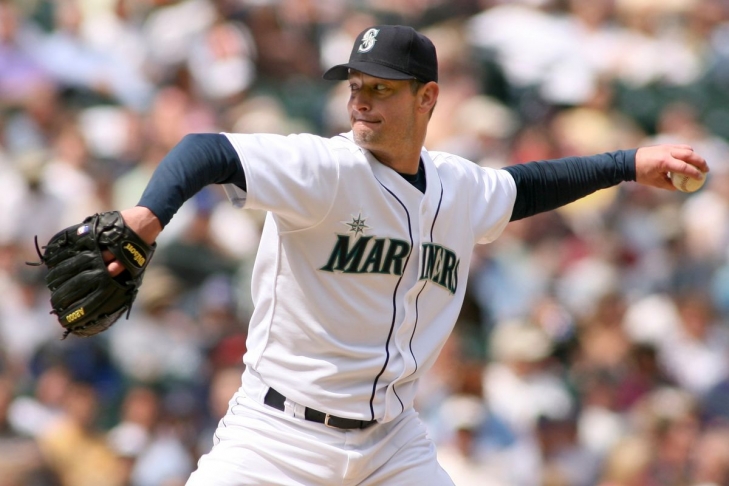
While some pitchers treat the mound like a launching pad for raw velocity, a master of deception and precision proved that the art of change-of-speed can completely dismantle big-league offenses for decades. Jamie Moyer constructed an astonishing 25-year major league career, spending his first ten seasons drifting through five different organizations as a respectable but somewhat unfulfilled arm. That narrative was permanently altered during the summer of 1996, when the Seattle Mariners acquired the left-hander from the Boston Red Sox in a trade-deadline deal. Arriving in the Pacific Northwest at age 33, Moyer didn't just find a new team; he unlocked the most dominant, volume-dense chapter of his life on the diamond, orchestrating a masterful decade of pitch sequencing that left American League hitters thoroughly exasperated.
His debut in the starting rotation served as a masterclass in quick tactical adjustments. In his first full summer with the Mariners in 1997, Moyer puzzled opponents by consistently hitting the corners of the strike zone, posting an impressive 17–5 record with a 1.178 WHIP. Instead of a fleeting peak, this soft-throwing southpaw made steady performance a daily habit under the roofs of Kingdome and Safeco Field.
He consistently surpassed the 15-win mark four times for Seattle, highlighted by consecutive 20-win seasons later in his tenure. He achieved an impressive 20–6 record during the historic 2001 team's 116-win season, and in 2003, he added a remarkable 21–7 regular-season record. Moyer operated with a fastball that barely breached the low 80s, yet his profound spatial awareness and lethal changeup allowed him to miss barrels entirely, accumulating 1,239 strikeouts during his tenure in a Mariners uniform.
Naturally, his hardware-certified authority deep in the counts drew extensive national recognition. Moyer captured three top-six finishes in the American League Cy Young Award balloting during his Pacific Northwest peak, finishing fifth in 1998, fourth in 2001, and fifth in 2003. His spectacular 2003 season also earned him his first career All-Star selection, but his lasting legacy that summer was forged by his immense character off the field. He put together an unprecedented clean sweep of baseball's most prestigious humanitarian honors, capturing the Lou Gehrig Memorial Award, the Hutch Award, and the Roberto Clemente Award for his profound community service and charitable foundations. He backed up that legacy by earning the Branch Rickey Award the very next autumn.
Moyer was traded to the Philadelphia Phillies during the 2006 season, and at age 45, he would help them win the World Series. As a Mariner, he went 145-87 in 2,093 Innings Pitched. The M's would induct Moyer into their Hall of Fame in 2015.
5. Randy Johnson
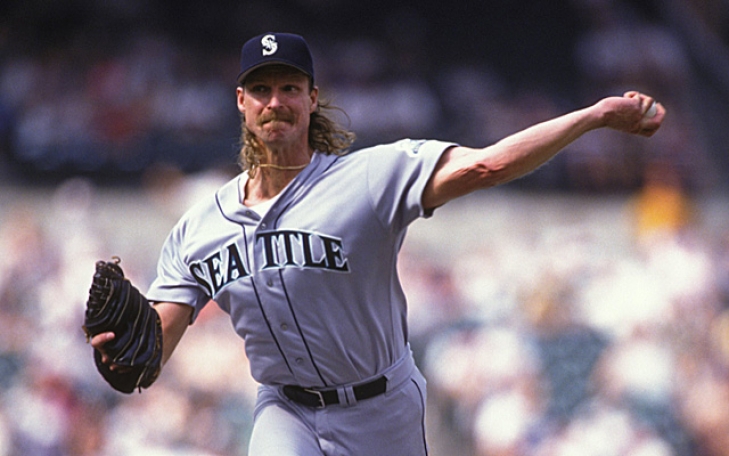
The Montreal Expos made what turned out to be a monumentally shortsighted decision when they traded a raw, erratic, 6-foot-10 left-hander to the Seattle Mariners early in the 1989 season. Randy Johnson was a literal and figurative giant on the mound, but his early years in the Pacific Northwest were defined by a frustrating paradox: an unhittable fastball paired with a complete lack of mechanical control. The "Big Unit" possessed an intimidating, low-three-quarters release point that terrified left-handed hitters, but he spent his first few seasons continuously fighting his own massive frame to find the strike zone.
His first full summer in Seattle in 1990 provided an immediate glimpse of this volatile baseline, as he earned All-Star selection and won 14 games with 194 strikeouts while leading the American League with 120 walks.
The pattern intensified over the subsequent two years. Johnson accumulated 228 strikeouts in 1991 and 241 in 1992; however, his inconsistent mechanics led to a significant number of free passes, totaling 152 and 144, respectively. Nevertheless, the 1992 season represented a pivotal moment; despite issuing walks, he secured his first American League strikeout title, beginning a formidable four-year dominance atop the leaderboard.
The legendary trajectory of his career was altered permanently in late 1992, thanks to a legendary dugout intervention by fellow power-pitcher Nolan Ryan and Mariners pitching coach Tom House. Ryan suggested a slight mechanical adjustment to Johnson’s landing foot to align his body toward home plate. The results were instantaneous and dramatic. By the spring of 1993, the Big Unit had harnessed his high-velocity arsenal. He emerged as a terrifyingly efficient frontline ace, winning 19 games and becoming the first Mariner to eclipse the 300-strikeout milestone with a spectacular 308 punchouts.
His newfound command culminated in a historic, award-winning 1995 campaign that carried the Mariners into the national spotlight. Johnson secured his first career American League Cy Young Award by orchestrating an incredible 18–2 record, pacing the league with a microscopic 2.48 ERA. His advanced efficiency metrics were entirely unrivaled; he dominated the league with a 1.045 WHIP and a 2.08 FIP, culminating in a legendary, heroic relief appearance in Game 5 of the American League Division Series against the Yankees to secure Seattle’s first postseason series victory.
While a severe back injury sidelined him for most of 1996, he rebounded with a magnificent 1997 showcase, winning 20 games with 291 strikeouts to anchor another postseason berth. However, by the summer of 1998, with free agency looming and relations with ownership souring, his performance temporarily dipped. Recognizing an impending career exit, the front office traded its iconic ace to the Houston Astros at the July deadline.
If there is a criticism of Johnson as a Mariner, it was that he was 0-6 for Seattle in the playoffs. While it is not relevant here, he did shake his post-season demons with the Arizona Diamondbacks in 2001.
Johnson was inducted into the Baseball Hall of Fame in 2015, three years after the Mariners selected him to their Hall of Fame.
3. Ichiro Suzuki
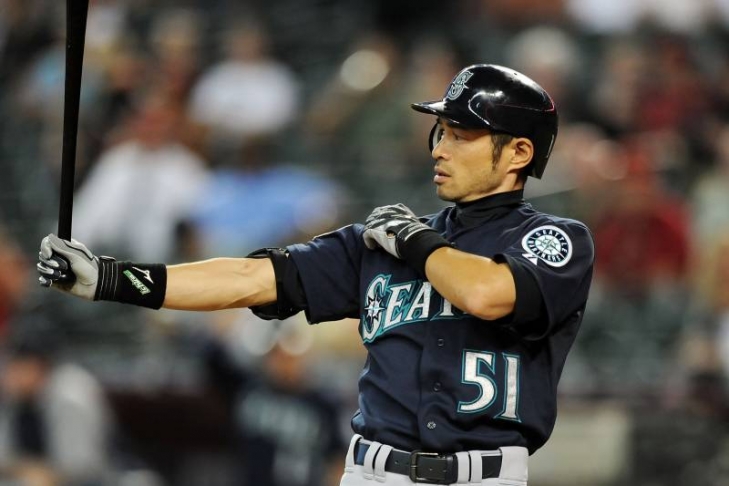
When establishing a historical hierarchy for the Seattle Mariners, the discussion at the apex of the leaderboards will invariably feature a trio of distinguished, localized deities. Whilst Ken Griffey Jr. exemplifies the utmost athletic excellence and Edgar Martinez signifies an enduring career-long presence, the right-field corner at T-Mobile Park was comprehensively dominated by a global cultural phenomenon who redefined the mechanical limits of professional hitting. Ichiro Suzuki did not merely play baseball in the Pacific Northwest; he transformed the simple act of singles into a high-velocity, highly watchable regular-season spectacle. Arriving in the United States in 2001 as a 27-year-old superstar from the Orix BlueWave, he encountered significant national skepticism from critics who openly questioned whether his slender frame and incisive style could endure Major League Baseball competition. He responded by orchestrating arguably the most explosive introductory campaign in the history of the sport.
His outstanding 2001 summer season was a remarkable demonstration of elite contact skills and exceptional speed. Ichiro systematically dismantled American League pitching staffs, leading the league with a remarkable .350 batting average, 56 stolen bases, and an impressive 242 hits. His persistent playmaking served as the primary engine driving a historic Mariners team that tied the major league record with 116 victories. Naturally, his exceptional individual performance earned him both the American League Rookie of the Year and the Most Valuable Player Award, making him only the second player in baseball history to attain both honors in the same season. Although that remained his sole MVP award, he spent the following decade amassing hits at a nearly supernatural pace.
From 2001 through 2010, Ichiro established the 200-hit milestone as a rigorous, daily routine, achieving 10 consecutive seasons with at least 200 hits and a .300 batting average, thereby setting an all-time Major League record for consecutive 200-hit seasons. In 2004, Ichiro demonstrated exceptional bat control, breaking George Sisler’s 84-year-old single-season record by accumulating an extraordinary 262 hits and securing his second career batting title with an impressive .372 average.
Opposing defenses were completely fractured by his unique, pre-swing pendulum motion and his ability to begin sprinting toward first base before the ball even left his bat. Yet, focusing entirely on his offensive volume tells only half the story. Weaponizing elite closing speed and a telepathic tracking ability, Ichiro converted the right-field grass into a strict no-fly zone, capturing 10 consecutive Gold Glove Awards from 2001 through 2010.
His throwing arm was a literal cannon, permanently frozen in Pacific Northwest lore after he unleashed a high-velocity, no-hop rocket to third base to nail Terrence Long during his rookie season—a sequence affectionately dubbed "The Throw."
A ten-time All-Star and three-time Silver Slugger in a Seattle uniform, he remained a lethal threat on the basepaths by swiping 438 bases during his first stint with the franchise; however, nothing lasts forever.
By the middle of the 2012 campaign, with his offensive metrics experiencing a natural, age-related dip and the Mariners fully committed to a youthful roster rebuild, Ichiro recognized that his presence was inadvertently blocking the development of the club's next generation. Showing immense grace, he quietly approached team executives during the All-Star break to request a trade. This was granted, and Ichiro would become a New York Yankee, but this was not the end of his story in Seattle.
He came back as a 44-year-old Free Agent in 2018, playing 15 Games while only batting .205. In May of that year, he would move to the Mariners Front Office, but made a special return in the first two games of 2019, which were held in Japan, allowing him to have the proper sendoff that a player of his stature deserved.
He left Seattle with a batting average of .321 and is the all-time franchise leader in that metric as well as hits (2,542) and stolen bases (438). In 2022, Ichiro was inducted into the Mariners Hall of Fame, and in 2025, he was chosen for the Baseball Hall of Fame.
2. Edgar Martinez
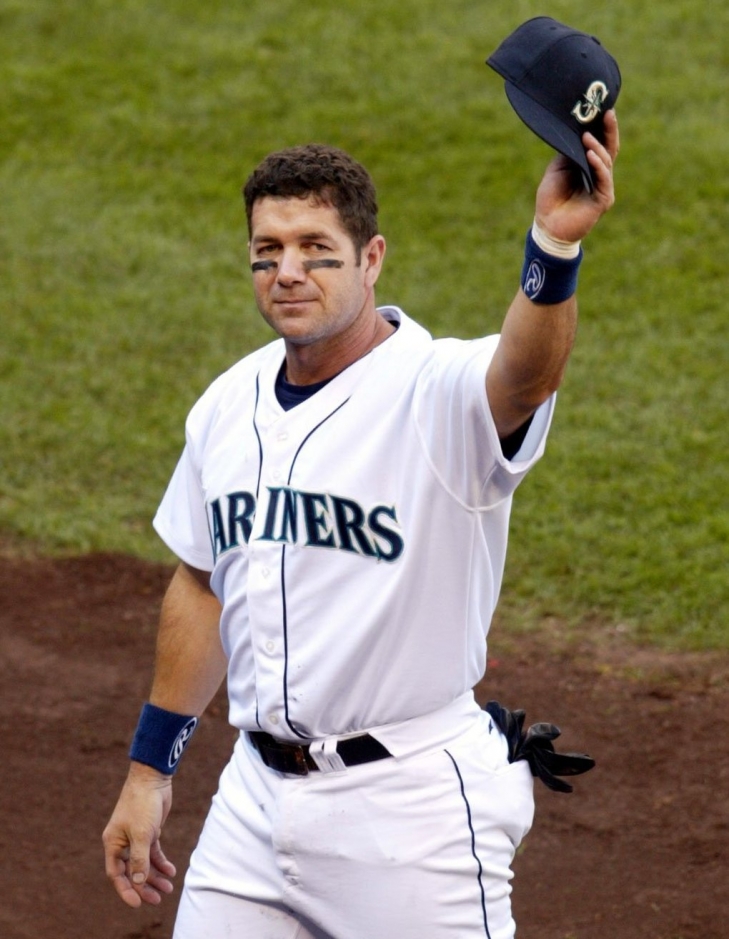
When considering the Seattle Mariners’ historical hierarchy, determining the top spot involves weighing raw physical talent against sustained career excellence. We can confidently argue that Ken Griffey Jr. had a higher athletic peak, especially since much of his prime was spent in the Pacific Northwest, making his place at number one a logical choice. However, if the focus is on the most devoted and consistently productive player, Edgar Martinez stands alone. He didn’t just play for the team; he became the core of Seattle's baseball identity. Over 18 seasons, this right-handed hitter turned the batter's box into a hub of hitting mastery, overcoming a late start in the organization to become a local legend.
Martinez signed as an unheralded amateur free agent from Puerto Rico in 1982. His early progress through the farm system gave little hint of the exceptional outlier he would become. He moved between Triple-A Calgary and the majors for several summers, lacking a consistent routine until finally becoming the regular starting third baseman in 1990 at age 27. He proved his elite contact ability immediately, batting .302, followed by a strong .307 in 1991. His outstanding hitting skills were fully showcased in 1992, when he dominated American League pitchers, winning his first batting title with a.343 average and leading the majors with 46 doubles, earning his first Silver Slugger Award.
Tragically, his availability was drastically limited by severe hamstring and knee injuries, reducing him to only 131 games in 1993 and 1994 and risking his career. Confronted with this major physical setback, the organization made a strategic decision before the 1995 season to convert Martinez permanently into a full-time Designated Hitter. This move resulted in an outstanding display of professional hitting that solidified the legitimacy of the role.
Returning with immense competitive authority, his spectacular 1995 regular-season masterpiece remains the stuff of Pacific Northwest legend. Martinez captured his second batting title with a career-high .356 average, paced the AL with 52 doubles, 121 runs scored, and a towering 1.107 OPS, drawing 116 walks to fuel a league-leading .479 on-base percentage. He put an absolute exclamation point on that magical summer in October, launching "The Double" down the left-field line in the 11th inning of Game 5 of the ALDS to score Ken Griffey Jr.—a legendary, high-leverage moment that single-handedly saved the franchise from relocation.
Martinez maintained his hardware-certified authority throughout his long career, making daily run production a routine. As the Mariners' dedicated DH, he achieved six All-Star selections, won four more Silver Slugger Awards, and excelled in the league's advanced metrics by securing back-to-back on-base percentage titles in 1998 and 1999. He was also a central catalyst for the historic 2001 squad that tied the major league record with 116 regular-season victories, pacing the American League with a career-high 145 RBIs the previous summer in 2000.
Martinez retired after the 2004 season, and he was widely regarded as the greatest Designated Hitter in the history of the game. We don’t say this flippantly. The award for the Designated Hitter of the Year was renamed the Edgar Martinez Award in his honor. Ironically (we think it is ironic), this award would take his namesake before the Baseball Hall of Fame would induct him. He would finally enter Cooperstown in 2019, his final year of eligibility. The team had already retired his number 11 in 2017, and ten years previously, he was inducted into the Mariners Hall of Fame.
Martinez is the Mariners’ all-time leader in Games Played (2,055), Total Bases (3,718), Doubles (514), Runs Batted In (1,261), Walks (1,283), and Win Probability Added (44.3). He would also have 309 Home Runs with a Slash Line of .312/.418/.515, making a member of the elusive career 3/4/5 club.
27. Raul Ibanez
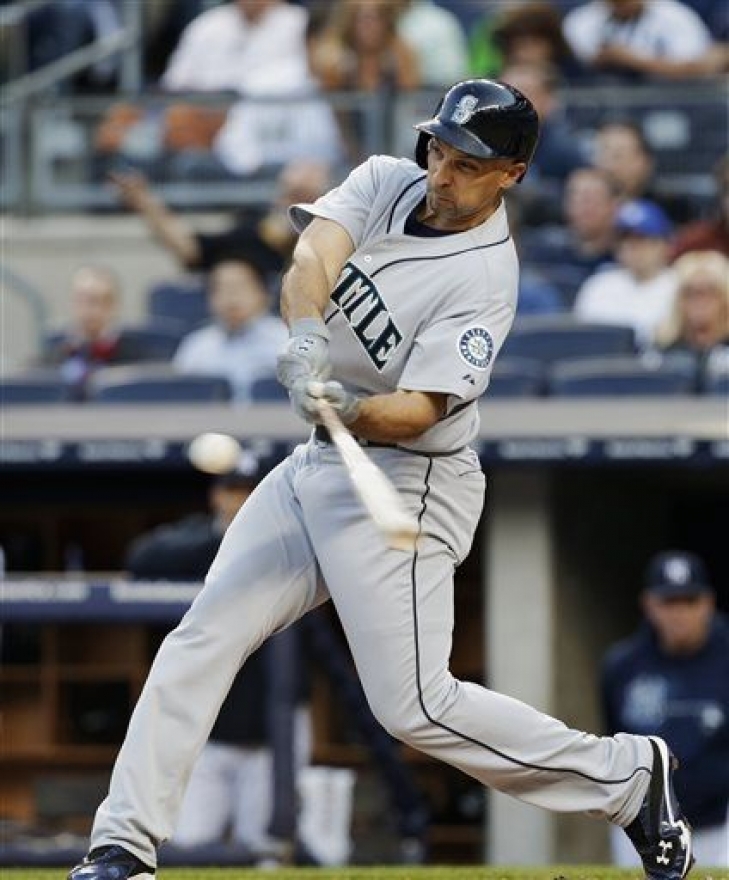
Playing 19 seasons in the major leagues is a remarkable feat for anyone, but it’s especially extraordinary for a player picked in the 36th round of the 1992 amateur draft. Drafted as a catcher from Miami-Dade Community College, Raúl Ibañez overcame the odds with his legendary work ethic and a smooth, left-handed swing. This combination helped him succeed in three separate stints with the Seattle Mariners, linking multiple generations of Pacific Northwest baseball.
His early days in Seattle tested his patience and perseverance. Debuting in the majors in 1996, Ibañez spent five years shuttling between the Kingdome and the minors, struggling to find regular playing time on star-packed teams with Ken Griffey Jr., Alex Rodriguez, and Edgar Martinez. After becoming a free agent after 2000, he moved to the Kansas City Royals, where he finally realized his potential as an everyday left fielder and laid the groundwork for the offensive success that would define his prime.
The Mariners, acknowledging they had missed out on Ibañez, quickly reacquired him before the 2004 season with a three-year free-agent contract. This second phase of his career marked his greatest achievement. Over five years of remarkable durability, he established himself as a consistent run producer in Seattle's lineup, posting five straight seasons with a .280+ batting average and reaching at least 20 home runs four times.
Although his defensive stats in left field were inconsistent, his powerful batting more than made up for any weaknesses on defense. His best offensive season was in 2006, when he hit a career-high 33 home runs and had 123 RBIs, the third-best in the American League. He continued with seasons of 105 and 110 RBIs, helping the team through tough times and earning MVP votes in 2006 and 2008.
After walking away again via free agency in 2009 to reach an All-Star game and a World Series with Philadelphia, the ultimate testament to his longevity arrived in 2013. Returning to Safeco Field as a gray-bearded, 41-year-old veteran, Ibañez electrified the fan base with a staggering exhibition of old-man power. He tied Ted Williams' historic major-league record for the most home runs in a single season by a 41-year-old, launching 29 longballs to provide a vital spark of leadership for a young, developing roster before concluding his playing days a year later.
Across his 1,110 games with the Mariners—over half of his 2,161 career MLB appearances—Ibañez had 1,077 hits, 216 doubles, and 156 home runs.
28. Mike Moore
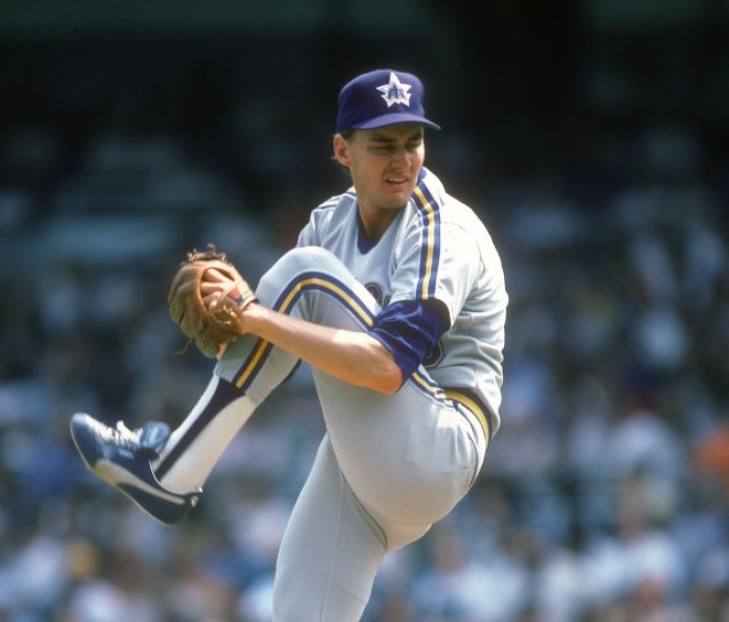
The Seattle Mariners, in their 1981 amateur draft, selected Mike Moore from Oral Roberts with the top overall pick, as they were a young franchise in need of a reliable workhorse. Moore, a powerful right-hander, was fast-tracked to the majors, joining the starting rotation the following summer. His debut at the Kingdome was intense, as he played for a struggling team and experienced three losing seasons with records of 7–14, 6–8, and 7–17, while trying to keep his ERA below 4.70. Despite these tough stats, his strong arm and high strikeout talent convinced the front office to focus on his long-term growth.
That patience paid off brilliantly during Moore’s remarkable 1985 season, a summer when he finally mastered his control and delivered the peak of his Pacific Northwest career. With a powerful, deceptive fastball, he achieved a 17–10 record and lowered his ERA to an impressive 3.46 across 247 innings. Demonstrating classic durability, he completed 14 games and carried a thin pitching staff on his broad shoulders, finishing tenth in the American League Cy Young Award voting and ranking sixth among AL pitchers with a 6.3 bWAR.
While surface losses returned the following summer, Moore’s significant contribution to the team became evident during the 1986 season. He started 37 games, pitching a remarkable 266 innings and facing a league-high 1,145 batters in the American League. Despite an 11–13 record and a 4.30 ERA, his skill in managing high-pressure situations and limiting damage in a hitter-friendly park earned him an impressive 4.6 bWAR, highlighting his value beyond win-loss statistics.
During his time in Seattle, Moore primarily relied on a fast, high-velocity pitch to keep opposing lineups unbalanced. He often ranked near the top of the league in strikeouts, making the top ten in the American League three times as a Mariner. The peak of this power pitching style came in his final summer with the team in 1988, when he achieved a personal best of 182 strikeouts in 228⅔ innings, establishing himself as one of the division’s most respected power pitchers before entering free agency.
After his contract expired following the 1988 season, Moore decided to sign with the dominant Oakland Athletics. There, he quickly reached the peak of his career. He gained national fame during an outstanding 1989 season, which saw him earn his first All-Star selection, win 19 games, and start two games in the Fall Classic, contributing to Oakland's World Series sweep.
Moore closed out his seven-year stretch in Seattle with a deceptive 66–96 record, but his legacy is truly defined by his 225 starts, 72 complete games, and 937 strikeouts.
19. Adrian Beltre
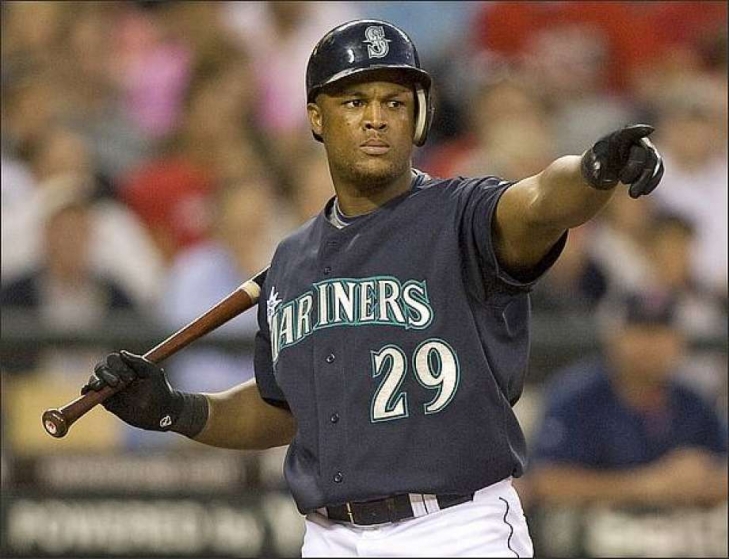
Examining the full, historical trajectory of a Cooperstown career reveals that true greatness involves overcoming significant structural challenges. When considering Adrián Beltré Pérez's legendary journey, the focus often falls on his rapid early success with the Los Angeles Dodgers, his impressive single-season hitting prowess in Boston, or the iconic status he achieved with the Texas Rangers. However, his five seasons in the Pacific Northwest form the crucial mechanical link across his career. Arriving in Seattle as the top free-agent pick of the 204–05 offseason, right after a remarkable 48-home-run season, the Dominican star faced tough, demanding conditions. Charged with stabilizing a changing lineup and coping with Safeco Field’s difficult environmental factors, Beltré proved critics wrong by demonstrating exceptional durability and elite defensive skills.
In his first year in Seattle, an undeniable reality check to fans expecting a repetition of his high-altitude Los Angeles statistics, but that was not the case as he batted .255 with 19 home runs.
Instead of letting the sudden contact leaks disrupt his overall performance, he fully focused on the dirt, transforming the hot corner into a tight barrier for opposing base runners. He improved his lower body stability before the 2006 season, beginning a steady three-year period during which he consistently produced power in the middle of the lineup.
In 2006, he hit exactly 25 home runs and had 89 RBIs. He followed this with a productive 2007 season, batting .276 with 26 home runs and 99 RBIs, and wrapped up the trilogy with another 25-homer season in 2008. Although his offensive stats never earned him an American League MVP vote while with the Mariners, his highly valuable defensive skills reached their peak during this period.
His defensive skills in the PNW were also impressive, earning him consecutive American League Gold Glove Awards in 2007 and 2008, which cemented his status as the top defensive third baseman in the junior circuit.
A series of nagging physical setbacks hampered his final summer with the organization in 2009, restricting him to just 111 appearances before a definitive business exit materialized that winter, as he chose to sign a one-year deal with the Boston Red Sox to jump-start his late-career renaissance.
Across his 715 appearances strictly representing the Mariners, he accumulated exactly 751 hits, 172 doubles, 103 home runs, and 396 runs batted in. Though his bat exploded to historic heights after his departure, culminating in his first-ballot walk into the National Baseball Hall of Fame in 2024, the golden glove work and relentless durability he showcased in the Pacific Northwest provided the essential platform for his eventual 3,000-hit immortality.
18. Hisashi Iwakuma
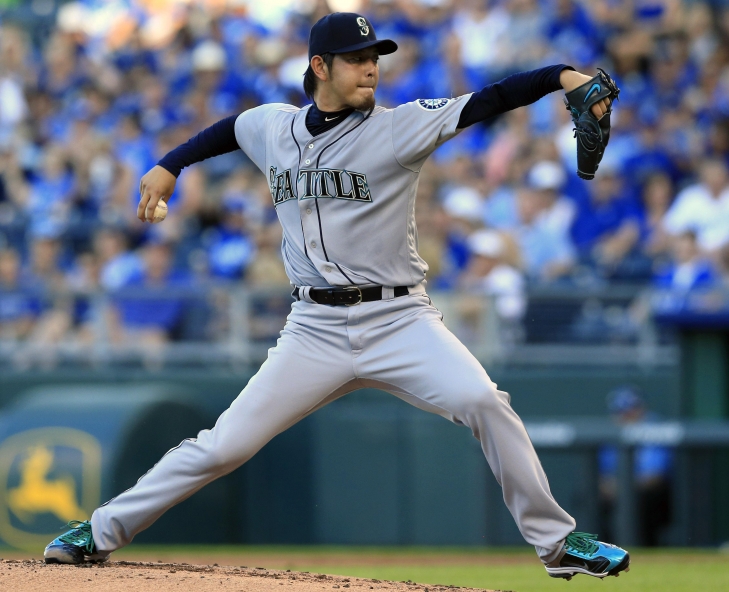
After a dozen seasons in the Japanese League, Hisashi Iwakuma made his way to the United States, specifically with the Seattle Mariners, the only team he would play for in Major League Baseball.
11. Alvin Davis
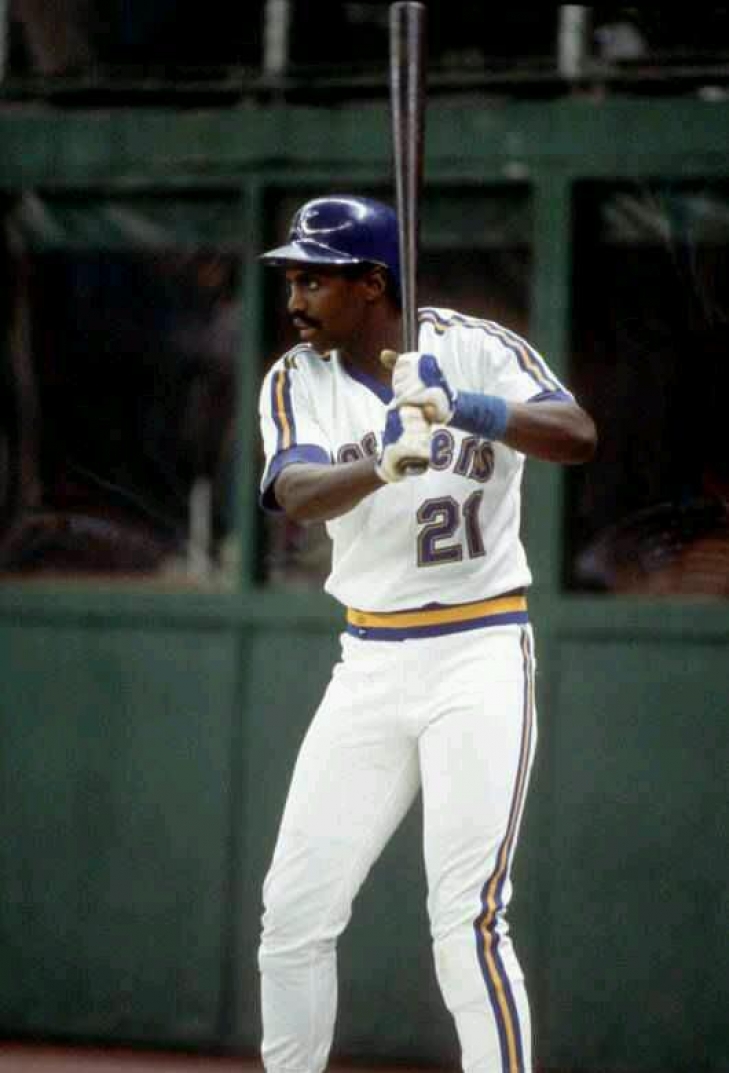
When one is unconditionally bestowed with the moniker "Mr. Mariner," it is inherently evident that the local footprint bears significant historical importance. Prior to the franchise's transformation into a prominent regular-season contender in the late 1980s and 1990s, the Seattle Mariners were a perpetually struggling expansion team, searching for a distinctive identity. This identity was found in the spring of 1984 in the form of a poised, left-handed hitting first baseman. Alvin Glenn Davis did not merely inherit a position in the batting order; he emerged as the unequivocal face of the franchise during a period when the club was in desperate need of a hero. He initiated a historic, multi-era residency characterized by exceptional strike-zone discipline, which laid the foundational offensive standards for the young team.
His introductory 1984 rookie showcase was an exemplary display of immediate, high-velocity run production. Davis entered the major-league scene by hitting home runs in his first two games, triggering widespread euphoria across the Pacific Northwest. He established a rigorous daily routine for reaching base, setting a major-league rookie record by safely reaching in each of the first 47 games of his career. He proceeded to earn his sole career All-Star selection, recording 34 doubles, 27 home runs, and 116 runs batted in while maintaining a strong .284 batting average. His advanced efficiency metrics dominated the landscape; he drew 97 walks, resulting in a notable .391 on-base percentage and a 147 OPS+, thereby confidently securing the American League Jackie Robinson Rookie of the Year award.
Davis wasn’t just a flash in the pan; he truly made a lasting impact over the following five years. His rookie season laid a solid foundation, and he proved incredibly dependable, maintaining a steady presence on the field. He hit back-to-back 18-homer seasons and maintained a batting average well above .270 during 1985 and 1986. His raw power reached its peak in 1987, when he completely dominated American League pitching. That year, Davis achieved personal bests in many areas, smashing 37 doubles, 29 home runs, and driving in 100 runs. He also collected a personal-high 171 hits and boasted a strong .516 slugging percentage, ensuring his place as a true star.
He backed that up with another 18 long balls in 1988, before staging a magnificent on-base clinic during the 1989 calendar. That summer, he clobbered 21 home runs, drove in 95 runs, and weaponized his elite zone awareness to draw a career-high 101 walks—fueling a brilliant, lifetime-best .424 on-base percentage that ranked second in the entire junior circuit.
To be fair, where Davis lost significant ground under modern analytical filters was his highly limited defensive footprint. He lacked range and quick lateral movement on the infield dirt, never registering a single season with a positive defensive bWAR or pacing American League first basemen in any traditional metric.
As the calendar turned to the 1990s and young star Tino Martinez progressed through the minor leagues, the coaching staff increasingly shifted the aging veteran into a permanent designated-hitter role. His production suffered a steep decline during the 1991 campaign, where he labored through mechanical inconsistency to bat a personal-low .221 with 12 home runs across 145 appearances. He became a free agent afterward and signed with the California Angels.
Davis would collect 1,163 hits with 160 home runs and a slash line of .281/.381/.453 over his Mariners career, and in 1997, he became the first member inducted into the Mariners Hall of Fame.
