
gold star for USAHOF

Top 50 Philadelphia Phillies

Philadelphia is one of the great sports cities of the United States and as such the Phillies have one of the strongest fan bases in baseball.  That being said, the success on the field has not matched the fervor of their fans.

Beginning in 1883 as the Philadelphia Quakers, the soon to be named Phillies had some very good players come through there in their early years (Billy Hamilton, Sam Thompson, and Ed Delahanty to name a few) but overall they were not particularly good.  In 1915, they would go to their first World Series though they would fail to win it and shortly afterward fall into an abyss of mediocrity.

The Phillies had only one winning season from 1918 to 1948.  Generally if looked at the bottom of the standing of the National League the chances were good that they were there.  In turned around briefly in the early 1950s when a crop of young talent known as “The Whiz Kids” took them to the 1950 World Series, though they lost again, but they went back to the bottom and more notably was on the wrong side of history as they were the last team to integrate.

After more years of poor performances, the Phils climbed back up the standings in the 1970s and they finally won their first World Series in 1980.  They would return to the Fall Classic in ’82 (they lost) and would lose again in 1993.  In 2008 they would win their second World Series.

For a team that has been around well over 100 years there are not as many elite players as there should be, but considering that they have had far more losing seasons than winning ones, this is not that much of a surprise.

Note: Baseball lists are based on an amalgamation of tenure, traditional statistics, advanced statistics, playoff statistics, and post-season accolades. 

This list is updated up until the end of the 2024 Season.
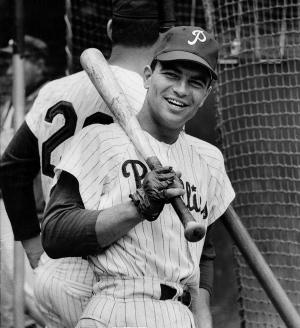
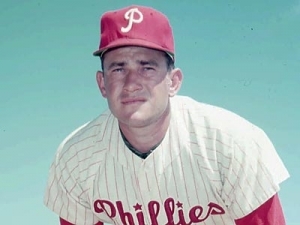
When John Callison joined the Philadelphia Phillies through a trade with the Chicago White Sox before the 1960 season, he quickly faced an almost unfair comparison. Known for his incredibly fast left-handed swing and a powerful arm, scouts and the national press eagerly compared him to Mickey Mantle. While matching such a lofty standard was impossible, Callison established a unique, star-quality legacy of his own, becoming the regular and reliable presence in the Phillies' outfield for ten years. Operating mainly from right field, with a short, tactical two-year stint in left field, Callison rapidly became one of the most well-rounded…
To truly determine the official geographic home of an elite pitcher's legacy, one must look beyond the win-loss record and examine the physical artifacts left behind. According to standard box-score logic, James Paul David Bunning might appear to be tied to Michigan, where he secured more regular-season wins and earned five of his seven All-Star selections with the Detroit Tigers. However, when considering the pinnacle of his historical significance, there is no debate: Bunning is fundamentally tied to the City of Brotherly Love. It is the city where his most legendary achievements were made, the city that permanently elevated his…
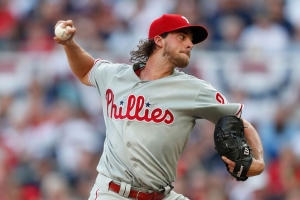
When the Philadelphia Phillies picked Aaron Michael Nola seventh overall in the 2014 draft from LSU, they invested in a polished arm. What they hadn't fully predicted was his durability and stability at the top of the rotation for over a decade. In an era of pitchers bouncing franchises, the Baton Rouge native has remained an unshakeable fixture in Pennsylvania, the only major league uniform he’s ever worn as of this writing. His first two seasons on Broad Street were typical learning phases, but by the 2017 campaign, a noticeably confident Nola had reached an advanced stage of development. Throughout…
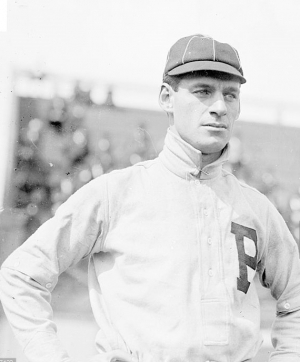
During the early, gritty years of the modern game, Roy Thomas stood out as a player who skillfully pushed the boundaries of the rulebook. Well before today's front offices obsess over on-base percentages to the tiniest detail, Thomas was a dedicated and disciplined center fielder for the Philadelphia Phillies, often serving as a strategic table-setter. He didn't just see drawing walks as a simple skill—he turned it into a mental game, creating psychological pressure on the opposing team. His persistent habit of fouling off high-velocity pitches by intentionally spoiling them annoyed opponents so much that it led Major League Baseball…
The relationship between the Philadelphia fans and Del Ennis was particularly complex, especially given the city's fiercely protective nature. Born in the city and excelling at Olney High School, Ennis had all the qualities of a hometown hero. He was also a key part of the iconic "Whiz Kids" team that transformed the city at the beginning of the 1950s. Despite his impressive regular-season stats, Ennis often became a target for harsh criticism and boos from the Shibe Park crowd. His debut on Broad Street in 1946 is a true standout achievement. After completing a three-year stint with the United…
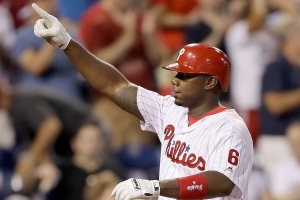
Few figures in modern baseball inspire such a clear divide between traditional fans and data-driven analysts as Ryan Howard. When measuring greatness by raw power and high-pressure performances that unsettle opposing teams, the left-handed slugger appears as an undeniable franchise icon, ranking high on any leaderboard. However, focusing on advanced efficiency stats, defensive skills, and strikeout rates presents a very different view. This internal tension explains why"The Big Piece"'s legacy remains rooted in a complex, highly analyzed middle ground. Let’s begin on the positive side of the ledger, where Howard’s absolute peak was as explosive as any hitting stretch the…
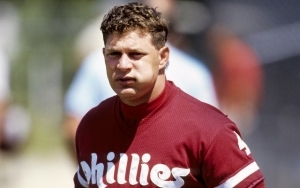
Few players in franchise history have ever matched the raw, dirt-caked intensity that Lenny Dykstra brought to the diamond. He had already established himself as a highly popular postseason catalyst with the New York Mets, helping secure the 1986 World Series title, but that outer-borough fame completely paled in comparison to the absolute obsession he generated in eastern Pennsylvania. Known universally as "Nails" for his fearless, wall-crashing style of play, the stocky center fielder personified the exact blue-collar, unyielding identity of the city he represented. When he was on the field, his hyper-aggressive energy dictated the club’s entire operational pace.…
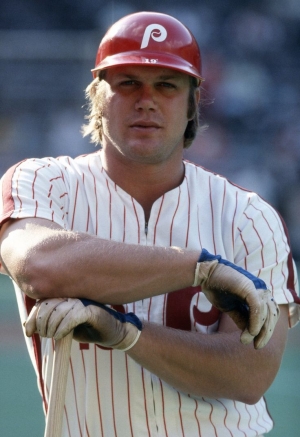
Few players have ever visualized their nickname quite like Gregory Michael "The Bull" Luzinski. Weighing 255 pounds on a six-foot-one frame, he appeared more like a powerful defensive lineman who accidentally wandered onto the baseball field rather than a typical outfielder. During the 1970s, Luzinski was a beloved figure in eastern Pennsylvania, teaming with Mike Schmidt to create one of the most formidable and high-powered batting duos of the post-war period. When he stepped up to the plate at Veterans Stadium, pitchers knew any mistake could send the ball soaring out of the park. During the mid-to-late 1970s, Luzinski wasn't…
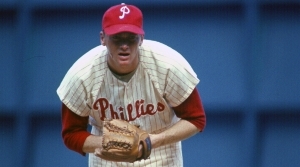
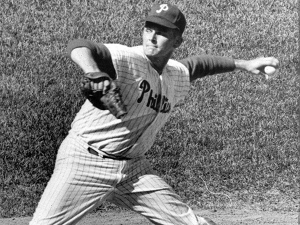
Though post-war baseball history often highlights legendary right-handers, Chris Short stood out in the mid-1960s as one of the top left-handed pitchers. Signed by the Philadelphia Phillies as an amateur free agent in 1957, this lanky Delaware native spent several summers developing before securing a spot in the starting rotation in 1963. Following this, he enjoyed a remarkable peak, where his sharp slider and deceptive delivery established him as a leading force on the mound. Between 1964 and 1968, Short led the pitching staff alongside Jim Bunning, establishing a five-year period marked by exceptional individual performances. He made success a…
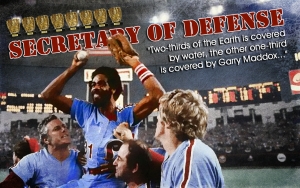
The outfield grass at Veterans Stadium had an unforgiving, low-friction artificial turf that often challenged defenders. However, in the late 1970s, Garry Maddox turned this difficult environment into his own stage for athletic control. Traded from the San Francisco Giants early in the 1975 season, the agile center fielder earned the nickname "The Secretary of Defense" from local media. His smooth, effortless ability to track high-speed line drives into the gaps contributed to a famous piece of baseball lore: “Two-thirds of the Earth is covered by water, the other one-third by Garry Maddox.” From the perspective of contemporary spatial metrics,…
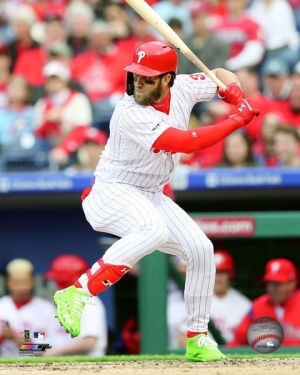
Few modern theater arcs hold the same dramatic, high-stakes importance as Bryce Harper's. From the moment he appeared on the cover of Sports Illustrated as a 16-year-old prodigy, he has borne the weight of being baseball's chosen one. For years, he was the unquestioned, charismatic face of the Washington Nationals, highlighted by a stunning, unanimous National League MVP award in 2015. However, when free agency took him across the Eastern Seaboard to a fierce divisional rival, fate played a strange, frustrating game: Washington secured their first-ever World Series victory in the very autumn following his departure. Instead of letting external…
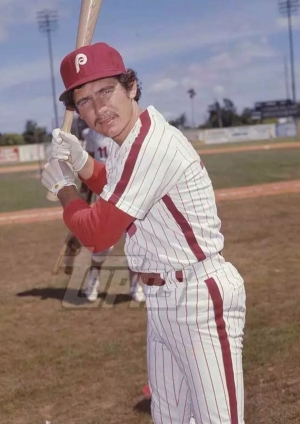
Surviving twelve tough seasons as the Phillies' starting shortstop demands exceptional defensive skills. For Larry Bowa, this was the only way to succeed. Known for his fiery, ultra-competitive nature, which earned him the nickname "The Gnat,” he turned the shortstop role into a showcase of precise positioning and relentless coverage. Although his power at the plate was modest, his glove was a top-tier, era-defining defense that anchored the infield during the team’s golden era. From a run prevention standpoint, Bowa was an exceptionally efficient player with low variability. He led all National League shortstops in fielding percentage five times, thanks…
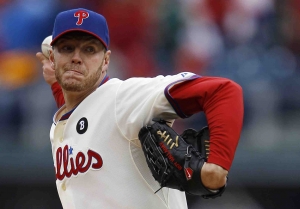
Before Roy Halladay donned a Philadelphia jersey, his reputation as a top-tier player in the modern game was well established. As the reliable and dominant pitcher for the Toronto Blue Jays, "Doc" had already won an American League Cy Young Award and led the league in bWAR for consecutive seasons. He exemplified the ideal old-school workhorse, thriving in an era of strict pitch counts. However, when he was traded to the Phillies before the 2010 season, Halladay managed to elevate his already stellar career into an enduring baseball legend. His debut campaign in red pinstripes showcased exceptional athletic control. Halladay…

2026 SEATTLE MARINERS FLEX MEMBERSHIPS

Jan 01, 1970

Buy your Tickets to see 2026 Seattle Mariners Flex Memberships HERE!

SEATTLE MARINERS VS. NEW YORK METS

Jun 03, 2026

Buy your Tickets to see Seattle Mariners vs. New York Mets HERE!

NEW YORK YANKEES V. CLEVELAND GUARDIANS * PREMIUM SEATING *

Jun 03, 2026

Buy your Tickets to see New York Yankees v. Cleveland Guardians * Premium Seating * HERE!

NEW YORK YANKEES VS. CLEVELAND GUARDIANS

Jun 03, 2026

Buy your Tickets to see New York Yankees vs. Cleveland Guardians HERE!

 
The story of the 1950 "Whiz Kids" often focuses on Robin Roberts's legendary achievements, but a closer look at that iconic era shows that Curtis Thomas Simmons was a crucial and consistent part of the rotation. Coming from a widely publicized amateur bidding war as a local star from Eastern Pennsylvania, this smooth left-hander skipped the typical minor league route to bring fast, reliable pitching directly to Broad Street. For more than ten years, his fluid pitching style and strategic mastery made him a key, high-volume contributor during one of the most celebrated periods in franchise history. His early-season performance…
The history of professional baseball is rich with legendary figures whose contributions are etched in history, yet some, like Charlie Ferguson, occupy a more bittersweet, frozen-in-time place. Ferguson, a Charlottesville native, was a standout for the 19th-century Philadelphia Quakers, long before the team officially became the Phillies. He quickly proved himself as a versatile and exceptional Player, not only participating in the game but also excelling at it from the pitcher’s mound and the middle of the batting order. Ferguson exemplified qualities of a modern elite athlete well before baseball fully evolved. His debut in the National League in 1884…
In the tough environment of 19th-century baseball, the catcher’s box was like a collision zone. Jack Clements, known as “Bones," was a striking figure due to his notoriously surly attitude, his thick, low-slung build, and his refusal to follow conventional rules in his career. The Pennsylvania native was a trailblazer behind home plate, among the first catchers to systematically wear a sheepskin chest protector. Even more remarkable for modern fans, Clements is one of the few true left-handed catchers in Major League Baseball history, a rare position that has disappeared in today’s game. His extensive and high-volume residency in Philadelphia…
Few entries on a historical leaderboard spark as much analytical fascination or emotional debate as Scott Bruce Rolen. For many in the wider baseball community, Rolen’s legacy is firmly associated with a bright red St. Louis Cardinals cap. This makes sense at first glance; he was a multiple-time All-Star in Missouri, finished fourth in the 2004 National League MVP race, and earned a World Series ring with the 2006 Redbirds. In contrast, during his time in eastern Pennsylvania, he received only a single, modest All-Star nod and no MVP considerations, making the narrative clear-cut. However, when you look beyond the…
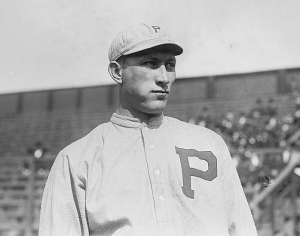
During the demanding Deadball Era, a position player typically required exceptional durability and a dependable hitting approach to stay relevant in the majors. For Fred Luderus, this consistent efficiency defined his career. As the primary first baseman for the Philadelphia Phillies throughout the 1910s, the unassuming Wisconsin native maintained stability at the hot corner, quietly establishing one of the most reliable, high-volume careers of his era. Luderus wasn't a flashy headline-maker who intimidated opposing managers; instead, he made consistent contact a regular part of the game. Throughout his ten years in red pinstripes, he surpassed 130 hits in an impressive…
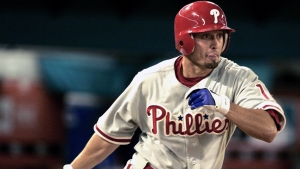
For a franchise established on a remarkable foundation of gritty, high-energy performances during its late-2000s prime, no individual embodied the city’s emotional core quite like Shane Victorino. Selected from relative obscurity through the Rule 5 draft, the switch-hitting outfielder, recognized for his infectious smile and relentless drive, swiftly acquired an enduring nickname among the Philadelphia supporters: "The Flyin' Hawaiian." Guarding the vast, challenging expanse at Citizens Bank Park with exceptional closing speed, Victorino transformed center field into his personal arena of athletic mastery, delivering a seamless blend of superior defensive coverage and high-stakes offensive performance. His extensive residency in eastern…