

21. Jim Bunning
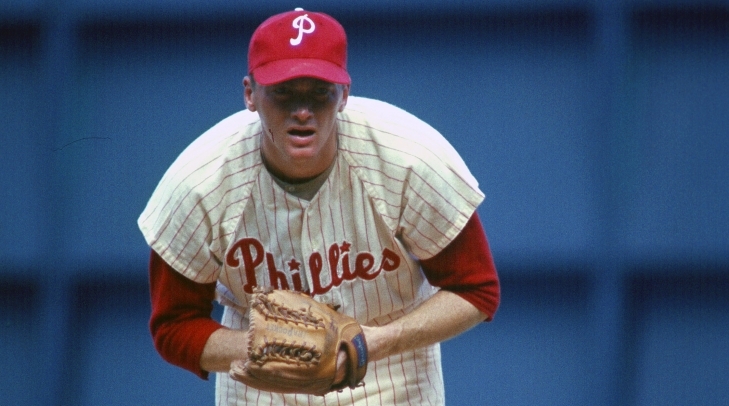
To truly determine the official geographic home of an elite pitcher's legacy, one must look beyond the win-loss record and examine the physical artifacts left behind. According to standard box-score logic, James Paul David Bunning might appear to be tied to Michigan, where he secured more regular-season wins and earned five of his seven All-Star selections with the Detroit Tigers. However, when considering the pinnacle of his historical significance, there is no debate: Bunning is fundamentally tied to the City of Brotherly Love. It is the city where his most legendary achievements were made, the city that permanently elevated his jersey into the rafters, and, most notably, the city whose iconic red script is forever engraved on the cap of his Cooperstown plaque.
Bunning officially joined the team through a blockbuster trade before the 1964 season, quickly becoming the Phillies' dominant, high-speed pitcher. With a deceptive sidearm delivery and a relentless, highly competitive attitude, he made the mound a showcase of athletic control.
Although he had previously pitched a no-hitter in Detroit, Bunning created a legendary moment on Father’s Day in 1964 by defeating the New York Mets at Shea Stadium and throwing the first regular-season perfect game in the National League in 84 years.
Far from being just a fleeting success, his core efficiency stats during his four-year prime on Broad Street were outstanding. He achieved an exceptional individual peak, highlighted by a historic 1967 season where he posted a 17-15 record, an impressive 2.29 ERA, and led the league with six shutouts and 302.1 innings pitched. He narrowly missed winning the National League Cy Young Award, finishing as a highly regarded runner-up.
Advanced metric purists often point out that, despite pitching fewer innings in Philadelphia than in Detroit, his exceptional dominance was so intense that he ended up with a higher career bWAR during his time with the Phillies. After an extended period in Pittsburgh and Los Angeles, Bunning returned to Broad Street for a two-year farewell, providing experience and stability to a rebuilding team before retiring after the 1971 season.
Bunning entered the Baseball Hall of Fame through the Veterans Committee in 1996, though he never should have had to wait so long to enter Cooperstown. As for the Phillies, his name was added to the Philadelphia Baseball Wall of Fame in 1982, and his number 14 was retired in 2001.
19. Jim Bunning
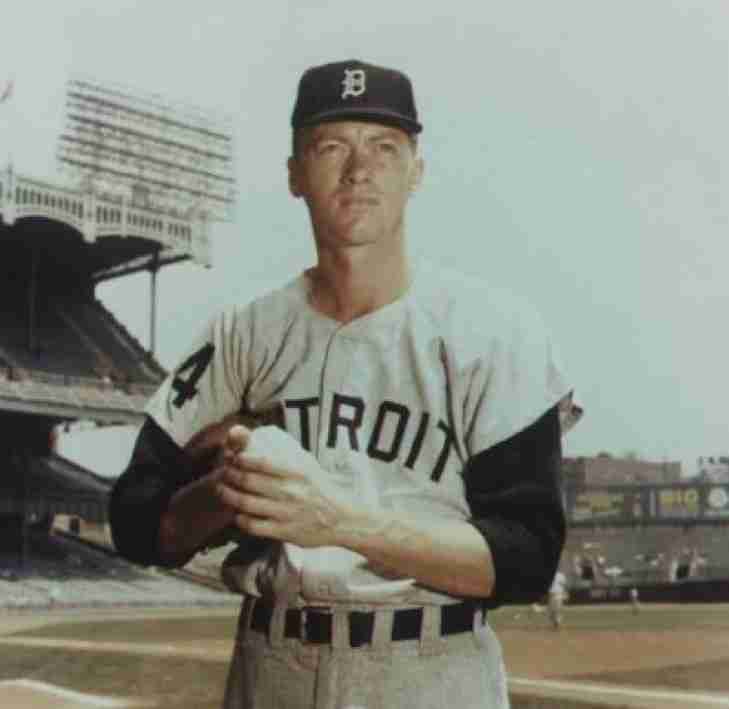
The trajectory of Jim Bunning in Detroit is a study of a specialized technician who arrived as a project and left as an elite hurler. While he is often associated with the perfect game he later threw in Philadelphia, Bunning’s professional foundation was built in the Motor City. For nine seasons, he served as the high-frequency engine of the Tigers' rotation, a sidearm-throwing right-hander whose deceptive delivery and focused intensity made him one of the most difficult matchups in the American League during the late 1950s.
Bunning’s ascent in Detroit began in earnest in 1957, a season that served as his arrival. After a few inconsistent years of seasoning, he reached a definitive level of efficiency by leading the American League with 20 wins and a 2.60 FIP. He possessed a specialized, cross-fire delivery that hid the ball until the last possible second, a style that allowed him to strike out 182 batters and earn the first of five All-Star selections with the club. He proved that a pitcher could become a franchise pillar by mastering the tactical demands of the "inner half," a steady-state approach that kept him at the top of the league's leaderboards for years.
The hallmark of his time in Detroit was a relentless run of high-frequency strikeout totals. In 1959 and 1960, he led the American League in strikeouts both seasons. During this window, he was a model of specialized durability, routinely throwing over 250 innings and maintaining a professional poise even as the Tigers struggled to find a consistent supporting cast. He famously threw a no-hitter against the Red Sox in 1958, signaling his transition into the upper echelon of the game's starters. He wasn't just a "solid contributor"; he was the arm the Tigers relied on to stop every losing streak, eventually amassing 118 wins in a Detroit uniform.
Despite the high-leverage workload, he finished his tenure with 1,406 strikeouts and a winning record in seven of his nine seasons with the club. However, the organization decided to pivot toward youth, trading Bunning to the Phillies following the 1963 season in a move that remains one of the most lopsided in franchise history. He departed as a five-time All-Star and a no-hit hero, a man who arrived as an unheralded prospect and left as a statistical titan of the mound.
The story in Detroit reached its final punctuation in 1996 when Bunning was inducted into the Baseball Hall of Fame. While he chose to wear a Phillies cap on his plaque, his legacy remains deeply rooted in the Motor City as one of the most dominant right-handers in club history.
