


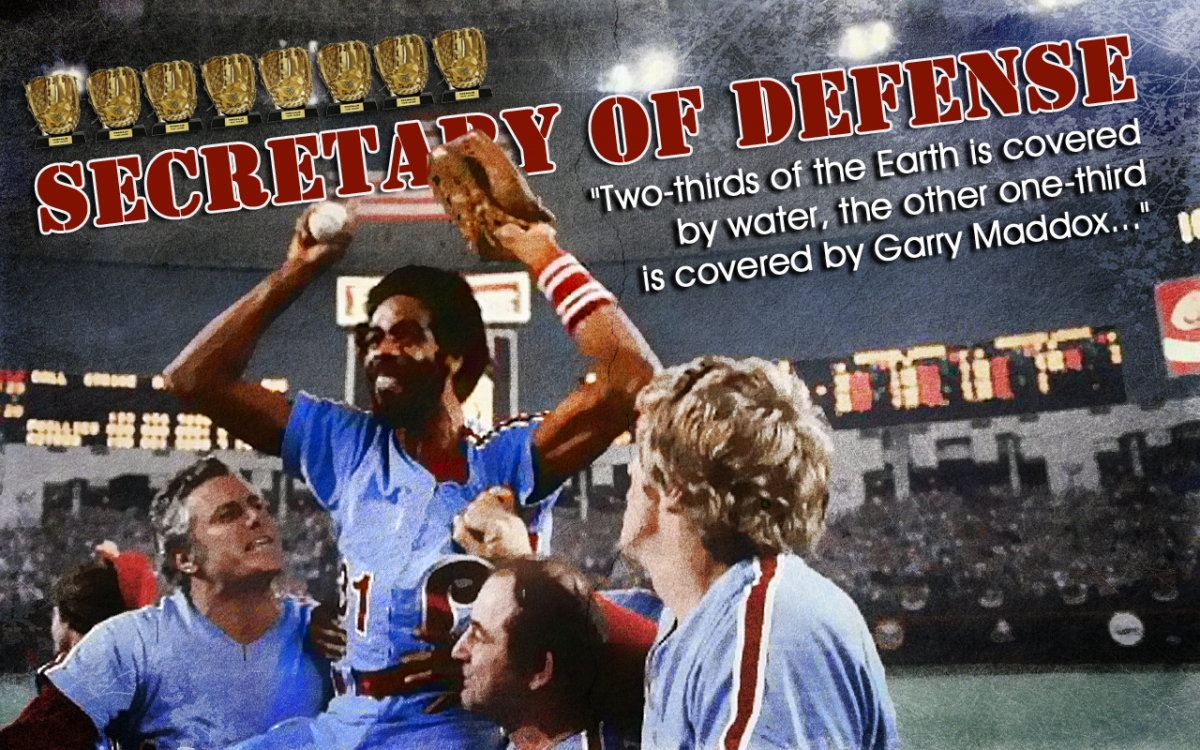



The outfield grass at Veterans Stadium had an unforgiving, low-friction artificial turf that often challenged defenders. However, in the late 1970s, Garry Maddox turned this difficult environment into his own stage for athletic control. Traded from the San Francisco Giants early in the 1975 season, the agile center fielder earned the nickname "The Secretary of Defense" from local media. His smooth, effortless ability to track high-speed line drives into the gaps contributed to a famous piece of baseball lore: “Two-thirds of the Earth is covered by water, the other one-third by Garry Maddox.”
From the perspective of contemporary spatial metrics, Maddox represented an unequivocal pioneer of his era. He secured eight consecutive National League Gold Glove Awards from 1975 to 1982, thereby effectively neutralizing the extra-base aspirations of opposing lineups.
Beyond being just a regional favorite, his advanced efficiency metrics were extremely elite; he led Major League Baseball in defensive bWAR twice, thanks to his quick first step and excellent positioning, which alone kept his pitching staff safe from costly big innings.
However, labeling Maddox solely as a brilliant yet one-dimensional gloveman overlooks his significant contributions at the plate. He was a capable hitter, amassing 1,333 hits and maintaining a steady .284 batting average over his lengthy career in eastern Pennsylvania.
His ultimate peak occurred in the historic 1976 season, where he led the lineup with an impressive career-high .330 batting average. That season, he also recorded 37 extra-base hits and stole 29 bases, earning a fifth-place finish in the National League MVP voting. This achievement cemented his reputation as a true, elite catalyst.
While his regular-season efficiency slightly declined with age by the early 1980s, his reputation in big games stayed strong during the team's remarkable 1980 championship season. He contributed by driving in the winning run in the tenth inning of Game 5 of the NLCS against Houston, and he also offered outstanding defensive support in the outfield during the World Series, helping the franchise achieve its first world title.
By the mid-1985 campaign, time and the relentless pounding of the Vet's artificial turf finally caught up with the veteran speedster, triggering a sharp decline in his overall physical volume. Rather than seeking a twilight change of scenery or hanging on as a bench compiler elsewhere, Maddox chose to walk away on his own terms.
In 2000, Maddox was chosen for the Philadelphia Baseball Wall of Fame.

Comments powered by CComment