


Committee Chairman
48. Justin Smith
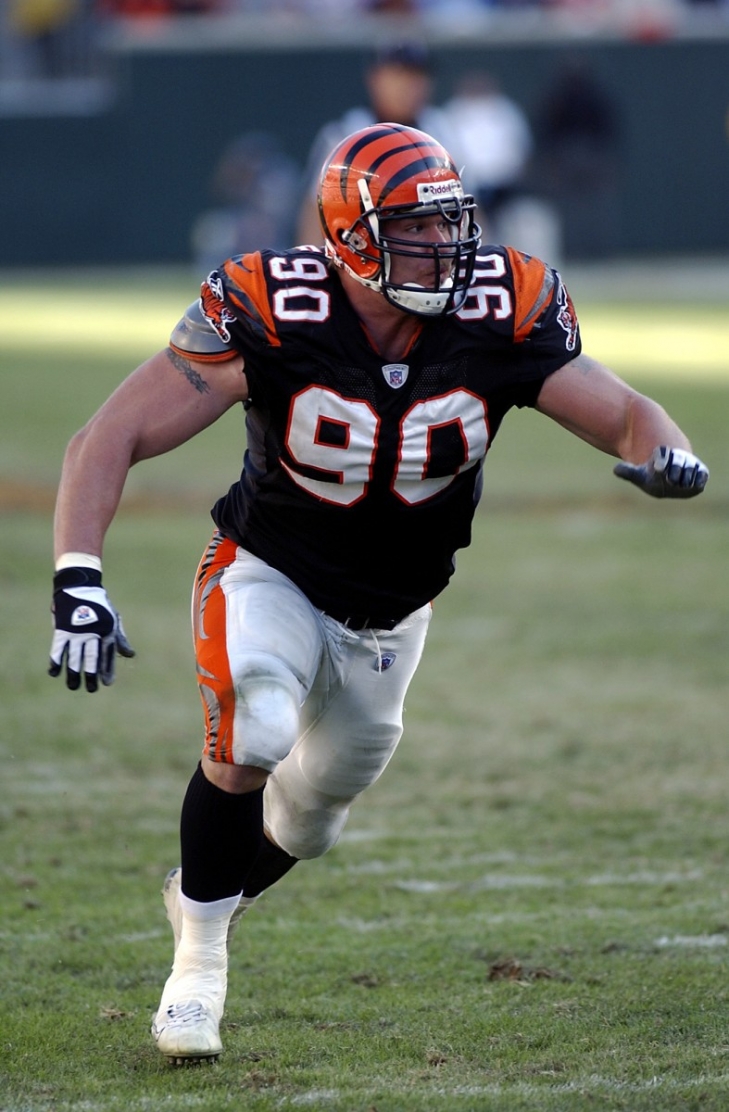
The Bengals had high expectations when they drafted Missouri’s Justin Smith fourth overall in the 2001 NFL Draft. Blessed with high motor intensity, brute functional strength, and relentless stamina on the edge, the defensive end proved to be an instant, durable anchor for the Bengals' front four.
Smith made an immediate splash as a rookie in 2001, setting a franchise rookie record with 8.5 sacks despite holding out during training camp. That breakout season ignited a remarkable seven-year run in Queen City, where his durability became his calling card: he missed just four games as a rookie and never missed a single contest again during his time in Cincinnati.
Operating as a traditional 4-3 right defensive end, Smith brought an unyielding physical presence to the defense, setting a tough edge against the run while consistently generating pressure. He registered at least 5.0 sacks in six of his seven seasons with the Bengals, peaking with an 8.0-sack campaign in 2004 and a career-best 80 combined tackles in 2006.
Following the 2007 season, Smith hit free agency and signed with the San Francisco 49ers, where a shift to 3-4 defensive end unlocked an all-pro tier that yielded five consecutive Pro Bowl selections and a First-Team All-Pro nod. As a Bengal, Smith accumulated 470 combined tackles, 43.5 sacks, two interceptions, six forced fumbles, and five fumble recoveries.
45. Leon Hall
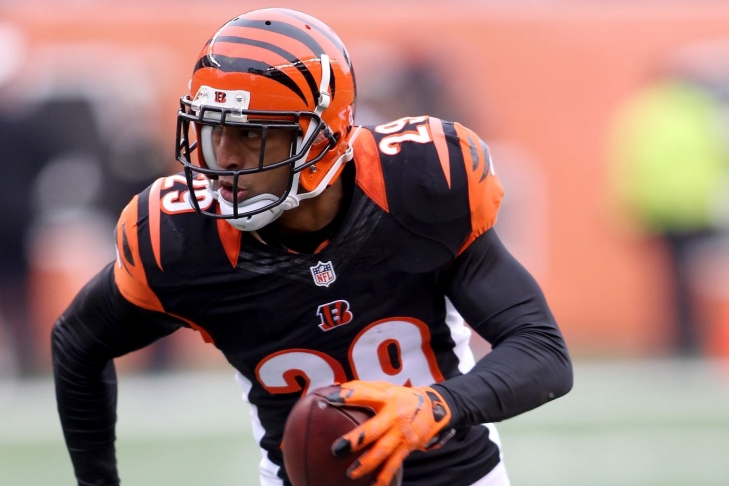
Consensus All-American Leon Hall was chosen 18th overall in the initial round of the 2007 NFL Draft from Michigan and joined Cincinnati as a highly regarded defensive back. He promptly fulfilled that draft promise by securing a starting boundary position and acting as the primary cover man for Marvin Lewis's defense over the subsequent decade.
Hall relied on smooth hip fluidity, elite route recognition, and a willingness to step up in run support. He hit the ground running as a rookie, starting all 16 games at right cornerback while picking off five passes. Hall put together his finest campaign in 2009, hauling in six interceptions and defending 24 passes to earn Second-Team All-Pro honors while anchoring a secondary that swept the AFC North and powered Cincinnati to a division title.
Hall remained a premier nickel and outside corner for the Cincinnati Bengals notwithstanding his struggles with two Achilles tear injuries in 2011 and 2013. His innate instincts and physical tackling capabilities enabled him to transition effortlessly between boundary and slot positions. He played a vital role during Cincinnati's consecutive five playoff appearances from 2011 to 2015, ultimately transitioning to a nickel back and secondary mentor in his final year, 2015.
Following the 2015 season, Hall signed with the New York Giants, then played for the 49ers and Raiders before retiring. During nine seasons with the Bengals (2007–2015), he appeared in 121 games (105 starts), with six postseason games. He totaled 26 interceptions, 115 pass deflections, 470 tackles, and three defensive touchdowns.
Our All-Time Top 50 New York Giants are now up
Yes, we know that this is taking a while!
As many of you know, we here at Notinhalloffame.com are slowly generating the 50 of each major North American sports team. We have a new one to unveil today, that of the New York Giants.
In 1925, the New York Giants were one of five teams that joined the National Football League, and of those five, they are the only ones that are still in existence.
The Giants have been in existence for nearly a century and have won eight Championships. The first four as NFL Champions (1927, 1934, 1938 & 1956) and they were a perpetual contender in the early 1960s. In the Super Bowl Era, they won in 1986 (XXI), 1990 (XXV), 2007 (XLII), and 2011 (XLVI).
Eight Championships is impressive regardless of the league and the sport!
As for all of our top 50 players in football we look at the following:
1. Advanced Statistics.
2. Traditional statistics and how they finished in the NFL.
3. Playoff accomplishments.
4. Their overall impact on the team and other intangibles not reflected in a stat sheet.
Remember, this is ONLY based on what a player does on that particular team and not what he accomplished elsewhere and also note that we have placed an increased importance on the first two categories.
This list is updated up until the end of the 2019 Season.
The complete list can be found here,but as always, we announce our top five in this article. They are:
3. Rosey Brown
4. Mel Hein
5. Michael Strahan
We will continue our adjustments on our existing lists and will continue developing our new lists.
Look for our more material coming soon!
Up next, will be the top 50 Los Angeles Chargers.
As always we thank you for your support.
44. Mike Wilson
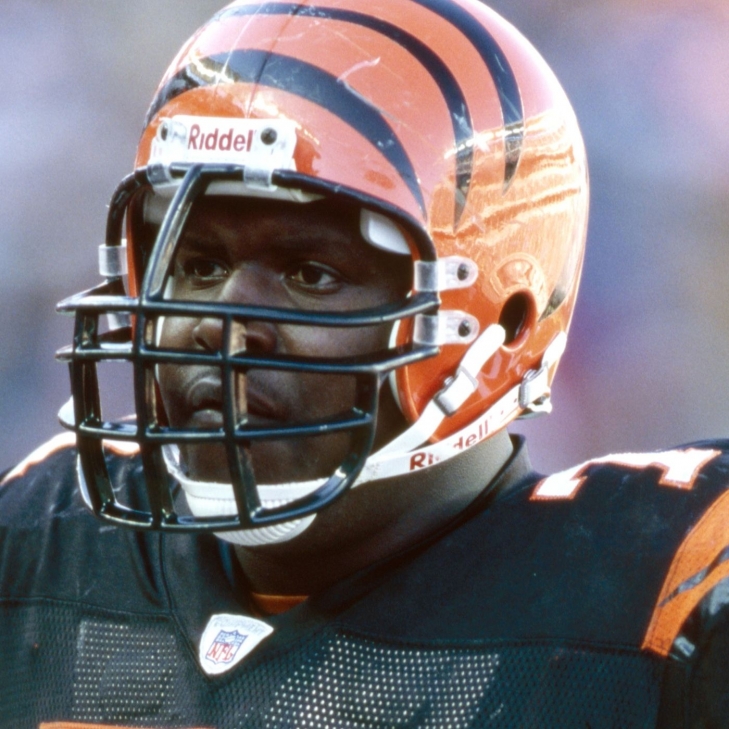
From Georgia, Mike Wilson was taken in the fourth round (103rd overall) of the 1977 NFL Draft. The imposing offensive lineman initially opted to head north, signing with the Toronto Argonauts of the Canadian Football League for the 1977 season, where he immediately earned CFL All-Star honors. He joined the Bengals in 1978, stepping directly onto the field as an NFL-ready starter.
At 6 feet 5 inches and 273 pounds, Wilson possessed the length, quick footwork, and functional power to hold down the perimeter. He stepped right into the starting lineup at left tackle for his first two seasons (1978–1979), protecting the blind side before shifting over to right tackle in 1980.
Wilson became an essential pillar on the offensive front during Cincinnati's 1981 AFC Championship run, starting every game and protecting Ken Anderson during his MVP campaign en route to Super Bowl XVI. Known for his game-in, game-out consistency, Wilson put together four separate seasons in Cincinnati with a double-digit Approximate Value rating, proving to be one of the most dependable tackles in the conference.
His eight-year run with the Bengals came to a close after the 1985 season, after which he spent his final professional campaign with the Seattle Seahawks in 1986 before retiring. He started all but two of his games for the team.
