


Committee Chairman
3. Jake Peavy
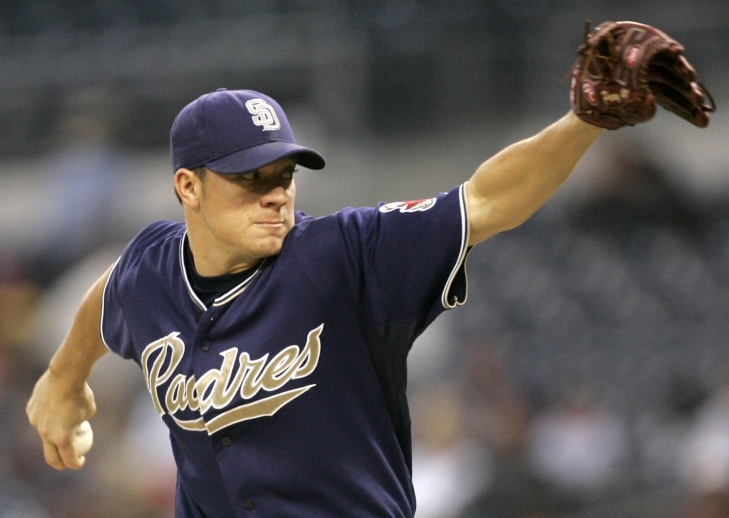
The profile of a top-tier, elite major league starter usually goes to celebrated first-round talents, but Jake Peavy distinguished himself in the baseball world through pure Southern grit. Drafted out of an Alabama high school in the 15th round of the 1999 amateur draft, many teams saw Peavy as mainly organizational depth. However, he defied these modest expectations, swiftly advancing through the minors to debut in the majors by summer 2002. With a fierce, highly competitive glare on the mound and a fast, crossfire delivery that posed a daunting sight for right-handed hitters, he spent the next seven seasons leading the starting rotation with relentless intensity and bravado.
By the 2004 season, the young right-hander had established himself as the team's leading pitcher. He consistently dominated in preventing runs, posting a remarkable 2.27 ERA over 166.1 innings, which earned him his first efficiency award. His success was not a fleeting peak; in 2005, Peavy earned his first All-Star spot, confirming his rising prominence. He continued to rack up impressive strikeout numbers using a powerful slider-fastball combo, finishing the year with a 2.88 ERA and leading the Senior Circuit with 216 strikeouts, thereby cementing his reputation on the national stage.
After a somewhat disappointing and uneven 2006 season marked by command problems, Peavy came back with a strong competitive drive for the 2007 pennant race. What followed was a showcase of pitching excellence. Peavy delivered an impressive performance, earning the National League Pitcher's Triple Crown by leading the league in wins (19), ERA (2.54), and strikeouts (240). His advanced efficiency metrics completely outperformed opponents, as he led the Senior Circuit in FIP (2.84), WHIP (1.061), and struck out an average of 9.7 batters per nine innings. Naturally, he was a unanimous selection for the 2007 National League Cy Young Award.
Sadly, the physical demands of his high-effort mechanics and ongoing tendon and shoulder injuries kept him from reaching those historic heights again in Southern California. By 2009, as the franchise shifted toward a complete rebuild in a small-market setting, the main goal was to unload Peavy's substantial contract. This led to a highly publicized saga: initially, the Padres agreed to send their ace to Chicago in May, but Peavy exercised his veto right, using his full no-trade clause to stay in the National League. The deadlock was eventually broken at the July 31 trade deadline. After injuring his ankle and aware that the cash-strapped Padres were determined to trade him, Peavy relented and waived his no-trade rights to join the Chicago White Sox.
With the Padres, Peavy posted a 92-68 record with 1,348 Strikeouts, which, as of this writing, is the franchise record.
2. Trevor Hoffman
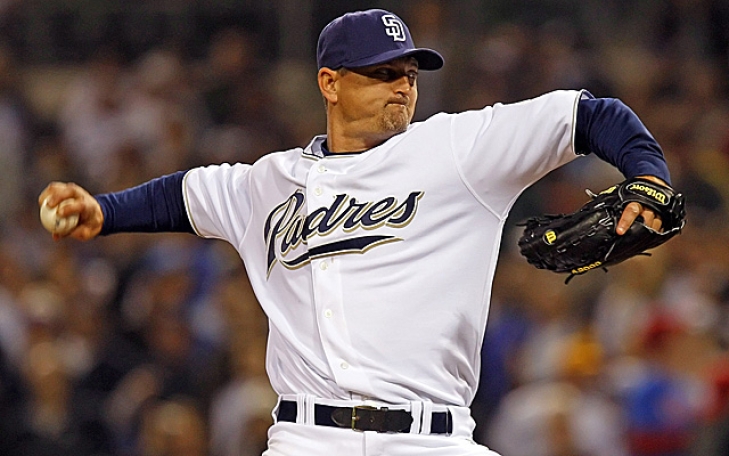
The loud groan that swept through San Diego in summer 1993 was entirely understandable. The Padres' management, amid a major salary dump, had just traded Gary Sheffield, the reigning batting champion and a franchise icon, to the Florida Marlins. Fans felt betrayed, but hidden within the traded players was a failed minor-league shortstop who became a rookie reliever and later transformed late-inning pitching. Trevor Hoffman didn't arrive as a top prospect, but over the next decade and a half, he became the gold standard for run prevention in the National League, anchoring the bullpen with a calm, relentless efficiency that redefined the closer role.
By 1994, Hoffman had fully established the role of the everyday closer, and the organization quickly recognized that they had found something extraordinary. Over time, his approach to games evolved into a true theatrical spectacle for stadium audiences.
As the stadium lights dimmed, AC/DC's "Hells Bells" echoed ominously through the ballpark, energizing the home fans and unsettling opposing teams. His true nightmare for hitters wasn't his fastball's velocity—often over 100 mph—but a powerful, high-concept changeup thrown with the same arm speed. The ball would vanish at the plate, leaving top sluggers lunging and off-balance.
Hoffman's emergence on the national stage was during the 1998 pennant race. He delivered an exceptional display of high-pressure performance, consistently shutting down National League batters to record a career-high 53 saves and a tiny 1.48 ERA. His steady hand in the ninth inning was the key driving force behind the Padres’ tough postseason run, leading them to their second National League pennant. Although they ultimately lost to the formidable Yankees in the World Series, Hoffman's reliable closing was vital in making October's journey possible.
Hoffman's impressive performance was not just a brief peak; he maintained his elite, low-variance output for more than ten years in Southern California. He made the ninth inning a daily, routine part of the regular season, leading the National League in saves again during a standout 2006 season. He also achieved nine seasons with at least 40 saves. His efficiency gains led to two second-place finishes in the National League Cy Young Award voting, including a very close result in 1998, and he was selected for seven All-Star Games, becoming a key representative of the franchise.
As he chased historic milestones, his unyielding longevity shattered the existing boundaries of baseball history. He became the very first pitcher to cross the mythical 500-save threshold, and though he would later collect his 600th career save while wearing a Milwaukee Brewers uniform at the twilight of his journey, the overwhelming volume of his historic footprint was compiled right by the beach.
Hoffman accumulated a staggering 552 of his 601 career saves representing San Diego, establishing a franchise record that may never be approached. San Diego retired his number 51 in 2011 and inducted Hoffman to their franchise Hall of Fame three years later. In 2018, Cooperstown came calling, inducting Hoffman in the third year of his eligibility. Appropriately, the player considered the best reliever in the NL now wins the Trevor Hoffman Award.
1. Tony Gwynn
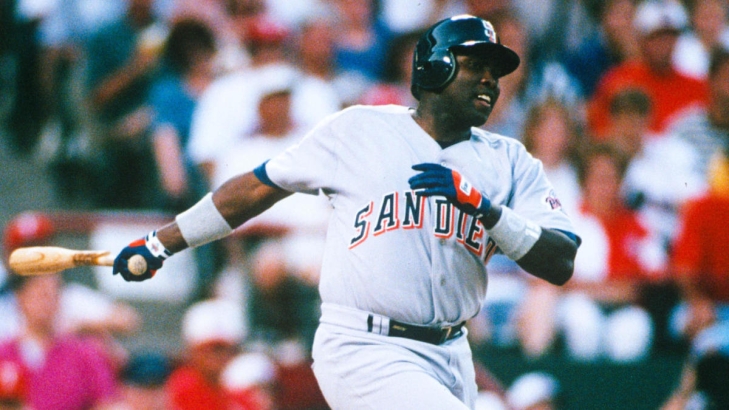
When constructing a historical hierarchy for a Major League franchise, debating the top spot usually requires parsing through eras, contrasting raw power against pitching longevity, and splitting hairs over decimal points. This is not one of those times.
Tony Gwynn is not just the undisputed legend of the San Diego Padres; he is one of the most exceptional and mesmerizing pure hitters in baseball history. Long before advanced analytics changed player evaluation, Gwynn revolutionized the game by approaching the batter's box as a science, pioneering detailed video analysis to study opposing pitchers. With a compact, instinctive left-handed swing that skillfully navigates the "5.5 hole" between third base and shortstop, he elevated contact hitting to an art form and a consistent part of his daily game.
His initial appearance during the 1982 season offered a brief preview of what was ahead, but Gwynn truly rose to star status in 1984. That year, he delivered an exceptional regular season, putting the franchise on the national stage. His consistent performance overwhelmed National League pitching by hitting a league-leading .351 and amassing 213 hits, the most in the league. His outstanding hitting fueled San Diego’s first-ever National League pennant run, earning him his first All-Star honor, a Silver Slugger award, and a third-place finish in MVP voting. In the NLCS against Chicago, his critical double in the bottom of the seventh inning of Game 5 drove in the tying and go-ahead runs, an iconic moment that sparked celebration at Jack Murphy Stadium and secured the Padres' first appearance in the Fall Classic.
The stunning breakout of 1984 quickly became routine over the next fifteen years. Aside from his brief 54-game debut, Gwynn consistently avoided slumps, batting over .300 in 19 consecutive summers. He achieved an impressive eight National League batting titles, tying Honus Wagner for the league record, and led in hits seven times. The peak of his individual dominance was during the strike-shortened 1994 season, when he batted an extraordinary .394, creating a lingering "what-if" regarding the .400 batting average milestone. Although he never won the MVP award, his advanced batting efficiency earned him seven top-ten MVP finishes and 15 All-Star selections.
Fourteen years after his first taste of October magic, Gwynn served as a revered elder statesman and offensive catalyst for the legendary 1998 team. Showing unwavering consistency at age 38, he hit .321 with a career-high 148 adjusted OPS+, guiding the team through a tough postseason, including victories over a strong Houston squad and the pitching-heavy Atlanta Braves. This outstanding run earned San Diego its second National League championship pennant, bringing the franchise back to baseball's biggest stage. In Game 1 of the 1998 World Series at Yankee Stadium, Gwynn capped his postseason performance with a majestic, decisive home run off El Duque Orlando Hernández, a memorable moment that remains etched in Padres fans’ memories.
Labeling Gwynn solely as a singles hitter overlooks the multi-dimensional skill set that defined his physical peak. While he wasn't primarily focused on hitting over fences, he had sneaky gap power, hitting 543 doubles and 135 home runs, which helped him achieve a strong .459 lifetime slugging percentage. Additionally, before aging and physical decline affected him, his exceptional spatial awareness and quick acceleration made him a dangerous base runner, with 319 stolen bases in his career. His defensive instincts were equally sharp, enabling him to move gracefully across the outfield and earn five National League Gold Glove awards.
Gwynn’s careful daily preparation set the stage for a historically unique profile, now even more complex with modern analytics. During a time when strikeouts increased rapidly league-wide, he demonstrated exceptional strike-zone judgment. He faced Hall of Fame legends like Greg Maddux, Tom Glavine, John Smoltz, and Pedro Martínez a total of 323 times, and was remarkably never struck out by any of them. His skill in making contact against top-tier, high-velocity pitches allowed him to lead the batting order with an extremely low walk-to-strikeout ratio, showing that his legendary vision was not just a physical talent but also a disciplined, mental mastery of situational hitting.
When he finally left the diamond at the end of the 2001 season, he did so as a true, unwavering “Lifer”, spending his entire 20-year career in a single uniform. Gwynn established an extraordinary, record-breaking career that sounds like science fiction today: 3,141 hits, 1,138 RBIs, and an impressive .338 batting average, with only 434 strikeouts in nearly 10,240 plate appearances. The organization quickly recognized his significance by retiring his iconic number 19 and inducting him into the Padres Hall of Fame in 2004. Three years later, national voters cemented his legacy by inducting him into the Baseball Hall of Fame on his first ballot in 2007, ensuring that "Mr. Padre" remains legendary forever.
The College Football Hall of Fame announces the Class of 2022
As we await tonight’s National Championship Game between Alabama and Georgia, the College Football Hall of Fame announced the 21-man Class of 2022. This year, 18 players and three Coaches were chosen.
Players:
LaVar Arrington. Linebacker, Penn State, 1997-99. Arrington was a product of “Linebacker U” under Joe Paterno, and in 1999 he was so dominant that he was ninth in Heisman voting, and won the Chuck Bednarik Award and Dick Butkus Award. He also was named the Big Ten Co-Defensive Player of the Year. The two-time All-American went on to play in the NFL for the Washington Redskins, earning three Pro Bowls.
Champ Bailey. Defensive Back, Georgia, 1996-98. Bailey was one of the best defensive players in Bulldogs history, winning the 1998 Bronko Nagurski Award as the nation’s top player. In addition to his defensive prowess, Bailey was also a decent Wide Receiver and Returner, and was the team’s star in their 1998 Peach Bowl win. Bailey went on to have a Pro Football Hall of Fame career, and went to 12 Pro Bowls in a career split between Washington and Denver.
Michael Crabtree. Wide Receiver, Texas Tech, 2007-08. Crabtree played two seasons for the Red Raiders, winning the Fred Biletnikoff as the top Wide Receiver in both years. He accumulated 3,127 Receiving Yards with 41 Touchdowns for the school, and he would have 7,499 Yards with 54 TDs as a pro playing for San Francisco, Oakland, Baltimore and Arizona.
Sylvester Croom. Center, Alabama, 1972-74. Croom helped lead Alabama to three SEC Titles and the National Championship in 1973. After playing one year for the New Orleans Saints, he would have a long history as a coach, punctuated by winning the SEC Coach of the Year in 2007 at Mississippi State.
Mike Doss. Safety, Ohio State, 1999-02. Doss was a three-time First Team All-Big Ten Selection, and had 331 Tackles, eight Interceptions and eight Sacks over his collegiate career. His highlight was winning the Fiesta Bowl MVP in the BCS National Championship Game, and he was also the Big Ten Co-Defensive Player of the Year. Doss would later win a Super Bowl with Indianapolis Colts.
Chuck Ealey. Quarterback, Toledo, 1969-71. Ealey was a three-time MAC Offensive Player of the Year and was eighth in Heisman voting in 1971. The Quarterback threw for an even 5,000 Yards and 42 Touchdowns for the Rockets. The African-American was passed over by the NFL, but he had a long career in the CFL.
Kevin Faulk. Running Back, LSU, 1995-98. Faulk rushed for 4,557 Yards for LSU, which at the time was second time all-time in SEC history. Also accumulating another 600 Yards, Faulk had 53 Touchdowns for the school. He would later help New England win three Super Bowls, and he won a National Championship as LSU’s Running Backs Coach in 2020.
Moe Gardner. Defensive Tackle, Illinois, 1987-90. Gardner was a two-time Consensus All-American who helped the Illini win the 1989 Citrus Bowl. Gardner was named the 1989 Big Ten Defensive Lineman of the Year and was the Co-Big Ten Defensive Player of the Year in 1890. He would later play six seasons in the NFL for Atlanta.
Boomer Grigsby. Linebacker, Illinois State, 2001-04. A three-time Division I-AA All-American, Grigsby was the three-time Gateway Player of the Year. The Linebacker finished second in his sophomore season for the Buck Buchanan Award as top defensive player in I-AA. He later played three years with the Kansas City Chiefs.
Mike Hass. Wide Receiver, Oregon State, 2002-05. Hass won the Biletnikoff Award as a Senior and amassed 3,924 Receiving Yards with 20 Touchdowns for the Beavers. He later played professionally for Chicago and Seattle.
Marvin Jones. Linebacker, Florida State, 1990-92. A two-time All-American with the Seminoles, Jones won the Butkus and Lombardi Awards in 1992. Jones later plated 11 seasons with the New York Jets.
Andrew Luck. Quarterback, Stanford, 2009-11. Luck was the Heisman Trophy winner in 2010 and 2011, and he captured the PAC-10/12 Offensive Player of the Year in both seasons. In 2011, Luck also won the Johnny Unitas Golden Arm Award, Maxwell Award and Walter Camp Player of the Year Award. Luck threw for 9,430 Yards and 82 Touchdowns, and had a successful career with the Indianapolis Colts.
Mark Messner. Defensive Tackle, Michigan, 1985-88. Messner was a four-time First Team All-Big Ten player, and the 1986 Fiesta Bowl Co-MVP as well as the 1988 Big Ten Defensive Player of the Year. Messner overall had 248 Tackles, 70 Tackles for Loss and 36 Sacks.
Terry Miller. Running Back, Oklahoma State, 1974-77. Miller rushed for 4,754 Yards with 49 Touchdowns for the Cowboys, and was the runner-up to Earl Campbell for the 1977 Heisman. He later played for Buffalo and Seattle.
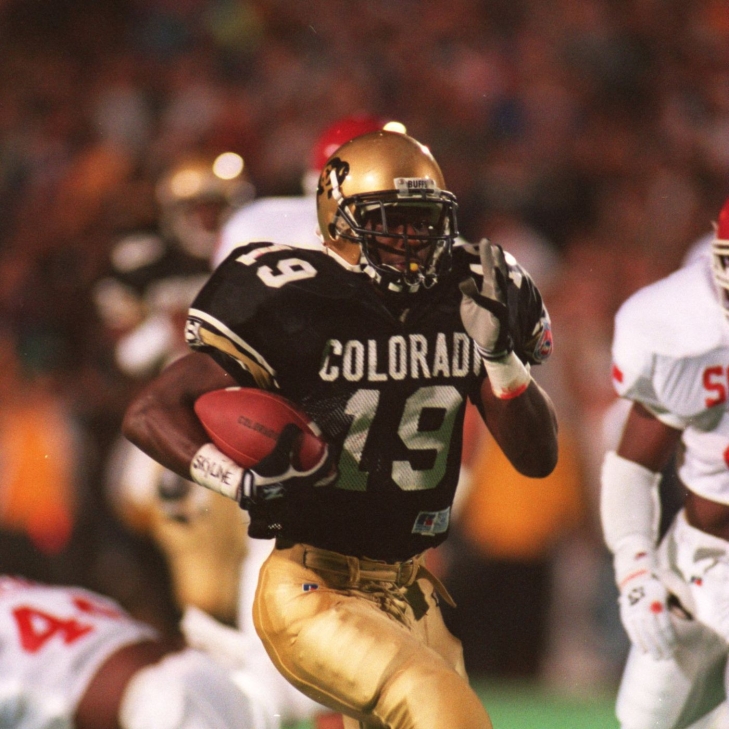
Rashaan Salaam. Running Back, Colorado, 1992-94. In 1994, Salaam won the Heisman, Walter Camp Award and Doak Walker Award, and led the Buffaloes to a 1995 Fiesta Bowl win. Salaam rushed for 2,005 Yards with 24 Touchdowns that year, and later played pro ball with Chicago and Cleveland.
Dennis Thomas. Center, Alcorn State, 1971-73. Thomas was a two-time All-American, and made history as the first (and to date) only Lineman to win the SWAC Offensive Player of the Year.
Zach Wiegert. Offensive Tackle, Nebraska, 1991-94. Wiegert dominated the O-Line for the Cornhuskers and won the Outland Trophy and Jim Parker Trophy in 1994. He was also a three-time First Team All-Big Eight Selection and professionally would play for St. Louis, Jacksonville and Houston.
Roy Williams. Defensive Back, Oklahoma, 1999-01. Williams had nine Interceptions for the Sooners and was a part of the team that won the National Championship in 2000. A two-time First Team All-Big 12 Selection, Williams won the Bronko Nagurski Award, Jim Thorpe Award and Big 12 Defensive Player of the Year in 2001. He later went to five Pro Bowls as a member of the Dallas Cowboys.
Coaches:
John Luckhardt. 222-70-2. Washington & Jefferson 1982-98, California 2002-11.
Billy Jack Murphy. 91-44-1. Memphis 1958-71.
Gary Pinkel. 191-110-3. Toledo 1991-00, Missouri 2001-15. Pinkel was a two-time MAC Coach of the Year, one-time SEC Coach of the Year and won two Cotton Bowls.
We here at Notinhalloffame.com would like to congratulate the newest members of the College Football Hall of Fame.
