

8. Jack Christiansen
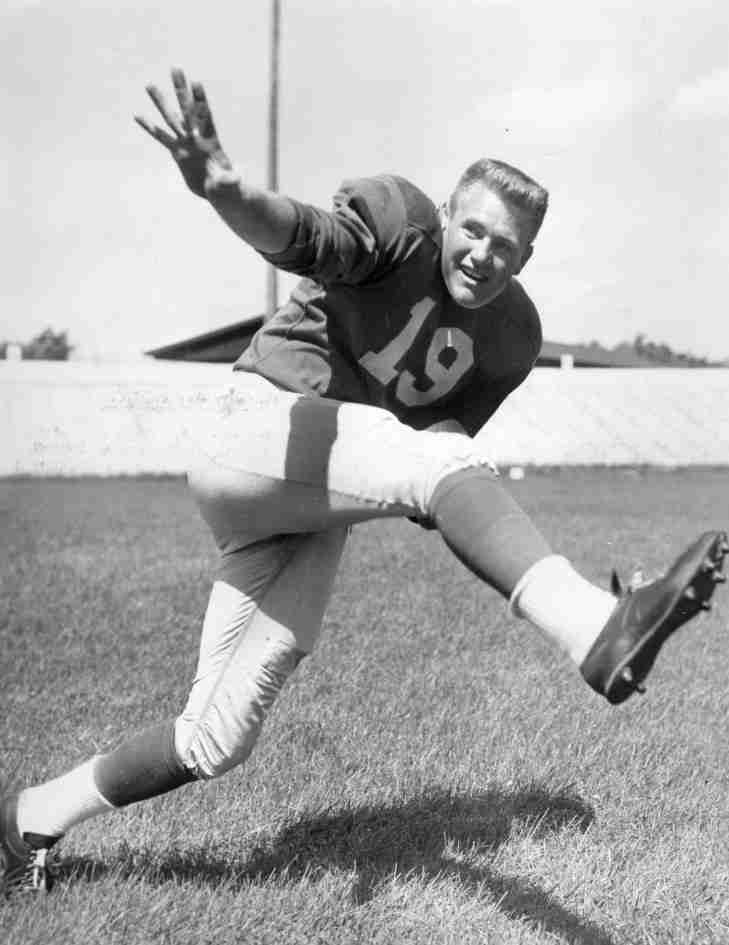
From Colorado A&M, Jack Christiansen was chosen in the sixth round of the 1951 NFL Draft, and he came in as a track-star athlete with game-breaking speed. Operating as the catalyst for Detroit’s secondary—famously nicknamed "Chris's Crew"—Christiansen revolutionized the safety position. His closing speed and instincts forced opposing offenses into a strict game plan: don't throw into his zone, and whatever you do, don't punt the ball anywhere near him.
Christiansen made his debut with an outstanding rookie season in 1951, establishing an NFL record by scoring four touchdowns on punt returns. This included a notable single-game achievement against Los Angeles, where he returned two punts for touchdowns—a feat he impressively replicated six weeks later against Green Bay on Thanksgiving. He maintained this momentum throughout 1952, achieving an NFL-record average of 21.5 yards per punt return along with two additional touchdowns. During this period, he also contributed significantly to the secondary, helping Detroit secure its first world championship in 17 years.
In 1953, Christiansen reached his peak performance, transitioning fully to strong safety and delivering one of the most impressive defensive seasons ever. He topped the league with 12 interceptions, including a 92-yard return for a touchdown, helping the Lions secure consecutive NFL Championships against Cleveland. This outstanding year sparked a six-year run of First-Team All-Pro selections (1952–1957), during which he recorded 8 interceptions in 1954 and again in 1956.
The crown jewel of his career came in 1957. Christiansen once again led the NFL in interceptions with 10 takeaways, serving as the defensive general for a squad that dismantled Cleveland 59–14 in the championship game, securing his third world title ring. By the time injuries prompted his retirement after the 1958 season, his eight career punt return touchdowns remained an NFL gold standard for more than three decades.
Statistically, Christiansen played in 89 regular-season games and amassed 46 interceptions for 717 return yards, three pick-sixes, and 85 punt returns for 1,084 yards (a 12.8 career average) with eight touchdowns, alongside three NFL Championship rings. A six-time First-Team All-Pro, five-time Pro Bowler, two-time NFL interception leader, and member of the NFL’s 1950s All-Decade Team, Christiansen was enshrined in the Pro Football Hall of Fame in 1970 and named a charter member of the Pride of the Lions in 2009.
3. Bobby Layne
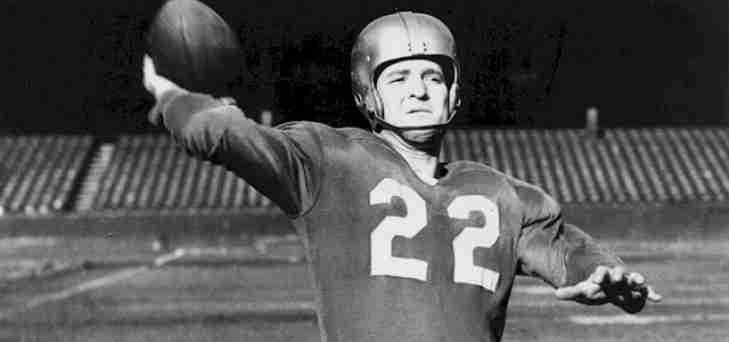
A standout multi-sport star at Texas, Bobby Layne went third overall in the 1948 draft but needed a few early detours—a season with the Chicago Bears behind Sid Luckman and a year with the New York Bulldogs—before finding his true football home. A 1950 trade brought him to Detroit, giving head coach Buddy Parker the fierce, swaggering signal-caller he needed to transform the Lions into the undisputed powerhouse of the decade.
Layne wasn't a textbook passer, but he was a born leader who commanded absolute loyalty in the huddle. A stocky, hard-charging quarterback who refused to wear a facebar on his helmet long after others adopted protective gear, Layne played with a street-fighter's mentality. He threw tight spirals when necessary, but he was equally dangerous scrambling, taking brutal hits, or callously running over linebackers to secure a first down. His off-field appetite for late-night living was legendary, yet his preparation and sheer competitive drive were unmatched when Sunday arrived.
His arrival marked the start of a golden era for the franchise. Layne led the NFL in passing yards for two consecutive seasons, with 2,323 yards in 1950 and 2,403 yards in 1951. He developed a potent aerial attack with high school teammate Doak Walker and receiver Cloyce Box. In 1952, Layne steered the Lions to a 9–2 record and secured an NFL Championship against the Cleveland Browns, giving the city its first league title in nearly twenty years.
In 1953, he again showed his exceptional clutch performance by orchestrating one of the most renowned drives in professional football history. When trailing Cleveland 16–10 late in the fourth quarter of the NFL Championship, Layne confidently led the Lions on an 80-yard march down the field, finishing with an 8-yard touchdown pass to Jim Doran, securing back-to-back championships. His calm under pressure earned Walker’s famous remark: "Bobby never lost a game. Some days, time just ran out on him."
Though a broken leg sidelined him late in the 1957 season, Layne's early-season play put Detroit in position to win its third NFL Championship of the decade. However, the organization stunned the fanbase early in the 1958 season by trading the fiery quarterback to the Pittsburgh Steelers. Legend has it that, on his way out, Layne declared that Detroit would "not win another championship for 50 years"—a curse that became the infamous "Curse of Bobby Layne" as the franchise endured decades of postseason heartbreak.
Over nine seasons in Detroit (1950–1958), Layne played 97 games, rushing for 1,601 yards and 13 TDs, and passing for 15,710 yards with 118 TDs. A four-time Pro Bowler, two-time First-Team All-Pro, and NFL 1950s All-Decade Team member, he was inducted into the Pro Football Hall of Fame in 1967. The Lions retired his No. 22 jersey and named him a charter member of the Pride of the Lions in 2009.
16. Herman Moore
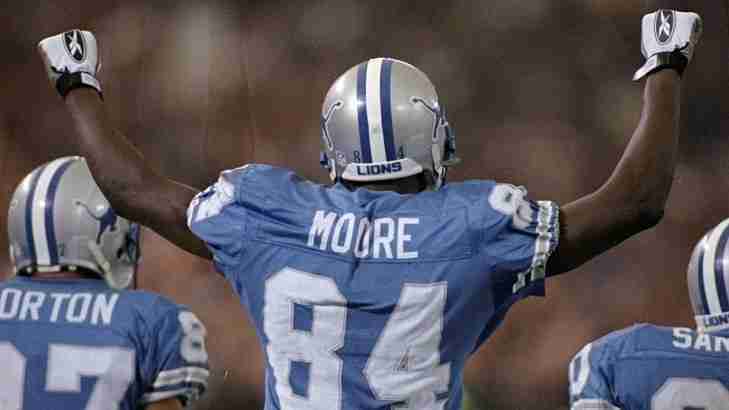
A fine offensive weapon for years, Herman Moore was drafted tenth overall in 1991 out of Virginia, bringing with him a sleek, 6-foot-4 wideout with high-jump athleticism and an extraordinary catch radius. While Barry Sanders commanded the attention of every defensive box in the league, Moore weaponized that single coverage to build one of the most dominant stretches by a wide receiver in 1990s pro football.
After a steady acclimation over his first three seasons, Moore broke out in 1994 with 72 receptions for 1,173 yards and 11 touchdowns, earning his first Pro Bowl nod. That proved to be just the prelude to a historic 1995 campaign. Moore hauled in an NFL-record 123 receptions for 1,686 yards and 14 touchdowns—shattering the league’s single-season catch mark and establishing himself as an absolute First-Team All-Pro superstar.
Moore, alongside Brett Perriman, formed one of the NFL’s most successful wide receiver duos. After a historic 1995 season, he continued with two more outstanding First-Team All-Pro years in 1996 and 1997, once again leading the league in 1997 with 104 catches. Over four seasons, he achieved four straight 1,000-yard campaigns, earned four Pro Bowl selections, and received three consecutive First-Team All-Pro honors (1995–1997). His skill in catching high balls over physical cornerbacks made Detroit’s red-zone offense extremely difficult to defend.
Injuries began to hamper his explosive athleticism in the late 1990s, but Moore departed Motown holding nearly every major receiving record in franchise history—all of which stood for over a decade until Calvin Johnson came along.
With the Lions, Moore compiled 670 receptions, 9,174 receiving yards, and 62 touchdown catches. In 2018, he became a member of the Pride of the Lions.
11. Calvin Johnson
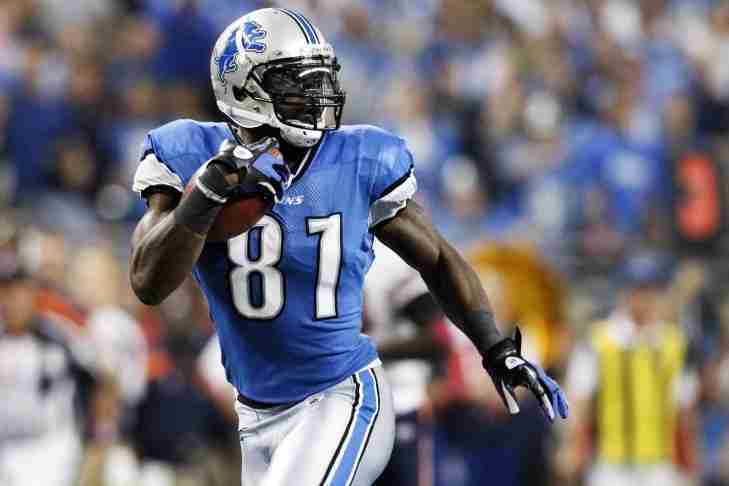
Selected second overall in the 2007 NFL Draft out of Georgia Tech, Calvin Johnson walked into Motown boasting physical attributes straight out of a video game. At 6-foot-5, 237 pounds with 4.35 speed and a 42.5-inch vertical, he earned the fitting nickname "Megatron" from teammate Roy Williams. Beyond those jaw-dropping athletic traits, Johnson was a pristine route runner with an absurd catch radius who turned double and triple coverage into a hopeless defensive strategy.
After showing star potential in his first few seasons—including a league-leading 12 touchdown catches in 2008—Johnson put together an absolute reign of terror from 2010 through 2013. His historic peak came in 2012, when he delivered the greatest receiving season in pro football history. Johnson shattered Jerry Rice's long-standing mark by hauling in an NFL-record 1,964 receiving yards on 122 catches, while recording eight consecutive 100-yard games along the way. Whether snatching jump balls over three defensive backs or outrunning cornerbacks on deep posts, he made the Lions an absolute must-watch national attraction.
That notable 2012 season marked the beginning of a streak with three consecutive First-Team All-Pro honors (2011–2013) and six consecutive Pro Bowl appearances (2010–2015). In 2013, he set a record by recording 329 receiving yards in a single game against Dallas, the highest total in regulation in NFL history. Despite dealing with persistent ankle and knee injuries from his aggressive playing style, Johnson remained a top performer until his final game, achieving 1,214 yards and nine touchdowns in his last season in 2015 before unexpectedly retiring at age 30.
Though his career spanned just nine seasons, Megatron rewrote the franchise record book, leaving as the Lions' all-time leader in receptions, receiving yards, and receiving touchdowns. He became the fastest player in NFL history to reach 10,000 receiving yards (doing so in just 115 games) and was named to the NFL’s 2010s All-Decade Team.
Across nine active seasons spent entirely with the Detroit Lions (2007–2015), Johnson played in 135 regular-season games with 130 starts. He compiled 731 receptions, 11,619 receiving yards, and 83 touchdown catches. A six-time Pro Bowler, three-time First-Team All-Pro, two-time NFL receiving yards leader, and Pride of the Lions member, Megatron was enshrined in the Pro Football Hall of Fame on his very first year of eligibility in 2021.
10. Alex Karras
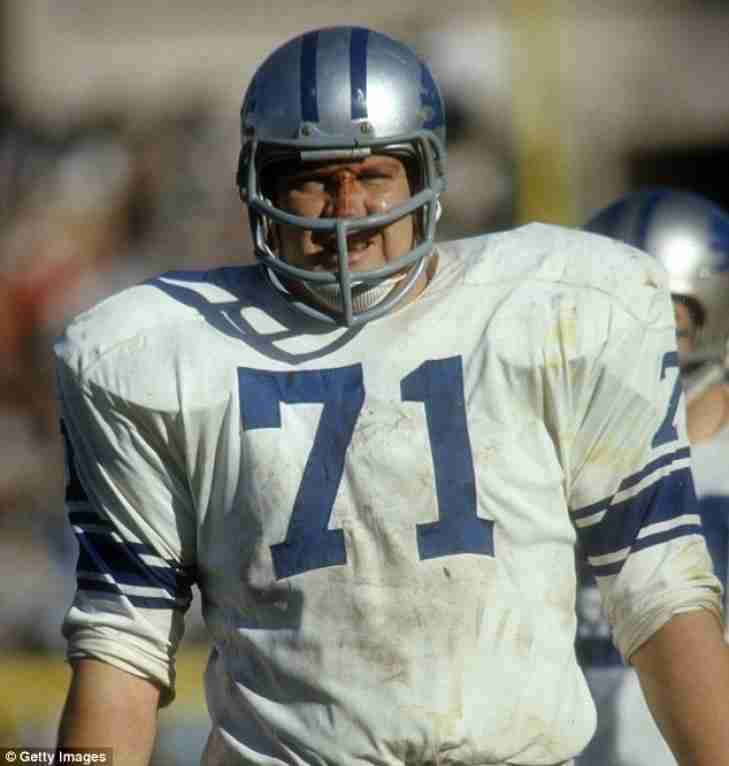
“Never mind that shit, here comes Mongo!”
The 1957 Outland Trophy winner, Alex Karras from Iowa, was selected tenth overall in the 1958 NFL Draft and brought immediate star power to Detroit. At 6-foot-2 and 248 pounds, Karras relied on explosive quickness, violent hand usage, and a relentless motor to penetrate opposing backfields. Alongside Roger Brown, Ndamukong Suh-precursor defensive tackle pressure, and a punishing front four, Karras anchored Detroit's defense throughout the 1960s.
When the whistle blew, Karras was pure bedlam for opposing interior linemen. He lacked the towering height of traditional tackles, but he weaponized his lower center of gravity with a devastating bull rush and a lightning-quick arm-over move that left guards lunging at air. In an era before sacks were an official stat, Karras made a habit of living in the backfield, most famously during the 1962 Thanksgiving Day "Thanksgiving Day Massacre" against Green Bay. Karras and the Lions' front four subjected Vince Lombardi’s unbeaten Packers to a brutal afternoon, sacking Bart Starr 11 times—including a safety by Karras—to hand Green Bay its only loss of the season.
Karras established his dominance early, reeling off three consecutive First-Team All-Pro selections and Pro Bowl nods from 1960 to 1962. His trajectory hit a dramatic wall in 1963 when NFL Commissioner Pete Rozelle suspended him for the entire season for gambling on NFL games and placing bets on his own team. Rather than let the controversy define him, Karras spent the year professional wrestling before marching right back onto the field in 1964 without missing a beat. He earned First-Team All-Pro honors again in 1965 while continuing to terrorize quarterbacks, remaining the emotional center of a defense that routinely ranked among the league's most fearsome. Film study research credits him with roughly 100 career sacks, a staggering output for an interior lineman in that era.
After retiring after the 1970 season, Karras seamlessly transitioned into a mainstream media icon. He punched Mongo in Blazing Saddles, spent years as a color commentator on Monday Night Football, and starred as the dad on the hit 1980s sitcom Webster. Yet despite his Hollywood fame, his gridiron legacy remained elite.
Karras played in 161 regular-season games with 155 starts. He compiled an unofficial 100.0 sacks, 18 fumble recoveries, four interceptions, and one safety. A four-time Pro Bowler, nine-time overall All-Pro (four First-Team selections), member of the 1960s All-Decade Team, and Pride of the Lions inductee (2018). His path to Canton was notoriously delayed, but justice finally arrived when he was chosen by the Centennial Slate Committee.
9. Lou Creekmur
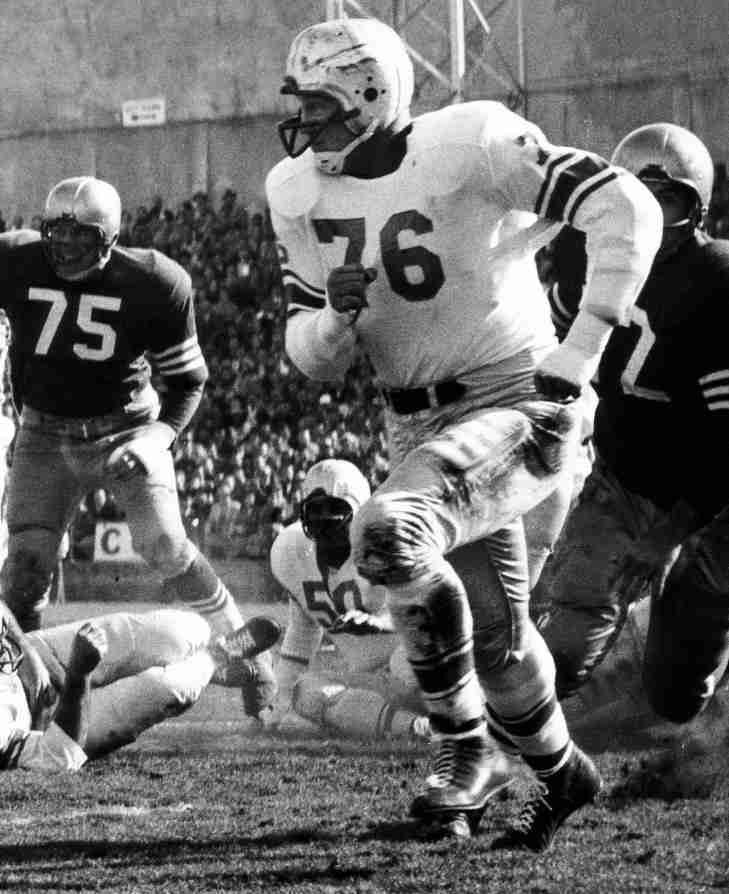
Acquired out of William & Mary in 1950, Lou Creekmur stepped onto the line of scrimmage in Motown and immediately established himself as an immovable force. Standing 6-foot-4 and 250 pounds, Creekmur possessed elite footwork and rare strength, functioning as the primary broad-shouldered bodyguard for backfield legends Bobby Layne and Doak Walker.
Creekmur's rare position-flexing talent anchored Detroit's dominant 1950s dynasty. He began his career as an offensive guard, earning All-Pro nods at the position in 1951 and 1952 while opening running lanes that powered the Lions to an NFL Championship over Cleveland. Shifted out to left tackle in 1953, he proved just as impenetrable on the edge, securing All-Pro honors at his new spot as Detroit captured back-to-back world titles. In fact, during that 1953 campaign, he earned All-League recognition at both guard and tackle—a testament to his incredible flexibility. He even filled in at defensive middle guard during emergency situations in 1955, making impact plays on both sides of the ball.
Beyond his technical leverage, Creekmur was legendary for his ironclad durability. Without the benefit of modern protective gear, he played through dislocated shoulders, severe knee sprains, and famously spent an entire season playing through a crushed sternum with a pad strapped to his chest. From his debut in 1950 through 1958, Creekmur never missed a single game—playing in 165 consecutive exhibition, regular-season, and postseason contests while leading the Lions to four championship game appearances and three world titles (1952, 1953, 1957). Retiring after the 1959 season, his decade-long career included eight Pro Bowls (1950-1957) and six First-Team All-Pros.
Creekmur played in 116 regular-season games with 107 starts and was enshrined in the Pro Football Hall of Fame in 1996 and named a charter member of the Pride of the Lions in 2009
6. Doak Walker
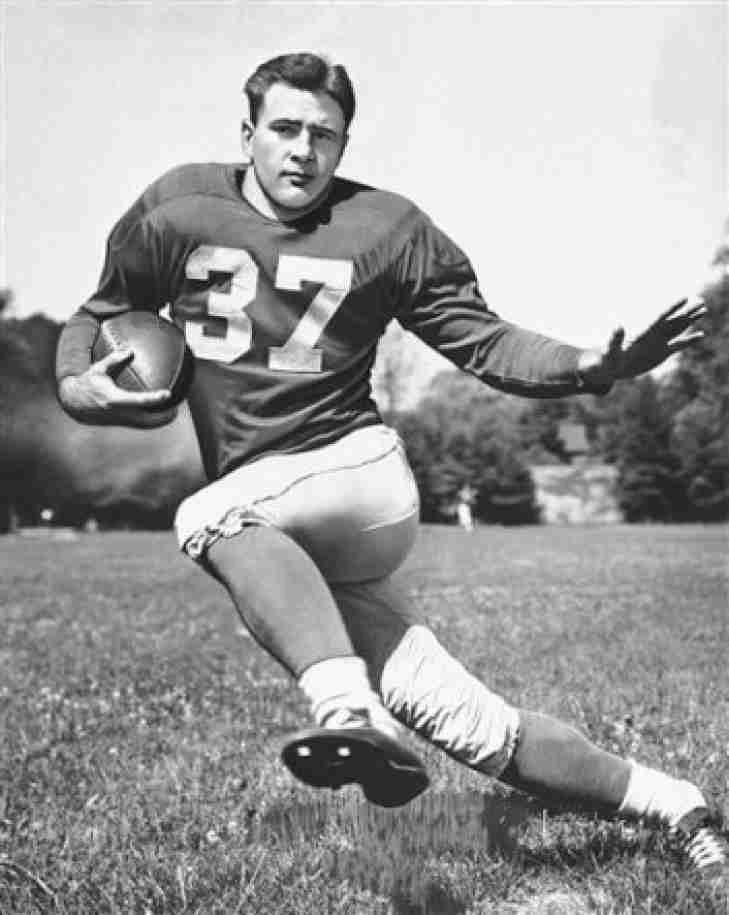
Drafted third overall in 1949 after an iconic collegiate tenure at SMU—where he won the 1948 Heisman Trophy and became such an institution that the national award for college football's top running back bears his name—Doak Walker stepped onto the professional stage carrying massive expectations. At 5-foot-11 and 173 pounds, critics openly questioned whether his lightweight frame could handle the physical toll of the NFL. Walker answered those doubts instantly, claiming Rookie of the Year honors in 1950 while leading the entire league in scoring with 128 points, racking up 11 touchdowns from scrimmage alongside 38 extra points and eight field goals.
Walker's impact on the game extended far beyond standard rushing charts. Operating as a halfback, wide receiver, placekicker, punter, and defensive back, he stood as the ultimate multi-dimensional threat in an era defined by two-way ironmen. Though his rushing total (1,520 career yards) appeared modest on paper, his versatility kept opposing coaches up at night; he averaged a remarkable 16.7 yards per reception out of the backfield, accumulating 2,539 receiving yards and 21 touchdown catches across his six seasons in Honolulu Blue.
That diverse skill set fueled Detroit's early 1950s dominance. Reuniting with his Highland Park High School teammate Bobby Layne, Walker became a clutch offensive playmaker who excelled at turning key moments in championship games. In the 1952 NFL Championship against Cleveland, he ended a scoreless tie with a memorable 67-yard touchdown run down the sideline, helping Detroit secure a 17–7 win. The next year, in the 1953 rematch against the Browns, Walker scored Detroit's first touchdown and later kicked the crucial extra point in a narrow 17–16 victory.
Walker concluded his career in 1955 with a remarkable individual performance, securing his second NFL scoring title with 96 points and earning his fifth Pro Bowl selection. At only 28 years old and at the height of his skills, he surprised the football world by retiring. When asked about his choice, Walker succinctly stated that he had achieved all his on-field goals, was in good health, and was prepared to focus on business pursuits outside football.
Walker played six seasons in Detroit (1950–1955), appearing in 67 games, with 1,520 rushing yards, 2,539 receiving yards, and 33 touchdowns. He also kicked 49 field goals and 183 extra points for 534 total points. A four-time First-Team All-Pro and NFL 1950s All-Decade Team member, his No. 37 jersey was retired by the Lions. Inducted into the Pro Football Hall of Fame in 1986, he became a Pride of the Lions charter member in 2009.
5. Lem Barney
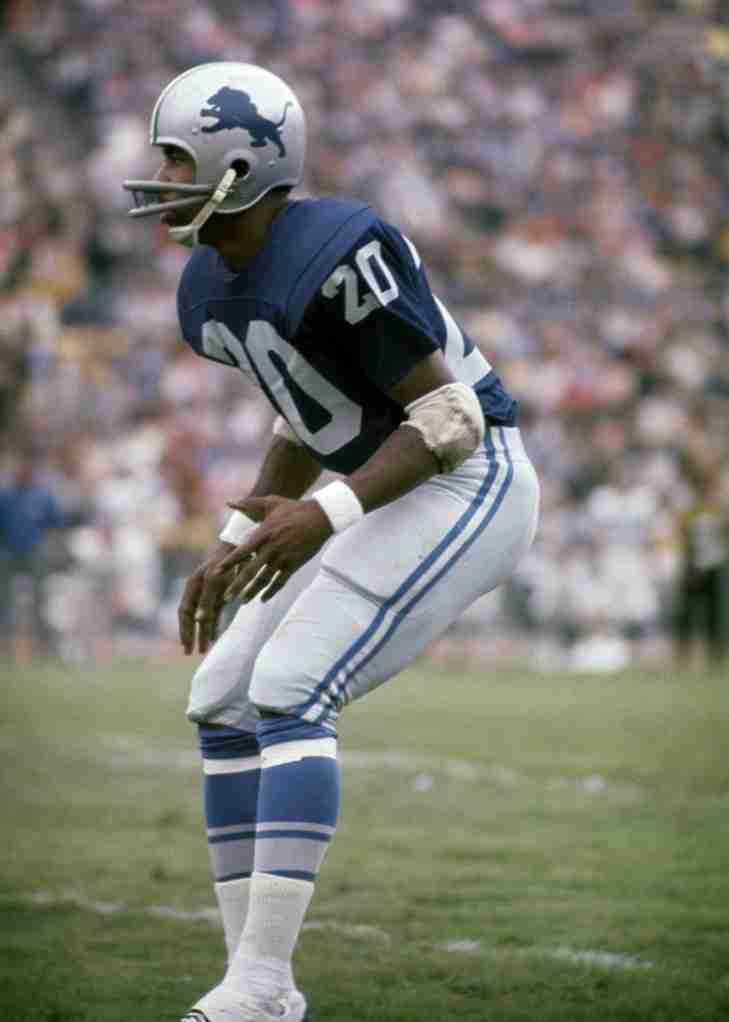
Selected in the second round of the 1967 NFL Draft out of Jackson State, Lem Barney stepped into the Detroit Lions secondary and delivered one of the most explosive rookie seasons in professional football history. On his very first NFL pass target, Barney intercepted Green Bay Packers legend Bart Starr and returned it 24 yards for a touchdown, setting the tone for a historic debut campaign. He led the entire NFL with 10 interceptions, returning three for touchdowns, while adding another score on a punt return to comfortably capture AP Defensive Rookie of the Year honors.
Barney followed up his historic rookie campaign with a dominant 1968 season, securing seven interceptions and returning a kickoff 98 yards for a touchdown against the Los Angeles Rams, which earned him his second invitation to the Pro Bowl as well as First-Team All-Pro honors. He elevated his performance in 1969 by intercepting eight passes and recording a 74-yard punt return touchdown against Minnesota, thereby securing his second consecutive First-Team All-Pro selection. In 1970, he intercepted seven passes and led the NFL with two interception returns for touchdowns — both against Bart Starr and the Green Bay Packers, including a 49-yard pick-six in the season finale that secured Detroit's qualification for the NFC playoffs. Despite opponents tending to avoid targeting his side of the field in the mid-1970s, Barney continued to demonstrate exceptional ball skills, earning consecutive Pro Bowl selections in 1972 and 1973, while maintaining his role as the defensive linchpin of the Lions' secondary.
Opposing quarterbacks quickly realized that throwing near Barney’s side was risky. With smooth hips, a quick burst, and top ball skills developed as a former college quarterback, he became the definitive shutdown cornerback of his era. Even as offenses avoided his side, Barney achieved seven Pro Bowl selections in his first eight seasons (1967–1969, 1972–1975) and was named First-Team All-Pro twice, in 1968 and 1969.
Beyond his dominance in coverage, Barney was a dangerous open-field player when he had the ball. He mainly handled punt and kickoff returns early in his career for Detroit, amassing 1,312 punt return yards, 1,274 kickoff return yards, and three touchdowns on special teams. Alongside his strong defense, Barney scored a total of seven non-offensive touchdowns, often changing field position and offering quick scoring opportunities for the Lions.
During 11 seasons in Detroit (1967–1977), Barney played 140 games, with 56 interceptions, 1,077 return yards, and seven defensive TDs. Named to the NFL 1970s All-Decade Team, his No. 20 jersey was retired in 2004 alongside Barry Sanders. He was inducted into the Pro Football Hall of Fame in 1992 and became a Pride of the Lions member in 2009.
12. Dick LeBeau
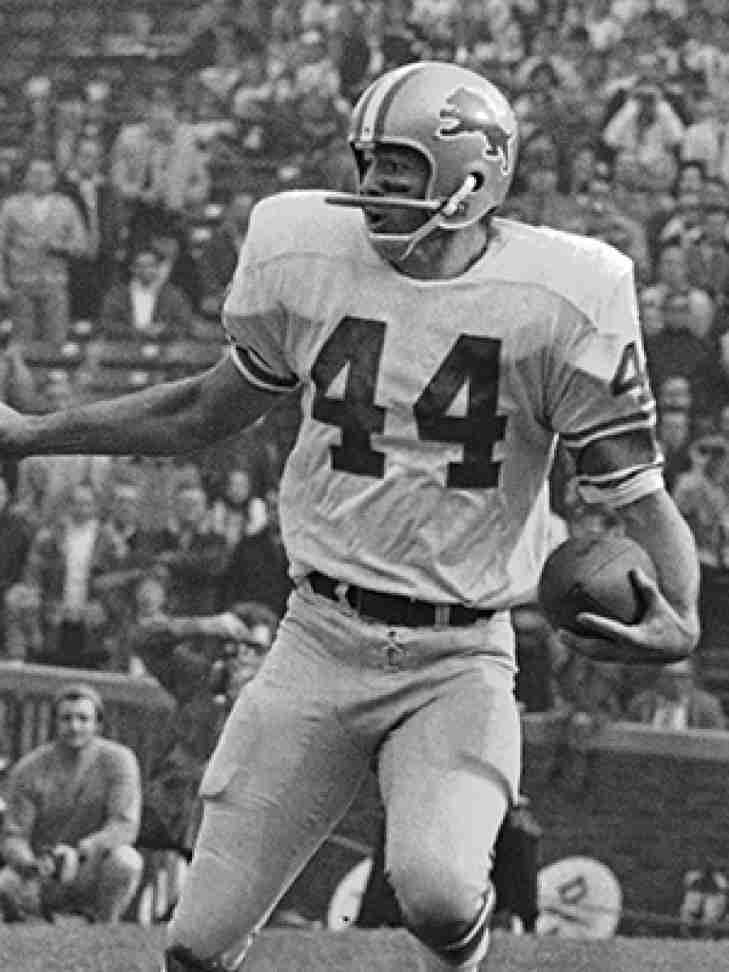
Drafted in the fifth round of the 1959 NFL Draft by Cleveland and promptly waived, Dick LeBeau landed in Detroit as a discarded defensive back with everything to prove. What the Lions acquired was a cerebral cornerback who would spend the next 14 years anchoring the right side of Motown's defense, mastering the intricacies of pass coverage and laying the strategic groundwork for a Hall of Fame career both on the field and on the sideline.
Playing as a secondary alongside Hall of Famer Dick "Night Train" Lane, LeBeau became known as a relentless ball hawk. His key physical ability was exceptional anticipation—predicting quarterback eye movements and route splits to intercept the ball before the throw was completed. Between 1962 and 1971, he achieved at least three interceptions in ten straight seasons. His personal best came during a three-year period from 1968 to 1970, when he earned three consecutive Pro Bowl selections and totaled 21 interceptions, including a career-high nine in 1970, tying for the NFC lead.
LeBeau was not only known for his coverage skills but also for his incredible durability. He set an NFL record for cornerbacks with 171 consecutive games played, demonstrating his toughness during a rough era of football. When he retired after the 1972 season, his 62 career interceptions were the highest in Lions history and ranked third in NFL history, following Paul Krause and Emlen Tunnell.
After retiring his pads, LeBeau made a second major impact on the sport by becoming a legendary defensive coordinator. He created the famous "Zone Blitz" scheme that shaped Pittsburgh's defense for many years. Even before he coached Super Bowl defenses from the sidelines, he was one of the most feared cornerbacks known for his ball-hawking skills.
LeBeau played 185 games, starting 172, with 62 interceptions, 762 return yards, three pick-sixes, and nine fumble recoveries. A three-time Pro Bowler, All-Pro, and Pride of the Lions (2010), he was inducted into the Hall of Fame in 2010.
13. Dick "Night Train" Lane
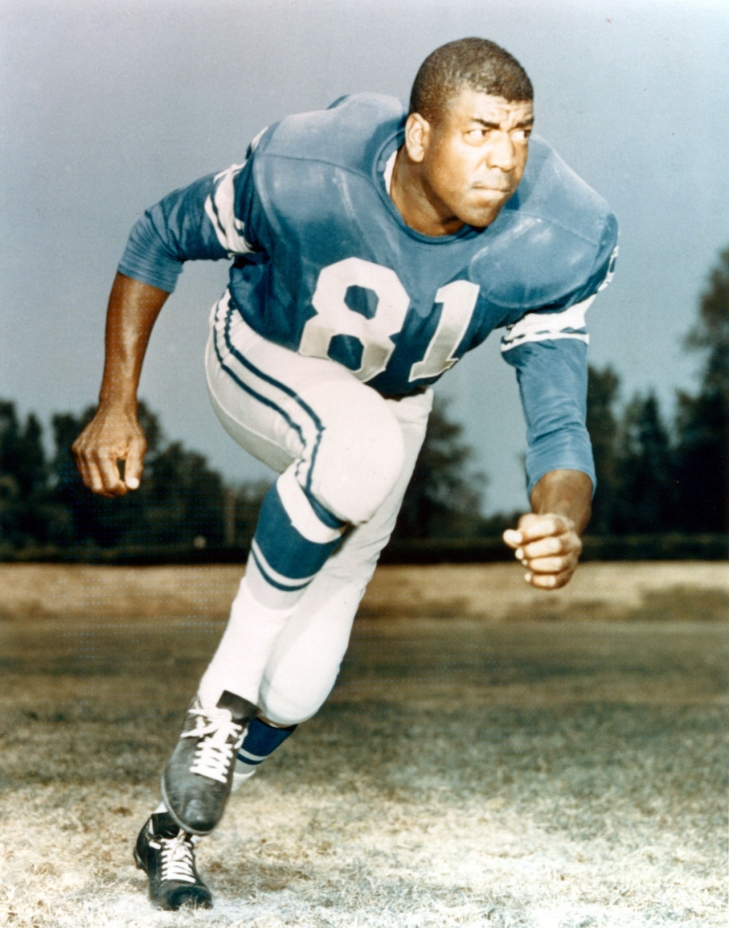
Acquired by Detroit in a trade with the Chicago Cardinals prior to the 1960 season, Dick "Night Train" Lane arrived in Motown at age 32 with his legendary reputation already carved into pro football lore. As an undrafted rookie with the Los Angeles Rams in 1952, he set an NFL single-season record with 14 interceptions in a 12-game schedule—a historic mark that still stands untouched today. Though he was entering the final chapter of his career when he put on the Honolulu Blue, Lane proved he remained the most feared perimeter corner in the game.
Lane brought an uncompromising, terrifying physicality to Detroit's secondary. Famous for his notorious "Night Train Necktie"—a violent clothesline tackle around ball carriers' necks that was eventually outlawed by the NFL—he intimidated receivers long before the ball reached their hands. Slotted at left cornerback alongside Dick LeBeau and Yale Lary, Lane anchored a secondary that made the Lions' defense one of the most punishing units of the 1960s.
His Motown stint yielded immediate elite honors. Lane earned three consecutive Pro Bowl selections from 1960 to 1962 and captured back-to-back First-Team All-Pro nods in 1961 and 1962, snaring 21 interceptions during his six seasons in Detroit. By the time he hung up his cleats following the 1965 campaign, his 68 career interceptions ranked second in NFL history behind only Emlen Tunnell. Named to the NFL's 50th, 75th, and 100th Anniversary All-Time Teams, Lane stands as arguably the greatest cornerback to ever play the game.
In his six seasons in Detroit, Lane played in 66 games for Detroit, compiling 21 interceptions for 272 return yards and one pick-six. A three-time Pro Bowler and two-time First-Team All-Pro in Detroit (seven-time First-Team All-Pro overall), Lane was enshrined in the Pro Football Hall of Fame in 1974 and inducted as a charter member of the Pride of the Lions in 2009.
7. Yale Lary
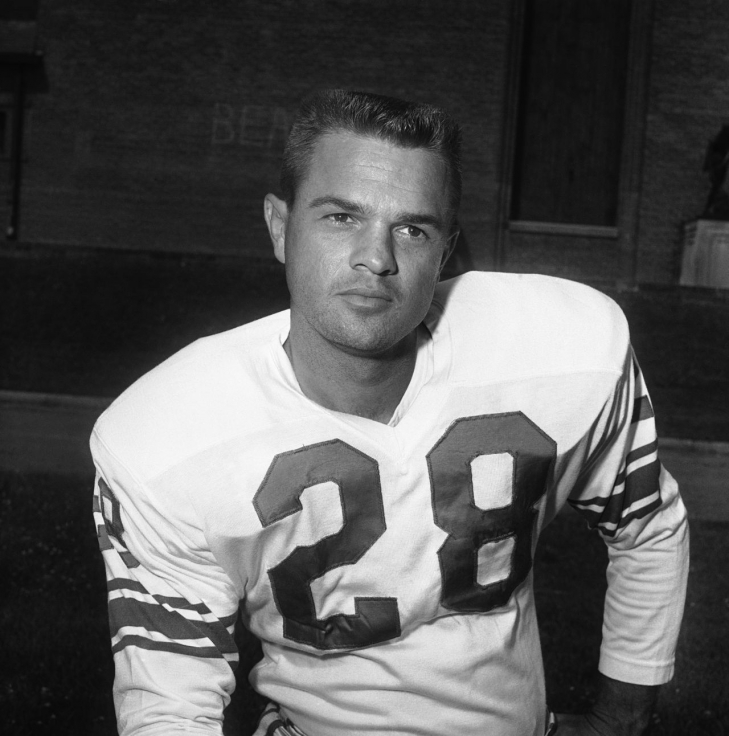
The Lions found a gem in the third round of the 1952 NFL Draft out of Texas A&M. Yale Lary stepped into Motown and instantly became a cornerstone of the finest secondary of his generation. Paired with Hall of Famers Jack Christiansen, Jim David, and later Dick "Night Train" Lane, Lary anchored the right safety spot for "Chris’s Crew," a defensive backfield that demoralized opposing passing attacks.
His rookie season in 1952 set the tone for Detroit’s golden era. Lary intercepted four passes, returned a punt 58 yards for a score against the Dallas Texans, and anchored the deep third as the Lions knocked off Cleveland 17–7 to secure the NFL Championship. He 1953, he continued his success with five interceptions, including a 74-yard punt return for a score against Baltimore, helping Detroit win consecutive world titles by beating the Browns again. Just as his career was soaring, Lary put it on hold in 1954 and 1955 to serve as a U.S. Army second lieutenant in Korea.
Returning seamlessly in 1956, Lary tied for second in the league with eight interceptions and returned a pick-six 73 yards. He picked up his third ring during Detroit's dominant 1957 championship run, sealing the 59–14 title-game blowout over Cleveland with his field-flipping playmaking. By the late 1950s, Lary had also established himself as the premier punter in professional football. He won three NFL punting titles (1959, 1961, and 1963)—highlighted by a staggering 48.9-yard average in 1963—and missed a fourth crown in 1964 by a fraction of an inch. Famous for incredible hang time, he once put together a stretch of six consecutive games without allowing a single punt return yard.
Lary concluded his playing days after the 1964 campaign as a rare three-way weapon who dictated every phase of the game.
Lary played in 133 games, with 50 interceptions for 787 yards, two pick-sixes, 503 punts for 22,279 yards (44.3 avg), and three touchdown returns, earning nine Pro Bowls, five All-Pro selections, and Hall of Fame induction in 1979. He was also a charter member of the Pride of the Lions in 2009.
2. Joe Schmidt
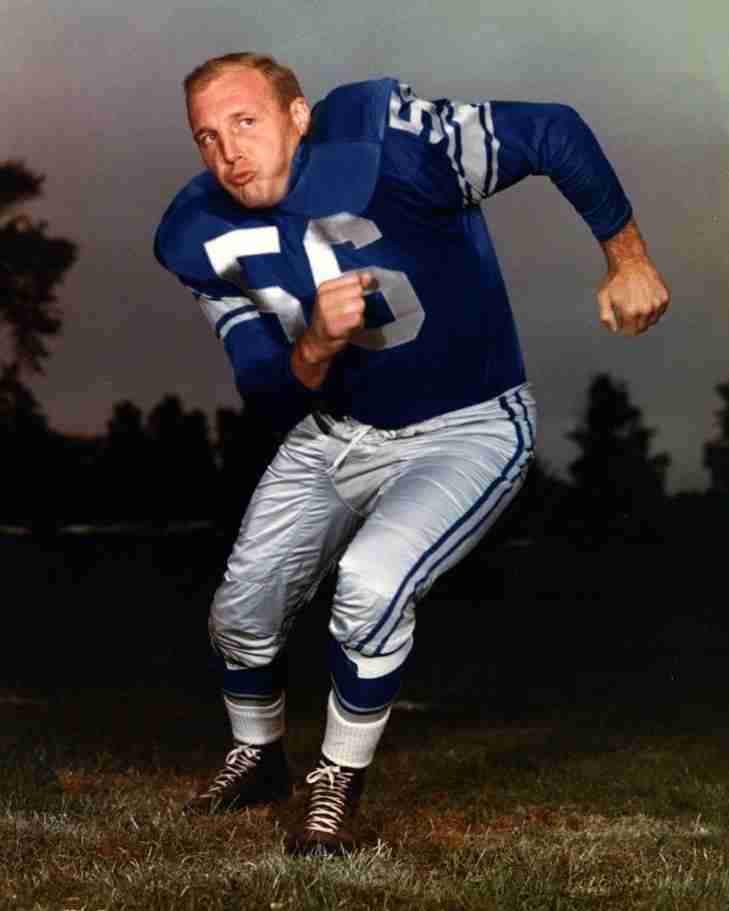
Selected in the seventh round of the 1953 NFL Draft out of Pittsburgh, Joe Schmidt came to the Motor City as an unheralded rookie with an incredible nose for the football. He quickly carved out a starting spot on a defense loaded with future Hall of Famers, making an immediate impact during Detroit's drive to the 1953 NFL Championship. By his second season, Schmidt had established himself as the absolute anchor of the Lions' defense, earning the first of ten consecutive Pro Bowl selections in 1954.
As head coach Buddy Parker installed the newly evolving 4-3 defense, Schmidt revolutionized the middle linebacker position. He brought unprecedented tactical instincts to the middle of the field, dropping seamlessly into pass coverage to blank opposing tight ends while maintaining the speed and instincts to fill run lanes from sideline to sideline. Named defensive captain in 1956—a leadership role he held for nine seasons—he essentially operated as an extension of the coaching staff, calling all defensive audibles at the line of scrimmage with uncanny accuracy.
Physically, Schmidt possessed a rare combination of brute strength and lateral range that set a brand-new prototype for the middle linebacker position. Listed at 6-foot-1 and 220 pounds, he was built like a granite slab, yet he maneuvered through traffic with the footwork of a safety. Rather than absorbing blocks from 250-pound guards, he used his fast hands and quick reads to slip underneath interior linemen, blowing up plays in the backfield before they could even materialize. His signature tackling form was devastating—a chest-to-chest blow that stopped ballcarriers in their tracks—and his sheer physical presence dictated how offenses approached the center of the field.
Schmidt reached the peak of his career in 1957, shining brightly as the defensive leader. He delivered an unforgettable season, with an impressive 157 tackles (80 solo) over 12 games, showcasing his talent and dedication. The United Press honored him with the NFL MVP award—an exceptional achievement for a defensive player—and he was also named to the First-Team All-Pro for the fourth year in a row. His remarkable season culminated in a spectacular performance during the 1957 NFL Championship Game, where he effectively contained rookie Jim Brown and the Cleveland Browns, helping Detroit secure a commanding 59–14 victory.
Opposing offenses really struggled to find an opening against him during his peak. When teams tried to throw over the middle, Schmidt would drop back into zone coverage with ease, grabbing 24 interceptions over his career. If they tried to run around the edges, his relentless energy and quick pursuit along the sidelines often forced runs out of bounds for only short gains. His knack for reading snap counts and spotting play-action fakes gave the Lions a clear strategic edge every time they took the field.
During his prime, Schmidt established one of the most impressive stretches by any NFL defender, earning eight First-Team All-Pro honors over nine seasons (1954–1957, 1958–1962). His strong leadership on defense made him a natural fit for coaching after retiring following the 1965 season. Schmidt joined the Lions' coaching staff as linebackers coach in 1966 and became head coach from 1967 to 1972, leading Detroit to four winning seasons and reaching the 1970 playoffs.
Schmidt played 13 seasons in Detroit (1953–1965), with 155 games, 24 interceptions, and 17 fumble recoveries as a top middle linebacker. He was named to the NFL 1950s All-Decade Team, had his No. 56 jersey retired by the Lions, and joined the Pride of the Lions in 2009. Inducted into the Pro Football Hall of Fame in 1973, he was also selected for the NFL 100th Anniversary All-Time Team.
1. Barry Sanders
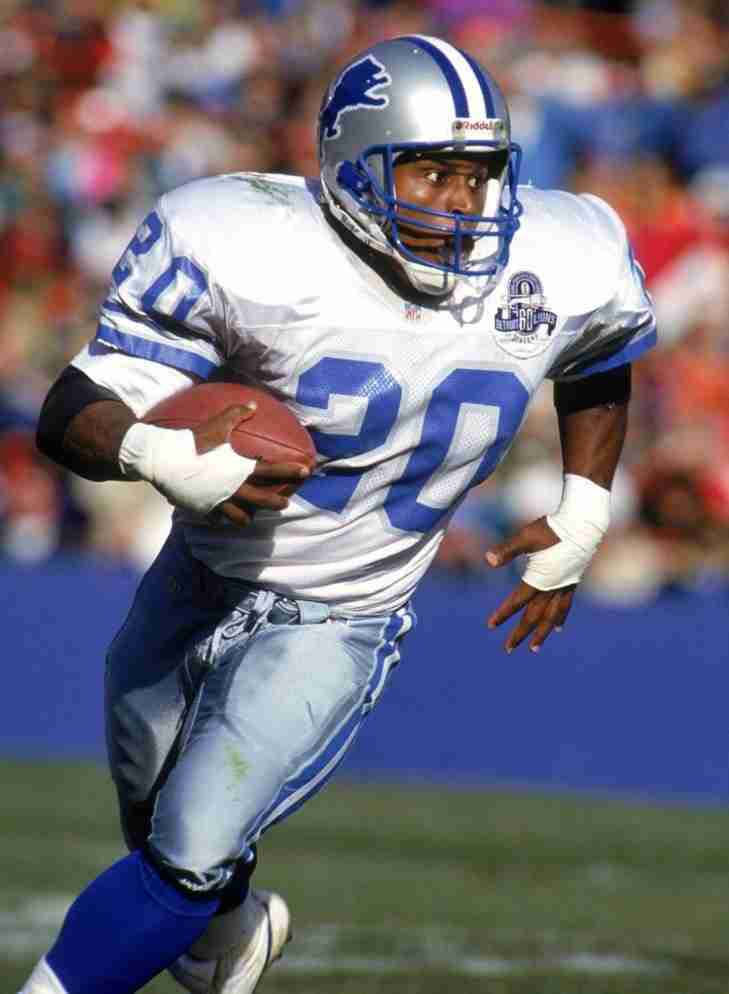
In 1988, Barry Sanders had one of the greatest seasons in college football history, rushing for 2,628 yards and 37 touchdowns, setting 34 NCAA records, and easily winning the Heisman Trophy. In the 1989 draft, Troy Aikman went first (Dallas), and after the Green Bay Packers whiffed on Tony Mandarich with the second pick, the Detroit Lions were blessed to have Barry Sanders as the third pick.
It was clear immediately that Detroit got a steal, even at number three. Barry Sanders took his first NFL handoff for an 18-yard burst, setting the tone for an astounding rookie campaign in which he fell just 10 yards short of the league rushing crown with 1,470 yards, comfortably capturing NFL Offensive Rookie of the Year honors.
What truly set Sanders apart was a movement profile unlike anything the sport had ever seen, making him a walking highlight reel whose playing style bordered on supernatural. Standing 5-foot-8 with a shockingly low center of gravity, massive thighs, and tree-trunk calves, he possessed an unmatched ability to sink his hips, plant a foot in the turf, and cut at right angles at maximum speed without losing momentum. His balance was absurd; where other backs were slowed down by low contact, Sanders simply bounced off arm tackles, spun out of scrums, and regained top speed in a single stride.
This elusive quality made him a nightmare for open-field tacklers, who often reached out in vain. Sanders mastered the rarely-used stop-and-start move, pausing suddenly to let overzealous defenders rush past, then quickly bursting in the opposite direction. He's well known for turning plays around—sometimes transforming a planned left run into a 50-yard dash down the right sideline—defying conventional coaching strategies and leaving defenders looking foolish in front of full stadiums.
This unique style yielded a high-variance, home-run-hitting brand of football that required the Lions to take the bad with the transcendent. Because Sanders refused to settle for a simple three-yard gain into the backs of his blockers, preferring instead to hit the brakes and probe for a seam, he holds the NFL record for the most carries stopped behind the line of scrimmage for negative yardage. Yet that willingness to improvise was precisely what made him unstoppable, as a play that looked destined for a five-yard loss could instantly turn into a jaw-dropping, ankle-breaking touchdown sprint.
That explosive ceiling allowed Sanders to dominate the 1990s as a four-time NFL rushing champion while hitting the 1,000-yard mark in all ten of his professional seasons. He captured his first rushing title in his sophomore year of 1990 with 1,304 yards, claimed his second in 1994 with an incredible 1,883 yards on the ground, and added a third crown in 1996 with 1,553 yards. His presence made the Wayne Fontes-led Lions a perennial playoff contender, famously leading Detroit to a 12–4 record and an appearance in the 1991 NFC Championship Game.
His most outstanding moment was during his legendary 1997 season, often considered one of the greatest individual campaigns in league history. After initially gaining only 53 yards in the first two games, Sanders then achieved an extraordinary streak, setting an NFL record with 14 straight games of 100 yards or more, ending the season with 2,053 rushing yards. He won both the NFL MVP and Offensive Player of the Year awards, joined the exclusive 2,000-yard club, and maintained an impressive 6.1 yards per carry, firmly establishing himself as the leader of Detroit's offense.
In addition to his remarkable production, Sanders was known for his modest, low-key attitude on the field. During a time when elaborate and choreographed touchdown celebrations became common, Sanders distinguished himself by silently handing the ball to the official after each touchdown and calmly returning to the sideline as if it was just another routine moment. This combination of humility and exceptional athleticism garnered widespread respect from teammates, rivals, and fans throughout the sports world.
The football world was knocked flat on its back prior to the 1999 season when Sanders, still at the absolute peak of his powers at age 31, announced his sudden retirement via fax. Frustrated by the organization's trajectory and unwilling to pad stats for another franchise, he walked away just 1,457 yards shy of Walter Payton's all-time NFL rushing record—leaving millions of fans (and this website in perpetuity) wondering just how unreachable his career totals would have been had he played another three or four years.
Over ten unforgettable seasons spent entirely in Detroit (1989–1998), Sanders appeared in 153 games, compiling 15,269 rushing yards, 99 rushing touchdowns, and 2,921 receiving yards while earning 10 Pro Bowl nods and ten All-Pro selections (six First-Team). The Lions retired his iconic No. 20 jersey in 2004, the same year he was enshrined in the Pro Football Hall of Fame in his first year of eligibility. Sanders was also named to the 1990s and NFL 100th Anniversary Team.
It's Official: Calvin Johnson Retires.
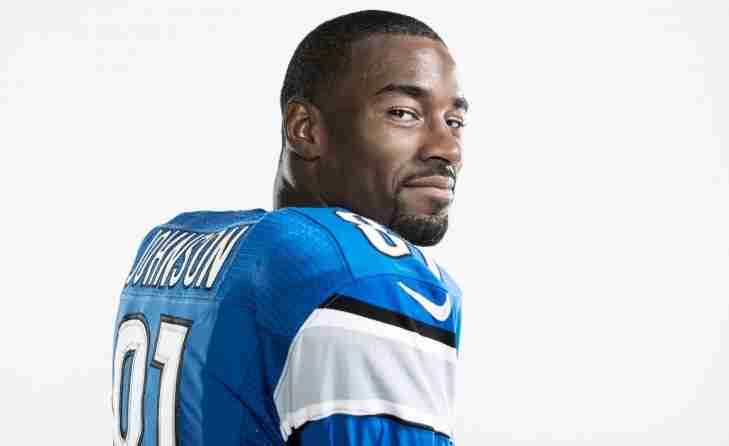
As reported a month ago, Calvin Johnson made good on his claim that he was done with playing professional football and he has officially retired.
“Megatron” goes down as one of the most dynamic players in the history of the Detroit Lions and easily the best Wide Receiver in team history. Johnson retires with 11,619 Receiving Yards and 83 Receiving Touchdowns with seven seasons exceeding the 1,000 Yard mark. He was a six time Pro Bowl choice, a three time First Team All Pro and would twice lead all receivers in yards.
While Johnson was an elite player, his Hall of Fame ticket is not punched, as with the exception of Receiving Yards/Game (he is 2nd overall) he is not in the top twenty in any major category and with the explosion in the modern offense, he will drop quickly. Johnson also has never won a playoff game, factors that could affect the voters.
Still, he is a Hall of Famer in our book, and we would like to wish Calvin Johnson the best in his post playing career.
Calvin Johnson Retires
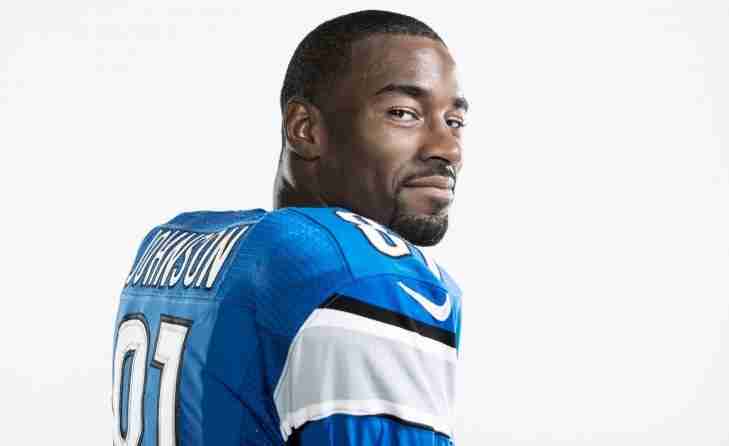
It was reported today that multiple sources have told ESPN that Calvin Johnson had informed the Detroit Lions and a close circle of family and friends that he will be retiring from the National Football League.
Should this in fact be the case, the Wide Receiver known as “Megatron” has put up a stellar NFL career that includes the following:
3 First Team All Pro Selections
5 Pro Bowls
1 Receptions Title
2 Receiving Yards Title
731 Receptions
11,619 Receiving Yards
83 Receiving Touchdowns
15.9 Yards/Reception
Calvin Johnson may not have the career numbers of some of the current former Wide Receivers who are chasing Canton, but he does have elite seasons, and was a game changer. This makes him in our eyes a bona fide Hall of Fame contender, which he will become eligible for in 2021.
Should this be the end of Calvin Johnson’s career, we here at Notinhalloffame.com would like to thank “Megatron” for the memories and wish him the best in his post-playing career.
RIP: Charlie Sanders
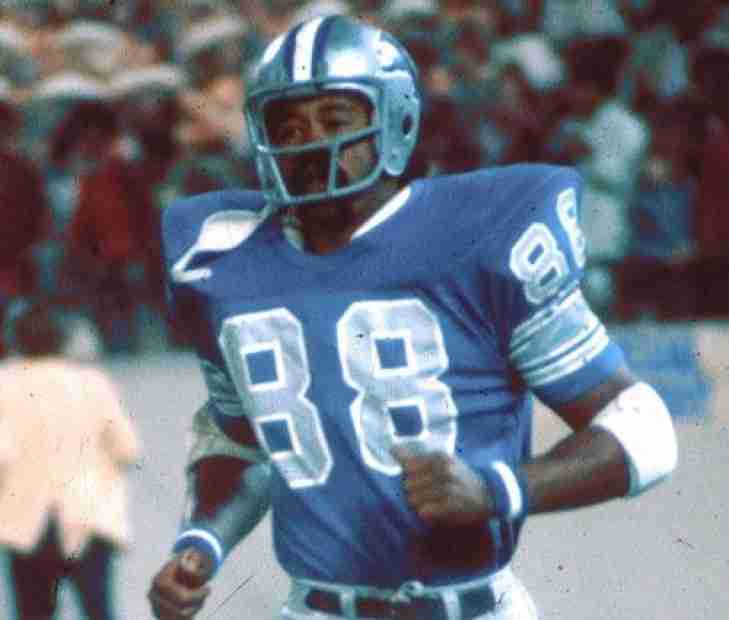
Sanders was a very popular figure with the Detroit Lions and would spend his entire playing career there. The Tight End was initially drafted in the third round in 1968 and would go on to make seven Pro Bowls and was also chosen for the 1970’s All-Decade Team. He would record nearly 5,000 receiving yards, an excellent amount for a Tight End in that era.
Sanders would go on to become a successful broadcaster for Detroit Lions broadcasts and later was an Assistant Coach. Overall, Charlie Sanders would spend over four decades affiliated in some capacity with the Detroit Lions.
We here at Notinhalloffame.com would like to extend our condolences to the friends and family of Charlie Sanders at this time.
RIP: Dick Stanfel
Last week, Dick Stanfel, a man who is ranked at #30 by us on our Notinhalloffame.com Football list passed away at the age of 87. Stanfel was a two time NFL Champion (1952 & 1953) with the Detroit Lions and was a member of the 1950’s All-Decade Team. The Offensive Guard would also be chosen for five Pro Bowls.
Following his playing career, Stanfel would enjoy a long tenure as an Offensive Line Coach, most notably a decade with the Chicago Bears, where he was a coach on the 1985 Bears Super Bowl winning team.
Stanfel would twice be named as a Senior Nominee for the Pro Football Hall of Fame, but would not be selected.
We here at Notinhalloffame.com would like to extend our condolences to the friends and family of Dick Stanfel at this time.
168. Roger Brown
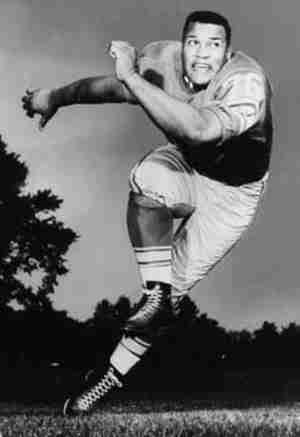
It is alleged that Roger Brown was the first legitimate 300-pounder in the National Football League. Today, this is commonplace, but Brown proved that a much larger man could be very athletic. It is also amazing that someone so big could be forgotten so quickly.
Brown was good, but he played alongside other greats of the sport. As a Detroit Lion, he played with Alex Karras, who got all the headlines. Later he would become a Los Angeles Ram and would be the fourth cog of the Ram’s Fearsome Foursome defense behind the big names of Deacon Jones and Merlin Olsen. Roger Brown may not have turned his name into a household one, but his size and skill made him one of the most feared Defensive Lineman in the league, and his Pro Bowls were earned and not by riding the coattails of his more famous teammates.
What would Roger Brown’s legacy be if he was the featured defensive star of his team? He was good enough to have been, but circumstances blessed him to play with the greats but cursed him to be in their shadows.
