


Site Admin
15. Edgardo Alfonzo
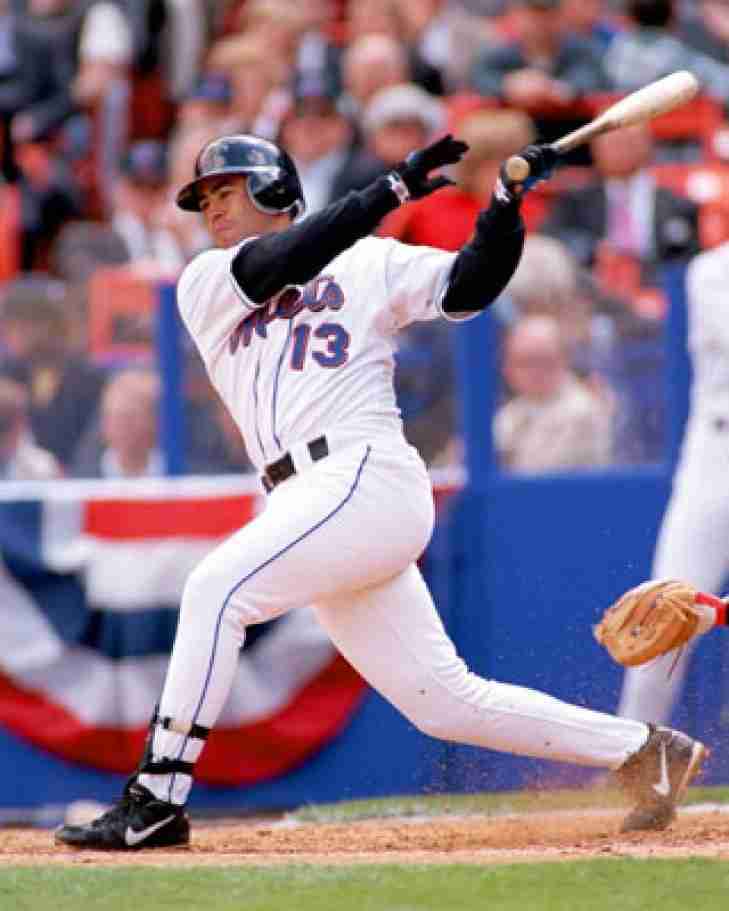
Edgardo Alfonzo made his debut on Shea Stadium's turf in 1995 as a notably poised young infielder from Venezuela. Over time, he subtly developed into one of the most versatile and clutch players in franchise history. Although he did not have the flashy public profile of some peers, he served as the vital backbone of the Mets' infield, moving effortlessly between third and second base.
Anchoring the iconic late-1990s infield, Alfonzo achieved a historic milestone by accumulating over 150 hits in five different seasons with the Mets. He combined this volume with a keen eye at the plate, hitting over .300 in four of those years. His peak offensive performance came in 1999, when he hit 27 home runs and drove in 108 RBIs, earning the National League Silver Slugger Award at second base. He continued his strong play with an All-Star selection in 2000, batting .324 with 109 runs scored, helping the Mets secure their fourth National League Pennant.
Beyond the numbers, Alfonzo achieved peer recognition, finishing in the top 15 of NL MVP twice (8th in 1999, 15th in 2000) and receiving votes in three years. He combined offensive efficiency with stellar defense, providing Gold Glove-caliber glove work wherever manager Bobby Valentine put him. In Flushing, he proved to be a postseason weapon, launching a two-run homer in the 1999 Wild Card game and a historic grand slam in the NLDS against Arizona.
Alfonso departed the Mets for San Francisco as a Free Agent in 2002. As a Met, he collected 1,136 hits, 120 home runs, and a stellar .374 on-base percentage. In 2020, he was selected for the Mets Hall of Fame.
17. Al Leiter
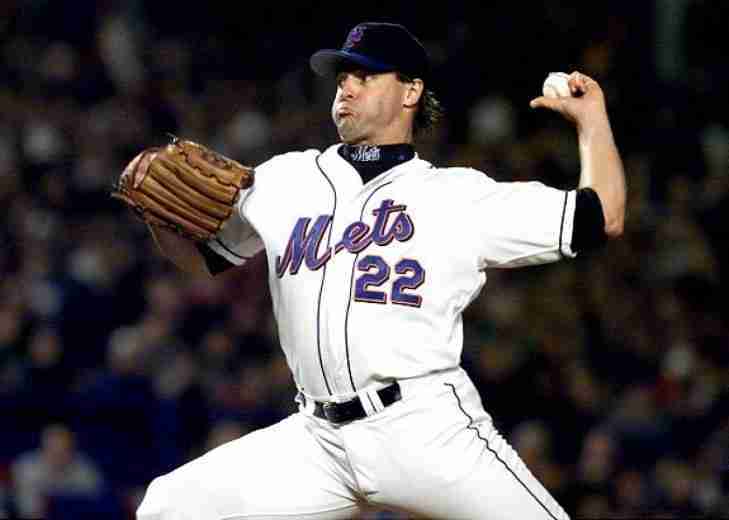
Al Leiter first entered the home clubhouse at Shea Stadium in 1998 as a local from Toms River, New Jersey, who had grown up supporting the Amazins. Coming over in a trade from the Florida Marlins shortly after their 1997 World Series win, the seasoned left-hander took on a leading role at the top of the rotation.
Leiter demonstrated remarkable consistency, winning at least 10 games in each of his seven seasons with the Mets and accumulating 95 wins overall. His strong pitching and resilient mindset drove a successful period, making his staff a formidable challenge for NL East competitors. In the 1999 and 2000 seasons, he established himself as one of the team’s top big-game pitchers. In 1999, Leiter delivered a historic performance by pitching a two-hit complete game shutout against the Reds in the high-pressure one-game Wild Card tiebreaker, securing a spot in October for New York. The following year, he earned an All-Star nod, posting a 16-8 record and maintaining a 2.93 ERA over four postseason starts, helping the Mets reach the Subway Series.
In 2002, he added a unique piece of baseball history to his resume by becoming the first pitcher in the Major Leagues to record a victory against all 30 franchises, but it came to an end in Flushing after the 2004 season, when the Mets declined his option.
With the Mets, Leiter owned a 95-67 record, a 3.42 ERA, and 1,106 strikeouts, and was inducted into the Mets Hall of Fame in 2023.
16. David Cone
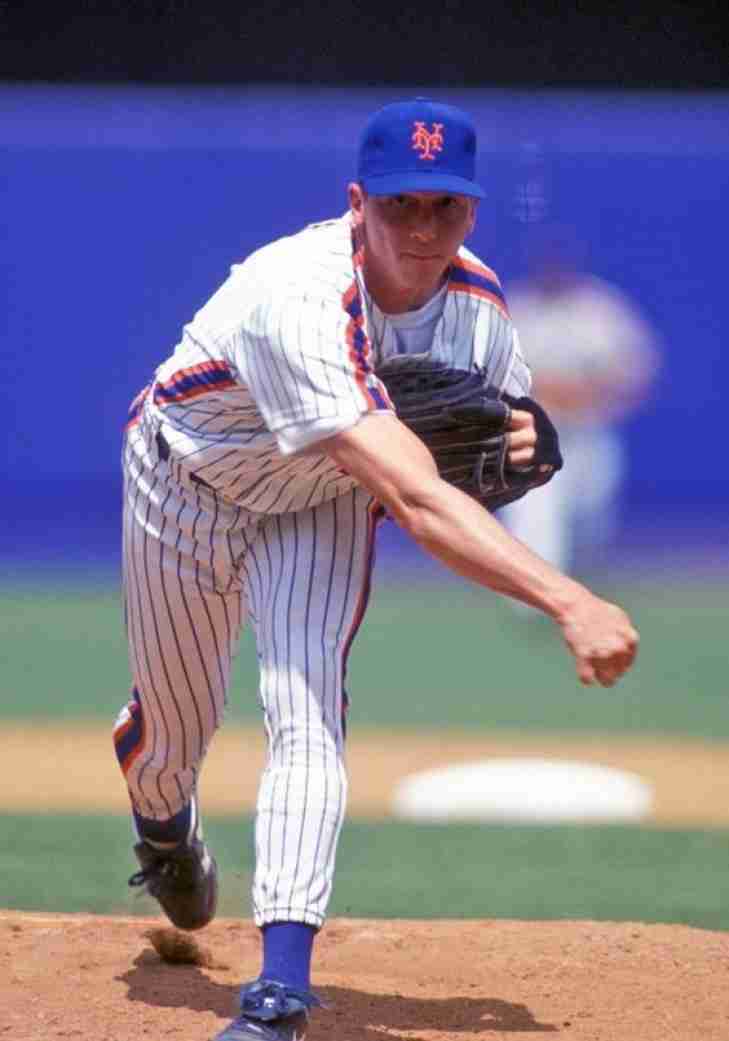
David Cone first arrived in Flushing in March 1987 through a significant trade with the Kansas City Royals, where he joined Chris Jelic in exchange for Ed Hearn, Rick Anderson, and Mauro Gozzo. Equipped with a deceptive multi-angle delivery and a deadly split-finger fastball, Cone rapidly secured a spot in the starting rotation. Alongside Doc Gooden, he helped build a powerful pitching duo that dominated National League hitters for nearly five years.
Cone achieved a historic milestone by winning consecutive National League strikeout titles in 1990 with 233 strikeouts and in 1991 with 241 strikeouts. This period included a legendary, record-tying 19-strikeout game against the Phillies on the last day of the 1991 season. His exceptional, swing-and-miss ability was unmatched, making him a top-tier pitcher for the Mets who regularly surpassed 200 innings with ease.
His 1992 campaign authored a truly bizarre and historic masterpiece of era dominance. Before the cash-strapped Mets moved him, Cone struck out 214 batters in 196.2 frames, leading the league in strikeout rate and tossing five shutouts. Even though he was dealt to the Toronto Blue Jays in late August, his National League body of work was so overwhelming that he still finished second in the NL strikeout race from another country. Combined with his Toronto output, his 261 punchouts paced all of Major League Baseball. Cone continued that excellent year by helping the Jays win their first World Series. Incidentally, he won four more as a New York Yankee.
He would return to New York briefly for one more attempt at baseball in 2003, though that would be only for five contests. Over his two runs with the Mets, he would compile a record of 81-51 with 1,172 strikeouts.
14. Howard Johnson
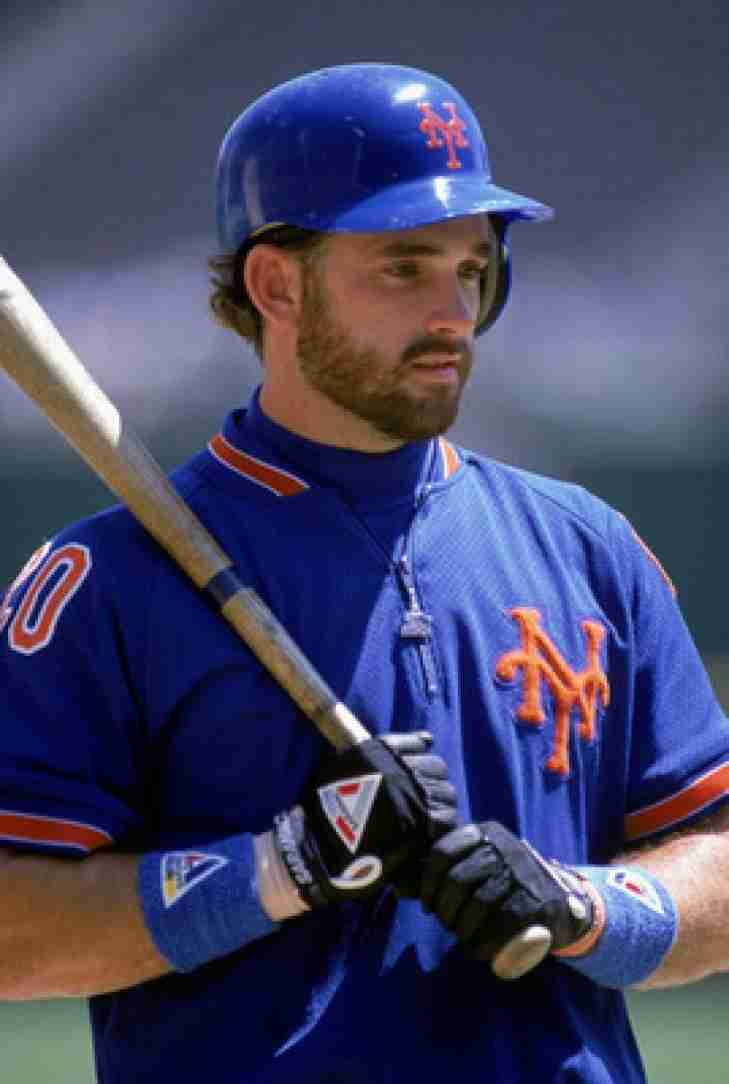
Howard Johnson first arrived in New York ahead of the 1985 campaign, traded from the Detroit Tigers in exchange for pitcher Walt Terrell. Having just earned a World Series ring in Detroit without seeing action in the 1984 postseason, the switch-hitting infielder landed on a rising Mets squad with plenty to prove.
After playing a role in New York’s 1986 World Series championship, Johnson made a breakthrough season in 1987, becoming the first switch-hitter in Major League history to reach the 30-30 club with 36 home runs and 32 stolen bases. This achievement was only the beginning; he would later accomplish the 30-30 feat three more times while with the Mets, setting a franchise record for energetic, high-impact offense.
He received two All-Star selections and two Silver Slugger Awards in 1989 and 1991. During this time, he consistently anchored the Mets' lineup alongside Darryl Strawberry. His peak offensive performance came in 1991, a remarkable season when he won the National League Home Run title with 38 home runs and the RBI crown with 117, while also leading the league in runs scored. His skill in contributing offensively from both sides of the plate earned him two fifth-place finishes in the NL MVP voting, in 1989 and 1991.
Following that torrid 1991 peak, Johnson entered a steep physical decline as injuries disrupted his timing and sapped his signature power during his final two years in New York. Johnson left the team for Colorado for free agency and, as a Met, had totals of 997 hits, 192 home runs, and 202 stolen bases, which warrant this high spot on our all-time New York Mets list. The Mets chose Johnson for their franchise Hall of Fame in 2023.
