


Site Admin
30. Rick Reed
Rick Reed became a Met before the 1996 season on a minor league deal. At 31, he was a journeyman whose career seemed stalled. His journey to New York was mired in controversy; during the 1994–95 MLB strike, Reed crossed the picket line to play as a replacement for the Cincinnati Reds. This decision made him a pariah in his own clubhouse when the regular players returned. Signed by the Mets as a backup, the control-focused right-hander proved the critics wrong with one of the most surprising and outstanding career comebacks of his time.
Reed's 1997 debut was solid, with a 13-9 record, 2.89 ERA, and a top-five 1.04 WHIP, showcasing his speed and corner pitching. In 1998, he achieved a career-high 16 wins, made his first All-Star team, and became a key figure in the league.
Reed was a key pitcher for the Mets, consistently giving team a strong chance to win with four seasons of at least 11 victories (1997–2000). His precise pitching was an era-defining outlier, often ranking high in strikeout-to-walk ratio, walking fewer than 35 batters and pitching over 180 innings. His reliability peaked during 2000, with 11 wins and a pivotal Game 3 in the NLCS, helping New York reach the 'Subway Series’ against the Yankees.
Just months after signing a lucrative three-year contract extension to stay in New York and earning his second National League All-Star nod, the front office traded the veteran right-hander to the Minnesota Twins at the 2001 July deadline in a straight-up deal for outfielder Matt Lawton.
With the Mets, Reed compiled a 59-36 record and a 3.64 ERA.
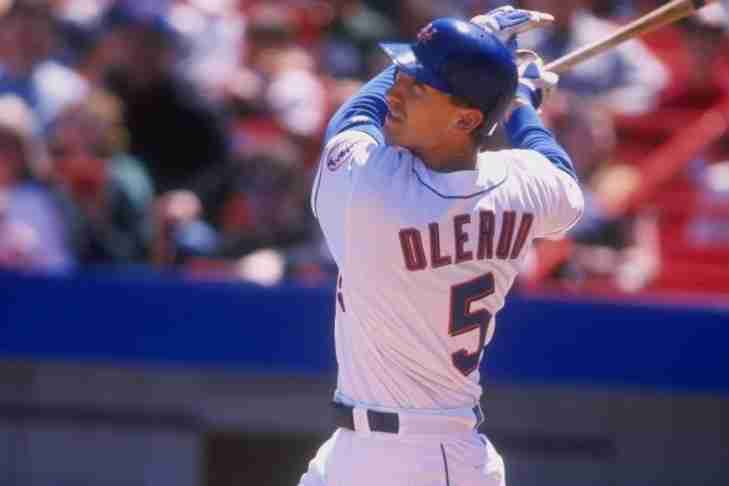
37. John Olerud
29. R. A. Dickey
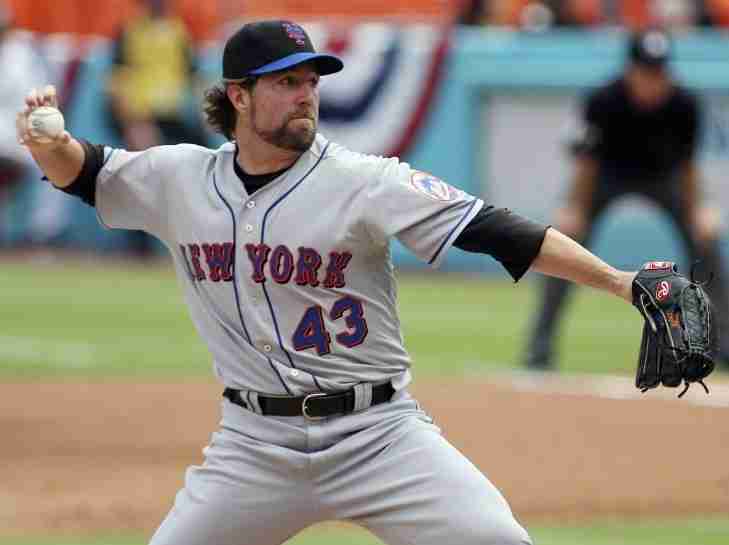
In December 2009, R.A. Dickey joined Flushing on a modest minor league deal, as a 35-year-old journeyman fighting to stay in baseball. For years, he had been a fringe major leaguer struggling to master his pitching, especially after learning he entirely lacked an ulnar collateral ligament in his throwing elbow.
Dickey was highly effective right from the start, posting a remarkable 2.84 ERA in 2010 and pitching over 200 innings in 2011. He utilized what analysts described as a "hard knuckleball," delivering the pitch at an unprecedented 78-to-80 mph with sharp, late movement.
That solid foundation led to an extraordinary standout during the legendary 2012 season. That summer, Dickey hit a career peak, delivering a remarkable campaign that is arguably the best individual season by a knuckleballer in Major League history. He impressed the city by going 20-6 and leading the National League in strikeouts (230), innings pitched (233.2), complete games (5), and shutouts (3). His efficiency peaked in June when he threw consecutive one-hitters with double-digit strikeouts, setting a franchise record with 32.2 straight scoreless innings and earning an All-Star nod. His historic dominance was confirmed when he was named the clear winner of the National League Cy Young Award, marking the first time a knuckleball pitcher won this honor.
In December 2012, at the peak of his trade worth, the rebuilding Mets sent the reigning Cy Young winner to the Toronto Blue Jays in a major seven-player trade that brought back numerous top prospects, such as future All-Star catcher Travis d'Arnaud and pitcher Noah Syndergaard. He left Queens with an impressive 39-28 record and a remarkable 2.95 ERA over three seasons with the team.
25. John Franco
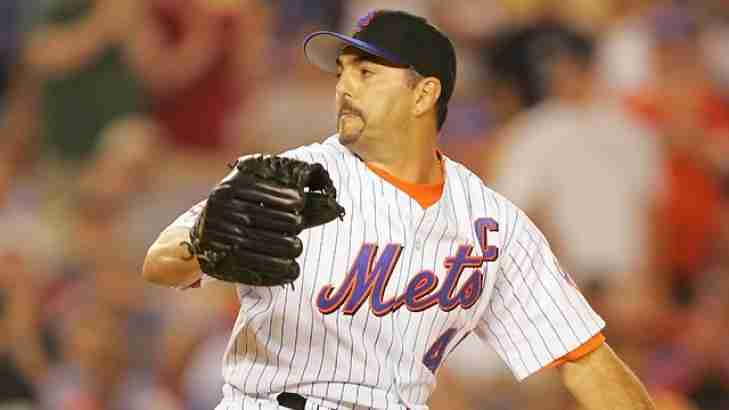
John Franco reached Flushing in December 1989 via a blockbuster trade with the Cincinnati Reds, which exchanged top bullpen pitchers and brought the Brooklyn native back home in exchange for Randy Myers. A proud Brooklynite who excelled at St. John's University in Queens, Franco took on a significant high-pressure role as the team's closer and worked out of the pen for 14 years.
Franco quickly gained the loyalty of local fans by delivering an impressive debut in the 1990 season, during which he led the National League with 33 saves and was awarded the Rolaids Relief Man of the Year. His performance peaked even further during the strike-shortened 1994 season, where he again led the junior circuit with 30 saves and posted a remarkable 2.70 ERA, finishing seventh in the NL Cy Young Award voting. As a consistent professional, he kept fans engaged with his signature circle changeup and strong determination to eliminate scoring threats.
Beyond just the baseline save numbers, Franco achieved a historic leadership milestone within the organization. On May 4, 2001, he received the uncommon honor of becoming the third official team captain in Mets history, highlighting his significant clubhouse presence and deep community ties. He played a key role during the 2000 Subway Series, notably earning the win out of the bullpen in Game 3 to secure the Mets' only victory in that memorable Fall Classic. Although he later stepped down from the primary closer role to Armando Benítez, he seamlessly transitioned into a top-tier high-leverage setup man, finishing his Queens career as the franchise’s all-time leader in both saves (276) and games pitched (695).
After the 2004 season, Franco departed for the Houston Astros as a free agent for one final season.
Franco was inducted into their franchise Hall of Fame in 2012.
