Site Admin
Theme From a Summer Place

Percy Faith and his Orchestra
A Theme From A Summer Place
48. Manny Corpas

Manny Corpas’ career is essentially a highlight reel of a single, pressurized autumn. A thin right-hander from Panama with a deceptive sidearm delivery, Corpas didn't arrive in Denver with the pedigree of a high-priced closer. Instead, he was a middle-relief option who happened to find his "peak" at the exact moment the franchise caught lightning in a bottle. While his overall career was a journey of inconsistent roles and physical setbacks, for one month in 2007, he was the most untouchable arm in the National League.
Corpas’ tenure is defined by a 2007 season that serves as a statistical outlier for the franchise. After taking over the closer role from a struggling Brian Fuentes in July, Corpas reached a professional level of efficiency that anchored the Rockies' historic 21-of-22 win streak. He finished the regular season with 19 saves and a 1.064 WHIP, but it was in the postseason where he reached a definitive state of dominance. Over 10.1 innings of playoff pressure, he allowed only a single run, recording five saves and a staggering 0.581 WHIP. He was the "steady hand" that stabilized the bullpen during the first World Series run in club history.
However, the high-leverage workload of 2007 took a significant toll. He was never able to replicate that specific brand of dominance again. By 2008, his ERA jumped to 4.52, and his sinker began to lose the sharp, biting movement that had made him elite. This physical decline reached a breaking point in 2010 when he suffered a torn ulnar collateral ligament in his throwing elbow. The injury required Tommy John surgery, and with Corpas facing a lengthy recovery and a rising salary, the Rockies chose to non-tender him in December 2010. It was an unceremonious exit for a man who had been the face of the franchise's greatest month, as the organization decided to cut ties rather than wait for his return.
His presence in the organization saw a brief second act in 2013 when he returned to Denver as a minor-league free agent. By then, he was primarily a low-leverage arm, providing some veteran-like poise for 31 appearances before his time in the big leagues effectively concluded. He finished his Colorado career with 34 saves and 121 games finished.
50. Jerry Dipoto
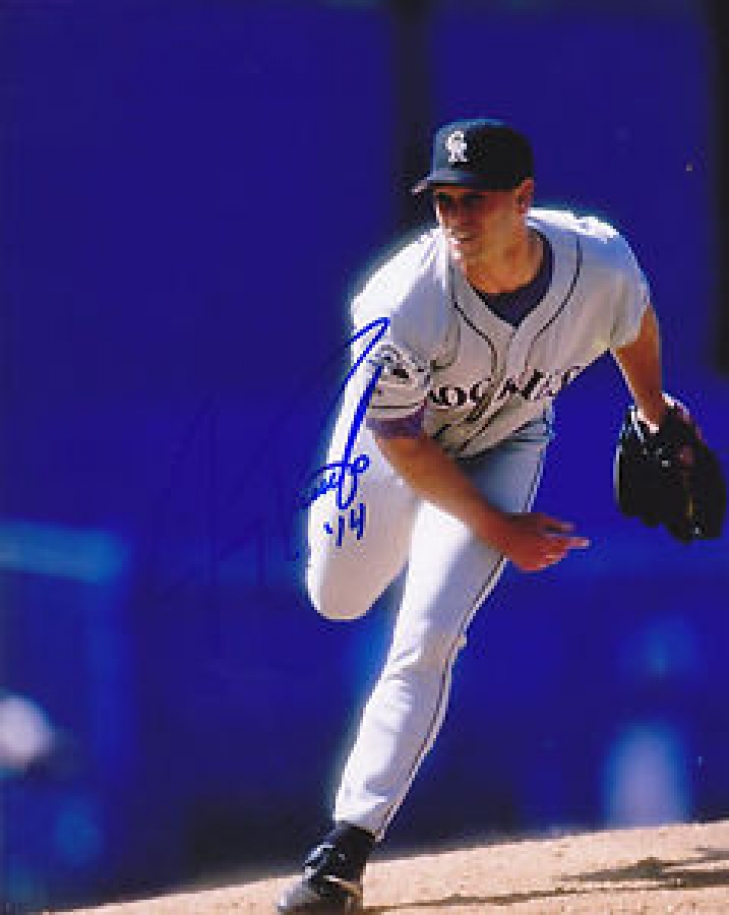
Jerry Dipoto was a high-leverage arm trying to survive the early, chaotic years of the Colorado Rockies. A right-handed reliever who relied more on a tactical slider than raw velocity, Dipoto arrived in Denver in 1997 via a mid-season trade from the Mets.
Dipoto’s tenure in Colorado was defined by professional resilience, as he transitioned into a part-time closer role. In 1998, a season in which he served as the primary finisher for a Rockies team still finding its identity. That year, he secured a career-high 19 saves and appeared in 68 games, proving he could maintain his composure even when the scoreboard was spinning. He was a model of specialized control, rarely giving up the free passes that often lead to disaster at altitude, and he finished that campaign with a respectable 3.53 ERA, a genuine achievement during the offensive explosion of the late '90s.
He slipped back into a set-up role shortly after, and by 2000, his efficiency dipped significantly, and a recurring bulging disc in his neck ultimately forced him to retire at the age of 32.
As a member of the Rockies, Dipoto compiled 36 saves and 188 strikeouts across 233 appearances.
Tamina Snuka