


Site Admin
23. Roy Thomas
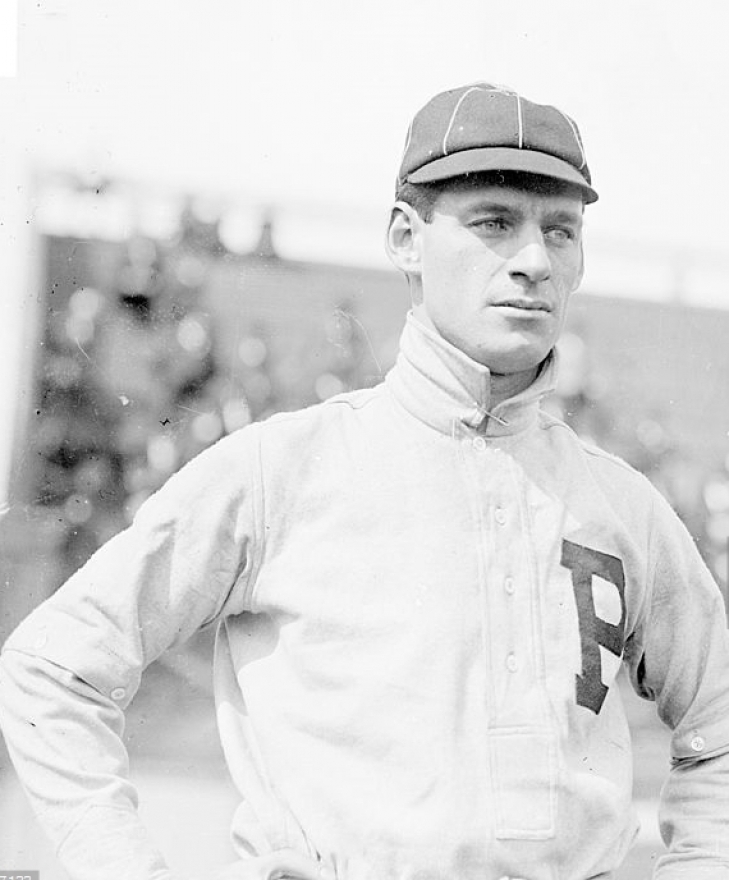
During the early, gritty years of the modern game, Roy Thomas stood out as a player who skillfully pushed the boundaries of the rulebook. Well before today's front offices obsess over on-base percentages to the tiniest detail, Thomas was a dedicated and disciplined center fielder for the Philadelphia Phillies, often serving as a strategic table-setter. He didn't just see drawing walks as a simple skill—he turned it into a mental game, creating psychological pressure on the opposing team. His persistent habit of fouling off high-velocity pitches by intentionally spoiling them annoyed opponents so much that it led Major League Baseball to change its rules in 1901, making foul balls count as strikes early in the at-bat.
Even after the league tried to set rules to limit his annoying tendencies, Thomas kept finding a way to get on base. He led the National League in walks an impressive seven times during his nine full summers in Philadelphia. His disciplined approach at the plate created a reliable presence at the top of the lineup, helping him lead the Senior Circuit in on-base percentage twice. Over an unforgettable seven-year stretch from 1899 to 1905, Thomas maintained an OBP comfortably above the impressive .400 mark every summer.
Although he crossed the .300 batting average threshold four times, he did so by embodying what many consider the most genuine form of a "slap hitter" in baseball history. Thomas disliked swinging for power, choosing instead to leverage his tall, slender build to drive line drives into gaps or execute well-placed bunts into open spaces.
This innovative, highly efficient method resulted in one of the most unusually charming and low-variance statistical signatures in professional baseball history. At retirement, Thomas uniquely stood out as the sole everyday player in major league history to have scored over three times the runs (1,011) he batted in (299). Additionally, he created an entirely novel pattern between his situational metrics, ending his career with a .413 on-base percentage supported by a mere .334 slugging percentage—marking the greatest gap ever between getting on base and total bases for a regular player.
While traditionalists of the Deadball Era occasionally clamored for more extra-base power, modern advanced analysts view his extreme on-base volume with immense reverence. Across his lengthy, split-tenure stay with the Phillies, he accumulated 1,364 hits and 235 stolen bases while serving as a premier, high-volume defender out on the grass.
24. Del Ennis
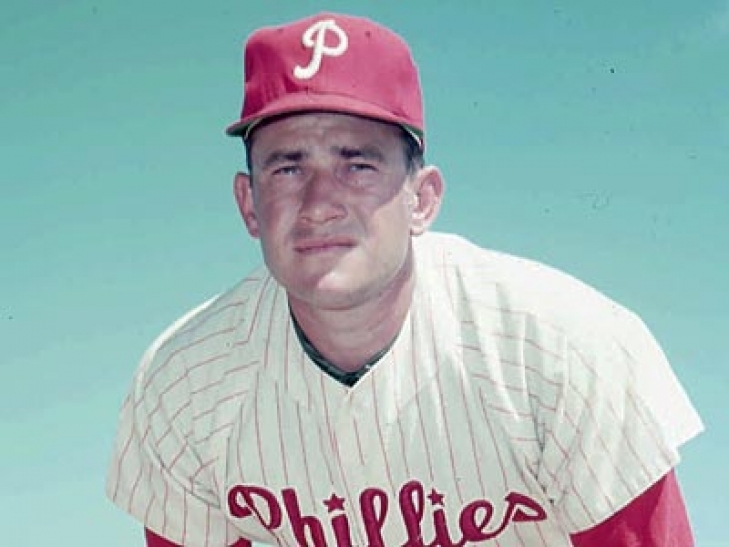
The relationship between the Philadelphia fans and Del Ennis was particularly complex, especially given the city's fiercely protective nature. Born in the city and excelling at Olney High School, Ennis had all the qualities of a hometown hero. He was also a key part of the iconic "Whiz Kids" team that transformed the city at the beginning of the 1950s. Despite his impressive regular-season stats, Ennis often became a target for harsh criticism and boos from the Shibe Park crowd.
His debut on Broad Street in 1946 is a true standout achievement. After completing a three-year stint with the United States Navy, Ennis excelled against National League pitchers, achieving an impressive .313 batting average. He made history as the first rookie in franchise history to be selected as an All-Star and was named The Sporting News Rookie of the Year.
This marked the beginning of a decade of display of powerful middle-of-the-order batting. Ennis mastered driving in runs, achieving seven seasons with at least 20 home runs and seven seasons surpassing 100 RBIs. He had a deadly right-handed swing capable of making high-quality contact, hitting over .300 for three seasons in red pinstripes.
His peak performance occurred during the memorable 1950 pennant race, where Ennis delivered an outstanding regular season by hitting 31 home runs and leading the Senior Circuit with a career-high 126 RBIs, helping the young "Whiz Kids" secure their first National League pennant in 35 years. This achievement earned him a career-high fourth-place MVP finish, one of seven seasons where he was a serious MVP contender.
The main reason "Ennis the Menace" was sometimes heavily criticized by local fans was because of his defensive skills. Although he had a strong, high-velocity throwing arm that occasionally led the league in outfield assists, his footwork and defensive positioning were consistently problematic. He was known for making errors and had significant difficulty with spatial awareness, never recording a positive defensive bWAR season throughout his career.
Trying to downplay his historical impact solely because of his defensive weaknesses ignores his remarkable ability to produce runs over a long career. When he was traded to the St. Louis Cardinals before the 1957 season, he left as the Phillies' all-time home run leader, with impressive career totals of 1,812 hits, 259 home runs, and 1,124 RBIs in 1,601 games with Philadelphia.
The Phillies chose Ennis for their Philadelphia Baseball Wall of Fame in 1981.
20. Johnny Callison
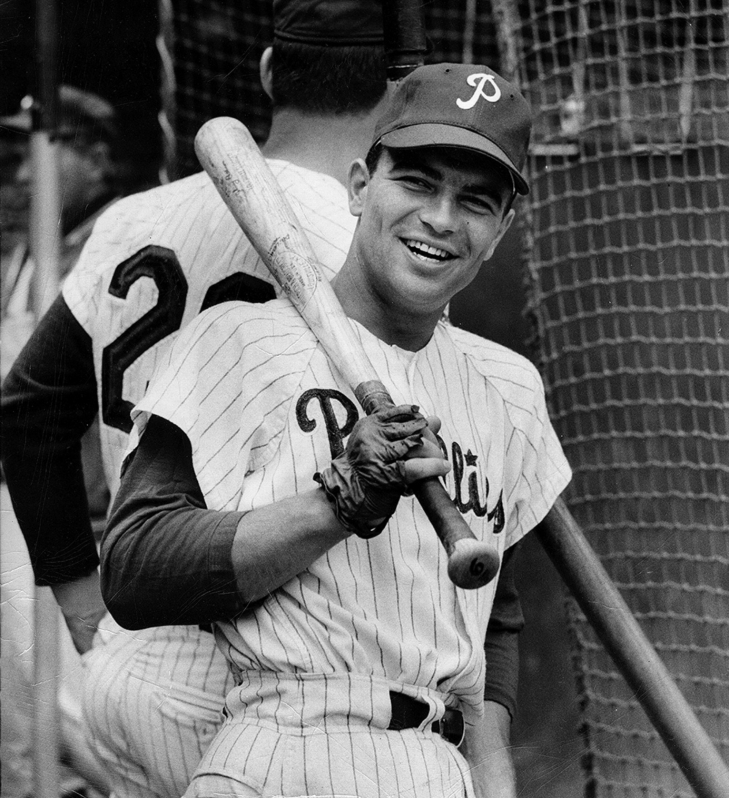
When John Callison joined the Philadelphia Phillies through a trade with the Chicago White Sox before the 1960 season, he quickly faced an almost unfair comparison. Known for his incredibly fast left-handed swing and a powerful arm, scouts and the national press eagerly compared him to Mickey Mantle. While matching such a lofty standard was impossible, Callison established a unique, star-quality legacy of his own, becoming the regular and reliable presence in the Phillies' outfield for ten years.
Operating mainly from right field, with a short, tactical two-year stint in left field, Callison rapidly became one of the most well-rounded and versatile players in the Senior Circuit. He delivered powerful over-the-fence hitting during a pitching-heavy era, achieving four seasons with at least 20 home runs. His standout period included consecutive summers where he surpassed 30 home runs.
However, focusing solely on his offensive performance overlooks a major part of his talent. On the field, Callison exemplified athletic mastery in containment, earning recognition as one of the top defensive right fielders of his era. With exceptional spatial awareness and an impressively precise, powerful throwing arm, he consistently topped the National League’s outfield assist charts, significantly influencing how opposing third-base coaches planned their strategies.
The peak of his career and national fame occurred during the famous 1964 pennant race. Callison delivered an impressive, year-long offensive display, hitting 31 home runs, with 104 RBIs, and leading the league with 40 doubles. He capped off that memorable summer by hitting a walk-off, three-run homer in the 1964 Midsummer Classic, earning All-Star Game MVP honors. He finished as a close and highly regarded runner-up for the National League Most Valuable Player Award.
While he may never have reached those specific statistical heights again, Callison continued to be a reliable, top-tier contributor. He received MVP votes in three different seasons and earned three All-Star selections in his career with the team. He maintained a steady, level-headed presence at the top of the order throughout the 1969 season before ending his career with periods in Chicago and New York.
With Philadelphia, Callison had 1,438 Hits, 185 Home Runs, and batted .271. He was added to the Philadelphia Baseball Wall of Fame in 1996.
21. Jim Bunning
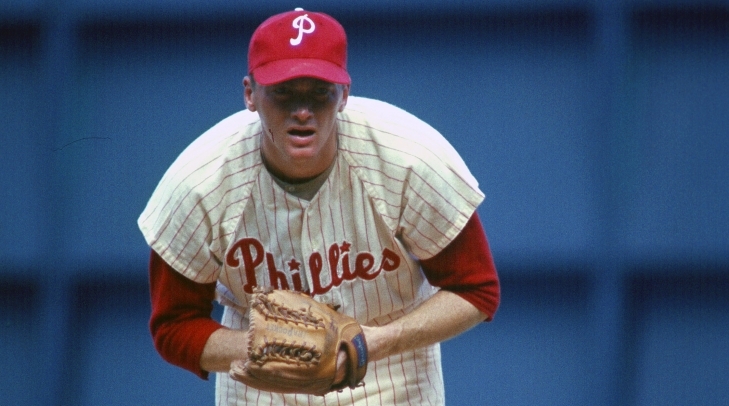
To truly determine the official geographic home of an elite pitcher's legacy, one must look beyond the win-loss record and examine the physical artifacts left behind. According to standard box-score logic, James Paul David Bunning might appear to be tied to Michigan, where he secured more regular-season wins and earned five of his seven All-Star selections with the Detroit Tigers. However, when considering the pinnacle of his historical significance, there is no debate: Bunning is fundamentally tied to the City of Brotherly Love. It is the city where his most legendary achievements were made, the city that permanently elevated his jersey into the rafters, and, most notably, the city whose iconic red script is forever engraved on the cap of his Cooperstown plaque.
Bunning officially joined the team through a blockbuster trade before the 1964 season, quickly becoming the Phillies' dominant, high-speed pitcher. With a deceptive sidearm delivery and a relentless, highly competitive attitude, he made the mound a showcase of athletic control.
Although he had previously pitched a no-hitter in Detroit, Bunning created a legendary moment on Father’s Day in 1964 by defeating the New York Mets at Shea Stadium and throwing the first regular-season perfect game in the National League in 84 years.
Far from being just a fleeting success, his core efficiency stats during his four-year prime on Broad Street were outstanding. He achieved an exceptional individual peak, highlighted by a historic 1967 season where he posted a 17-15 record, an impressive 2.29 ERA, and led the league with six shutouts and 302.1 innings pitched. He narrowly missed winning the National League Cy Young Award, finishing as a highly regarded runner-up.
Advanced metric purists often point out that, despite pitching fewer innings in Philadelphia than in Detroit, his exceptional dominance was so intense that he ended up with a higher career bWAR during his time with the Phillies. After an extended period in Pittsburgh and Los Angeles, Bunning returned to Broad Street for a two-year farewell, providing experience and stability to a rebuilding team before retiring after the 1971 season.
Bunning entered the Baseball Hall of Fame through the Veterans Committee in 1996, though he never should have had to wait so long to enter Cooperstown. As for the Phillies, his name was added to the Philadelphia Baseball Wall of Fame in 1982, and his number 14 was retired in 2001.
