

Our All Time Top 50 Los Angeles Angels have been revised to reflect the 2025 Season

Yes, we know that this is taking a while!
As many of you know, we at Notinhalloffame.com are slowly generating the top 50 of each major North American sports team. That being said, we maintain and update our existing Top 50 lists annually. As such, we are delighted to present our pre-2026 revision of our top 50 Los Angeles Angels.
As for all of our top 50 players in baseball, we look at the following:
1. Duration and Impact.
2. Traditional statistics and how they finished in the Major League Baseball.
3. Advanced Statistics.
4. Playoff performance.
5. Their respective legacy on the team.
6. How successful the team was when he was there.
7. Respecting the era in which they played.
Criteria 1-4 will make up the lion’s share of the algorithm. Please note that we have implemented this for the first time. This has changed the rankings all throughout the board.
Last year, the Angels won 72 Games and finished last in the American League West. There was no new entrant, but there were changes within the Top 50 due to the new algorithm.
As always, we present our top five, which saw changes due to the new algorithm.
1. Mike Trout
2. Nolan Ryan
3. Chuck Finley
4. Shohei Ohtani
5. Jared Weaver
You can find the entire list here.
Please note that Nolan Ryan and Chuck Finley flipped the #2 and #3 positions. Shohei Ohtani was repurposed from #5 to #4. Jared Weaver took over #5, and Jim Fregosi dropped off the top five.
We thank you for your continued support of our lists on Notinhalloffame.com.
Our All Time Top 50 Los Angeles Angels have been revised to reflect the 2024 Season
Yes, we know that this is taking a while!
As many of you know, we at Notinhalloffame.com are slowly generating the top 50 of each major North American sports team. That being said, we have existing Top 50 lists and consistently look to update them when necessary and based on necessity. As such, we are delighted to present our post-2024 revision of our top 50 Los Angeles Angels.
As for all of our top 50 players in baseball, we look at the following:
1. Advanced Statistics.
2. Traditional statistics and how they finished in the American League.
3. Playoff accomplishments.
4. Their overall impact on the team and other intangibles that are not reflected in a stat sheet.
Please note that our algorithm has changed, which yielded minor changes throughout the baseball lists.
Last year, the Angels had their first year of the post-Ohtani era finished last in the division as expected. There were no new entrants based on 2024, but there was one from the new algorithm.
As always, we present our top five, which saw two changes based on the new algorithm.
1. Mike Trout
2. Chuck Finlay
3. Nolan Ryan
4. Jim Fregosi
You can find the entire list here.
Under the new algorithm, Finlay surpasses Ryan for #2 and Jim Fregosi entered the top five..
With the new algorithm, Shortstop Gary DiSarcina comes in at #49.
We thank you for your continued support of our lists on Notinhalloffame.com.
Our All-Time Top 50 Los Angeles Angels have been revised to reflect the 2023 Season
Yes, we know that this is taking a while!
As many of you know, we here at Notinhalloffame.com are slowly generating the 50 of each major North American sports team. That being said, we have existing Top 50 lists out and we always consistently look to update them when we can and based on necessity. As such, we are very happy to present our post 2022/23 revision of our top 50 Los Angeles Angels.
As for all of our top 50 players in baseball we look at the following:
1. Advanced Statistics.
2. Traditional statistics and how they finished in Major League Baseball.
3. Playoff accomplishments.
4. Their overall impact on the team and other intangibles not reflected in a stat sheet.
Last year, the Angels went all in and imploded with another failure to make the playoffs. We only saw one change, and no new entries.
As always, we present our top five, which saw one major change.
1. Mike Trout
2. Nolan Ryan
3. Chuck Finley
5. Frank Tanana
You can find the entire list here.
Notably, Trout was already at the top of the list, and with Shohei Ohtani departing the club, his status at #1 is cemented for decades.
Ohtani made it to #4 from #12. As mentioned, he left the struggling Angels for a shot at the World Series with the Dodgers.
As always, we thank you for your support, and look for more revisions in the future.
Our All Time Top 50 Los Angeles Angels have been updated to reflect the 2022 Season
Yes, we know that this is taking a while!
As many of you know, we here at Notinhalloffame.com are slowly generating the 50 of each major North American sports team. That being said, we have existing Top 50 lists out and we always consistently look to update them when we can and based on necessity. As such, we are very happy to present our post 2022 revision of our top 50 Los Angeles Angels.
As for all of our top 50 players in baseball we look at the following:
1. Advanced Statistics.
2. Traditional statistics and how they finished in the American League.
3. Playoff accomplishments.
4. Their overall impact on the team and other intangibles not reflected in a stat sheet.
Last year, Los Angeles again failed to make the playoffs, despite having the two best players of this generation, one who is ranked number one on this list, and another who jumped 20 spots.
As always, we present our top five, which was not affected by the last season:
1. Mike Trout
2. Nolan Ryan
3. Chuck Finley
4. Frank Tanana
5. Jered Weaver
You can find the entire list here.
2021 MVP and dual-threat superstar, Shohei Ohtani, rocketed from #31 to #12.
We welcome your input and comments and as always, we thank you for your support.
Our All-Time Top 50 Los Angeles Angels are up
Yes, we know that this is taking a while!
As many of you know, we here at Notinhalloffame.com are slowly generating the 50 of each major North American sports team. We have a new one to unveil today, that of the Los Angeles Angels.
The Los Angeles Angels came into existence in 1961 as an expansion team, and while they were (and are) still secondary to the Dodgers, the constant name changes didn't help. They went from the Los Angeles Angels (1961-65) to the California Angels (1965-96), Anaheim Angels (1997-2004), Los Angeles Angels of Anaheim (2005-15), and back to the Los Angeles Angels.
The team did not go to their first postseason until 1979, and in 2002, they won their first Pennant, which is, to date, the only one they have captured. They made the most of their lone World Series appearance, winning it all.
Our Top 50 lists in Baseball look at the following:
1. Advanced Statistics.
2. Traditional statistics and how they finished in the American League.
3. Playoff accomplishments.
4. Their overall impact on the team and other intangibles not reflected in a stat sheet.
Remember, this is ONLY based on what a player does on that particular team and not what he accomplished elsewhere and also note that we have placed an increased importance on the first two categories.
This list is updated up until the end of the 2021 Season.
The complete list can be found here, but as always, we announce our top five in this article. They are:
1. Mike Trout
2. Nolan Ryan
3. Chuck Finley
4. Frank Tanana
5. Jared Weaver
We will continue our adjustments on our existing lists and will continue developing our new lists.
Look for our more material coming soon!
As always, we thank you for your support.
2. Nolan Ryan
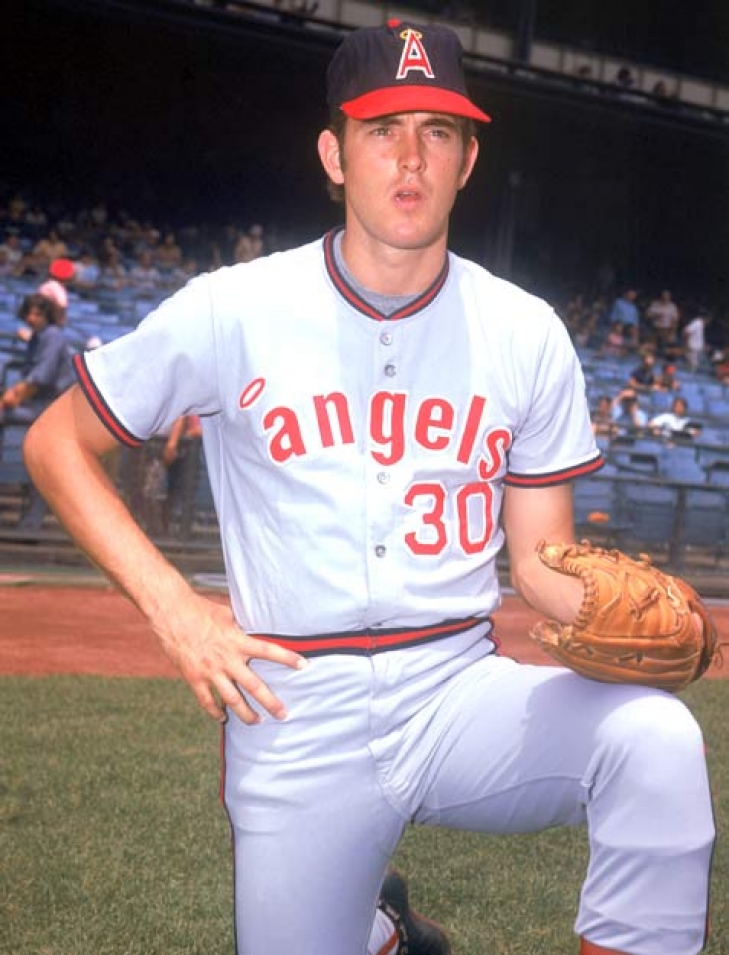
The arrival of Nolan Ryan in Anaheim in 1972 is often cited as the greatest trade heist in baseball history. While the Mets sought a veteran bat in Jim Fregosi, the Angels acquired a lightning bolt in a glove. Ryan didn't just find his footing in California; he transformed into the "Ryan Express," a high-velocity phenomenon that spent eight seasons redefining what was physically possible on a major league mound. While he is a legend in Texas, his years in an Angels uniform were his most explosive, marked by a relentless pursuit of strikeouts and a refusal to let anyone put the ball in play.
Ryan’s tenure in California began with an immediate major turning point for his career trajectory. After years of struggling with his control in New York, he landed in the American League and instantly became its most terrifying outlier. In his 1972 debut season with the club, he reached a new level of dominance, winning 19 games and leading the league with 329 strikeouts and a microscopic 5.3 hits per nine innings. He possessed a focused intensity that turned every start into a potential historical event, a style that reached a career peak just one year later. In 1973, Ryan fanned 383 batters, moving past Sandy Koufax to set the modern single-season strikeout record—a milestone that remains the gold standard of the live-ball era.
The middle of his run was defined by a steady-state of sheer power. Between 1972 and 1974, he averaged over 20 wins and 360 strikeouts per season, cementing his status as the premier flamethrower in the sport. He was a model of physical resilience, famously throwing 235 pitches in a single 13-inning start in 1974, only to return to the mound three days later. Even during a slight dip in his win totals in 1975, he remained a high-frequency threat, leading the American League in strikeouts nearly every year of the late seventies. He showed the organization that a pitcher could become a franchise pillar through intimidation and raw speed, eventually amassing 2,416 punchouts in just eight seasons with the club.
His time in Anaheim also saw him master the art of the no-hitter, tossing four of his record seven gems while wearing the Halo. He reached a crescendo of efficiency in 1977 and 1979, earning two more All-Star nods and proving his arm hadn't lost a tick of its specialized heat. Despite his status as a local icon and a five-time All-Star, the reality of the era’s burgeoning free agency led to his departure. Following the 1979 season, Ryan returned to his home state to sign with the Houston Astros, leaving California as the most prolific strikeout artist in the history of the franchise.
The story in Anaheim reached its closing punctuation in 1992. In a ceremony held while he was still an active player for the Rangers, the Angels retired his number 30 and inducted him into their Hall of Fame.
Our Top 50 All-Time Houston Astros has been revised
Yes, we know that this is taking a while!
As many of you know, we here at Notinhalloffame.com are slowly generating the 50 of each major North American sports team. That being said, we have existing Top 50 lists out and we always consistently look to update them when we can and based on necessity. As such, we are very happy to present the first revision of our top 50 Houston Astros of all-time.
As for all of our top 50 players in baseball we look at the following:
- Advanced Statistics.
- Traditional statistics and how they finished in the American League.
- Playoff accomplishments.
- Their overall impact on the team and other intangibles not reflected in a stat sheet.
Remember, this is ONLY based on what a player does on that particular team and not what he accomplished elsewhere and also note that we have placed an increased importance on the first two categories, which has altered the rankings considerably.
This list is updated up until the end of the 2018 Season.
The complete list can be found here, but as always we announce our top five in this article. They are:
There is a significant shift in many of the players and a few new ones based on shuffling of the metrics we have used for our Top 50s.
The biggest change based on recent play is Altuve’s rise to number 5.
As always we thank you for your support.
The Top 50 Houston Astros of All-Time are now up
We return to the world of Baseball with the Houston Astros and that we believe are Top 50 players ever from that organization.
We encourage you to see the complete list here, but for those who can’t wait, here are the top five Houston Astros of all-time:
1.Jeff Bagwell
2. Craig Biggio
3. Lance Berkman
4. Cesar Cedeno
5. Jose Cruz
This won’t be the last of this, as we have the Detroit Lions up next.
As always, we thank you for your support and look for your input!
12. Nolan Ryan

Nolan Ryan’s arrival in Houston in 1980 was a homecoming that doubled as a massive free-agent statement. At 33, an age when most power pitchers are bracing for a decline, the Texas native returned to his roots to become the highest-paid player in the game. While he had already established himself as a strikeout king with the Angels, his nine-season run with the Astros proved he was a physical outlier whose professional resilience could defy the standard aging curve.
Ryan’s tenure in Houston began with an immediate high-leverage impact, as he helped anchor the rotation of the 1980 squad that captured the franchise's first division title. In the strike-shortened 1981 season, he led the National League with a 1.69 ERA and threw his record-breaking fifth no-hitter against the Dodgers. He possessed a specialized, high-velocity fastball that remained elite well into his late thirties, a style that allowed him to maintain a steady-state dominance over National League hitters who had never seen anything quite like his "Express."
In 1983, Ryan surpassed Walter Johnson to become the all-time strikeout leader, a moment that cemented his status as a franchise pillar. While his win-loss records were often victims of poor run support, most notably in 1987 when he led the league in ERA (2.76) and strikeouts (270) but finished with only eight wins, his focused intensity never wavered. He was a model of high-frequency strikeout production, leading the league in punchouts twice as an Astro and finishing in the top five of the Cy Young voting on two occasions.
The final chapters of his Houston story reached a frustrating plateau in 1988. Despite still being a premier draw and a productive arm, contract disputes with owner John McMullen led to Ryan’s departure for the Texas Rangers following the season. He left the organization with 106 wins and 1,866 strikeouts, having proven that a veteran-like poise and a 100-mph heater could coexist for nearly a decade. He showed the world that a player's second act can be just as legendary as the first, leaving a statistical footprint that eventually forced the club to acknowledge his permanence in their history.
The story in Houston reached its final punctuation in 1996 when the Astros retired his number 34, followed by his induction into the inaugural class of the Astros Hall of Fame in 2019. He showed the organization that when you have the heart of a competitor and the arm of a phenomenon, you don't just play for a team, you become the identity of the entire state.
In Houston, Ryan compiled 106 wins, 1,866 strikeouts, and a 3.13 ERA across nine seasons.
19. Nolan Ryan
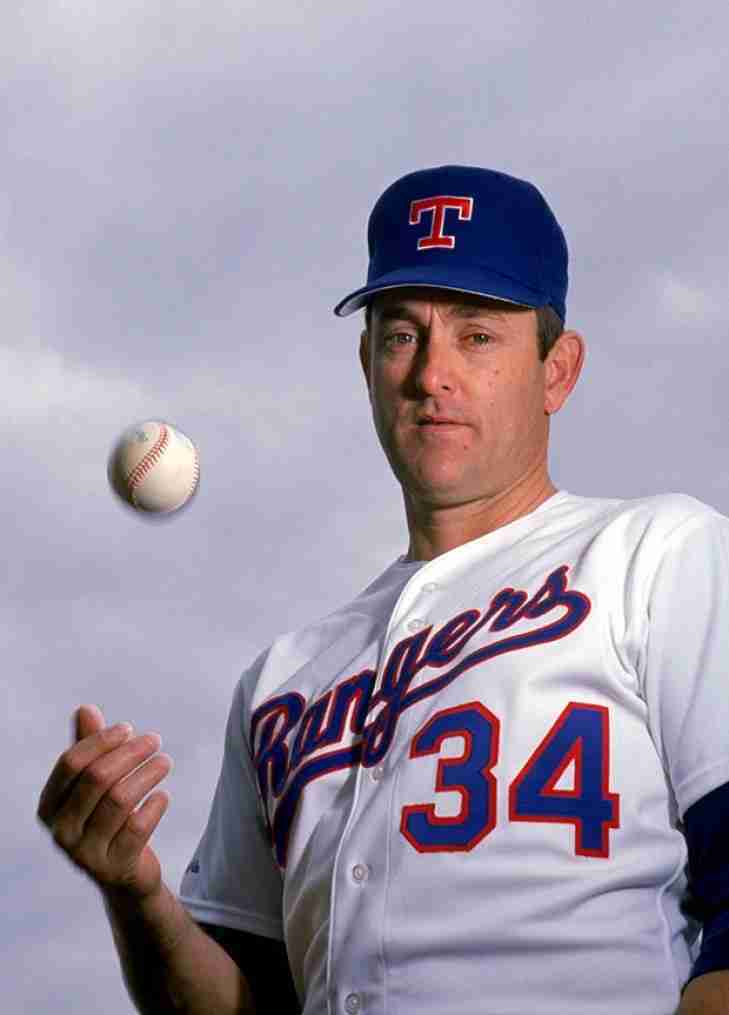
When Nolan Ryan entered into a free agency agreement with the Texas Rangers in December 1988, he was already 41 years old and possessed a distinguished career filled with numerous accolades. Traditional baseball wisdom indicated that the native Texan was returning home primarily to transition into retirement. However, "The Ryan Express" transformed his final five seasons into an extraordinary cultural and statistical phenomenon, thereby solidifying his position as a legendary figure in the history of sports in Lone Star State.
Operating with a high-velocity fastball that still defied time and physics, Ryan did not merely maintain a position in the starting rotation; he remained a formidable front-line force. His 1989 debut at Arlington was a remarkable demonstration of power, as he led the American League with 301 strikeouts over 239 innings—marking the sixth occasion in his career that he reached the 300-strikeout threshold. Even into his mid-40s, his exceptional pitching abilities remained entirely unhittable when he was fully concentrated, a fact he demonstrated to the baseball community by delivering his sixth career no-hitter against Oakland in 1990, followed by a spectacular no-hitter with 16 strikeouts against Toronto on May 1, 1991.
While his raw on-field value in Arlington was concentrated into the back end of his career, his physical presence provided the franchise with a significant competitive advantage and an immediate national profile. He was an intense, traditional competitor who demanded the strike zone, as famously exemplified by his legendary mound confrontation with Robin Ventura in 1993. Each time Ryan took the mound, he elevated the game to a high-stakes level, concluding his five-year tenure with an impressive 51–39 record and amassing 939 strikeouts against a heightened level of baseball age.
His final departure from the baseball field took place in September 1993, when a torn ligament in his right elbow abruptly ended his illustrious 27-year career in Major League Baseball. Although his number of starts was limited to 135, thereby resulting in his total statistical contributions being somewhat behind the franchise’s record holders over the decade, his late-career performance in terms of raw dominance and structural influence deeply left an indelible impression on the organization.
With the Rangers, Ryan made 135 appearances (all starts). He compiled a 51–39 record with a 3.43 ERA and a 1.12 WHIP. He logged 840 innings, recording 15 complete games, six shutouts, and 939 strikeouts. To permanently cement his monumental legacy, the Rangers retired his number 34 in 1996, and he was inducted into Cooperstown as a first-ballot member of the National Baseball Hall of Fame in 1999. He completed his journey with the organization by being inducted into the inaugural class of the Texas Rangers Hall of Fame in 2003, serving as the ultimate punctuation on his identity as a Texas icon.
