


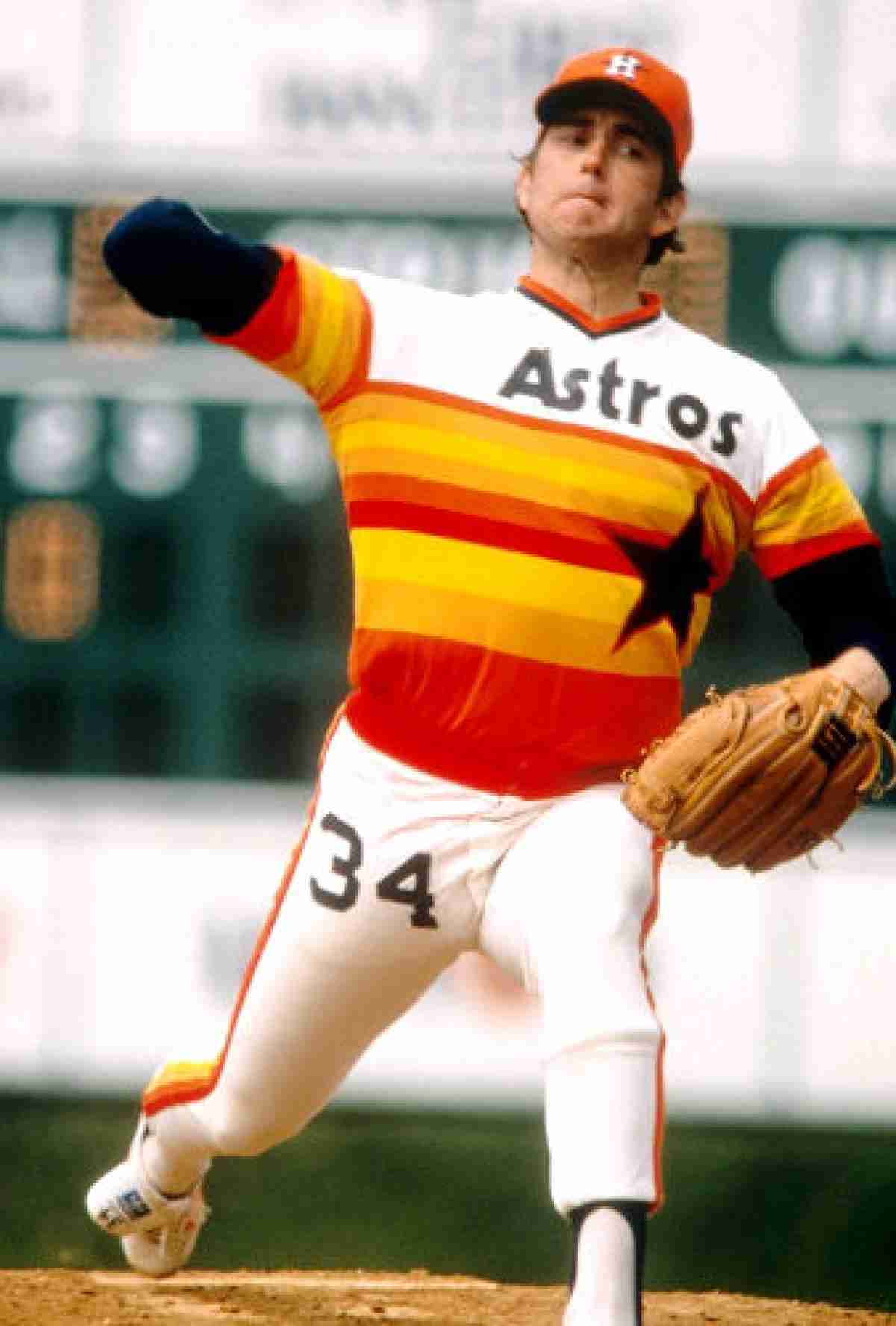



Nolan Ryan’s arrival in Houston in 1980 was a homecoming that doubled as a massive free-agent statement. At 33, an age when most power pitchers are bracing for a decline, the Texas native returned to his roots to become the highest-paid player in the game. While he had already established himself as a strikeout king with the Angels, his nine-season run with the Astros proved he was a physical outlier whose professional resilience could defy the standard aging curve.
Ryan’s tenure in Houston began with an immediate high-leverage impact, as he helped anchor the rotation of the 1980 squad that captured the franchise's first division title. In the strike-shortened 1981 season, he led the National League with a 1.69 ERA and threw his record-breaking fifth no-hitter against the Dodgers. He possessed a specialized, high-velocity fastball that remained elite well into his late thirties, a style that allowed him to maintain a steady-state dominance over National League hitters who had never seen anything quite like his "Express."
In 1983, Ryan surpassed Walter Johnson to become the all-time strikeout leader, a moment that cemented his status as a franchise pillar. While his win-loss records were often victims of poor run support, most notably in 1987 when he led the league in ERA (2.76) and strikeouts (270) but finished with only eight wins, his focused intensity never wavered. He was a model of high-frequency strikeout production, leading the league in punchouts twice as an Astro and finishing in the top five of the Cy Young voting on two occasions.
The final chapters of his Houston story reached a frustrating plateau in 1988. Despite still being a premier draw and a productive arm, contract disputes with owner John McMullen led to Ryan’s departure for the Texas Rangers following the season. He left the organization with 106 wins and 1,866 strikeouts, having proven that a veteran-like poise and a 100-mph heater could coexist for nearly a decade. He showed the world that a player's second act can be just as legendary as the first, leaving a statistical footprint that eventually forced the club to acknowledge his permanence in their history.
The story in Houston reached its final punctuation in 1996 when the Astros retired his number 34, followed by his induction into the inaugural class of the Astros Hall of Fame in 2019. He showed the organization that when you have the heart of a competitor and the arm of a phenomenon, you don't just play for a team, you become the identity of the entire state.
In Houston, Ryan compiled 106 wins, 1,866 strikeouts, and a 3.13 ERA across nine seasons.

Comments powered by CComment