
The Pro Football Hall of Fame Revisited Project: 1996 Final VOTE

1996 Pro Football Hall of Fame Revisited Project Class.
Here we are! Again!!
If you have been following our Pro Football Hall of Fame Revisited Project, you know we have asked the question: What if the PFHOF had begun in January 1946?
After soliciting and obtaining a passionate group of football fans and historians, we sent out a ballot for a Preliminary Vote, in which each voter selected 25 names as their semi-finalists and five names for the Senior Pool. We then asked the group to vote for their 15 Finalists in the Modern Era and 3 in the Senior Category. The final stage was to vote for their five Modern Era inductee and one Senior inductee.
This is the result of the 51st official class.
Below are the final results of this project based on 31 votes.
Remember that we have reverted back to the top five candidates entering the Hall in the Modern Era
This is for the “Modern Era”
*Bold indicates they have been elected to the Pro Football Hall of Fame Revisited Class of 1996:
|
Player |
Year of Eligibility |
Vote Total |
|
Ozzie Newsome TE |
1 |
24 |
|
Mike Webster C |
1 |
24 |
|
Kenny Easley DB |
4 |
14 |
|
Ray Guy P |
5 |
13 |
|
Claude Humphrey DE |
10 |
12 |
|
John Stallworth WR |
4 |
10 |
|
Dan Hampton DE-DT |
1 |
10 |
|
Dick LeBeau DB |
19 |
8 |
|
Dave Robinson LB |
17 |
8 |
|
Charlie Joiner WR |
4 |
7 |
|
Ken Stabler QB |
7 |
6 |
|
Donnie Shell DB |
4 |
4 |
|
L.C. Greenwood DE |
10 |
3 |
|
Bob Kuechenberg G-T-C |
8 |
3 |
|
Cliff Branch WR |
5 |
0 |
This is for the “Senior Era”,
*Bold indicates they have been elected to the Pro Football Hall of Fame Revisited Class of 1996.
|
Gino Cappelletti FL-SE-DB-WR-K |
1 |
11 |
|
Pat Harder FB |
18 |
8 |
|
Les Richter LB-C |
9 |
8 |
|
None of the Above |
N/A |
4 |
This is for the “Coaches/Contributors”,
*Bold indicates they have been elected to the Pro Football Hall of Fame Revisited Class of 1996.
|
Ralph Wilson (Owner) |
5 |
14 |
|
Gil Brandt (Scout) |
5 |
9 |
|
Bill Nunn (Scout) |
3 |
5 |
|
None of the Above |
3 |
About the 1996 Inductees:
Ozzie Newsome, TE, CLE 1978-90: Inducted in the Pro Football Hall of Fame Revisited Project in 1996 on his 1st Ballot. Inducted into the actual Pro Football Hall of Fame in 1999.
At the time of his retirement, many felt that Ozzie Newsome was one of the most prolific Tight Ends in football history, and some say he still is.
Taken in the First Round (23rd Overall) out of Alabama, Newsome brought his blocking and receiving skills to the Browns in 1978. Known for his cerebral play, Newsome helped take the Browns to two AFC Championship Games, and he would have three 1,000-Yard seasons, which were excellent for a Tight End in the 1980s. Newsome played his entire career with Cleveland, accumulating 7,980 Yards with 47 Touchdowns.
Newsome was elected into the Pro Football Hall of Fame in 1996, his first year of eligibility, and was part of the first class of the Browns Ring of Honor in 2010. As an executive, he orchestrated teams that won two Super Bowls when the franchise relocated to Baltimore.
Mike Webster, C, PIT 1974-88 & KAN 1989-90: Inducted in the Pro Football Hall of Fame Revisited Project in 1996 on his 1st Ballot. Inducted into the actual Pro Football Hall of Fame in 1997.
After being drafted in the Fifth Round in 1974, Mike Webster worked on Special Teams, Center, and Guard in his first two seasons, contributing to the Steelers in little ways while helping them win their first two Super Bowls. What followed was one of the greatest runs ever by an NFL Center.
Webster began the 1976 season as the Steelers’ starting Center, and he would do so for the next 150 Games. He became an icon in Pittsburgh for his tenacity and ability to play through injuries, regardless of the severity. The Steelers were mostly known for their defense, but Webster ran the line that won two more Super Bowls and kept Pittsburgh competitive through the 80s.
“Iron” Mike would win two more Super Bowls and was a perennial Pro Bowl Selection from 1978 to 1985, with another one in 1987. Five of those Pro Bowl years were also First Team All-Pro seasons, with four of them being consecutive (1978-81). He would later earn the honor of being named to the 1970s and 1980s All-Decade Team, and he was also chosen for the 75th and 100th Anniversary Team. Webster played for Pittsburgh until 1988, when he signed with Kansas City for two more years. The Pro Football Hall of Fame called his name in 1997, and he was posthumously named to the Steelers Hall of Honor 20 years later.
Webster's end was tragic. The Center incurred substantial brain damage and was diagnosed with chronic traumatic encephalopathy (CTE), a degenerative brain disease that football players are now all aware of. He died at the age of 50, following years of pain, dementia, and depression.
Kenny Easley, DB, SEA 1981-87. Inducted in the Pro Football Hall of Fame Revisited Project in 1996 on his 4th Ballot. Inducted into the actual Pro Football Hall of Fame in 2017.
A star player with UCLA, Kenny Easley was the fourth overall pick by the Seattle Seahawks in 1981.
Easley came in with high expectations, which he showed with a good rookie season as their starting Strong Safety. That good start was followed by a four-year run during which he was considered the best, or among the best, Defensive Backs in the game of pro football. Easley went to the Pro Bowl in four straight years (1982-85) with a fifth in 1987, and he was also a three-time First Team All-Pro (1983-85). His best year was in 1984, when he was the Defensive Player of the Year, the first Seahawk to win the honor. That year, he led the NFL in Interceptions with 10 and would finish his career with 32.
Easley was vocal during the 1987 strike, and some believe this was why he was traded to the Cardinals in the off-season. The trade did not stick, as Easley flunked the physical, and it was learned that he had kidney problems, which forced him out of football. He would later sue the Seahawks, claiming that the overuse of Advil prescribed due to an ankle issue led to his kidney problems. After an out-of-court settlement, the two parties reconciled, and Easley was inducted into their Ring of Honor.
Ray Guy, P, OAK/RAI, 1973-86. Inducted in the Pro Football Hall of Fame Revisited Project in 1996 on his 5th Ballot. Inducted into the actual Pro Football Hall of Fame in 2014.
Ray Guy made headlines when he became the first punter drafted in the first round. Guy proved worthy of the trust the Raiders placed in him, as his booming, accurate kicks changed how special teams were thought of. Guy’s punts were not just powerful; they had long hang time and could be deadly accurate when needed.
Punters were never thought of as having the ability to win games, but there were occasions when Guy’s leg did just that for the Raiders.
Claude Humphrey, DE, ATL 1968-78 & PHI 1979-81. Inducted in the Pro Football Hall of Fame Revisited Project in 1996 on his 10th Ballot. Inducted into the actual Pro Football Hall of Fame in 2017.
The Atlanta Falcons chose Humphrey with the Third Overall Pick in 1968, and despite his obvious talent, the Defensive End played his college ball at Tennessee State, and did not face the elite competition that other draftees did. Anyone who was worried need not have been, as Humphrey won the AP Defensive Rookie of the Year and began a run of dominance in destroying Quarterbacks.
Humphrey had at least 10 Sacks in six of his first seven years, which was far more impressive considering that, beyond Tommy Nobis, there were no other Falcons defenders that offenses feared. He went to five consecutive Pro Bowls (1970-74) that included two First Team All-Pros (1972 & 1973), and had there been an All-Half Decade Team, you can bet that Humphrey would be on it.
A knee injury prevented Humphrey from competing in 1975, but he returned at a high level, adding another Pro Bowl in 1977. Humphrey joined the Philadelphia Eagles in 1979, played there for three years, and finally tasted the playoffs, which included an NFC Championship Game appearance.
Humphrey had 130 (Unofficial) Sacks over his career, with at least 10 in nine of his seasons.
Gino Cappelletti FL-SE-DB-WR-PK, BOS 1960-70. Inducted in the Pro Football Hall of Fame Revisited Project in 1996 on his 1st Senior Ballot. Was never inducted into the actual Pro Football Hall of Fame.
The New England Patriots would have a lot of talent come wear their uniform, but only one of them would have the nickname of "Mr. Patriot."
The road to the pros was a long one for Cappalletti, as he went undrafted in 1955 after an excellent college career at the University of Minnesota and would play semi-pro for a few years. The creation of the American Football League in 1960 would create opportunities, and Cappelletti signed with the Boston Patriots, where he was hired as a Kicker and Cornerback. He would find a perfect home on the East Coast, and over the 1960s, he would be the team's permanent kicker and lead the AFL in field goals three times. That, however, was not the only job that Cappalletti would have for the Pats.
Cappelletti moved away from the defensive side of the ball and would also play at Flanker and Split End, and over his 11 seasons in Boston, he would accrue 292 Receptions for 4,589 Yards and 42 Touchdowns. Four of his seasons would see him finish in the top ten in Receiving Yards.
Scoring TDs, Field Goals, and Extra Points, Cappalletti would retire by far as the franchise leader in points, though Adam Vinatieri has since eclipsed that. He is, however, the All-Time leader in Points Scored for the AFL, a record we feel certain anyone, Vinatieri included, can never touch.
Ralph Wilson, Owner, BUF 1960-2013. Inducted in the Pro Football Hall of Fame Revisited Project in 1996 on his 5th Coach/Contributor Ballot. Inducted into the actual Pro Football Hall of Fame in 2009.
Ralph Wilson was a businessman who founded the Buffalo Bills in 1959 as an original member of the American Football League (AFL). Serving as a key part of the "Foolish Club," he helped the upstart league challenge the established NFL before successfully negotiating its historic merger in 1970. Wilson's leadership early on brought Western New York two AFL Championships in 1964 and 1965.
Throughout his 54 years as owner, he became the NFL's "voice of reason," heavily advocating for league stability, revenue sharing, and keeping his franchise in its original market. His franchise saw its peak success in the 1990s, winning four consecutive AFC titles to make an unprecedented four straight Super Bowl appearances.
Our All Time Top 50 Pittsburgh Steelers have been revised to reflect the 2025 Season

Yes, we know that this is taking a while!
As many of you know, we at Notinhalloffame.com are slowly generating the top 50 of each major North American sports team. That being said, we maintain and update our existing Top 50 lists annually. As such, we are delighted to present our post-2024 revision of our top 50 Pittsburgh Steelers.
As for all of our top 50 players in football, we look at the following:
1. Advanced Statistics.
2. Traditional statistics and how they finished in the National Football League.
3. Playoff accomplishments.
4. Their overall impact on the team and other intangibles that are not reflected in a stat sheet.
Last year, the Steelers had a good season, finishing 10-7, but were taken out in the opening round by the Buffalo Bills. There were two elevations on our Top 50.
As always, we present our top five, which remain unchanged.
1. Joe Greene
2. Jack Lambert
3. Mike Webster
4. Franco Harris
5. Jack Ham
You can find the entire list here.
Superstar T.J. Watt moved up one spot to #12.
The second elevation was Cameron Heyward, who moved to #15 from #19.
We thank you for your continued support of our lists on Notinhalloffame.com.
Our All-Time Top 50 Pittsburgh Steelers Have Been Revised to Reflect the 2023 Season
Yes, we know that this is taking a while!
As many of you know, we at Notinhalloffame.com are slowly generating the top 50 of each major North American sports team. That being said, we have existing Top 50 lists and consistently look to update them when necessary and based on necessity. As such, we are delighted to present our post-2023 revision of our top 50 Pittsburgh Steelers.
As for all of our top 50 players in football, we look at the following:
1. Advanced Statistics.
2. Traditional statistics and how they finished in the National Football League.
3. Playoff accomplishments.
4. Their overall impact on the team and other intangibles that are not reflected in a stat sheet.
Last year, the Steelers made the playoffs but were eliminated in the first round. They had no new entrants in the Top 50 but two major elevations.
As always, we present our top five, which saw no changes:
1. Joe Greene
2. Jack Lambert
3. Mike Webster
4. Franco Harris
5. Jack Ham
You can find the entire list here.
T.J. Watt, the Former Defensive Player of the Year, last year’s runner-up, and Sack Leader rocketed to #12 from #28.
Cameron Heyward, a six-time Pro Bowl Defensive End moved to #19 from #22.
We thank you for your continued support of our lists on Notinhalloffame.com.
Our All-Time Top 50 Pittsburgh Steelers have been revised to reflect the 2022 Season
Yes, we know that this is taking a while!
As many of you know, we here at Notinhalloffame.com are slowly generating the 50 of each major North American sports team. That being said, we have existing Top 50 lists out and we always consistently look to update them when we can and based on necessity. As such, we are very happy to present our post 2022 revision of our top 50 Pittsburgh Steelers.
As for all of our top 50 players in football we look at the following:
1. Advanced Statistics.
2. Traditional statistics and how they finished in the National Football League.
3. Playoff accomplishments.
4. Their overall impact on the team and other intangibles not reflected in a stat sheet.
Last year, the Steelers were unable to make the playoffs, but they had two defensive players that made significant jumps on the list.
As always, we present our top five, which was not affected by the last season:
1. Joe Greene
2. Jack Lambert
3. Mike Webster
5. Jack Ham
You can find the entire list here.
Defensive End, Cameron Hayward, advances six spots to #22. He enters 2023 on a six-year Pro Bowl streak.
Former Defensive Player of the Year, T.J. Watt, moved to #28 from #33. He added another Pro Bowl last season.
We welcome your input and comments and as always, we thank you for your support.
Our All-Time Top 50 Pittsburgh Steelers are now up
Yes, we know that this is taking a while!
As many of you know, we here at Notinhalloffame.com are slowly generating the 50 of each major North American sports team. We have a new one to unveil today, that of the Pittsburgh Steelers.
There are many that feel that the Pittsburgh Steelers really did not begin until the 1970s, but of course, that isn't true.
The origin of the Steelers dates all the way back in 1933, and they are the seventh oldest NFL franchise in existence. They made the playoffs in 1947, but that was the only time they made it to a post-season from 1933 to 1971. The Steelers would then become the power of the AFC, winning four Super Bowls in the 1970s, primarily on the strength of their potent "Steel Curtain" defense.
Their 70s success made them one of the most popular teams in the game, a status that they maintain today. Pittsburgh never had another dynasty, but they did have success winning two more Super Bowls this millennium, giving them six, which is tied with the New England Patriots for the most.
1. Advanced Statistics.
2. Traditional statistics and how they finished in the NFL.
3. Playoff accomplishments.
4. Their overall impact on the team and other intangibles not reflected in a stat sheet.
Remember, this is ONLY based on what a player does on that particular team and not what he accomplished elsewhere and also note that we have placed an increased importance on the first two categories.
This list is updated up until the end of the 2019 Season.
The complete list can be found here, but as always, we announce our top five in this article. They are:
1. Joe Greene
2. Jack Lambert
3. Mike Webster
5. Jack Ham
We will continue our adjustments on our existing lists and will continue developing our new lists.
Look for our more material coming soon!
As always, we thank you for your support.
3. Mike Webster
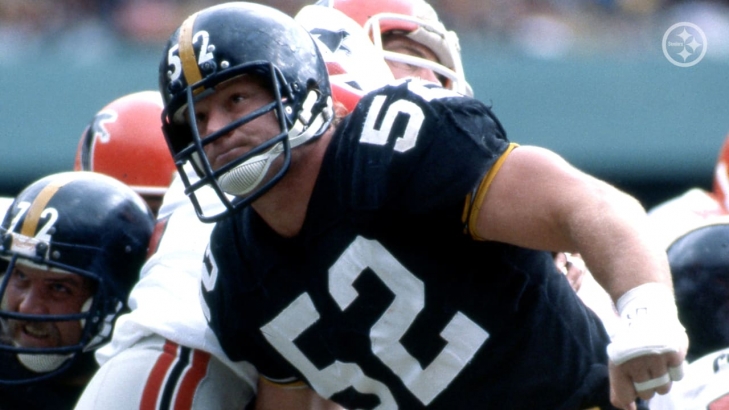
After being drafted in the Fifth Round in 1974, Mike Webster worked on Special Teams, Center and Guard in his first two seasons, contributing to the Steelers in little ways while helping them win their first two Super Bowls. What followed was one of the greatest runs ever by an NFL Center.
The Pittsburgh Steelers announce their Hall of Honor
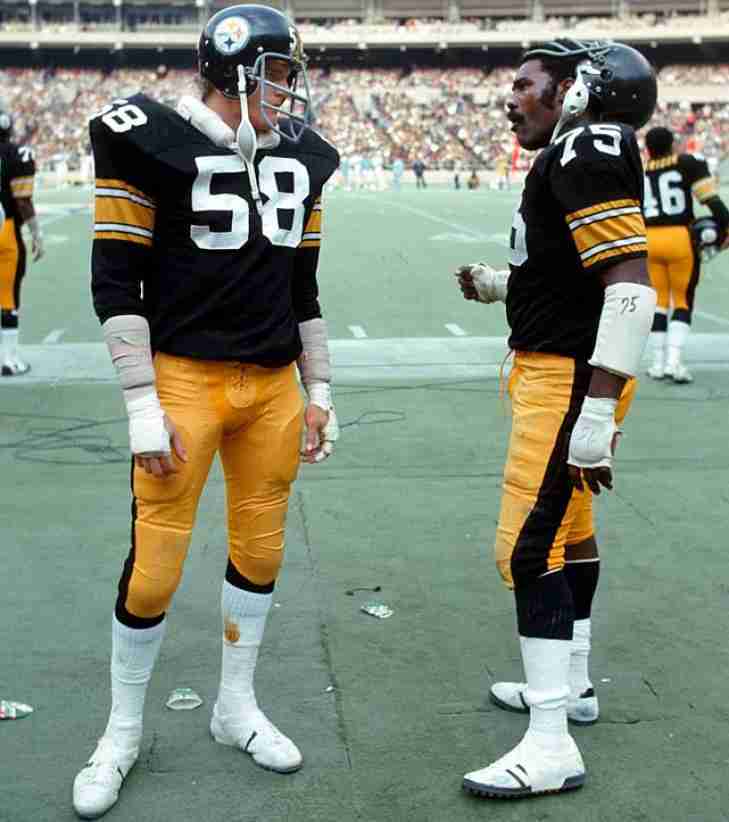
This has been a long time coming, so much so that this group comprises 23 Pro Football Hall of Famers.
Let’s get right to this very esteemed group:
Art Rooney: The founding owner of the Steelers and President of the team from 1933 to 1974. He also served as the Chairman until 1988.
Dan Rooney: The son of Art Rooney, Dan Rooney was the Steelers President from 1975 to 2002. He spearheaded the push for minority hires as coaches or GM creating the “Rooney Rule”, whereby all NFL teams must interview a minority candidate for a coaching or GM job.
Chuck Noll: The Head Coach for Pittsburgh from 1969 to 1991, Noll is a four time Super Bowl winner with a regular season record of 193-148-1. He would win two more Super Bowls with the Steelers as an Executive.
Jack Butler: a four time First Team All-Pro Cornerback from 1956 to 1959. He led the NFL in Interceptions in 1957.
Dick Hoak: A Pro Bowl Running Back in 1968 and the Running Coach from 1972 to 2007. He has five Super Bowl Rings as a Coach.
Joe Greene: “Mean” Joe was a four time Super Bowl Champion and a Defensive Tackle who went to ten Pro Bowls while earning six First Team All-Pro Selections. He was the Defensive Player of the Year in both 1972 and 1974.
Terry Bradshaw: The Quarterback of the 1970’s Steelers dynasty, Terry Bradshaw was a three time Pro Bowler and two time Super Bowl MVP.
Franco Harris: The Fullback was the engine of the Steelers juggernaut and he too is a four time Super Bowl Champion. He was also a nine time Pro Bowl Selection and the MVP of Super Bowl IX.
Mike Webster: The Center for the 70’s juggernaut, he also won four Super Bowls. He would be named to nine Pro Bowls and seven First Team All-Pro squads.
Lynn Swann: The very popular Wide Receiver was also a four time Super Bowl winner. Twice he would be a Pro Bowler and he was the MVP of Super Bowl X.
L.C. Greenwood: Greenwood also won four Super Bowls and the Defensive End went to six Pro Bowls.
Mel Blount: The Cornerback also won four Super Bowls and was himself a five time Pro Bowl and four time First Team All Pro. He led the NFL in Interceptions in 1975 and was named the NFL Defensive Player of the Year.
Jack Ham: Playing Outside Linebacker, Ham also won four Super Bowls and was a eight time Pro Bowl and six time First Team All Pro Selection.
Jack Lambert: Yet another four time Super Bowl winner Jack Lambert went to nine Pro Bowls and seven First Team All Pros. The Middle Linebacker was a two time Defensive Player of the Year in both 1976 and 1983.
Andy Russell: A two time Super Bowl winner with eight Pro Bowl Selections. Russell played Linebacker.
Rod Woodson: The Cornerback played ten years of his career with Pittsburgh and was a seven time and five time First Team All Pro Selection with Pittsburgh. As a Steeler he won a Super Bowl and was named the Defensive Player of the Year in 1993.
Kevin Greene: Only a Steeler for three seasons, Greene won the Super Bowl with the team and was named to a First Team All Pro squad.
Jerome Bettis: “The Bus” won a Super Bowl with Pittsburgh as well as earning four Pro Bowls.
Donnie Shell: Another four time Super Bowl Champion, the Safety was a five time Pro Bowl and three time First Team All-Pro Selection.
John Stallworth: Stallworth also won four Super Bowls and he was named to three Pro Bowls. The Wide Receiver also made a First Team All Pro squad once.
Bobby Layne: The Hall of Fame Quarterback played his final five seasons with Pittsburgh and he was a two time Pro Bowl Selection as a Steeler.
Ernie Stautner: A star Defensive Tackle of the 1950’s, Statutner would be a nine time Pro Bowl.
John Henry Johnson: A Fullback who went to three Pro Bowls as a Steeler in early 1960’s.
Bill Dudley: “Bullet Bill” was an imposing halfback who was with Pittsburgh for three seasons; one before World War II, and two after his service. He would be named the MVP in 1946.
Walt Kiesling: Kiesling only played one season with Pittsburgh but served as their coach for two stints.
John “Blood” McNally: McNally played three seasons for Pittsburgh as well as coached them for three.
Dermontti Dawson: The Center was a seven time Pro Bowl and six time First Team All Pro Selection.
The Hall of Honor will be located at the river end of the FedEx Great Hall at Heinz Field with the eventual plan to grow it to a museum.
To qualify for the Pittsburgh Steelers Hall of Honor a player must have been with the team for at least three years and be retired for at least three years.
We here at Notinhalloffame.com are beyond delighted that the Steelers have finally begun to honor their past legends with an institution like this.
