
The Pro Football Hall of Fame Revisited Project: 1981 Final VOTE

1981 Pro Football Hall of Fame Revisited Project Class.
Here we are! Again!!
If you have been following our Pro Football Hall of Fame Revisited Project, you know we have asked the rhetorical question: What if the PFHOF began in January 1946?
After soliciting and obtaining a passionate group of football fans and historians, we sent out a ballot for a Preliminary Vote, in which we asked each voter to give us 25 names as their semi-finalists and 5 in the Senior Pool. We then asked the group to vote for their 15 Finalists in the Modern Era and 3 in the Senior Category. The final stage was to vote for their five Modern Era inductee and one Senior inductee.
This is the result of the 36th official class.
Below are the final results of this project based on 31 votes.
Remember that we have reverted back to the top five candidates entering the Hall in the Modern Era
This is for the “Modern Era”
*Bold indicates they have been elected to the Pro Football Hall of Fame Revisited Class of 1981:
|
Player |
Year of Eligibility |
Vote Total |
|
Len Dawson QB |
1 |
18 |
|
Jimmy Johnson DB |
1 |
17 |
|
George Blanda QB-K |
1 |
16 |
|
Johnny Robinson DB-FL-HB |
5 |
14 |
|
Del Shofner E-DB |
9 |
12 |
|
Billy Shaw G |
7 |
11 |
|
Abe Woodson DB |
10 |
10 |
|
Tom Sestak DT |
8 |
9 |
|
Eddie Meador DB |
6 |
9 |
|
Billy Howton E-FL |
13 |
8 |
|
Gene Hickerson G |
3 |
7 |
|
Bob Brown T |
3 |
5 |
|
Maxie Baughan LB |
2 |
5 |
|
Bob Hayes SE-WR |
1 |
5 |
|
Dave Robinson LB |
2 |
4 |
This is for the “Senior Era”,
*Bold indicates they have been elected to the Pro Football Hall of Fame Revisited Class of 1981.
|
Marshall Goldberg FB |
8 |
11 |
|
Pat Harder FB |
3 |
7 |
|
Bucko Kilroy G-T |
1 |
6 |
|
None of the Above |
N/A |
7 |
This is for the “Coaches/Contributors”,
*Bold indicates they have been elected to the Pro Football Hall of Fame Revisited Class of 1981.
|
John Madden (Cach) |
1 |
13 |
|
Weeb Ewbank (Coach) |
5 |
9 |
|
Geroge Allen (Coach) |
2 |
9 |
About the 1981 Inductees:
Len Dawson QB, PIT 1957-59, CLE 1960-61, DTX/KAN 1962-75: Inducted in the Pro Football Hall of Fame Revisited Project in 1981 on his 1st Ballot. Inducted into the actual Pro Football Hall of Fame in 1987.
Len Dawson was a First Round Draft Pick by the Pittsburgh Steelers but the former Purdue Boilermaker accomplished nothing there as he would in Cleveland shortly thereafter. It looked like Dawson became a bust, but after being released by the Browns, he would sign with the Dallas Texans, and it was a match made in football heaven.
Dawson would lead the American Football League in Touchdown Passes in his first season there, while more importantly taking the team to a league championship win (1962). Dawson and the team would move north to Kansas City, where they would become the Chiefs, but while the team’s geography would change, Dawson’s efficiency would not.
Dawson’s AFL league-leading Passer Rating of 1962 would be duplicated in every season from 1964 to 1968, as well as posting four seasons where he led the league in Touchdown Passes. Dawson would take the Chiefs to the first Super Bowl, where, although they lost, Dawson impressed many in defeat. He would later take the Chiefs to a win in Super Bowl IV (where he was named the Super Bowl MVP), which to date is the only one in franchise history.
Overall, he threw for 28,711 Yards and 239 Touchdown Passes, which are incredible for his time.
Jimmy Johnson, DB, SFO 1961-76: Inducted in the Pro Football Hall of Fame Revisited Project in 1981 on his 1st Ballot. Inducted into the actual Pro Football Hall of Fame in 1994.
How good an athletic family did Jimmy Johnson come from? The Pro Football Hall of Famer was the brother of the 1960 Olympic Gold Medalist (Decathlon), Rafer Johnson.
Johnson, who played his college ball at UCLA, did not have to travel far to join the Professional ranks as the San Francisco 49ers with the Sixth Overall Pick in 1961. Johnson was incredibly versatile, though he was undoubtedly at his best at Cornerback, where he began as a rookie. While he had five Interceptions as a rookie and was considered good, the Niners moved him to Flanker in 1962, where he played for one year with 627 Yards. Johnson went to Safety in 1963 but returned to Corner, where he stayed for the rest of his professional career.
Johnson proved his worth in the Secondary throughout the 1960s, but it was not until 1969 that he turned heads. From 1969 to 1972, Johnson was both a Pro Bowl and First Team All-Pro Selection, with his Approximate Value never going below 14 in those seasons. During this time, Johnson was considered the best Defensive Back in Football, and many thought he was.
Johnson played until 1976, never leaving San Francisco. He would go to his fifth Pro Bowl in 1974, and he retired with 47 Interceptions.
George Blanda, QB-K, BCL 1949, CHI 1949–58, HOU 1960-66 & OAK 1967-75. Inducted in the Pro Football Hall of Fame Revisited Project in 1981 on his 1st Ballot. Inducted into the actual Pro Football Hall of Fame in 1981.
Regarding longevity, few players in team sports in the United States can light a candle to George Blanda.
Playing in four different decades, Blanda had periods as an elite quarterback, and his durability kept him in professional football, thanks in part to his special teams ability. Blanda played for the Chicago Bears through the 1950s as a quarterback and kicker, and when the American Football League started in 1960, he signed with the Houston Oilers.
In the AFL, he was a three-time champion, two with Houston and one with Oakland, and he was the league MVP in 1961. When the AFL merged with the NFL, Blanda’s kicking ability was kept in pro football until 1975, making his 26-year career the longest in pro football.
Johnny Robinson, DB-FL-HB, DTX-KAN 1960-71. Inducted in the Pro Football Hall of Fame Revisited Project in 1981 on his 5th Ballot. Inducted into the actual Pro Football Hall of Fame in 2019.
Johnny Robinson is arguably the greatest Safety in Kansas City Chiefs history, though he did not start his professional career that way.
Robinson was drafted as a Halfback for the inaugural season of the American Football Leagues’ Dallas Texans. Converted to a Flanker, he accrued over 1,800 Yards from Scrimmage in his first two seasons. Robinson would be moved to Safety the following year, and he would help the Dallas Texans win the AFL Title in 1962. He would stay with the team when they relocated to Kansas City, and his defensive prowess began to blossom. Robinson was named a First Team AFL All-Pro every season from 1965 to 1969 and would be a First Team All-Pro in 1970 in the NFL following the merger. The product of LSU would lead his respective league in Interceptions twice (1966 AFL, 1970 NFL), and he would secure 57 picks overall in his career.
His best performance took place in Super Bowl IV, where he helped the Chiefs win the game with a fumble recovery and an interception. Robinson had a pick in each of the three AFL Championship Games he played! Robinson was one of the early inductees into the Chiefs Hall of Fame, receiving the call in 1974.
Del Shofner, E-DB, RAM 1957-60, NYG 1961-67. Inducted in the Pro Football Hall of Fame Revisited Project in 1981 on his 9th Ballot. Was never inducted in to the Pro Football Hall of Fame.
Del Shofner was a remarkable receiver who was part of the 1960s All-Decade Team. He achieved this status thanks to his outstanding performance during a six-year stretch from 1958 to 1963, where he was named a First Team All-Pro and Pro Bowl selection in all those years except for 1960.
During his time with the Los Angeles Rams, Shofner topped the NFL in Receiving Yards in 1958 with 1,097, and finished second in the following year with 936. In 1960, he was relegated more to punting duties, but once he joined the New York Giants, he regained his place as an elite receiver. In his first three years with the Giants, Shofner had at least 1,100 Receiving Yards and finished in the top four in that metric. Although he never had a stretch close to that again, his reputation as one of the top offensive skill players and deep ball threats of his era earns him a high spot on this list.
Our All Time Top 50 Kansas City Chiefs have been revised to reflect the 2025 Season

Yes, we know that this is taking a while!
As many of you know, we at Notinhalloffame.com are slowly generating the top 50 of each major North American sports team. That being said, we maintain and update our existing Top 50 lists annually. As such, we are delighted to present our post-2024 revision of our top 50 Kansas City Chiefs.
As for all of our top 50 players in football, we look at the following:
1. Advanced Statistics.
2. Traditional statistics and how they finished in the National Football League.
3. Playoff accomplishments.
4. Their overall impact on the team and other intangibles that are not reflected in a stat sheet.
Last year, the Chiefs had another outstanding campaign, going 15-2 with a combination of elite skill and incredible luck. The squad marched to their third consecutive Super Bowl, but could not win the third straight, as Philadelphia easily dispatched them. There was a pair of elevations with a new entrant.
As always, we present our top five, which saw a change.
1. Len Dawson
2. Derrick Thomas
3. Tony Gonzales
4. Patrick Mahomes
5. Bobby Bell
You can find the entire list here.
Mahomes moved up within the top five by one spot to #4.
Of note, Travis Kelce remains at #7.
The phenomenal defensive star, Chris Jones, advanced from #19 to #12.
We thank you for your continued support of our lists on Notinhalloffame.com.
Our All-Time Top 50 Kansas City Chiefs have been revised to reflect the 2023 Season
Yes, we know that this is taking a while!
As many of you know, we at Notinhalloffame.com are slowly generating the top 50 of each major North American sports team. That being said, we have existing Top 50 lists and consistently look to update them when necessary and based on necessity. As such, we are delighted to present our post-2023 revision of our top 50 Kansas City Chiefs.
As for all of our top 50 players in football, we look at the following:
1. Advanced Statistics.
2. Traditional statistics and how they finished in the National Football League.
3. Playoff accomplishments.
4. Their overall impact on the team and other intangibles that are not reflected in a stat sheet.
Last year, Kansas City did it all again, winning their second straight Super Bowl and fourth overall. Despite this, there were no new entrants but two very significant elevations.
As always, we present our top five, which saw a new number five:
1. Len Dawson
2. Derrick Thomas
3. Tony Gonzalez
4. Bobby Bell
5. Patrick Mahomes
You can find the entire list here.
Mahomes moves into the top five and is poised to become the greatest Chief of all time. If you go by Super Bowls, he is already there, and we understand if you think he should be #1 right now.
Defensive Tackle Chris Jones, who secured his fifth Pro Bowl and Second First Team All-Pro jumped from #31 to #19.
Notably, Tight End Travis Kelce, who may have earned his ninth Pro Bowl, could not move up this loaded list. He is still ranked at #7.
We thank you for your continued support of our lists on Notinhalloffame.com.
Our All-Time Top 50 Kansas City Chiefs have been updated to reflect the 2022 Season
Yes, we know that this is taking a while!
As many of you know, we here at Notinhalloffame.com are slowly generating the 50 of each major North American sports team. That being said, we have existing Top 50 lists out and we always consistently look to update them when we can and based on necessity. As such, we are very happy to present our post 2022 revision of our top 50 Kansas City Chiefs.
As for all of our top 50 players in football we look at the following:
1. Advanced Statistics.
2. Traditional statistics and how they finished in the National Football League.
3. Playoff accomplishments.
4. Their overall impact on the team and other intangibles not reflected in a stat sheet.
Last year, Kansas City won their third Super Bowl and advanced in the overall hierarchy of the greatest NFL franchises of all-time. We saw three distinct rank elevations due to the powerful 2023 campaign.
As always, we present our top five, which did not change.
1. Len Dawson
4. Bobby Bell
5. Will Shields
You can find the entire list here.
Tight End, Travis Kelce, exploded from #13 to #6.
Quarterback, Patrick Mahomes, who is now a two-time MVP, also rocketed up the ranking. He went to #8 from #19.
Defensive Tackle, Chris Jones, advanced nine spots to #31.
We welcome your input and comments and as always, we thank you for your support.
RIP: Len Dawson
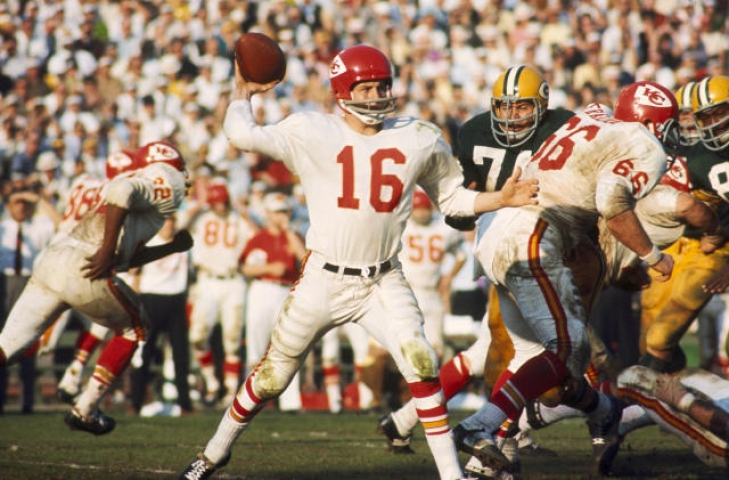
One of the game’s greatest Quarterbacks, Len Dawson, passed away today at the age of 87 while in hospice care.
A college star at Purdue, Dawson was a First Round Draft Pick by the Pittsburgh Steelers in 1957 but the former Boilermaker accomplished nothing there as he would in Cleveland shortly thereafter. It looked like Dawson become a bust but after being released by the Browns he would sign with the Dallas Texans and it was a match made in football heaven.
Dawson would lead the American Football League in Touchdown Passes in his first season there while more importantly taking the team to a league championship win (1962). Dawson and the team would move north to Kansas City where they would become the Chiefs but while the team’s geography would change, Dawson’s efficiency would not.
Dawson’s AFL league leading Passer Rating of 1962 would be duplicated in every season from 1964 to 1968 as well as posting four seasons where he led the league in Touchdown Passes. Dawson would take the Chiefs to the first Super Bowl where although they lost, Dawson impressed many in defeat. He would later take the Chiefs to a win in Super Bowl IV (where he was named the Super Bowl MVP), which was the only one in franchise history.
Overall as a Chief, he threw for 28,507 Yards and 237 Touchdown Passes numbers which are incredible for his time period.
Dawson would enter the Pro Football Hall of Fame in 1987, and was inducted into the Chiefs Hall of Fame the same year. His no. 16 has also been retired by the team.
We here at Notinhalloffame.com would like to extend our condolences to the fans, friends and family of Len Dawson.
5. Len Dawson
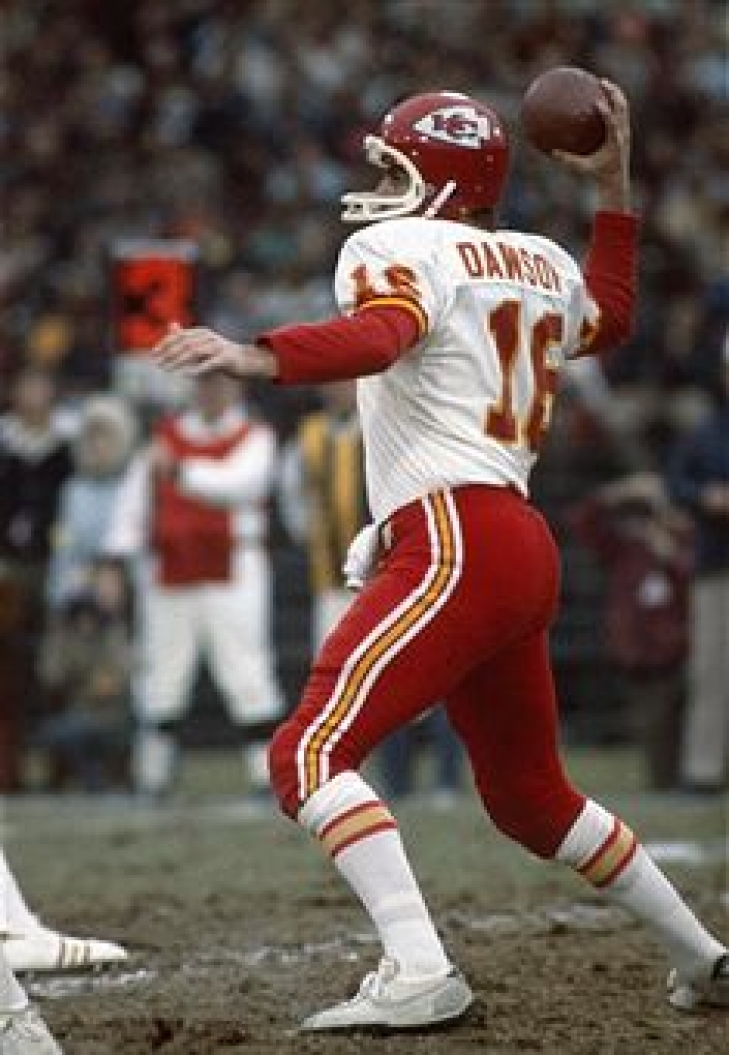
Before he became the undisputed royalty of Kansas City football, Len Dawson looked like a first-round draft bust buried on NFL sidelines. Selected fifth overall by Pittsburgh out of Purdue in 1957, Dawson spent three anonymous seasons underutilized by the Steelers before being shipped to Cleveland, where he languished behind Milt Plum. Released after five NFL seasons with just two career touchdown passes to his name, Dawson’s professional career seemed dead on arrival until former Purdue assistant Hank Stram threw him a lifeline with the AFL’s Dallas Texans in 1962.
Reunited with Stram, Dawson immediately unspooled one of the most remarkable career turnarounds in pro football history. Taking the reins of Stram’s innovative "moving pocket" offense, Dawson brought clinical precision and icy composure to a fledgling league often criticized for chaotic play. Nicknamed "Lenny the Cool" for his unflappable demeanor under pressure, he transformed the Texans into an instant juggernaut, leading the AFL with 29 touchdown passes and a 98.3 passer rating in his very first season as a full-time starter.
The memorable 1962 campaign ended with a double-overtime win against the Houston Oilers in the AFL Championship, earning the franchise its first league title. When Lamar Hunt moved the team north to Missouri to form the Kansas City Chiefs the next year, the team’s location shifted, but Dawson's consistent brilliance did not change. He became the standard for efficiency throughout the decade, consistently leading the AFL in passing.
Dawson’s mastery of Stram’s scheme was unmatched in his era. He won six AFL passer rating titles (1962, 1964–1968)—including five straight seasons on top—and led the league in touchdown passes four times (1962, 1963, 1965, 1966). Unlike opponents who focused on deep vertical throws, Dawson dissected defenses with pinpoint accuracy, leading the league in completion percentage in eight seasons and consistently achieving touchdown-to-interception ratios that were far ahead of his time.
In 1966, Dawson led Kansas City to an 11–2–1 record and a decisive victory over Buffalo in the AFL title game, securing their place in the first AFL-NFL World Championship Game (Super Bowl I). Although the Chiefs ultimately lost to Vince Lombardi’s Green Bay Packers, Dawson impressed many by completing 16 of 27 passes against a renowned NFL defense, demonstrating to skeptical fans across the country that the AFL’s top quarterback had exceptional, world-class skills.
Three years later, Dawson created his career's defining masterpiece in 1969. Although he missed five games due to a knee injury and faced false, sensationalized gambling accusations before Super Bowl IV against the favored Minnesota Vikings, Dawson stayed resilient. His steady leadership kept Kansas City focused as they dominated Minnesota's renowned "Purple People Eaters" defense, winning 23–7. Dawson received Super Bowl MVP honors, confirming the AFL's strength just months prior to the official merger.
Dawson was more than just a champion with his awards; he was a tough physical player who took harsh hits during an era with almost no protective rules for quarterbacks. He led the Chiefs through their integration into the unified NFL, starting until he retired after the 1975 season at age 40. By retirement, he had played 14 seasons in Chiefs red, setting statistical records that stood for nearly 50 years until Patrick Mahomes came along.
His post-playing career further cemented his reputation as a local legend. Dawson smoothly shifted into a popular broadcaster, leading local sports coverage in Kansas City and working for decades as the color commentator for the Chiefs Radio Network, while also hosting HBO's Inside the NFL. His unique ability to earn trust both on the field and at home made him the enduring elder figure in Kansas City sports culture.
With the Chiefs, Dawson compiled 28,507 passing yards, 237 passing touchdowns, and 178 interceptions in red and gold, along with 1,241 rushing yards and nine rushing touchdowns. A Super Bowl IV champion and MVP, three-time AFL Champion (1962, 1966, 1969), six-time AFL All-Star, 1968 Pro Bowler, and 1962 First-Team All-AFL selection, Dawson had his No. 16 jersey retired by the Chiefs and remains a universally revered pillar of football history; he was inducted into the Pro Football Hall of Fame in 2009.
