

The Pro Football Hall of Fame Revisited Project: 1982 Final VOTE

1982 Pro Football Hall of Fame Revisited Project Class.
Here we are! Again!!
If you have been following our Pro Football Hall of Fame Revisited Project, you know we have asked the rhetorical question: What if the PFHOF began in January 1946?
After soliciting and obtaining a passionate group of football fans and historians, we sent out a ballot for a Preliminary Vote, in which we asked each voter to give us 25 names as their semi-finalists and 5 in the Senior Pool. We then asked the group to vote for their 15 Finalists in the Modern Era and 3 in the Senior Category. The final stage was to vote for their five Modern Era inductee and one Senior inductee.
This is the result of the 37th official class.
Below are the final results of this project based on 33 votes.
Remember that we have reverted back to the top five candidates entering the Hall in the Modern Era
This is for the “Modern Era”
*Bold indicates they have been elected to the Pro Football Hall of Fame Revisited Class of 1982:
|
Player |
Year of Eligibility |
Vote Total |
|
Merlin Olsen DT |
1 |
26 |
|
Eddie Meador DB |
7 |
16 |
|
Billy Howton E-FL |
14 |
14 |
|
Tom Sestak DT |
9 |
12 |
|
Abe Woodson DB |
11 |
10 |
|
Billy Shaw G |
8 |
9 |
|
Maxie Baughan LB |
3 |
9 |
|
Bob Hayes SE-WR |
2 |
9 |
|
Jimmy Patton DB |
11 |
8 |
|
Dave Wilcox LB |
3 |
8 |
|
Gene Hickerson G |
4 |
7 |
|
Dave Robinson LB |
3 |
7 |
|
Alan Ameche FB |
17 |
6 |
|
Tommy Nobis LB |
1 |
5 |
|
Dick LeBeau DB |
5 |
4 |
|
Jim Tyrer T |
3 |
4 |
This is for the “Senior Era”,
*Bold indicates they have been elected to the Pro Football Hall of Fame Revisited Class of 1982.
|
Bucko Kilroy G-T |
2 |
9 |
|
Ace Gutkowski FB-TB |
18 |
7 |
|
Pat Harder FB |
4 |
6 |
|
None of the Above |
N/A |
11 |
This is for the “Coaches/Contributors”,
*Bold indicates they have been elected to the Pro Football Hall of Fame Revisited Class of 1982.
|
Weeb Ewbank (Coach) |
6 |
17 |
|
John Madden (Coach) |
2 |
9 |
|
George Allen (Coach) |
3 |
7 |
About the 1982 Inductees:
Merlin Olsen, DT, RAM 1962-76: Inducted in the Pro Football Hall of Fame Revisited Project in 1982 on his 1st Ballot. Inducted into the actual Pro Football Hall of Fame in 1982.
The Outland Trophy winner from Utah State, Merlin Olson, was the third overall pick in the 1962 Draft, and as a rookie, he would go to the Pro Bowl. That was the first of fourteen straight Pro Bowl appearances for Olsen, which set a record that has since been tied but not surpassed. Olsen would anchor the Rams' defense, where he was part of the greatest group of Defensive Linemen of the 1960s, "The Fearsome Foursome," consisting of Olsen, Deacon Jones, Rosey Grier, and Lamar Lundy.
Not only was Olsen good, but he also seemed to be good forever. In addition to those 14 Pro Bowls, he would be considered an elite performer for most of those seasons. Olsen was named a First Team All-Pro five straight seasons (1966-70) and was a Second Team All-Pro another four times. So respected was Olsen that in 1974, he would become the Bert Bell Award winner (becoming the second defensive player to do so), which is presented by the Maxwell Football Club to whom they deem the MVP. Realistically, if Olsen was going to win this award, it should have been in an earlier year, but in true Olsen fashion, he thanked all defensive players. This man was indeed a class act!
A member of both the 1960s and 1970s All-Decade Team, Olsen would go on to have a successful career as an actor and broadcaster. The Rams retired his no. 74, and in 2020, he was posthumously named to the NFL 100th Anniversary Team.
Eddie Meador, DB, RAM 1959-70: Inducted in the Pro Football Hall of Fame Revisited Project in 1982 on his 7th Ballot. Was never inducted into the actual Pro Football Hall of Fame.
In the 1960s, the Los Angeles Rams defense was primarily known for its "Fearsome Foursome" Defensive Line, but there was a star in their Secondary by the name of Eddie Meador, who would be chosen for six Pro Bowls. Meador came from Arkansas Tech and would become the starting Left Cornerback in his second season. That year (1960), he was named to the Pro Bowl, but when he moved to Right Safety in 1964, he was in a better spot for his skill set. Meador would go to five straight Pro Bowls (1964-68) and was a First Team All-Pro in both 1968 and 1969.
As of this writing, Meador is still the Rams' all-time leader in Interceptions (46), and he would be named to the 1960s All-Decade Team.
Billy Howton, E, GNB 1952-58, CLE 1959 & DAL 1960-63. Inducted in the Pro Football Hall of Fame Revisited Project in 1982 on his 14th Ballot. Was never inducted into the actual Pro Football Hall of Fame.
Billy Howton was the all-time leader when he retired in 1963. He has dropped considerably since then.
A top receiver for the Green Bay Packers throughout the 1950s, Howton was a constant fixture for years in every receiving category. When he became the all-time leader in receptions and yards, he took that slot from the legendary Don Hutson.
A huge force works against him (for the actual Hall) as he was cast off from the Green Bay Packers when the most iconic figure in professional football, Vince Lombardi, arrived in the tundra. Many speculated that if he wasn’t good enough for Lombardi, he couldn’t possibly be good enough for Canton. That is a compelling argument. While we acknowledge that fact, Howton helped lay the groundwork for today's modern Wide Receivers, and that also can't be dismissed, as acknowledged here.
Tom Sestak, DT, BUF, 1962-68. Inducted in the Pro Football Hall of Fame Revisited Project in 1982 on his 9th Ballot. Was never inducted into the actual Pro Football Hall of Fame.
One of the most dominating Defensive Tackles of the AFL, Tom Sestak, joined the Buffalo Bills of the American Football League in 1962, where he quickly became the team's defensive anchor. Sestak was an AFL All-Star in his first four seasons, and in years two through four, he was a First Team All-Pro and was in the top ten in Approximate Value. The Bills won the 1964 and 1965 AFL Championship, and during that timeframe, Sestak and the Buffalo Defense would hold opponents without a rushing touchdown in seventeen straight games, a record that still stands. Knee problems would force an early retirement after the 1968 Season, but his play was strong enough to make the AFL All-Time Team.
Abe Woodson, DB, SFO 1958-64 & STL 1965-66. Inducted in the Pro Football Hall of Fame Revisited Project in 1982 on his 11th Ballot. Was never inducted into the Pro Football Hall of Fame.
Abe Woodson’s regular role was at Cornerback, where he would accumulate 19 Interceptions over his career, but it was his returning ability that would see him gain five straight Pro Bowl selections (1959-63)
Drafted in the 2nd Round from the University of Illinois, Abe Woodson's best seasons were with the San Francisco 49ers. Woodson, who was also a two-time First Team All-Pro, would record 6,850 Return Yards and would average a whopping 28.7 Yards per Kick Return. He would have four straight years where he had at least 1,000 All-Purpose Yards.
Weeb Ewbank, Coach, BAL 1954-62 & NYJ 1963-73. Inducted in the Pro Football Hall of Fame Revisited Project in 1982 on his 6th Coaches/Contributor Ballot. Inducted into the Pro Football Hall of Fame in 1978.
Weeb Ewbank would win four championships under Paul Brown as an Assistant Coach with Cleveland, and under his learning tree, he was able to thrive as a Head Coach, first with the Baltimore Colts in 1954.
Ewbank guided the Colts to back-to-back NFL Championships in 1958 and 1959, cementing Baltimore as a top franchise. After falling out of favor with Colts management, he was let go in 1962, but went to the AFL to coach the New York Jets the following year. Ewbank led New York to the 1968 AFL Title, and then they stunned the sporting world by winning Super Bowl III, defeating his old team.
Ewbank remained with the Jets until 1974 and went down as the only man in football history to win an NFL and AFL Championship.
He retired with a record of 130-129-7.
Our All Time Top 50 Los Angeles Rams have been revised to reflect the 2025 Season

Yes, we know that this is taking a while!
As many of you know, we at Notinhalloffame.com are slowly generating the top 50 of each major North American sports team. That being said, we maintain and update our existing Top 50 lists annually. As such, we are delighted to present our post-2024 revision of our top 50 Los Angeles Rams.
As for all of our top 50 players in football, we look at the following:
1. Advanced Statistics.
2. Traditional statistics and how they finished in the National Football League.
3. Playoff accomplishments.
4. Their overall impact on the team and other intangibles that are not reflected in a stat sheet.
Last year, the Chargers had a strong season, finishing 10-7 and advancing to the playoffs, and made it to the Divisional Round, falling to the eventual Super Bowl Champions, the Philadelphia Eagles. There was one new addition to the list and one elevation on our Top 50.
As always, we present our top five, which remain unchanged.
1. Aaron Donald
2. Merlin Olsen
3. Deacon Jones
4. Jack Youngblood
5. Orlando Pace
You can find the entire list here.
Cooper Kupp, who is now with the Seattle Seahawks, was unable to move from #31.
Quarterback Matthew Stafford makes his debut at #41.
We thank you for your continued support of our lists on Notinhalloffame.com.
Our All-Time Top 50 Los Angeles Rams have been revised to reflect the 2023 Season
Yes, we know that this is taking a while!
As many of you know, we at Notinhalloffame.com are slowly generating the top 50 of each major North American sports team. That being said, we have existing Top 50 lists and consistently look to update them when necessary and based on necessity. As such, we are delighted to present our post-2023 revision of our top 50 Los Angeles Rams.
As for all of our top 50 players in football, we look at the following:
1. Advanced Statistics.
2. Traditional statistics and how they finished in the National Football League.
3. Playoff accomplishments.
4. Their overall impact on the team and other intangibles that are not reflected in a stat sheet.
Last year, the Rams made it back to the playoffs but were bounced in the opening round by the Detroit Lions. There were no new entrants in the Top 50, but there were two elevations, including a brand new number one.
As always, we present our top five, which saw a major change:
1. Aaron Donald
2. Merlin Olsen
3. Deacon Jones
4. Jack Youngblood
5. Orlando Pace
You can find the entire list here.
Three-time Defensive Player of the Year, Aaron Donald overtook fellow Defensive Tackle Merlin Olsen to take over the top spot. Donald retired after the 2023 Season.
The only other change was Wide Receiver Cooper Kupp, who advanced two spots to #31.
We thank you for your continued support of our lists on Notinhalloffame.com.
Our All-Time Top 50 Los Angeles Rams have been updated to reflect the 2022 Season
Yes, we know that this is taking a while!
As many of you know, we here at Notinhalloffame.com are slowly generating the 50 of each major North American sports team. That being said, we have existing Top 50 lists out and we always consistently look to update them when we can and based on necessity. As such, we are very happy to present our post 2022 revision of our top 50 Los Angeles Rams.
As for all of our top 50 players in football we look at the following:
1. Advanced Statistics.
2. Traditional statistics and how they finished in the National Football League.
3. Playoff accomplishments.
4. Their overall impact on the team and other intangibles not reflected in a stat sheet.
Two years ago, the Rams won it all, but last year they were unable to make it to a winning record. They still had one elevation and one new entrant based on last season.
As always, we present our top five, which did not change.
1. Merlin Olsen
2. Aaron Donald
3. Deacon Jones
5. Orlando Pace
You can find the entire list here.
Aaron Donald, who came last year at #2 remains there, but we were very close in placing him over Merlin Olsen. This could likely change in 12 months.
Wide Receiver, Cooper Kupp, who was the Super Bowl MVP and Offensive Player of the Year in 2021, advanced six rungs to #31.
The only new entry is Jalen Ramsey, the Cornerback who is now with the Miami Dolphins. He enters at #49.
We welcome your input and comments and as always, we thank you for your support.
Our All-Time Top 50 Los Angeles Rams have been revised to reflect the 2021 Season.
Yes, we know that this is taking a while!
As many of you know, we here at Notinhalloffame.com are slowly generating the 50 of each major North American sports team. That being said, we have existing Top 50 lists out and we always consistently look to update them when we can and based on necessity. As such, we are very happy to present our post-2021 revision of our top 50 Los Angeles Rams.
As for all of our top 50 players in football we look at the following:
1. Advanced Statistics.
2. Traditional statistics and how they finished in the National Football League.
3. Playoff accomplishments.
4. Their overall impact on the team and other intangibles not reflected in a stat sheet.
Last year, the Rams won it all, their second Super Bowl, and their first since they relocated to Los Angeles. The loaded team gave us two new entries, and we thought we might have seen a new number one, but we will explain that further as there are no changes in the top five.
As always, we present our top five, though there were no changes in this elite group:
1. Merlin Olsen
2. Aaron Donald
3. Deacon Jones
5. Orlando Pace
You can find the entire list here.
Aaron Donald, who we wondered if we jumped it too fast by rocketing him to #2, was seriously considered to supplant Olsen on the top spot. Anther Pro Bowl year likely will put him there.
Wide Receiver, Cooper Kupp, who won the Receiver’s Triple Crown, the Super Bowl, the Super Bowl MVP and the Offensive Player of the Year Award in 2021, debuts at #49.
Recently retired Offensive Lineman, and last year’s Walter Payton Man of the Year, Andrew Whitworth, appears at #50.
We welcome your input and comments and as always, we thank you for your support.
Our All-Time Top 50 Los Angeles Rams have been revised to reflect the 2020 Season

Yes, we know that this is taking a while!
As many of you know, we here at Notinhalloffame.com are slowly generating the 50 of each major North American sports team. That being said, we have existing Top 50 lists out and we always consistently look to update them when we can and based on necessity. As such, we are very happy to present our pre-2021 revision of our top 50 Los Angeles Rams of all-time.
As for all of our top 50 players in football we look at the following:
1. Advanced Statistics.
2. Traditional statistics and how they finished in the NFL.
3. Playoff accomplishments.
4. Their overall impact on the team and other intangibles not reflected in a stat sheet.
This our first revision in two years, and there is only one change, but it has direct impact in our top five.
1. Merlin Olsen
2. Aaron Donald
3. Deacon Jones
5. Orlando Pace
You can find the entire list here.
Donald moved up from #23 to #2, and is the reigning and three-time Defensive Player of the Year. It would not surprise us if he becomes the greatest Ram of all-time.
We welcome your input and comments and as always, we thank you for your support.
2. Merlin Olsen
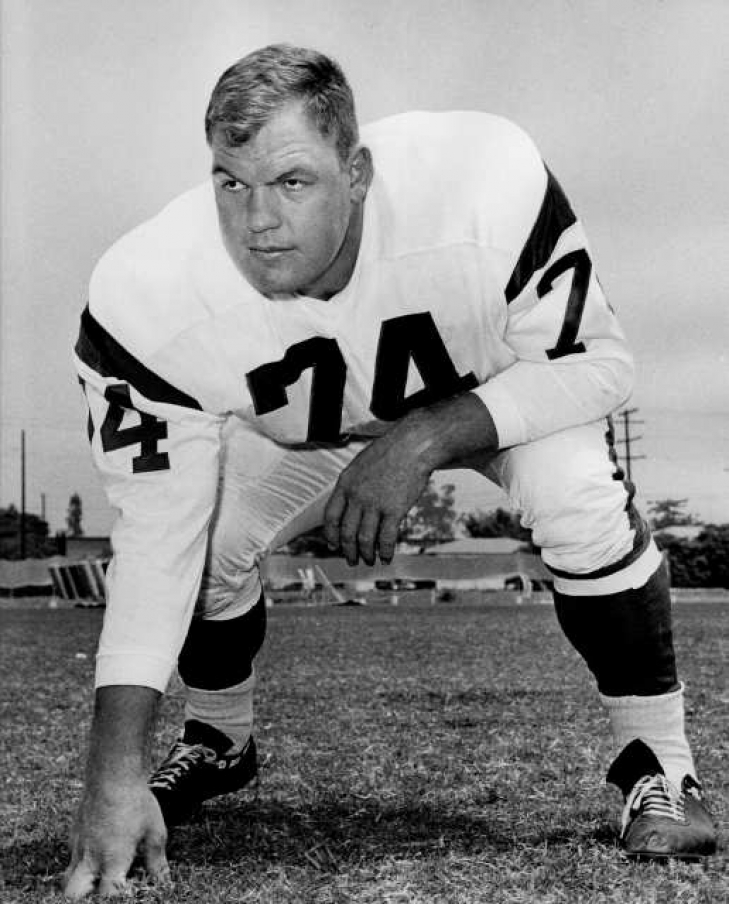
Chosen third overall out of Utah State in the 1962 NFL Draft, Merlin Olsen arrived in Los Angeles with towering expectations after sweeping the Outland Trophy and earning consensus All-American honors in his final college season. Stepping directly onto the professional gridiron, Olsen made an immediate impact as an elite interior disrupter. He earned a spot on the Western Conference Pro Bowl squad as a rookie, launching an incredible 15-year career that defined interior defensive line play for an entire generation.
That rookie selection was merely the beginning of an unprecedented individual run: Olsen was named to 14 consecutive Pro Bowls from 1962 to 1975, setting a league record for consecutive invitations that still stands today. As the left defensive tackle and intellectual anchor of the Rams' legendary "Fearsome Foursome"—alongside Deacon Jones, Rosey Grier, and Lamar Lundy—Olsen provided a rock-solid, disciplined counterweight to Jones' wild pass-rushing speed. Opposing offenses simply could not run the football up the middle against Olsen's supreme leverage and technique.
What elevated Olsen above his peers was a rare combination of physical strength, technical execution, and relentless durability. Standing 6-foot-5 and weighing 270 pounds, he controlled the line of scrimmage with uncanny balance, absorbing double teams while regularly collapsing pockets from the inside. Between 1966 and 1970, Olsen earned First-Team AP All-Pro honors in five consecutive seasons, establishing himself as the undisputed premier defensive tackle of his era alongside Bob Lilly and Alan Page.
In addition to five First-Team All-Pro selections, Olsen earned Second-Team All-Pro four times (1965, 1971–1973), maintaining elite production across three decades of football. His selfless, team-first leadership earned him the Bert Bell Award in 1974 as the NFL's Most Valuable Player, the Maxwell Football Club's recognition of the league's top player—and he became only the second defensive player ever to win the award. In typical humble fashion, Olsen accepted the trophy by deflecting credit and thanking defensive players everywhere for the recognition.
Olsen's remarkable durability saw him play 208 consecutive regular-season games for the Rams, never missing a single contest across his 15 years in Southern California. Whether anchoring the line during the defensive battles of the 1960s or leading Los Angeles to three straight NFC West division titles in the mid-1970s, he remained the franchise’s emotional heartbeat, locker-room standard, and tactical backbone.
After retiring following the 1976 season, Olsen transitioned seamlessly into a high-profile second career in entertainment and broadcasting. He became a household name off the field as an actor—starring in popular television series like Little House on the Prairie and Father Murphy—and served as a color commentator alongside Dick Enberg for NBC's top NFL broadcast crew.
National recognition followed Olsen's brilliant gridiron career at every turn. He was selected to both the NFL 1960s All-Decade Team and the NFL 1970s All-Decade Team, honoring his dominance across two distinct eras. Elected to the Pro Football Hall of Fame in 1982 in his first year of eligibility, his legendary No. 74 was retired by the Rams organization, permanently cementing his place in franchise lore.
Following his passing in 2010 at age 69, Olsen's legacy continued to earn historic recognition. In 2019, he was posthumously selected to the official NFL 100th Anniversary All-Time Team, taking his rightful place on the Mount Rushmore of defensive tackles. Before Aaron Donald's transcendent era, Olsen held the crown as the greatest player in Rams history—a consensus icon whose leadership and character set the gold standard for every player who put on the horns.
Olsen's enduring impact extended far beyond individual awards; he was the ultimate coach's player, leading purely by example. He handled the grueling demands of interior line play with absolute dignity, proving that a defensive tackle could play with brutal physical force without ever losing his sportsmanship or professional composure.
Statistically speaking, over his 208 games, he had 91 (unofficial) sacks.
