

Notinhalloffame List Update: 81-90 on Football Revised
The problem with running a Hall of Fame-related website is that many of the big ones we cover all have announcements within months of each other. The backbone of what we do is list-related, so this results in a long push to revise what we already have; specifically, now with our Football and Basketball Lists.
At present, we have a minor update as we have completed the eighth ten of the 2024 Football List, which you can comment on and vote on:
The new 81 to 90:
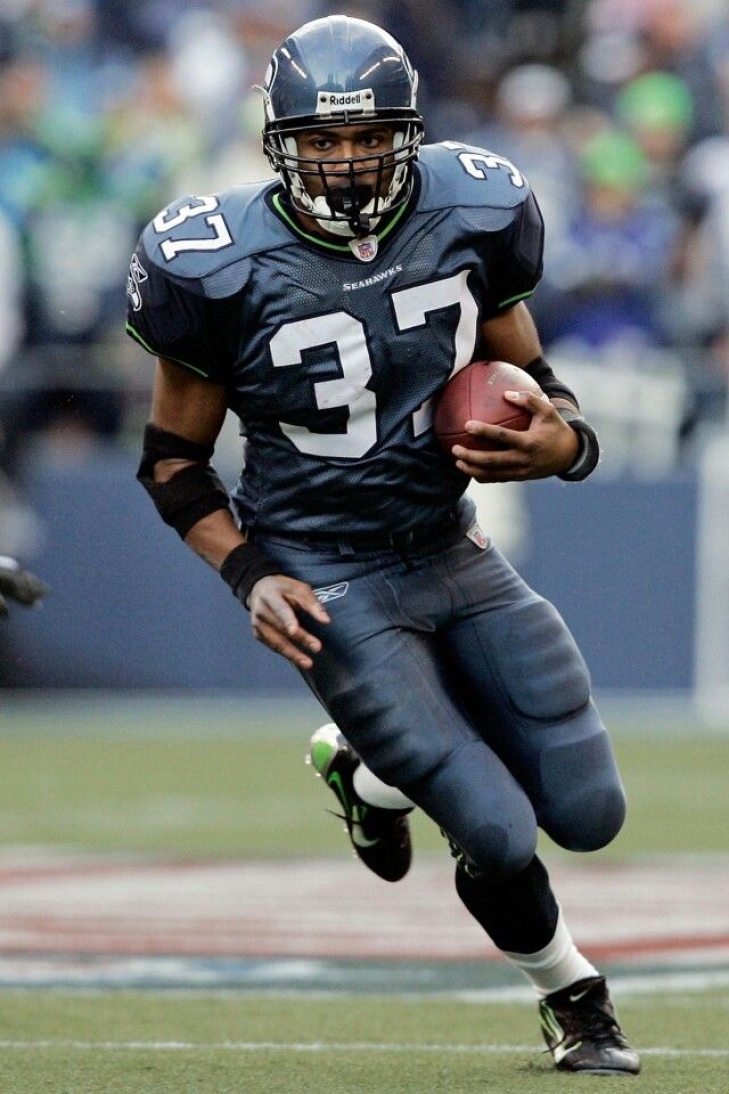
81. Shaun Alexander
82. Gene Lipscomb
83. Anquan Boldin
84. Donovan McNabb
85. Everson Walls
86. Cookie Gilchrist
87. Phil Simms
88. Ray Childress
89. Dick Anderson
90. Herschel Walker
Rankings are impacted annually based on your comments and votes.
Thank you all for your patience. We will soon unveil more changes to the football and basketball lists.
Our All-Time Top 50 Buffalo Bills have been revised
Yes, we know that this is taking a while!
As many of you know, we here at Notinhalloffame.com are slowly generating the 50 of each major North American sports team. That being said, we have existing Top 50 lists out and we always consistently look to update them when we can and based on necessity. As such, we are very happy to present the second revision of our top 50 Buffalo Bills of all-time.
As for all of our top 50 players in football we look at the following:
1. Advanced Statistics.
2. Traditional statistics and how they finished in the National Football League.
3. Playoff accomplishments.
4. Their overall impact on the team and other intangibles not reflected in a stat sheet.
This one went a complete overhaul, which was reflected in our top five as seen below.
The complete list can be found here, but as always we announce our top five in this article. They are:
1. Bruce Smith
3. O.J. Simpson
4. Bart Starr
5. Andre Reed
O.J. Simpson moved up from #5, which moved Jim Kelly and Andre Reed down one spot.
We had a colossal error in that former Fullback, Cookie Gilchrist was omitted from our first list. He appears at #16.
Former Running Back, Joe Cribbs also should have been on our initial top 50. He enters at #34. Another Running Back, LeSean McCoy debuts at #39.
The other additions are Defensive End, Mario Williams (#44), Linebacker, Bryce Paup (#45), Linebacker, John Tracey (#46) and Defensive Tackle, Marcell Dareus (#48).
We welcome your input and commentsand as always, we thank you for your support.
17. Cookie Gilchrist
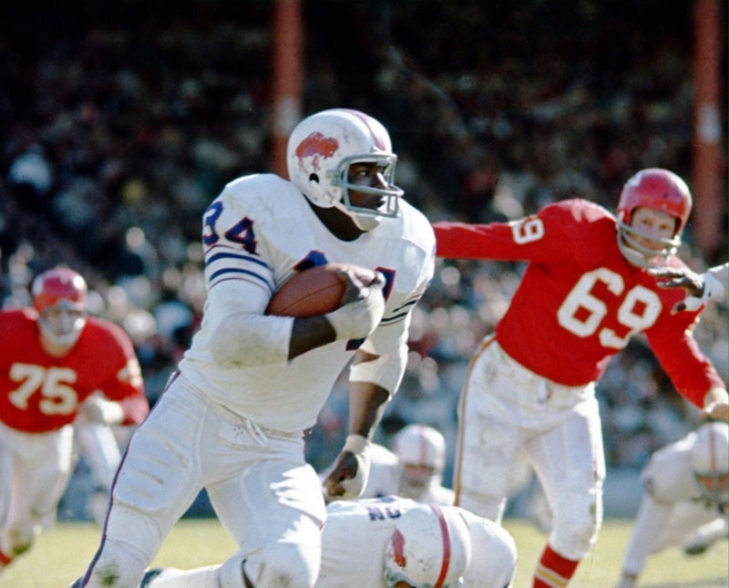
Carlton Chester "Cookie" Gilchrist embarked on one of the most unconventional journeys in football history. After initially signing a contract with the Cleveland Browns straight out of high school, which was then quickly revoked, Gilchrist chose to skip college and instead played in Canadian amateur leagues before entering the CFL. He spent six seasons in Canada, including winning a Grey Cup with the Hamilton Tiger-Cats in 1957, before making his NFL debut with the Buffalo Bills in 1962. Over the next three years, he became known for his fierce, uncompromising interior play.
Gilchrist was an unstoppable freight train, representing an imposing physical force ahead of his era. Combining the strides of a sprinter with formidable power, he did not circumvent defenders but rather ran directly through them. Serving as a robust fullback, he exhibited a rare capacity to efficiently punish tacklers in the gap, break arm tackles at the line of scrimmage, and accelerate away from defensive backs in the secondary. Furthermore, he contributed to the team by handling field goals and kickoff responsibilities during his early tenure in Western New York.
Gilchrist's arrival in 1962 transformed the AFL's offensive landscape. In his first year with the Bills, he became the AFL’s first 1,000-yard rusher, leading the league with 1,096 rushing yards and 13 touchdowns. His immediate dominance earned him the AFL Most Valuable Player honors.
In 1963, he achieved another historic milestone. During a December game against the New York Jets, Gilchrist set a then-record for pro football by rushing 243 yards and scoring five touchdowns in a single game. He concluded the season with 979 yards and once more led the AFL with 12 rushing touchdowns.
In 1964, Gilchrist concluded his short stint with Buffalo by winning his second AFL rushing title with 981 yards. He also led the league in rushing touchdowns (6) for the third year in a row. He performed especially well in the postseason, rushing for 122 yards in the 1964 AFL Championship Game, which helped Buffalo defeat San Diego and secure its first league title.
While Gilchrist's achievements on the gridiron were remarkable, his influence outside the sport was even more profound. An independently minded thinker and a pioneer in civil rights, Gilchrist consistently took a stand against systemic injustice throughout his life. In January 1965, following widespread segregation and discrimination faced by Black players upon their arrival in New Orleans for the AFL All-Star Game, Gilchrist organized and led a successful boycott. The players’ united stance compelled the league to relocate the game to Houston. Many years later, Gilchrist notably declined his induction into the Canadian Football League Hall of Fame, citing issues of racism and the exploitation of players.
Despite his on-field success, friction with head coach Lou Saban over playing time and team management led to his departure shortly after the 1964 title run. Gilchrist was traded to the Denver Broncos, where he logged his fourth career 1,000-yard-caliber season in 1965, before closing out his career with Miami and Denver in 1967. He was named the fullback on the AFL All-Time Team.
In three seasons with the Bills (1962–1964), Gilchrist played in 42 regular-season games, amassing 3,056 rushing yards and 31 rushing touchdowns while adding 502 receiving yards and four receiving scores. The Bills would finally choose Gilchrist for their Wall of Fame in 2017.
98. Cookie Gilchrist
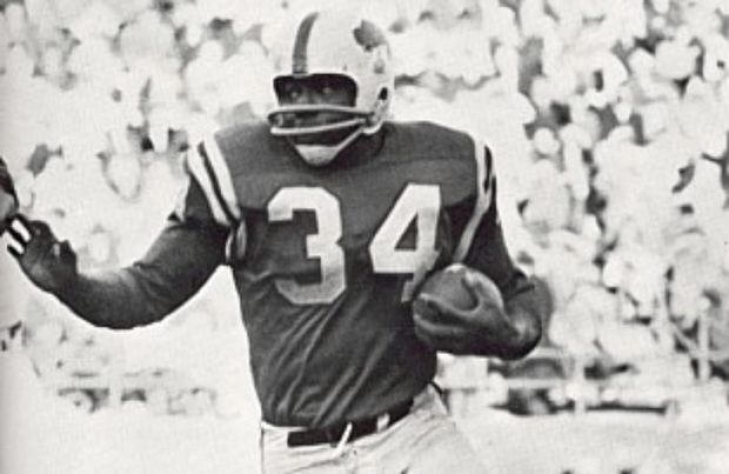
Cookie Gilchrist had a bizarre road to the pro football in the United States, and dare we say, had he never crossed the path of Paul Brown, the owner of the Cleveland Browns, he could have been a household name in the 1960s.
Gilchrist signed(what had to be an illegal) contract with the Cleveland Browns when he was still in high school. The Browns reneged, and he would forego college to play in an amateur league in Canada before he was old enough to play in the Canadian Football League. He played there for five years, winning a Grey Cup with the Hamilton Tiger-Cats, and in 1961 he would finally play pro in the United States when he traveled around Lake Ontario to play for the Buffalo Bills of the American Football League.
Gilchrist was an absolute phenom in his first three seasons in the AFL, where he would win the Rushing Title in 1962 and 1964 and led the league in Rushing Touchdowns in all three years. Both the AP and UPI named him the MVP, and in 1964 he rushed the Bills into an AFL Championship. After '64, he joined the Denver Broncos for two seasons (1965 & 1967), where he again finished first in rushing touchdowns in '65. He played one final year in Miami before retiring for good in 1968.
Any story on Gilchrist has to mention that he was an early civil rights leader, and he led a successful boycott of having the AFL All-Star Game in New Orleans, where segregation still occurred. He also refused induction into the Canadian Football League Hall of Fame, citing racist policies.
The only thing better than Cookie on the field was Cookie showing his character off of it.
