

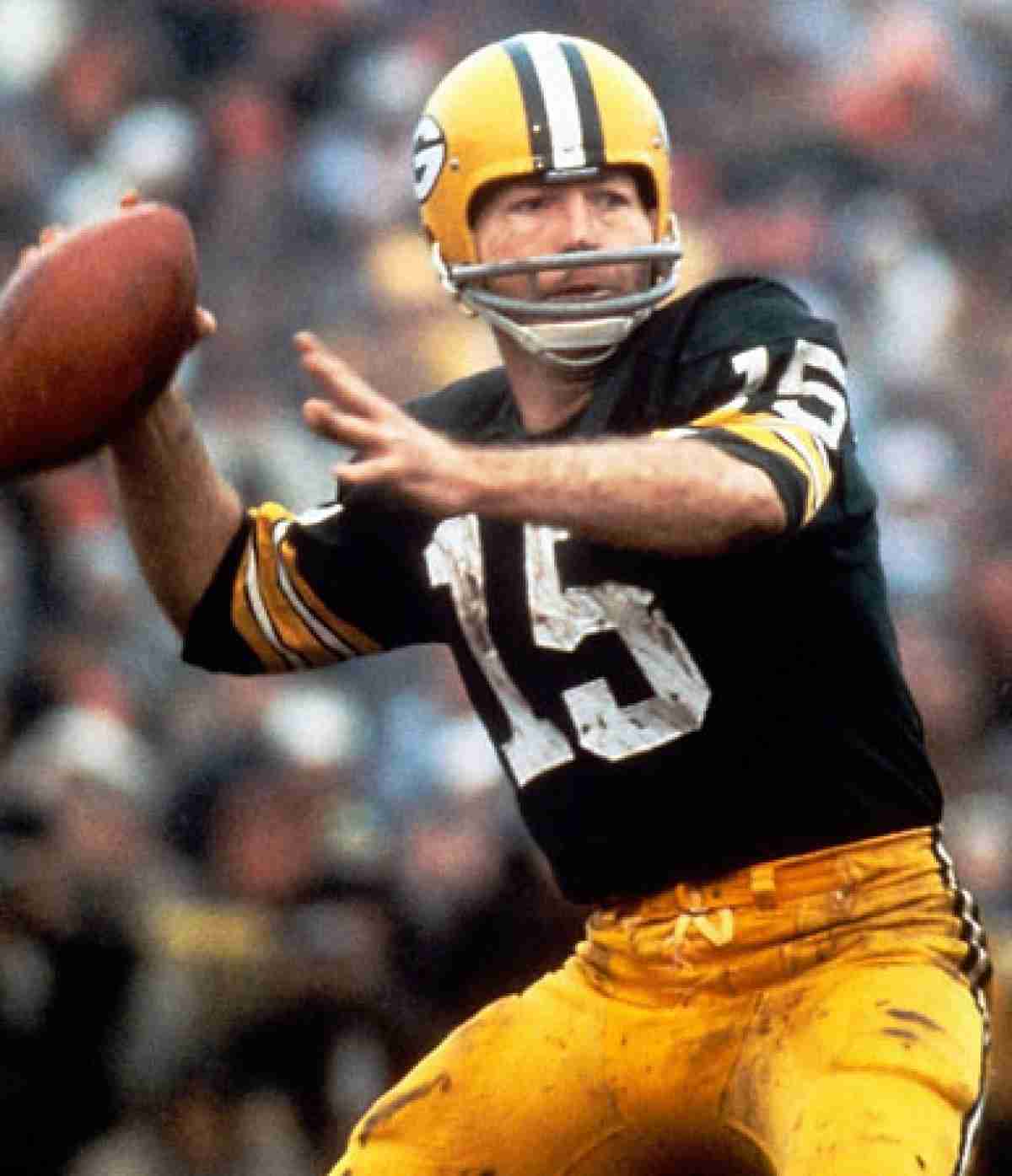
Can we begin by saying that Bart Starr is one of the greatest athlete names ever?
With the 200th overall pick of the 1956 NFL Draft out of Alabama, Bart Starr quietly went from an afterthought depth piece before transforming into the ultimate field general of pro football's grandest dynasty. He spent his early years splitting time in a struggling offense, but everything shifted with the 1959 arrival of head coach Vince Lombardi. Recognizing Starr's elite preparation, unflappable composure, and sharp decision-making, Lombardi handed him full control of the offense, setting off a golden era in Titletown.
Starr was the ultimate master of field position, running Lombardi's offense with a calculating mindset that prized efficiency over raw volume. In an era when quarterbacks routinely threw nearly as many interceptions as touchdowns, Starr treated turnover avoidance like a religion. He set a then-NFL record by throwing 294 consecutive passes without an interception across the 1964 and 1965 seasons, demonstrating an ability to read coverage and protect the football that was decades ahead of its time.
His accuracy in executing Green Bay's iconic power sweep compelled opposing safeties to step up towards the line of scrimmage, creating dangerous play-action passing chances. Starr led the NFL in completion percentage four times (1962, 1966, 1968, 1969) and in passer rating four times, consistently outperforming opposing secondary schemes with precise timing. His 1966 season remains a benchmark for quarterback mastery: throwing 14 touchdowns with only three interceptions, guiding the Packers to a 12–2 record, winning the AP NFL MVP award, and earning Super Bowl I MVP honors.
When the stakes were highest, Starr possessed a unique, ice-cold clarity that defined his big-game brilliance. He orchestrated back-to-back world titles in 1961 and 1962, dismantling the New York Giants in consecutive NFL Championship Games. In the 1961 title matchup, he threw three touchdown passes in a 37–0 rout, proving that Green Bay's offense could flex its passing muscles whenever teams stacked the box against the run.
That clutch DNA reached its legendary apex in the 1967 NFL Championship Game—the iconic "Ice Bowl" against the Dallas Cowboys. Trailing 17–14 in minus-13-degree temperatures with 16 seconds left and no timeouts, Starr called his own number on third-and-goal. After Jerry Kramer's famous block on Jethro Pugh, Starr lunged over the goal line for the game-winning touchdown sneak, securing Green Bay's third consecutive league title and cementing his reputation as the most clutch quarterback to ever play on the gridiron.
Starr’s postseason metrics remain mind-boggling in historical context. He compiled an astonishing 9–1 postseason record, throwing 15 touchdown passes and just three interceptions. His career postseason passer rating of 104.8 stood as an NFL record for decades, serving as definitive mathematical proof that no quarterback in history elevated his game in the playoffs more consistently than No. 15.
With the Packers, Starr played 196 games, completing 1,808 passes for 24,718 yards and 152 touchdowns. A four-time Pro Bowler and on the NFL 1960s All-Decade Team, his No. 15 jersey was retired in 1973. Enshrined in the Pro Football Hall of Fame and Packers Hall of Fame in 1977, he is regarded as the ultimate winning quarterback in pro football history.


Comments powered by CComment