

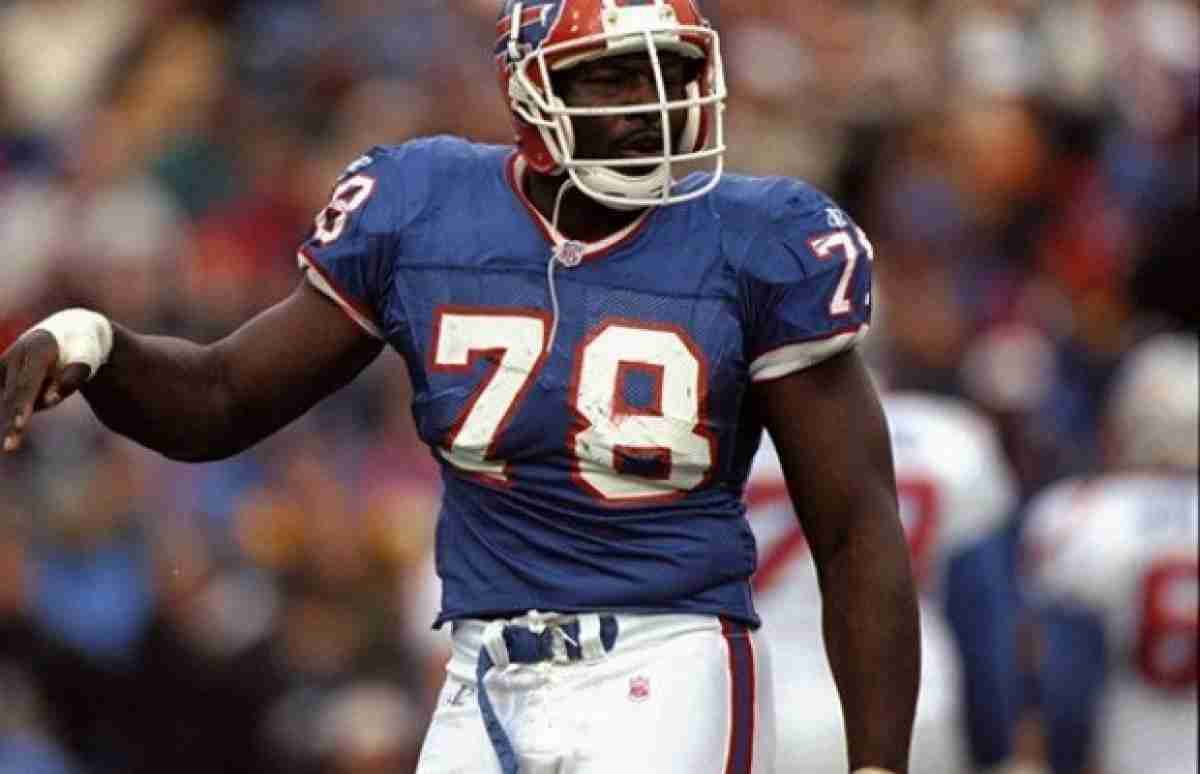
Drafted first overall in the 1985 NFL Draft from Virginia Tech, Bruce Smith came to Western New York with high expectations and quickly proved himself. Although Buffalo's explosive K-Gun offense frequently made headlines nationally, Smith was the true driving force of the team, dominating opposing backfields for 15 seasons and becoming the all-time leading sack artist in football history.
Smith combined explosive quickness, lateral agility, and raw power with an exceptional skill set. Usually playing as a 3-4 defensive end—an role mainly focused on absorbing double-teams rather than racking up individual stats—he defied traditional positional roles. Smith utilized his signature dip-and-rip move, leveraging his flexibility to bend around corners at sharp angles without losing speed. When offensive linemen over-kicked to contain the outside, he responded with a powerful swim move or a fierce bull rush that pushed the pocket into the quarterback. Additionally, Smith showed impressive stamina and sharp game awareness, often disengaging from blocks to tackle running plays behind the line of scrimmage.
Smith made an immediate impact as a rookie in 1985 with 6.5 sacks, then truly established himself in 1986 with 15 sacks, marking his rise. In 1987, he achieved his first Pro Bowl and First-Team All-Pro honors after recording 12.0 sacks in only 12 games, beginning a streak of double-digit sacks in 12 of his 13 full seasons in Buffalo. He continued with 11.0 sacks in 1988 and 13.0 in 1989, leading a swiftly improving defense that propelled Buffalo into serious playoff contention.
His standout season was 1990, when he earned the Defensive Player of the Year award. Smith led the league throughout the season, setting a franchise record with 19.0 sacks and making 101 tackles—an impressive feat for a defensive lineman. His dominance was especially clear in Week 14, when he sacked Indianapolis quarterback Jeff George four times in the first 20 minutes. He finished the year by helping Buffalo reach its first AFC championship, highlighted by a safety in Super Bowl XXV.
After missing most of the 1991 regular season due to knee surgery, Smith made a strong comeback in 1992, recording 14.0 sacks and helping the defense secure a third consecutive AFC title. He replicated that 14.0-sack achievement in 1993, adding 108 tackles and earning another First-Team All-Pro honor as Buffalo secured its fourth straight conference championship. Smith continued to perform at an elite level into the mid-1990s, with 10.0 sacks in 1994 and 10.5 in 1995.
Smith captured his second AP Defensive Player of the Year award in 1996 at age 33. Racking up 13.5 sacks, 90 tackles, and five forced fumbles, he proved virtually unblockable even as offenses geared their entire blocking schemes toward stopping him. He backed that up with 14.0 sacks in 1997 and 10.0 sacks in 1998, turning in his final double-digit sack year in Western New York. He completed his Buffalo tenure in 1999 with a 7.0-sack campaign, taking the team to its final postseason appearance of the decade.
Smith played his final four seasons in Washington, surpassing Reggie White's all-time record in 2003 to finish with 200.0 sacks, a mark that remains the benchmark for pass rushers. During his 15 seasons with Buffalo, he appeared in 217 regular-season games, set franchise records with 171.0 sacks, and earned 11 Pro Bowl selections. He was named to the NFL 1980s All-Decade Team, the 1990s All-Decade Team, and the NFL 100th Anniversary All-Time Team.
His impact in Western New York is unparalleled. The Buffalo Bills added him to their Wall of Fame in 2008. A year afterward, he was inducted into the Pro Football Hall of Fame in 2009 on his first ballot. In 2016, the team honored him with a jersey retirement ceremony for No. 78, the first in franchise history.


Comments powered by CComment