


Site Admin
27. Ed "Too Tall" Jones
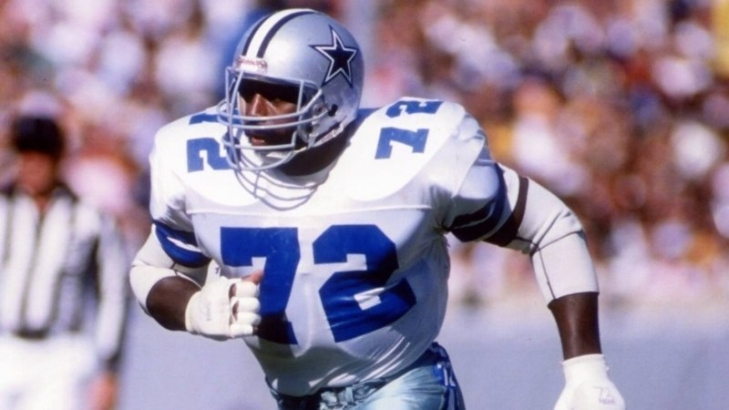
Standing at a towering six feet, nine inches, Edward Lee “Too Tall” Jones possessed one of the most distinctive and accurate monikers in sports history. Out of Tennessee State, he made history in the 1974 NFL Draft by becoming the first player from a Historically Black College or University (HBCU) to be selected number one overall, landing directly in Tom Landry’s Dallas locker room.
Jones’s early years involved adapting to the professional ranks, initially rotating through different roles before securing the left defensive end position. With a remarkable wingspan and exceptional lateral agility for his size, he became a key part of the "Doomsday II" defense. His reach enabled him to deflect passes frequently and disrupt quarterbacks, leading to a standout postseason that contributed to Dallas's 27–10 victory over the Denver Broncos in Super Bowl XII.
In a stunning career pivot following the 1978 season, Jones abruptly stepped away from the gridiron to test his mettle in professional boxing. He compiled an unblemished 6–0 record inside the ring during his one-year sabbatical. Rather than derailing his football trajectory, the grueling boxing conditioning sharpened his physical conditioning, allowing him to return to the Cowboys in 1980 even stronger and more explosive than before.
The post-boxing chapter marked the absolute peak of his dominance. Jones ripped off three consecutive Pro Bowl selections from 1981 to 1983, captured First-Team All-Pro honors in 1982, and defied age by setting a personal single-season high with 13 sacks in 1985 at 34 years old. He was a master of durability, rarely missing assignments and anchoring the front line through massive personnel transitions into the late 1980s.
Jones played 15 seasons with the Dallas Cowboys (1974–1978, 1980–1989), setting a franchise record with 224 regular-season games and 203 starts. Though sacks weren't officially recorded until 1982, Cowboys records credit him with 106.0, along with 19 fumble recoveries and three interceptions. A three-time Pro Bowler, All-Pro, and Super Bowl champion, he was inducted into the Black College Football Hall of Fame in 2013, cementing his legacy as a legendary athlete of Dallas football.
26. Nate Newton
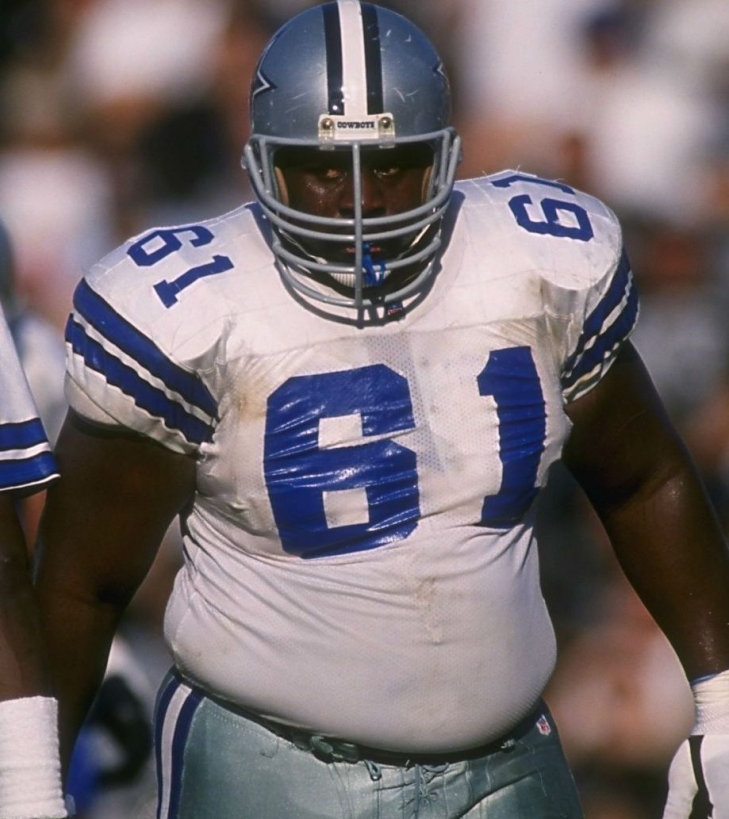
After graduating from Florida A&M in 1983, Nate Newton was not selected in the NFL draft and was overlooked by talent scouts. He initially signed as an offseason free agent with the Washington Redskins but was released before the start of the regular season. Not willing to give up on a professional football career, Newton found another opportunity with the United States Football League, signing with Steve Spurrier's Tampa Bay Bandits. The lineman, who weighed over 300 pounds, excelled during the USFL's 1984 and 1985 seasons, earning a place on the All-Time USFL Team and gaining the nickname "The Kitchen," a fun reference to Chicago's William "The Refrigerator" Perry, because of Newton’s size.
When the USFL folded, the Dallas Cowboys signed Newton in 1986. He earned the starting left guard spot in 1987 and held the role for three seasons before Jimmy Johnson arrived and moved him to right tackle for two years. While Newton was always a massive, physical presence, his career trajectory shifted when Johnson famously challenged his conditioning. Newton trimmed down, refined his technique, and returned to left guard in 1992 to help solidify the legendary unit known as "The Great Wall of Dallas."
Working alongside Mark Tuinei, Mark Stepnoski, Erik Williams, and eventually Larry Allen, Newton became a formidable interior player. He blended powerful run-blocking with surprisingly agile pass protection, regularly creating large running lanes for Emmitt Smith and maintaining strong protection for Troy Aikman. This impactful period earned him six Pro Bowl selections (1992–1996, 1998) and consecutive First-Team All-Pro honors in 1994 and 1995, during which Dallas won three Super Bowls in four years (XXVII, XXVIII, and XXX).
Newton remained a rock on the Cowboys' front line through the 1998 season, anchoring the interior despite coaching changes and roster turnover. He spent his 14th and final NFL season in 1999 with the Carolina Panthers before injuries forced his retirement, ending a remarkable journey from an unheralded minor-league blocking prospect to a multiple-time champion.
With Dallas, Newton appeared in 191 regular-season games and started 180, plus 18 postseason contests. A six-time Pro Bowler, two-time First-Team All-Pro, three-time Super Bowl champion, and 2022 Black College Football Hall of Fame inductee, Newton stands as one of the ultimate success stories in franchise history.
24. Deion Sanders
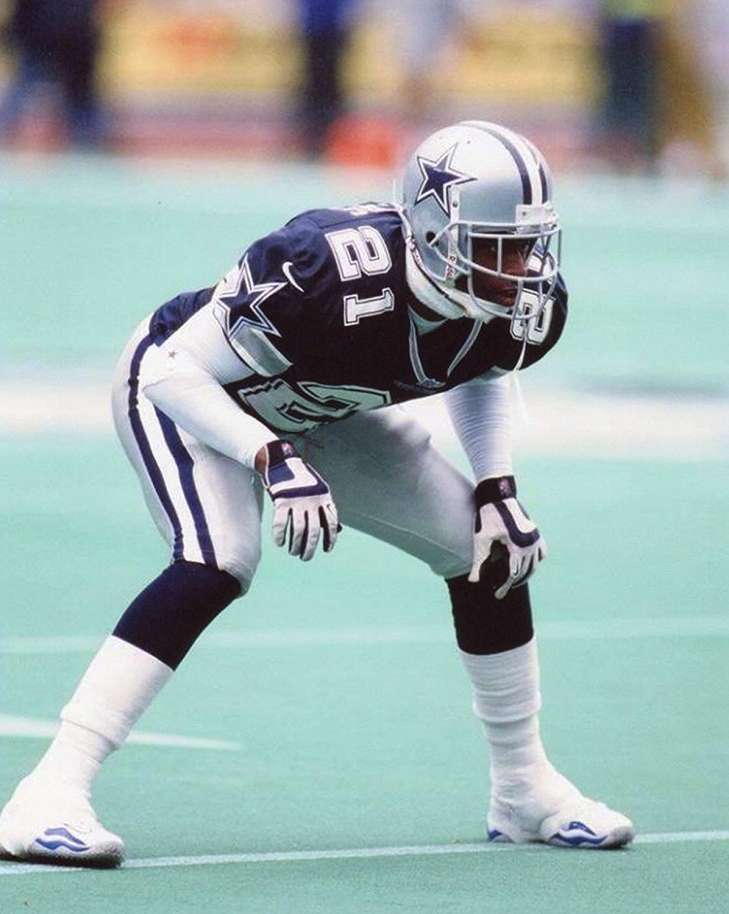
Before he ever set foot in Big D, "Prime Time" had already established himself as the undisputed king of gridiron swagger. Coming off a transcendent 1994 campaign in San Francisco where he captured the AP NFL Defensive Player of the Year award and led the 49ers to a world championship, Sanders became the most coveted free agent in league history. Jerry Jones won the high-stakes bidding war in September 1995, signing the ultimate mercenary to a landmark contract to ensure the Lombardi Trophy returned to Texas.
Sidelined for the first half of the 1995 season following arthroscopic ankle surgery, Sanders finally made his silver-and-blue debut in Week 9. His arrival immediately transformed the secondary and provided the missing piece for the franchise's championship puzzle. Sanders locked down one side of the field while opposing quarterbacks were forced to test Larry Brown—a dynamic that directly fueled Brown's Super Bowl XXX MVP performance. Sanders capped his abbreviated debut season by catching a 47-yard pass on offense in the NFC Championship and scoring a rushing touchdown in Super Bowl XXX to help Dallas secure its third title in four years.
Over the next four seasons, Sanders put on a weekly show in Dallas, proving why he was the premier shutdown corner of his generation. Quarterbacks routinely refused to throw to his side of the field, effectively erasing half the gridiron. His combination of world-class track speed, high-stepping flair, and instinctive ball skills earned him four consecutive Pro Bowl invitations and three First-Team All-Pro selections (1996, 1997, and 1998) in a Cowboys uniform.
Recognizing his game-breaking athletic gifts, head coach Barry Switzer fully unleashed Sanders as a two-way superstar in 1996. Lineup changes saw "Prime Time" moonlight at wide receiver, catching 36 passes for 475 yards while maintaining his full-time starting duties at cornerback. Combined with his electrifying work as a punt returner—where he routinely turned fielded punts into high-stepping house calls—Sanders was the ultimate three-phase weapon in pro football.
The high-flying marriage in Dallas eventually ended after the 1999 season, when the front office released him in a major salary-cap purge. Yet, his five-year run in Big D stands as one of the most explosive individual stretches in franchise history, proving that no matter the jersey, "Prime Time" always delivered on the main stage.
Across five seasons with the Dallas Cowboys (1995–1999), Sanders played 63 games, with 14 interceptions, two defensive and two punt return touchdowns, and 48 receptions for 526 yards and a touchdown. A four-time Pro Bowler, three-time First-Team All-Pro, and NFL 1990s All-Decade Team member, Sanders was inducted into the Hall of Fame in 2011 in his first year of eligibility.
14. Tyron Smith
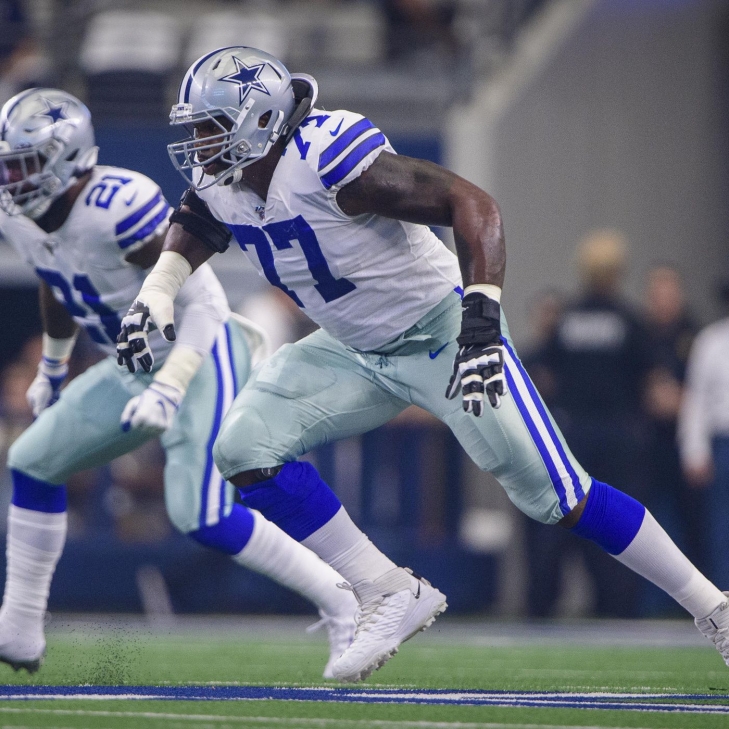
Tyron Smith stepped into Big D as a 20-year-old first-round (9th overall) phenom possessing a rare blend of length, explosive power, and quick footwork. Dallas initially placed him at right tackle, where his immediate impact earned him All-Rookie Team honors. His seamless move to left tackle in his sophomore campaign unlocked his true ceiling, providing the Cowboys with an elite edge anchor for the next decade.
That position switch catalyzed one of the most physically imposing runs by an offensive tackle in modern NFL history. From 2013 through 2019, Smith reeled off seven consecutive Pro Bowl selections, earning four AP All-Pro nods (First-Team in 2014 and 2016; Second-Team in 2013 and 2015). He formed the cornerstone of a legendary Dallas front five alongside Zack Martin and Travis Frederick, routinely neutralizing the league's most dangerous edge rushers without needing tight end assistance.
Smith’s presence transformed the entire identity of the Dallas offense, clearing massive lanes for multiple NFL rushing champions while keeping the pocket clean. His signature 2014 campaign saw him pave the way for DeMarco Murray's franchise-record 1,845 rushing yards, a performance that cemented Smith’s status as a generational pass protector. His total dominance across the era was officially recognized when he earned a spot on the NFL 2010s All-Decade Team.
Though recurring neck, back, and knee injuries limited his availability during his final four seasons in Dallas (2020–2023), Smith remained an unshakeable presence whenever he took the field. He added an eighth Pro Bowl selection in 2021 and earned Second-Team All-Pro honors in 2023 after allowing just one sack all year, serving as the trusted veteran protector through his final days in blue and silver.
Smith started all 161 regular-season games he appeared in before joining the New York Jets in 2024. His eight Pro Bowls, five All-Pro selections, and decade-plus of edge dominance assure his eventual place in the Cowboys Ring of Honor and a strong case for the Pro Football Hall of Fame.
