


Site Admin
40. Flozell Adams
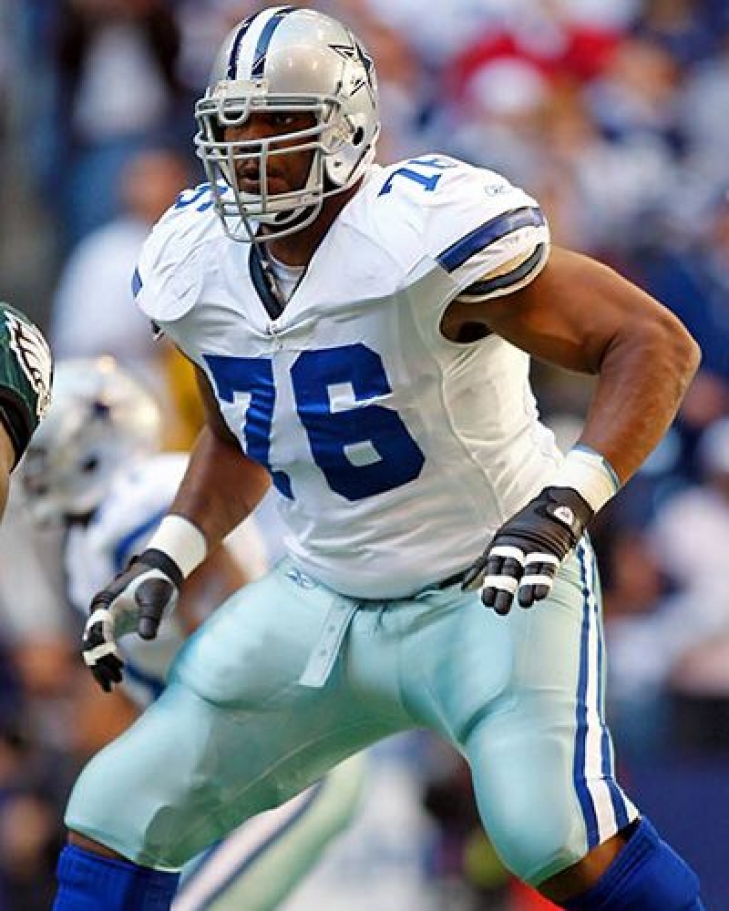
Selected in the second round (38th overall) out of Michigan State in 1998, Flozell Adams arrived in Big D carrying an imposing 6-foot-7, 340-pound frame. Initially slotted at right guard as a rookie, Adams quickly demonstrated the elite lateral footwork and bone-crushing power needed to handle pass protection on the perimeter. By his second season, the coaching staff moved him to left tackle—a position he would lock down for the next decade as one of the most reliable edge protectors in franchise history.
Nicknamed "Hotel" for his massive physical footprint, Adams anchored the blind side through multiple quarterback transitions, shielding passers like Quincy Carter, Vinny Testaverde, and eventually Tony Romo. Despite being legally deaf in his right ear—a condition that occasionally led to pre-snap false start penalties due to hearing home-crowd snap counts—he weaponized his length and immense upper-body strength to stonewall the elite pass rushers of his era.
Adams peaked in the mid-2000s, earning his first Pro Bowl nod in 2003 after helping guide Dallas back to the postseason under Bill Parcells. After overcoming a torn ACL in 2005, he bounced back with remarkable resilience, stringing together three consecutive Pro Bowl selections from 2006 to 2008. His standout 2007 campaign earned him Second-Team All-Pro honors and helped lead a powerhouse 13–3 Cowboys team.
His durability was a hallmark of his long tenure; from 1999 through 2009, Adams started every game he played, serving as a fierce physical enforcer on the line for 12 seasons in navy and silver. Following his release in early 2010, he played one final season with the Pittsburgh Steelers, starting in Super Bowl XLV before hanging up his cleats.
In his 12 seasons, he recorded 178 starts for the franchise.
39. Charlie Waters
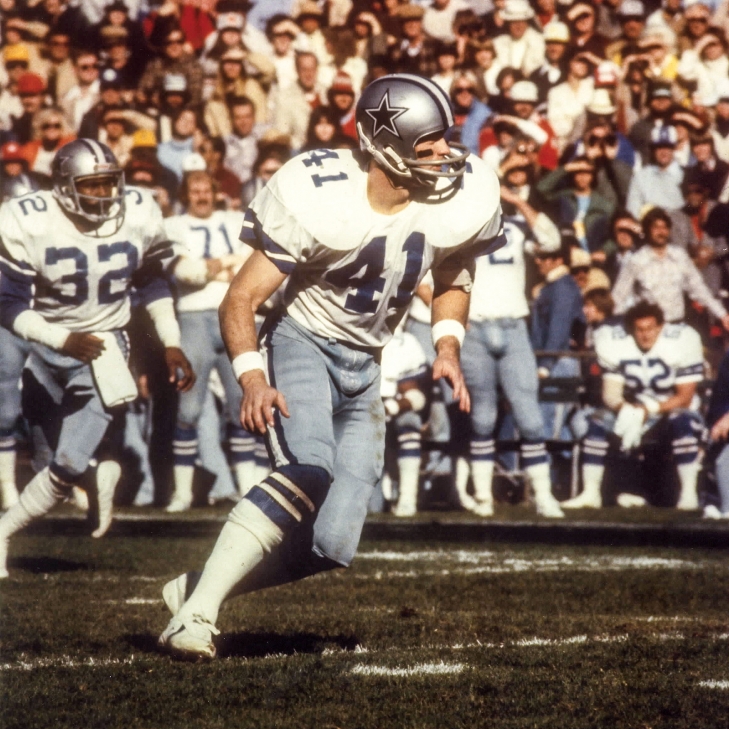
Drafted in the third round out of Clemson in 1970, Charlie Waters arrived in Big D as a versatile defensive back, but his early years were marked by a search for his permanent home in Tom Landry’s complex Flex defense. After playing every game across his first three seasons as a free safety and spending two years at cornerback, Waters struggled with consistency while adapting to Landry’s rigorous adjustments, leaving his long-term role uncertain.
Everything clicked in 1975 when Landry moved Waters permanently to strong safety, pairing him alongside free safety Cliff Harris to form "The Crash Brothers"—one of the most lethal, cerebral safety tandems in NFL history. Armed with elite football instincts and rare processing speed, Waters mastered the intricacies of Landry’s system. He was a bona fide ballhawk in coverage and a relentless, sure-tackling alley-runner who consistently disrupted opposing run designs before they could develop.
From 1976 through 1978, Waters put together a dominant three-year stretch that cemented his status as an elite defensive back, earning three consecutive Pro Bowl selections. He served as an integral anchor for the legendary "Doomsday II" defense that dominated Super Bowl XII, setting an NFL postseason record with three interceptions in a single playoff game against Chicago in 1977. His instincts under pressure made him a perpetual big-game performer when the national spotlight was brightest.
Disaster struck in the 1979 preseason when Waters suffered a torn ACL that wiped out his entire campaign. Showcasing remarkable grit and professionalism, he spent the year coaching from the sidelines before mounting an impressive comeback in 1980. Waters played two final high-level seasons, picking up 11 more interceptions over his last two years to cap off an exceptionally reliable career.
When he retired following the 1981 season, Waters hung up his cleats having never experienced a losing record in 12 NFL seasons. He appeared in five Super Bowls—winning Super Bowl VI and XII—and earned a reputation as one of the smartest safety commanders to ever wear the iconic silver helmet.
Waters compiled 41 career interceptions for 584 yards, two interception return touchdowns, 7.0 unofficial sacks, and 16 fumble recoveries as a Cowboy.
38. Jay Novacek
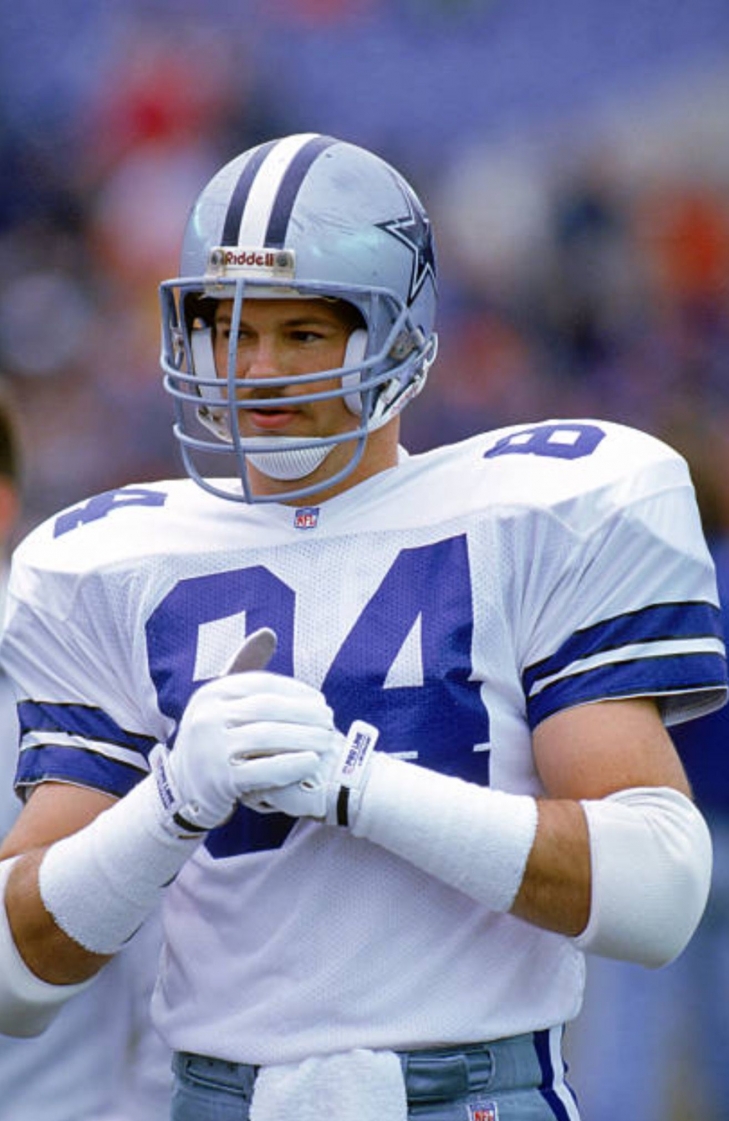
During the 1990s, when the Dallas Cowboys rose to prominence with "The Triplets"—Troy Aikman, Emmitt Smith, and Michael Irvin—tight end Jay Novacek was the team's vital security blanket. Before joining Dallas, Novacek played five quiet seasons with the Cardinals in the desert, starting only six games. When Dallas signed him as a Plan B free agent in 1990, few expected he would become a key figure in their three Super Bowl titles.
Novacek was never renowned as a devastating inline blocker, but he was masterfully functional at tangling up linebackers and sealing edges. Where he truly excelled was as an elite, dependable pass-catcher. Possessing a hurdler's fluid movement, crisp route discipline, and rare body control, Novacek had an uncanny instinct for finding soft spots in zone coverage, giving Aikman a reliable third-down valve when opposing defenses bracketed Irvin outside.
His arrival in Dallas ignited a six-year run of remarkably steady production. Between 1990 and 1995, Novacek accumulated 3,576 receiving yards and 22 touchdowns in the regular season. His individual peak arrived in 1992, when he hauled in 68 passes for 630 yards and six scores, leading all NFL tight ends in catches to earn First-Team All-Pro honors and help secure the franchise's first ring of the decade.
Novacek’s true value shone bright in January. Across 13 postseason games with the Cowboys, he grabbed 62 receptions for 645 yards and six touchdowns, making critical third-down conversions after third-down conversions. Across three Super Bowl victories (XXVII, XXVIII, and XXX), he pulled down 17 passes and two touchdowns, giving Dallas an interior weapon that opposing defensive coordinators simply could not account for.
Severe, chronic back issues forced Novacek to sit out the entire 1996 campaign before bringing his career to an abrupt end. His retirement left a massive, noticeable hole in the offense, proving how vital his subtle, clutch style was to the dynasty's engine.
As a Cowboy, Novacek played in 95 regular-season games with 88 starts for the franchise (158 career). He compiled 339 receptions, 3,576 receiving yards, and 22 receiving touchdowns.
37. Erik Williams
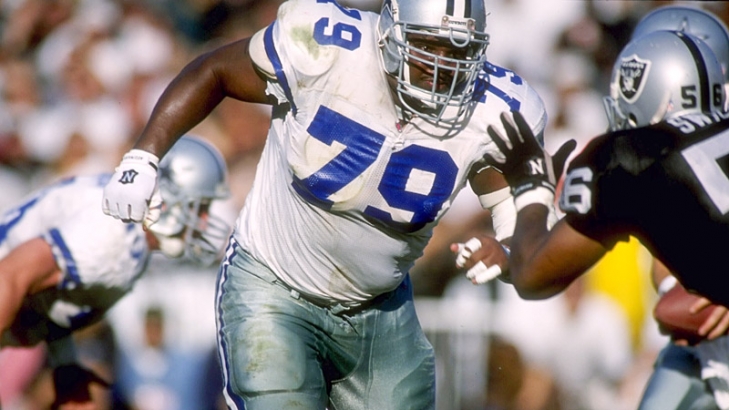
Overcoming poor academic marks in high school, Erik Williams took a unconventional path to gridiron stardom, landing at Division II powerhouse Central State University in Ohio. There, the massive Philadelphia native helped lead the Marauders to an NAIA national title, displaying a terrifying blend of size, power, and athletic movement. When the Dallas Cowboys selected him in the third round (70th overall) of the 1991 draft, they weren't just picking an interior depth piece—they were adding the final, mean-spirited cornerstone of a dominant offensive dynasty.
Williams logged time as a backup during his rookie campaign, but his ferocious performance during 1992 training camp forced Jimmy Johnson to shuffle the starting lineup. The Cowboys shifted veteran Nate Newton inside to guard, clearing space for Williams to take over at right tackle. Standing 6-foot-6 and 320 pounds, "Big E" brought a mean, physically imposing edge to the perimeter, locking down elite pass rushers and clearing lanes for Emmitt Smith. His signature moment arrived in 1992, when he single-handedly neutralized Reggie White without tight end help, signaling his ascension as the most feared edge-blocker in the sport.
As a vital pillar of "The Great Wall of Dallas" alongside Newton, Mark Tuinei, Mark Stepnoski, and Kevin Gogan, Williams anchored the front line during Dallas's back-to-back title runs in Super Bowl XXVII and XXVIII. He earned First-Team All-Pro honors and a Pro Bowl nod in 1993, establishing a reputation so dominant that many analysts regarded him as a future first-ballot Hall of Famer.
Tragedy struck in October 1994 when Williams suffered severe, multi-ligament knee damage in a near-fatal automobile crash in Dallas, forcing him to miss the rest of the season. Though the injury permanently sapped some of his elite lateral quickness, Williams fought through agonizing rehabilitation to reclaim his starting job in 1995. Relying on sheer power, mental toughness, and a veteran edge, he helped lead Dallas to a third title in Super Bowl XXX, earning two more First-Team All-Pro selections (1995, 1996) and three additional Pro Bowl honors (1996, 1997, 1999).
Williams spent a decade in America's Team uniform before concluding his career with a brief stint in Baltimore in 2001. While the 1994 accident altered his trajectory, his peak play at right tackle remains among the highest levels of offensive line execution in Cowboys history.
Williams played in 141 regular-season games with 128 starts for the franchise, and in 2024, he was inducted into the Black College Football Hall of Fame.
