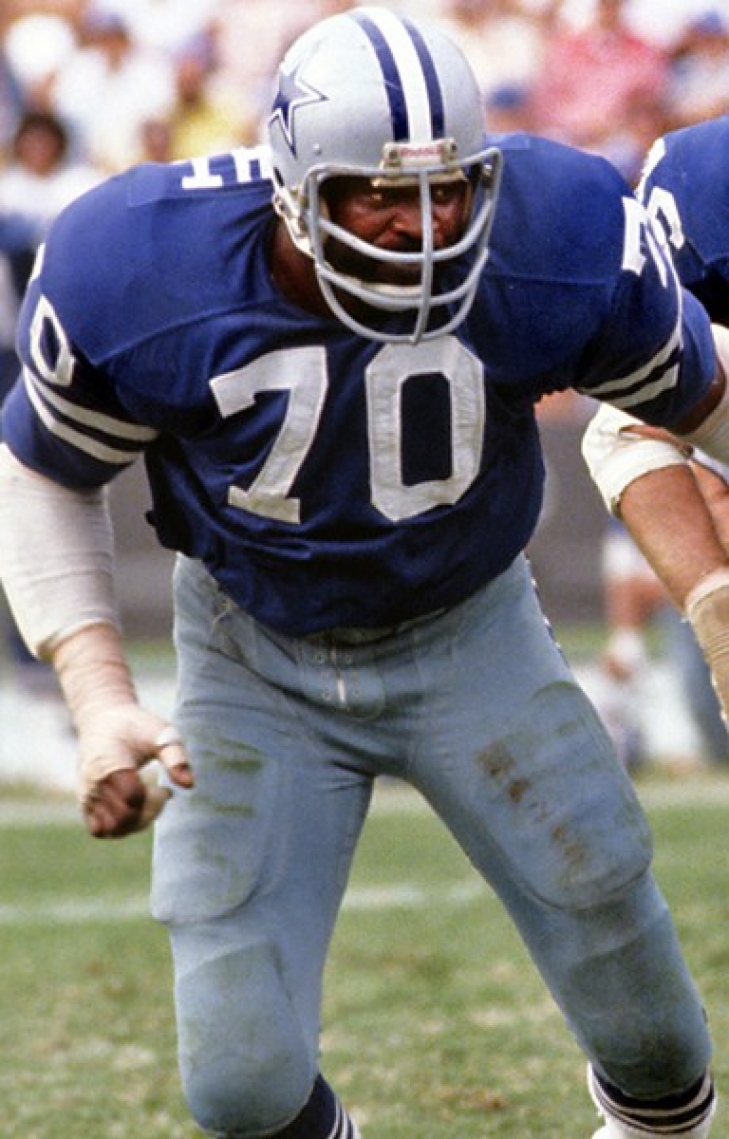
Drafted in the seventh round of the 1967 NFL Draft out of Fort Valley State, Rayfield Wright, the versatile athlete, spent his first three years in Dallas as a utility player—taking snaps at offensive tackle and tight end, and even filling in at defensive tackle. His career trajectory changed in 1970 when Tom Landry permanently installed him as the starting right tackle. "Big Cat" immediately blossomed, using his long arms, nimble footwork, and tight-end athleticism to redefine the standard for modern offensive tackles.
Settling in on the right side of the line, Wright established himself as an elite pass protector and a dominant run blocker. From 1971 through 1976, he earned six consecutive Pro Bowl selections, including three straight First-Team All-Pro nods from 1971 to 1973. Wright became the primary edge protector for Roger Staubach, routinely shutting down the era’s premier defensive ends and opening huge lanes for the Cowboys' multifaceted rushing attack.
His role on the offensive line was fundamental to the franchise's successful decade. Wright played in five Super Bowls, contributing to the Cowboys’ victories in Super Bowl VI and XII. His uncommon agility in open space enabled Landry to design creative sweep plays, and his strong pass-blocking gave the offense the time to execute deep, vertical routes.
Though he signed with the Philadelphia Eagles after his 1980 release, Wright never appeared in a game for them, keeping his entire playing career anchored in Dallas.
Wright played 166 games across 13 seasons in Big D (1967–1979), made the NFL 1970s All-Decade Team, was inducted into the Cowboys Ring of Honor in 2004, and entered the Pro Football Hall of Fame in 2006.
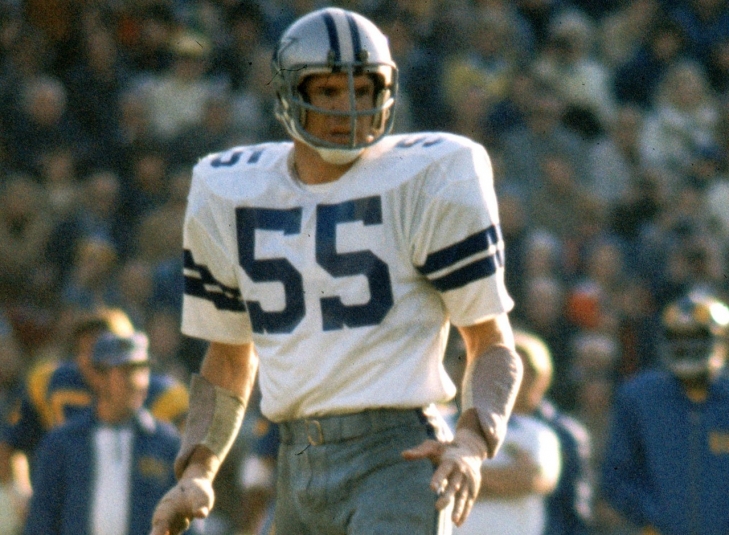
Bypassed by every franchise in the 1970 NFL Draft out of NAIA school Ouachita Baptist, the unheralded safety arrived at Dallas training camp as an underdog determined to make the roster. Cliff Harris did far more than snag a roster spot; his rare closing speed, open-field tackling, and fiery demeanor blew away the coaching staff, earning him the starting free safety job as a rookie.
In his early years, Harris balanced multiple roles, delivering strong special teams play and occasionally returning punts and kickoffs while learning Tom Landry's "Flex" defense. By 1974, he had become the key center fielder for the "Doomsday Defense." That season marked the start of a remarkable period during which Harris achieved six straight Pro Bowl appearances (1974–1979) and three First-Team All-Pro selections (1976, 1977, and 1978). These accomplishments solidified his status as one of the most hard-hitting and instinctive safeties in the NFL.
His skill in reading quarterbacks and making powerful hits over the middle gave the Dallas secondary a formidable advantage. Alongside Charlie Waters, Harris became part of a legendary safety duo in football history, leading a secondary that contributed to Dallas’s five Super Bowl appearances during the decade. He was key in winning two world championships for Big D, lifting the Lombardi Trophy in both Super Bowl VI and Super Bowl XII.
Harris took the football world by surprise when he opted to retire at the top of his game after the 1979 season, at just 31, to pursue business opportunities.
Over a ten-year career spent entirely in Dallas (1970–1979), Harris recorded 29 interceptions and 18 fumble recoveries, while earning a spot on the NFL 1970s All-Decade Team. The Cowboys enshrined him in their Ring of Honor in 2004, and years later, he received long-overdue induction into the Pro Football Hall of Fame as part of the Centennial Class of 2020.
In 1958, Chuck Howley was selected seventh overall by Chicago out of West Virginia, but his early career was derailed by a severe knee injury that sidelined him for the entire 1960 season. Unsure whether his body would hold up, Howley considered stepping away from football altogether before a 1961 trade to Dallas offered a second chance. That move to Texas saved his career, transforming him from an injury-prone linebacker into one of the most dynamic playmakers in franchise history.
Inserted into Tom Landry's newly established "Doomsday Defense," Howley excelled after transitioning to the weakside linebacker position, where his exceptional speed, lateral agility, and coverage instincts thrived. Between 1965 and 1971, Howley received six Pro Bowl nominations over a seven-year period, notably earning five consecutive First-Team All-Pro honors from 1966 to 1970. His proficiency in dropping into coverage and discerning passing lanes contributed a significant and dangerous dimension to Landry's intricate defensive schemes, rendering him an indispensable component of the defensive front.
Apart from his personal achievements, Howley functioned as the strategic driving force behind those early Landry units during the team's evolution from an expansion team to a consistent contender. His thorough knowledge of opposing offenses enabled him to anticipate plays, often disrupting sweep plays in the backfield and applying pressure to perimeter receivers. He led a tenacious linebacking group alongside Lee Roy Jordan and Dave Edwards, setting a physical benchmark that characterized Dallas football in the late 1960s and early 1970s.
Howley's postseason exploits sealed his legacy, most notably during Super Bowl V against Baltimore. Despite the Cowboys falling in a 16–13 heartbreaker, Howley put together an iconic individual performance, picking off two passes and forcing a fumble. His effort earned him Super Bowl MVP honors—making him the first defensive player, and to this day the only player from a losing team, to capture the award. Bittersweet as that milestone was, Howley and the Doomsday Defense got their redemption the following year, smothering Miami 24–3 to claim victory in Super Bowl VI.
He remained a steady leader in Dallas through the 1973 campaign before finally hanging up his helmet after 13 years in blue and silver. In his 13 seasons with the Cowboys (1961–1973), Howley appeared in 165 games, recording 24 interceptions and 17 fumble recoveries in Big D. The franchise honored his decade-plus of defensive brilliance by adding him to the Cowboys Ring of Honor in 1977, setting the stage for his long-awaited, overdue induction into the Pro Football Hall of Fame in 2023.