


Site Admin
44. Jethro Pugh
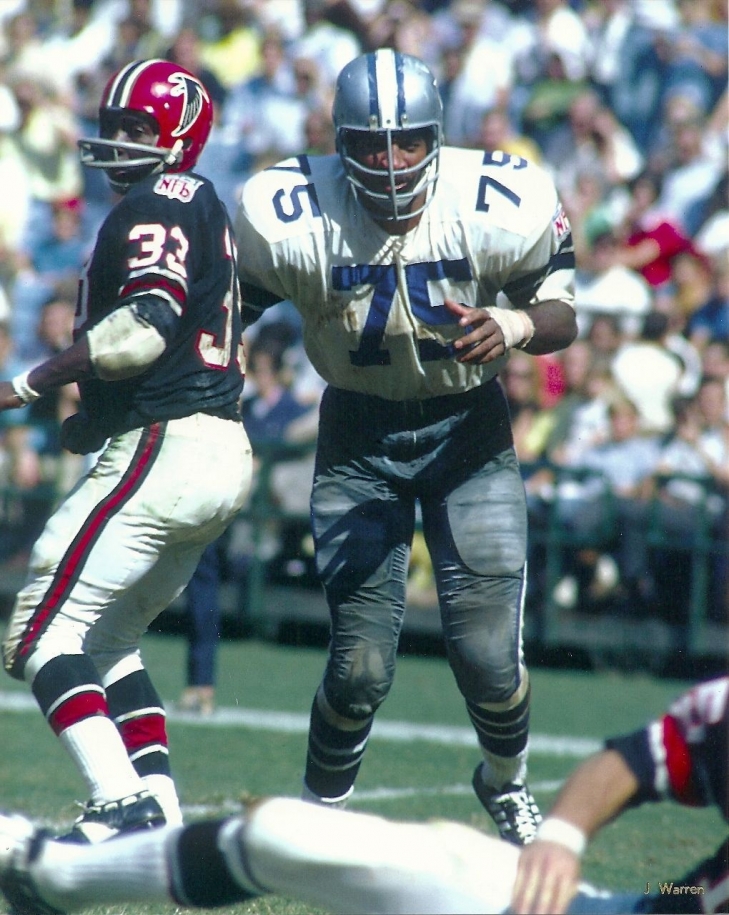
Long before small-school gems became prized commodities in modern draft rooms, Jethro Pugh put Elizabeth City State College on the national football map. Drafted in the 11th round in 1965, the 6-foot-6 North Carolina native arrived in Big D as a project with extraordinary length and explosive leverage. Tom Landry and Gil Brandt recognized those raw traits, molding Pugh into a dominant interior enforcer who anchored the legendary "Doomsday Defense" for nearly a decade and a half.
After serving as a rotational backup during his first two seasons, Pugh claimed the starting left defensive tackle spot in 1967. Lined up adjacent to Hall of Fame tackle Bob Lilly, Pugh took immediate advantage of the single-coverage schemes generated by Lilly's presence. He earned Second-Team All-Pro honors in 1967, bringing a rare blend of interior quickness and length that systematically disrupted opposing pocket mechanics.
While high-profile teammates like Lilly, Randy White, and Harvey Martin frequently captured national headlines and Pro Bowl nods, Pugh served as the unsung enforcer of Landry’s Flex system. He led the Cowboys in quarterback sacks for five consecutive seasons from 1968 through 1972, proving to be one of the most prolific interior pass rushers of his era. Though sacks did not become an official NFL statistic until 1982, internal team tracking credits Pugh with an eye-popping 95.5 career sacks.
Pugh was a constant big-game anchor during the franchise’s golden era, appearing in four Super Bowls and helping Dallas win Super Bowl VI and Super Bowl XII. His remarkable durability allowed him to log 13 consecutive postseason appearances, compiling 23 playoff games in navy and silver while anchoring an interior front that consistently dominated winter football.
When he retired after the 1978 season, Pugh departed as one of the longest-tenured and most dependable defensive contributors in franchise history. His 14 seasons in the Big D tie him for the third-longest tenure in Cowboys history, a testament to his toughness and technical mastery.
Over his career, Pugh compiled 96.5 unofficial sacks and 14 fumble recoveries.
43. Tony Hill
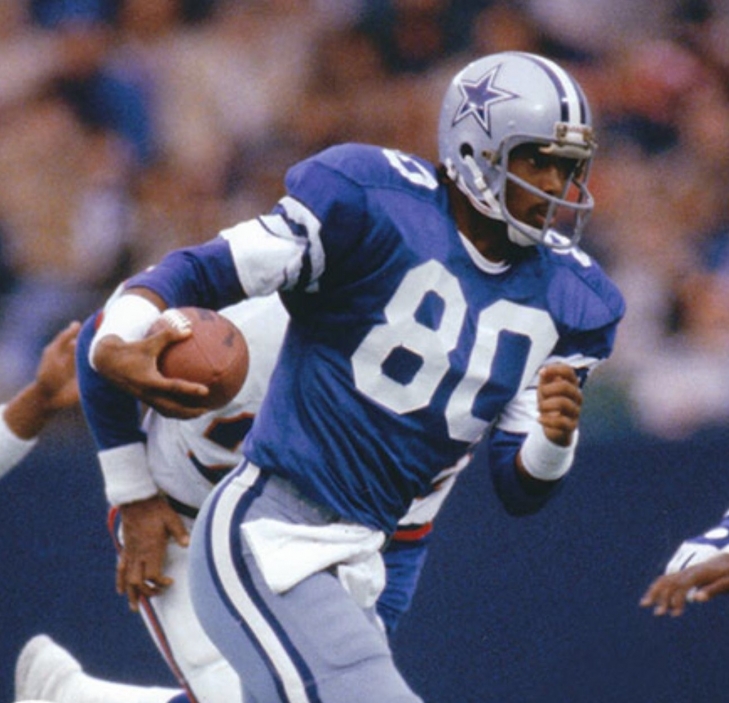
Selected in the third round out of Stanford in 1977, Tony Hill was a smooth, long-striding athlete who earned his stripes on special teams. Used primarily as a punt returner during his rookie campaign, Hill logged a minor role on offense, but he walked away with a championship ring following Dallas's victory over Denver in Super Bowl XII.
He stepped into the starting lineup the very next season and never looked back. Possessing rare deep speed and elite tracking ability, Hill quickly won over head coach Tom Landry, who dubbed him the offense's "home run hitter" for his uncanny knack for blowing top-covers off opposing secondaries. Hill validated that confidence in 1978 by pulling down 46 passes for 823 yards and six touchdowns, earning his first Pro Bowl nod and helping lead Dallas to an appearance in Super Bowl XIII.
His breakout campaign sparked a dominant era for the Dallas passing game. In 1979, Hill hauled in 60 receptions for 1,062 yards and ten touchdowns. Paired alongside Drew Pearson and Tony Dorsett, Hill helped the Cowboys make history as the first NFL offense to boast two 1,000-yard receivers and a 1,000-yard rusher in the same season. He backed that up in 1980 with another 1,055-yard, eight-touchdown showcase, cementing his status as Roger Staubach's and later Danny White's premier downfield weapon.
Hill remained the cornerstone of the receiving corps through the mid-1980s, producing high-volume output even as defenders rolled coverage heavily toward his side. His individual peak arrived in 1985, when he set career highs with 74 receptions for 1,113 yards and seven touchdowns, earning his third Pro Bowl selection. Across his decade in silver and navy, Hill recorded three 1,000-yard seasons and served as the steady big-play threat that bridged the Landry dynasty into its late era.
Hill was waived after the 1986 season. With Dallas, Hill secured 479 receptions, 7,988 receiving yards, and 51 receiving touchdowns.
42. Roy Williams
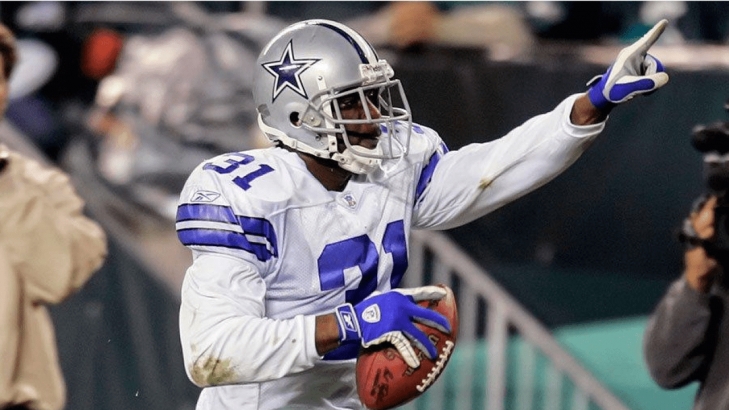
Following Oklahoma's victory in the 2000 national championship, Roy Williams entered the 2002 NFL Draft as the leading figure among collegiate defensive backs. The consensus All-American achieved a clean sweep of the Bronko Nagurski Trophy and Jim Thorpe Award in 2001, establishing himself as the country's most formidable enforcer. The Dallas Cowboys, aiming to make him the cornerstone of their secondary, traded up to pick the hard-hitting safety eighth overall.
Paired alongside veteran Darren Woodson as a rookie free safety in 2002, Williams wasted no time asserting his presence, earning All-Rookie honors while tying a franchise record with two interception returns for touchdowns. His true breakout arrived in 2003, when he logged 75 tackles and two picks to earn First-Team All-Pro honors, anchoring Bill Parcells' top-ranked defense and kicking off an impressive run of five consecutive Pro Bowl selections through 2007.
Williams was a throwback defensive back whose sheer physicality fundamentally changed how opposing receivers approached the middle of the field. Known for imposing, bone-jarring hits, his horse-collar tackling technique proved so punishing to ball-carriers that the NFL officially outlawed the move after the 2004 season—a mandate forever etched in league vernacular as the "Roy Williams Rule”.
Shifting permanently to strong safety in 2005, Williams continued to serve as a primary physical enforcer for Big D, putting together back-to-back five-interception campaigns in 2002 and 2006. However, as the league increasingly shifted toward high-flying passing attacks, his physical, run-support style faced mounting coverage challenges against speedier tight ends and slot receivers.
A forearm fracture derailed his 2008 season after just three games, prompting his release from Dallas the following spring. Williams spent two final seasons with the Cincinnati Bengals before hanging up his cleats.
He compiled 19 interceptions, 510 combined tackles, 6.5 sacks, 56 pass deflections, and three defensive touchdowns for Dallas.
41. Calvin Hill
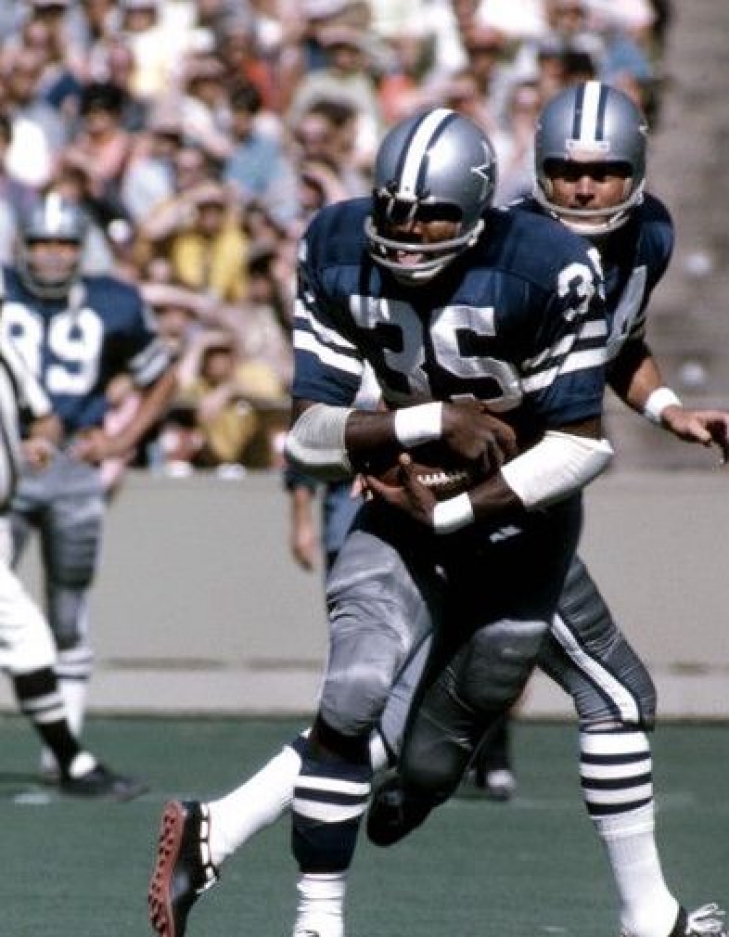
Before the Ivy League became an afterthought for top-tier NFL talent evaluators, Calvin Hill proved that elite athleticism can come from anywhere. Legendary Dallas scouting director Gil Brandt spotted rare traits in the Yale standout, who spent his college years lining up at quarterback, defensive back, and linebacker. When the Cowboys picked him 24th overall in the 1969 draft, head coach Tom Landry immediately shifted the 6-foot-4, 227-pound athlete to running back during training camp—a gamble that reshaped the franchise's offense.
Hill took the league by storm in 1969, rushing for 942 yards and eight touchdowns while averaging an explosive 4.6 yards per carry. His rare blend of power, soft hands out of the backfield, and open-field stride earned him NFL Offensive Rookie of the Year honors, alongside First-Team All-Pro and Pro Bowl selections. He brought a rare physical dimension to Landry’s offense, punishing linebackers while giving Craig Morton and Roger Staubach an elite dual-threat valve.
Injuries slowed his production over the next two seasons, but Hill remained an indispensable contributor for back-to-back championship teams, helping Dallas reach Super Bowl V and win Super Bowl VI. He reclaimed full health in 1972 and made franchise history, becoming the very first Dallas Cowboy to rush for 1,000 yards in a single season when he piled up 1,036 yards and six touchdowns on the ground.
He proved that milestone was no fluke in 1973, rushing for 1,142 yards and six touchdowns while catching 30 passes for 280 yards and another score. That dominant three-year stretch from 1972 to 1974 yielded three consecutive Pro Bowl nods, solidifying Hill as one of the premier offensive focal points in professional football and establishing a benchmark for future Dallas backfield legends like Tony Dorsett and Emmitt Smith.
Lured away by a lucrative contract, Hill departed Big D following the 1974 season to join the Hawaiians of the new World Football League. Though an MCL injury and the WFL's sudden collapse shortened that venture, he later returned to the NFL with Washington and Cleveland, concluding a long, distinguished pro career.
With Dallas, he compiled 5,009 rushing yards, 39 rushing touchdowns, 1,359 receiving yards, and 11 receiving touchdowns.
