

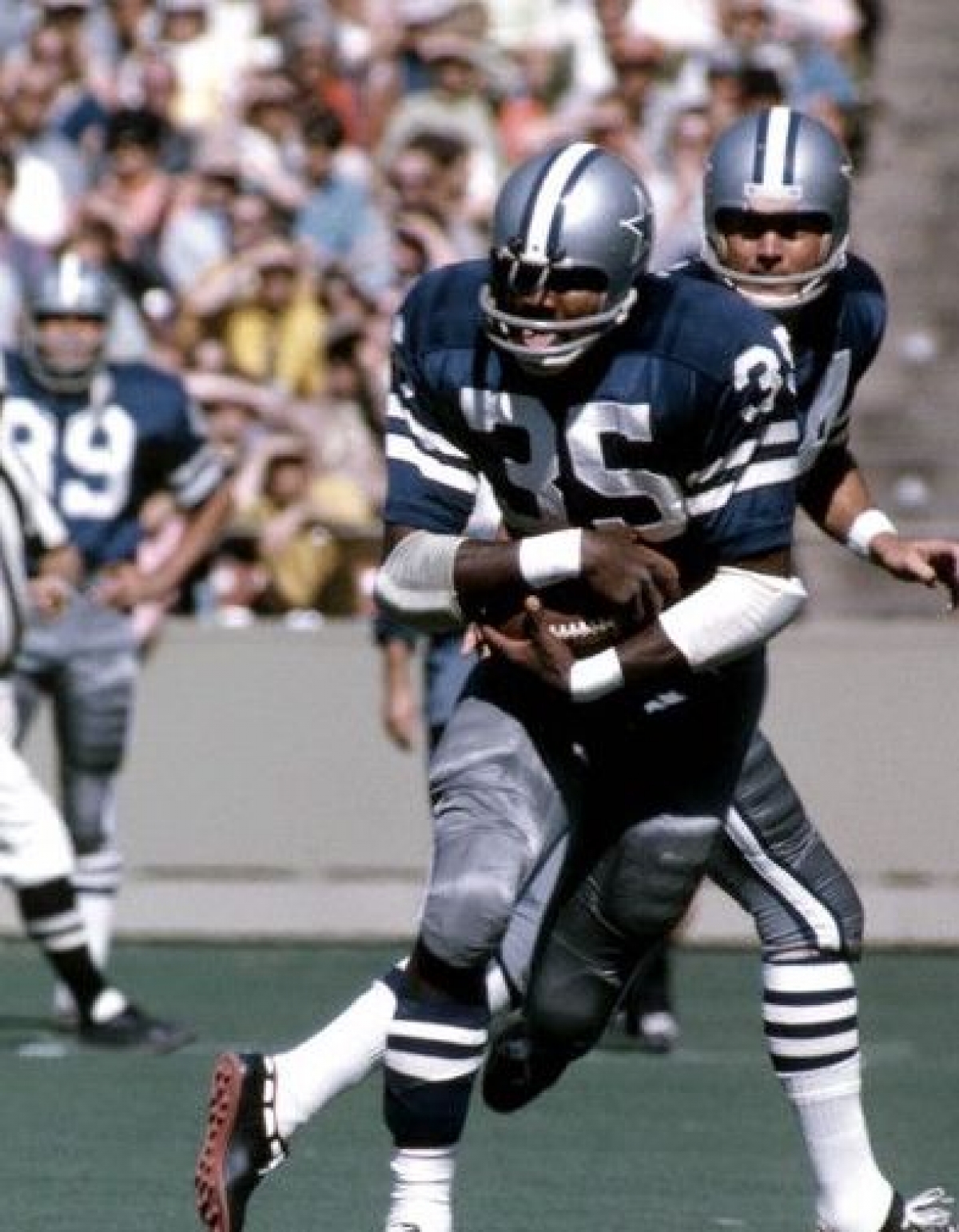
Before the Ivy League became an afterthought for top-tier NFL talent evaluators, Calvin Hill proved that elite athleticism can come from anywhere. Legendary Dallas scouting director Gil Brandt spotted rare traits in the Yale standout, who spent his college years lining up at quarterback, defensive back, and linebacker. When the Cowboys picked him 24th overall in the 1969 draft, head coach Tom Landry immediately shifted the 6-foot-4, 227-pound athlete to running back during training camp—a gamble that reshaped the franchise's offense.
Hill took the league by storm in 1969, rushing for 942 yards and eight touchdowns while averaging an explosive 4.6 yards per carry. His rare blend of power, soft hands out of the backfield, and open-field stride earned him NFL Offensive Rookie of the Year honors, alongside First-Team All-Pro and Pro Bowl selections. He brought a rare physical dimension to Landry’s offense, punishing linebackers while giving Craig Morton and Roger Staubach an elite dual-threat valve.
Injuries slowed his production over the next two seasons, but Hill remained an indispensable contributor for back-to-back championship teams, helping Dallas reach Super Bowl V and win Super Bowl VI. He reclaimed full health in 1972 and made franchise history, becoming the very first Dallas Cowboy to rush for 1,000 yards in a single season when he piled up 1,036 yards and six touchdowns on the ground.
He proved that milestone was no fluke in 1973, rushing for 1,142 yards and six touchdowns while catching 30 passes for 280 yards and another score. That dominant three-year stretch from 1972 to 1974 yielded three consecutive Pro Bowl nods, solidifying Hill as one of the premier offensive focal points in professional football and establishing a benchmark for future Dallas backfield legends like Tony Dorsett and Emmitt Smith.
Lured away by a lucrative contract, Hill departed Big D following the 1974 season to join the Hawaiians of the new World Football League. Though an MCL injury and the WFL's sudden collapse shortened that venture, he later returned to the NFL with Washington and Cleveland, concluding a long, distinguished pro career.
With Dallas, he compiled 5,009 rushing yards, 39 rushing touchdowns, 1,359 receiving yards, and 11 receiving touchdowns.


Comments powered by CComment