

Site Admin
24. Doug Smith

Doug Smith spent his entire career with the Los Angeles Rams after going undrafted out of Bowling Green in 1978. He began as a backup center and later played right guard during his first few seasons, earning his way onto the roster through consistent work. By 1982, he had become the permanent starting center, a role he held for the rest of his time in Los Angeles. Smith was not a high-profile prospect coming out of college, but he proved durable enough to stay healthy and productive for more than a decade.
Once he settled at center, Smith became the anchor of a strong offensive line. From 1984 through 1989, he earned Pro Bowl selections every year. Those seasons coincided with multiple playoff appearances for the Rams, including runs that featured Eric Dickerson in the backfield and later Jim Everett at quarterback. Smith was a steady technician who handled the calls at the line and kept the pocket clean. He played alongside other longtime linemen and helped the unit stay balanced between the run and the pass.
The Rams reached the postseason in six of the seasons after Smith became the full-time starter. He started the large majority of the games he played and rarely missed time once he locked in the center spot. His quickness off the ball and reliability in pass protection made him a fit for the schemes the Rams ran during that stretch. Smith stayed the starter through the late 1980s even as the roster turned over around him.
He played through the 1991 season before retiring. In L.A., he appeared in 180 games across 14 seasons, an impressive total for an undrafted player. Those numbers reflect both his longevity and the trust the coaching staff placed in him at the most important interior position.
Smith’s six consecutive Pro Bowl selections mark the peak of his career, while the full 14 seasons show the foundation he built from an overlooked start. He gave Los Angeles a reliable center who helped the offensive line compete in the playoffs for years.
1. Aaron Donald
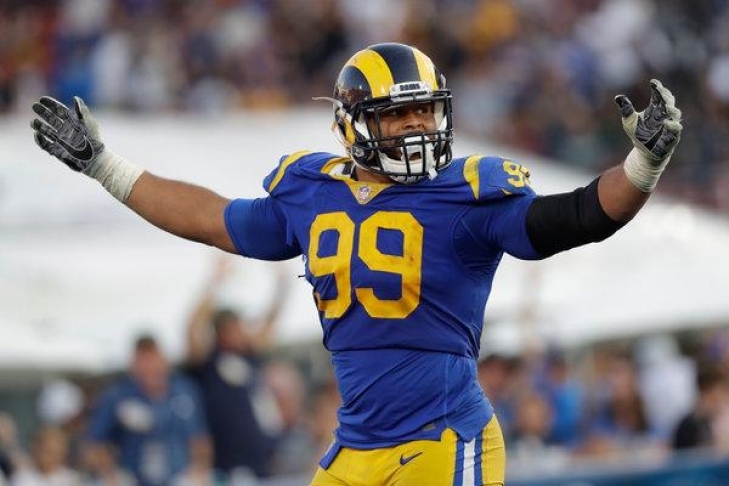
Selected 13th overall out of the University of Pittsburgh in the 2014 NFL Draft, Aaron Donald entered the professional ranks with legendary collegiate credentials. In his final season with the Panthers, Donald put together one of the most dominant individual campaigns in NCAA history, sweeping the ACC Defensive Player of the Year, Lombardi Award, Bronko Nagurski Trophy, Chuck Bednarik Award, and Outland Trophy. Despite initial concerns regarding his 6-foot-1, 280-pound frame, Donald shattered all expectations from the moment he stepped onto an NFL field, capturing the 2014 Defensive Rookie of the Year Award and earning his first of ten consecutive Pro Bowl selections.
What made Donald an absolute force of nature was a rare combination of explosive get-off speed, terrifying leverage, and relentless technique. Operating primarily from the interior defensive tackle position—a spot traditionally tasked with absorbing double-teams—Donald routinely disarmed offensive linemen with a lightning-fast first step and hand-combat mechanics that blew up plays before they could develop. His ability to generate edge-rusher-level pressure from the 3-technique alignment disrupted offensive schemes like no defensive tackle before him, forcing opposing coordinators to completely rewrite their game plans.
Following his stellar rookie year, Donald established himself as the indisputable premier defensive tackle in football, stringing together four consecutive First-Team AP All-Pro selections from 2015 to 2018. His steady trajectory reached new heights in 2017 when he captured his first AP NFL Defensive Player of the Year Award despite playing in just 14 games. Rather than plateauing after reaching the peak of his profession, Donald responded by putting together a 2018 campaign that stands among the greatest single seasons ever recorded by an interior lineman.
During that historic 2018 season, Donald led the NFL with a mind-boggling 20.5 sacks and 25 tackles for loss, setting the single-season sack record for a defensive tackle. Behind his game-breaking dominance, the Rams marched all the way to Super Bowl LIII. Joining Lawrence Taylor and J.J. Watt as one of only three players in league history to win back-to-back Defensive Player of the Year honors, Donald's individual brilliance carried Los Angeles back into national prominence. He followed that up in 2019 by capturing his fifth straight First-Team All-Pro nod while once again leading the league with 20 tackles for loss.
As the sport entered a new decade, Donald's dominance remained unchallenged. Named a unanimous choice for the NFL 2010s All-Decade Team, he kicked off the 2020s by capturing his third AP Defensive Player of the Year Award, tying Taylor and Watt for the most in NFL history, while topping the league with a 20 Approximate Value. In 2021, the Rams' aggressive, championship-caliber roster put it all together. Donald capped off his seventh consecutive First-Team All-Pro season by sealing Super Bowl LVI, pressuring Cincinnati's Joe Burrow on fourth down to secure the franchise's second Lombardi Trophy.
Following two more elite seasons that brought his First-Team All-Pro total to eight and extended his streak of Pro Bowl selections to a perfect ten-for-ten, Donald initially announced his retirement from professional football in March 2024. Leaving the game at age 32 with 111.0 career sacks, 176 tackles for loss, and 24 forced fumbles, he solidified his status as a first-ballot Hall of Famer and a consensus pick for the Mount Rushmore of defensive linemen.
However, the story of the legendary wrecking ball received an unexpected, blockbuster addition. In late August 2026, after two full seasons away from the gridiron, Donald sent shockwaves across the sporting landscape by officially coming out of retirement to re-sign with the Los Angeles Rams on a one-year deal. Drawn back by the competitive fire and the opportunity to pair with newly acquired pass-rusher Myles Garrett, Donald's return instantly elevated the Rams into heavy Super Bowl contention once again.
While head coach Sean McVay opted to ramp Donald up slowly—holding him out of the team's Week 1 clash in Australia to ensure peak physical readiness—his presence on the 2026 roster reaffirms his immortal bond with the organization. His decision to put the horns back on serves as the ultimate bonus chapter for a star who spent ten seasons dominating the interior line of scrimmage in Southern California.
Whether viewed through his initial ten-year sprint or his 2026 comeback, Donald's candidacy as the greatest player in Rams history is well earned. His uncanny ability to destroy passing pockets from the inside while remaining a dominant run defender forced NFL offenses to rethink how to protect the quarterback. Facing constant double- and triple-teams for a decade, he simply converted that extra attention into highlight-reel disruption.
Going into this season, Donald compiled 543 total tackles (340 solo, 203 assists), 111.0 sacks, 176 tackles for loss, 256 quarterback hits, 24 forced fumbles, and seven fumble recoveries. Let’s see what he adds in 2026!
23. Charlie Cowan

Charlie Cowan spent his entire 15-year career with the Los Angeles Rams after they drafted him in the fourth round out of New Mexico Highlands in 1961. The team converted him from a college fullback to the offensive line, and he settled in quickly enough to start games as a rookie. Over the years, he shifted between left guard, right tackle, and left tackle, showing he could handle whatever spot the line needed. Cowan was not flashy, but he was a steady presence who protected the quarterback and opened lanes for the run.
He became a regular starter by the mid-1960s and earned his first recognition late in the decade. From 1968 to 1970, he was selected to the Pro Bowl each season. Cowan also earned Second-Team All-Pro honors twice, in 1968 and 1973. Those years came as the Rams built strong teams on both sides of the ball, and his consistency on the line helped keep the offense balanced. He played next to longtime teammates like Joe Scibelli and Tom Mack, forming a durable front that protected Roman Gabriel and the quarterbacks who followed.
Cowan’s durability stood out over the long haul. He appeared in 206 games for the Rams, a franchise record at the time he retired. He started the large majority of those contests and stayed healthy enough to play into his late 30s. The Rams reached the playoffs several times during his later seasons, including NFC Championship appearances, and Cowan remained part of the line through those runs.
He played his final season in 1975 and retired afterward. With Los Angeles, he was never considered the franchise's best lineman, but his length of service and reliable play earned him a place among the more substantial contributors of his era. Cowan blocked for a succession of quarterbacks and running backs without missing extended time, which was rare for an offensive lineman in that period.
His three Pro Bowl selections and two All-Pro nods reflect the peak of his career, while the 206 games speak to the steadiness that defined the rest of it. Cowan gave the Rams a versatile and dependable presence up front for a decade and a half.
22. Jim Benton

Jim Benton was one of the first true stars for the Cleveland Rams after they selected him out of Arkansas in the 1938 Draft. As a rookie, he led the NFL in yards per reception, even though his 418 yards look modest by today’s standards. The game was different then, and Benton quickly showed he could stretch the field. In 1939 he led the league in touchdown receptions with seven and earned a Pro Bowl selection. After a solid 1940 season, he stepped away for a year to coach high school football, something more common in that era when salaries were low.
He returned in 1942, but World War II depleted rosters and the Rams suspended operations. Benton spent 1943 with the Chicago Bears, helping them win the NFL Championship. He came back to Cleveland when the Rams resumed play in 1944 and immediately re-established himself as a dangerous end. Benton had a long reach and reliable hands, and he specialized in big downfield plays rather than piling up short catches.
The 1945 season was the high point of his career with the Rams. He led the NFL with 1,067 receiving yards in only nine games and earned First-Team All-Pro honors. On Thanksgiving, he caught 10 passes for 303 yards against Detroit, a single-game record that stood for decades. Benton also contributed in the championship game as Cleveland beat Washington for the title. The next year the franchise moved to Los Angeles, and Benton led the league again in receiving yards with 981 while also topping the NFL in receptions with 63. He earned another All-Pro selection.
Benton played one more season in Los Angeles before retiring after 1947. As a Ram, he finished with 4,566 receiving yards. At the time of his retirement, he ranked second all-time in the NFL in receiving yards, behind only Don Hutson. Those numbers were exceptional for an era that still favored the run.
Benton was named to the NFL’s 1940s All-Decade Team. He won two championships, one with the Bears and one with the Rams, and his big-play ability helped the franchise establish itself both in Cleveland and after the move to Los Angeles.
