


Site Admin
27. Nolan Cromwell

Nolan Cromwell spent his entire 11-year NFL career with the Los Angeles Rams after they drafted him in the second round out of Kansas in 1977. He began as a backup and special-teams contributor, then moved into the starting free safety role in his third season. Cromwell quickly showed the range and anticipation that would define his game, and he helped the Rams reach Super Bowl XIV in his first year as a full-time starter.
He peaked in the early 1980s. From 1980 to 1982, Cromwell earned First-Team All-Pro honors each season, and he added a fourth consecutive Pro Bowl selection in 1983. In 1980, he intercepted eight passes, led the team in that category, and earned NFC Defensive Player of the Year honors. Cromwell was a classic free safety of that era, reading routes early and closing on the ball with enough speed to turn potential completions into turnovers. He also returned four of his interceptions for touchdowns during his career.
Cromwell remained a starter for most of his remaining time in Los Angeles, even as the defensive scheme shifted and he sometimes moved between free and strong safety. The Rams continued to reach the playoffs in several of his later seasons, and he stayed productive as a ball hawk who could still make plays in coverage. Injuries limited him at times in the mid-1980s, but he kept his place on the field through 1987.
He retired after the 1987 season. As a Ram, he finished with 37 interceptions and 671 interception-return yards, the franchise record for return yardage at the time. Those numbers, along with his four Pro Bowl selections and three All-Pro nods, marked him as one of the better safeties of his generation.
After his playing days concluded, Cromwell moved into coaching and later won a Super Bowl as the special-teams coach for the Green Bay Packers in Super Bowl XXXI. He was also named to the NFL’s 1980s All-Decade Team, a fitting recognition for the range and playmaking he brought to the Rams secondary for more than a decade.
26. Steven Jackson
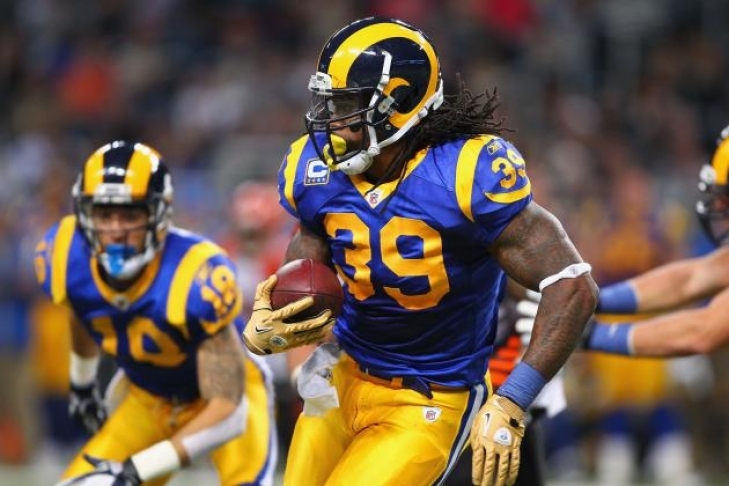
Steven Jackson arrived in St. Louis as the 24th overall pick in the 2004 Draft out of Oregon State, brought in to eventually replace an aging Marshall Faulk. He showed promise as a rookie with 673 rushing yards in limited duty, then took over as the full-time starter in 2005. From there, he became one of the league’s more consistent runners, posting at least 1,000 rushing yards every season from 2005 through 2012. Two of those years reached the 1,400-yard mark and ranked in the top five in the league.
His peak came in 2006, when Jackson rushed for a career-high 1,528 yards and 13 touchdowns while also catching 90 passes for 806 yards. That combination gave him 2,334 yards from scrimmage, the highest total in the NFL that season, along with the league lead in all-purpose yards. He earned Second-Team All-Pro honors and his first Pro Bowl selection. Jackson was a powerful back who could break tackles between the hashes and also serve as a reliable receiver out of the backfield, which made him hard to defend in a variety of looks.
He stayed productive for years afterward even as the Rams struggled as a team. In 2009, Jackson rushed for 1,416 yards, finishing second in the league, and earned another Pro Bowl and Second-Team All-Pro nod. He returned to the Pro Bowl the following year after another 1,000-yard season. Jackson topped 1,000 rushing yards in 2011 and 2012, showing durability and a willingness to carry a heavy workload on an offense that often lacked balance around him.
Jackson left the Rams after the 2012 season and signed with the Atlanta Falcons. With St. Louis, he finished as the franchise’s all-time leading rusher with 10,138 yards. He also added 3,324 receiving yards during those nine seasons, giving him more than 13,000 yards from scrimmage in a Rams uniform.
His three Pro Bowl selections and two All-Pro nods capture the best of his years in St. Louis, while the long streak of 1,000-yard seasons shows the consistency that defined the rest of his time there. Jackson gave the Rams a workhorse back who produced at a high level for nearly a decade.
Roses are Red (My Love)

July 14 – August 10, 1962
Bobby Vinton
Roses are Red (My Love)
25. Larry Brooks

Larry Brooks spent his entire NFL career with the Los Angeles Rams after they selected him in the 14th round out of Virginia State in 1972. He became a defensive tackle starter early in his rookie season and held that role for most of the next decade. Brooks was a steady interior presence on a defense that often featured bigger names around him, yet he regularly ranked among the team’s top tacklers and disrupted quarterbacks before sacks became an official statistic.
His best statistical season came in 1976, when he recorded 14.5 sacks, tying for the team lead and ranking among the league’s better marks that year. Brooks earned his first Pro Bowl selection that season and followed it with four more consecutive trips from 1977 through 1980. He was named First-Team All-Pro in 1979 after leading the Rams’ defensive line in tackles while adding six sacks. Those years coincided with some of the franchise’s strongest defensive units, which regularly ranked near the top of the league in points and yards allowed.
Brooks remained the primary starter through the late 1970s as the Rams reached the playoffs multiple times. In 1979 he played in Super Bowl XIV against the Pittsburgh Steelers despite an ankle injury, helping Los Angeles reach the title game for the first time. He continued to contribute in 1980 with another Pro Bowl nod and solid sack production before injuries limited him in the following seasons.
He appeared in his final games in 1982 and retired afterward. With the Rams, he played 131 games and started most of them. Unofficial sack totals put him over 74 for his career, a strong number for an interior lineman of that era who also handled run-stopping duties.
His five Pro Bowl selections and All-Pro recognition show the respect he earned from peers and coaches, even if he was sometimes overshadowed by more colorful teammates on the same defensive line. Brooks gave the Rams a reliable and productive defensive tackle who stayed effective for more than a decade.
