


Site Admin
21. Roman Gabriel
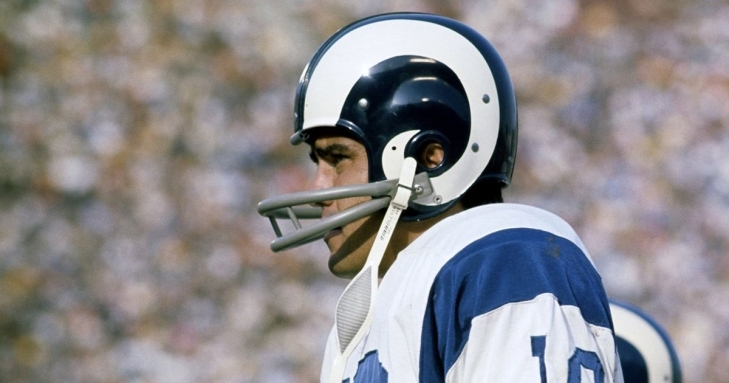
Roman Gabriel stood out the moment he arrived in Los Angeles. At 6-foot-5 and more than 220 pounds, the North Carolina State product looked more like a linebacker than the second overall pick in the 1962 Draft. He spent his first few seasons sharing snaps with veterans Zeke Bratkowski and Bill Munson before new head coach George Allen ended the competition in 1966 and named him the clear starter. Gabriel answered with a steady season and quickly built a reputation for protecting the ball in an era when interceptions were common.
He found his rhythm in 1967 and earned the first of three consecutive Pro Bowl nods. That year he threw for 2,779 yards and 25 touchdowns as the Rams went 11-1-2. Gabriel combined a strong arm with enough size and toughness to run on short-yardage plays when the defense stacked the box. In 1969, he put together his best season with the club, throwing 24 touchdowns against only seven interceptions and winning NFL MVP. Los Angeles won 11 games and reached the playoffs, though the postseason run ended in a loss.
From 1966 to 1972, Gabriel finished among the league’s top ten in passing yards in most seasons. He was a careful passer who still pushed the ball downfield, and the Rams’ strong defenses during those years made his steady play even more valuable. He stayed the primary quarterback into the early 1970s even as the supporting cast and coaching staff shifted around him.
After the 1972 season, Gabriel left Los Angeles and signed with the Philadelphia Eagles. With the Rams, he threw for 22,223 yards and 154 touchdowns. Those numbers stood as franchise records for years, and the touchdown total remains the highest in team history.
Gabriel earned four Pro Bowl selections in his career, three of them with the Rams, along with the 1969 MVP award. He took longer than most high draft picks to become the full-time starter, but once he did, he gave Los Angeles one of the more reliable and productive quarterbacks of that era.
20. Tom Fears
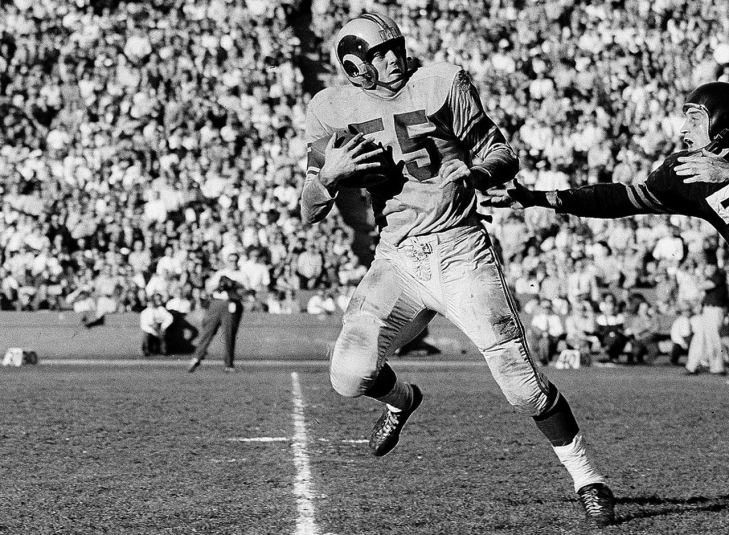
Tom Fears spent his entire nine-year NFL career with the Los Angeles Rams after they drafted him out of UCLA. He was originally projected as a defensive back, but the team moved him to offense, where he became a reliable end who helped advance the passing game. As a rookie in 1948, he led the NFL with 51 receptions. The next year he led the league again with 77 catches, setting a new single-season record at the time.
He broke his own mark in 1950 with 84 receptions for a league-leading 1,116 yards and earned First-Team All-Pro honors. That season included an 18-catch game against Green Bay, which stood as an NFL record for years. Fears was not the fastest receiver, but he ran precise routes and was willing to catch the ball in traffic. Those skills made him a consistent target for the Rams’ quarterbacks during a period when the team reached the NFL Championship Game in consecutive seasons.
His peak with the Rams came in 1951. Injuries limited him to seven games, yet he still contributed to another title-game appearance. In the championship against the Cleveland Browns, with the score tied, Fears caught a short pass and turned it into a 73-yard touchdown that put Los Angeles ahead for good. It was the franchise’s first championship since moving to the West Coast.
Injuries began to take a larger toll after that. Fears remained a useful piece of the offense for several more seasons, but he never again matched the production of his early years. He played his final games in 1956. With the Rams, he finished with 400 receptions, 5,397 yards, and 38 touchdowns.
Fears was inducted into the Pro Football Hall of Fame in 1970. He was the first NFL player of note born in Mexico, and his early receiving records helped show what a dedicated pass-catcher could do in an era still dominated by the run. His 1951 championship catch remains one of the signature moments of his Rams career.
19. Isiah Robertson
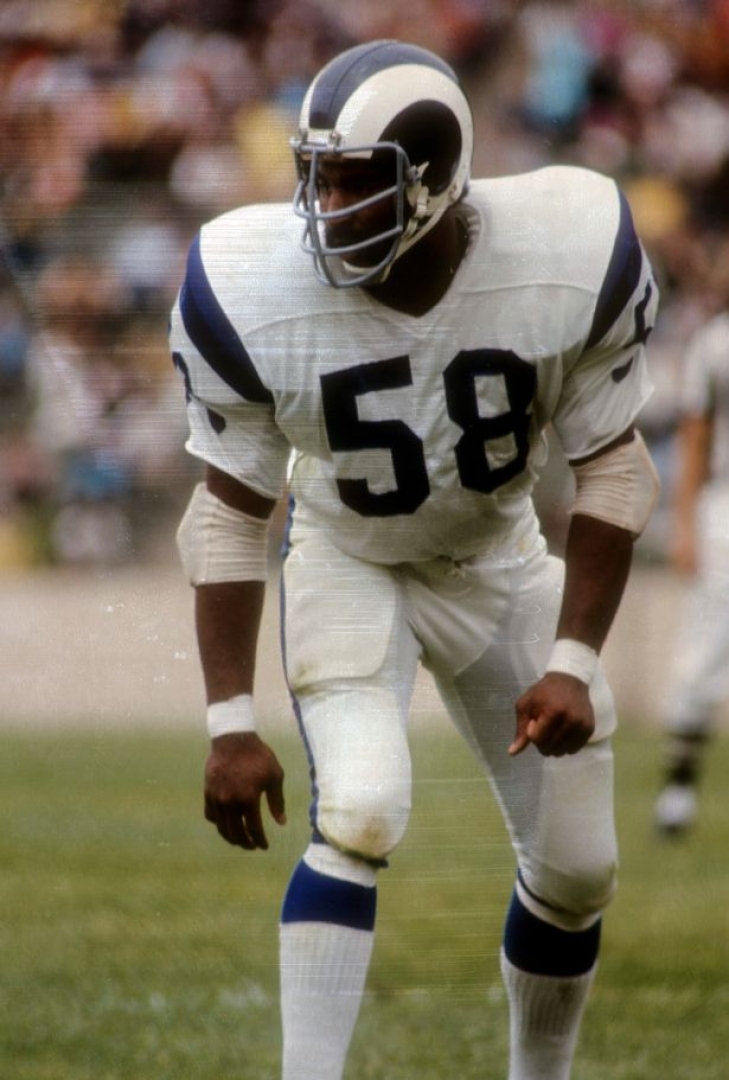
Isiah Robertson joined the Los Angeles Rams as the 10th overall pick out of Southern in 1971 and made an immediate impact. He stepped in as the starting strongside linebacker and won Defensive Rookie of the Year after intercepting four passes. He also earned a Pro Bowl selection and Second-Team All-Pro honors that season. Robertson was a fast, athletic linebacker who could cover tight ends and running backs while also rushing the passer and stopping the run.
He built on that start with a strong run through the mid-1970s. From 1973 to 1977, he earned Pro Bowl honors every year and was named All-Pro each season, including two First-Team selections. Robertson intercepted three passes in 1973 and returned one for a touchdown, then matched his career high with four interceptions in both 1975 and 1976. One of those 1975 picks went 76 yards for a score. He was a consistent presence on a Rams defense that helped the team win multiple division titles and reach NFC Championship games.
Robertson’s combination of speed and instincts kept him around the ball. He also contributed in the playoffs, including an interception in a postseason game against Washington. The Rams were one of the better teams in the NFC during his time, and his play at outside linebacker was a regular part of that success. He stayed productive into the late 1970s even as his role adjusted slightly under a new coaching staff.
After the 1978 season, the Rams traded him to the Buffalo Bills. With Los Angeles, he played eight seasons and recorded 18 interceptions along with solid contributions against the run and as a pass rusher. Those numbers, plus the six Pro Bowls and multiple All-Pro nods, ranked among the best by any linebacker in franchise history at the time.
Robertson finished his career in Buffalo and later received recognition in various halls of fame for his college and professional work. With the Rams, he was one of the most productive and decorated linebackers of the 1970s, delivering from the moment he arrived and staying at a high level for most of his time in Los Angeles.
18. Henry Ellard

The Rams selected Henry Ellard in the second round out of Fresno State in 1983, and he immediately showed he could contribute in multiple ways. The Rams used him early on as both a wide receiver and a punt returner. He led the NFL in punt-return average as a rookie and kept producing big returns the next year. In 1984, he earned First-Team All-Pro and Pro Bowl honors as a returner after taking two punts back for touchdowns, one of 83 yards and another of 69. He also caught passes, but his return work gave him extra chances to impact games while the offense was still finding its balance.
Ellard’s role expanded as a receiver, and he became a consistent deep threat with precise routes and the speed to separate. From 1988 through 1991, he topped 1,000 receiving yards each season. In 1988 he led the NFL with 1,414 yards and earned another First-Team All-Pro selection. He finished fourth in the league in receiving yards the next year and second the year after that, posting 1,382 and 1,294 yards respectively. Those seasons established him as one of the better wideouts in the league and the clear lead receiver for the Rams.
He stayed productive in Los Angeles after that stretch, though the yardage totals dipped as the offense changed. Ellard finished his time with the Rams after the 1993 season. With the club, he totaled 593 receptions and 9,761 receiving yards, both franchise records at the time he left. He also added strong return numbers earlier in his career that helped set up the offense.
Ellard signed with the Washington Redskins and had three more 1,000-yard seasons there. With the Rams, he earned three Pro Bowl selections and two All-Pro nods, one as a returner and one as a receiver. His early return ability and steady production later made him one of the franchise’s more reliable offensive weapons during the 1980s and early 1990s.
