


Site Admin
15. Julio Lugo
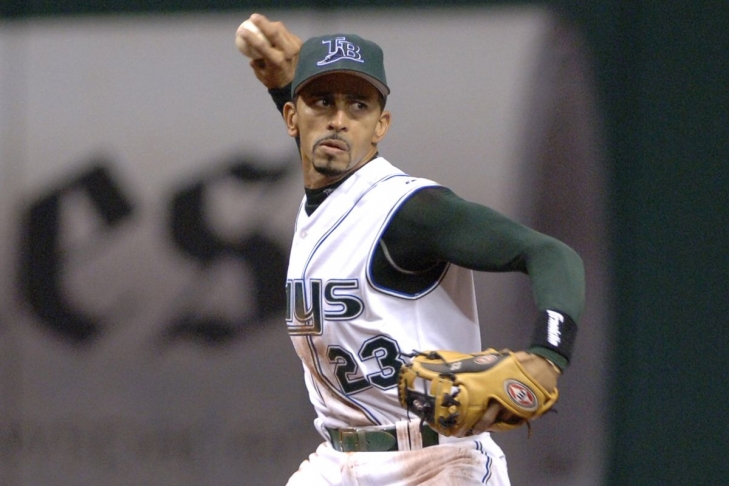
The signing of Julio Lugo in spring 2003 stands out as one of the most savvy and opportunistic moves by the Devil Rays’ front office during their early years. Released by the Houston Astros early in the season after an off-field arrest, the Dominican infielder was placed on waivers as a troubled player. With limited finances and a pressing need for stability at middle infield, the Rays took a calculated risk on his potential. This move quickly paid off for both Lugo and the franchise, as he immediately filled the shortstop position and maintained the starting role for over three and a half seasons.
Lugo’s impact on a perennially struggling defense was instantaneous and profound. During that initial 2003 campaign, he completely reconfigured the left side of the Tampa Bay infield with his exceptional lateral mobility and quick release. He finished the year leading all American League shortstops in Range Factor per Game—a metric reflecting his uncanny ability to get to balls that average defenders simply watched bleed into the outfield. He paired that elite defensive coverage with a highly respectable offensive baseline, swatting 15 home runs and hitting .275.
The 2004 season was a near-mirror image of consistency, as Lugo once again anchored the infield dirt while turning in identical offensive metrics. He proved that his first year in St. Pete was no fluke, giving manager Lou Piniella a reliable, high-energy catalyst who could slide into multiple spots in the batting order. While the Devil Rays as a whole were still mired in the American League East cellar, Lugo’s presence ensured that the shortstop position was an undeniable area of strength rather than a liability.
Lugo saved his absolute best individual performance for the 2005 campaign, putting together a definitive breakout year at the plate. He raised his batting average to a blistering .295 and collected a career-high 182 hits, showing an evolved approach that featured better gap-to-gap spray and sharper situational hitting. Meanwhile, his defensive wizardry remained fully intact, as he once again outpaced his junior circuit peers to finish first among AL shortstops in Range Factor per Game, cementing himself as one of the most complete players at his position in the league.
By the time the 2006 trade deadline approached, Lugo was playing the best baseball of his career, carrying a stellar .308 batting average and drawing immense interest from contenders looking for a postseason spark. Recognizing that the impending free agent was at the peak of his trade value, the Rays dealt him to the Los Angeles Dodgers in late July. He departed St. Petersburg with 550 hits and a sharp .287 batting average across 505 games, leaving behind a legacy as arguably the first truly elite defensive shortstop in the history of the young organization.
After his stint in Los Angeles, Lugo would parlay his success into a lucrative free-agent contract with the Boston Red Sox, where he would secure a World Series ring as their starting shortstop in 2007.
16. Desmond Jennings
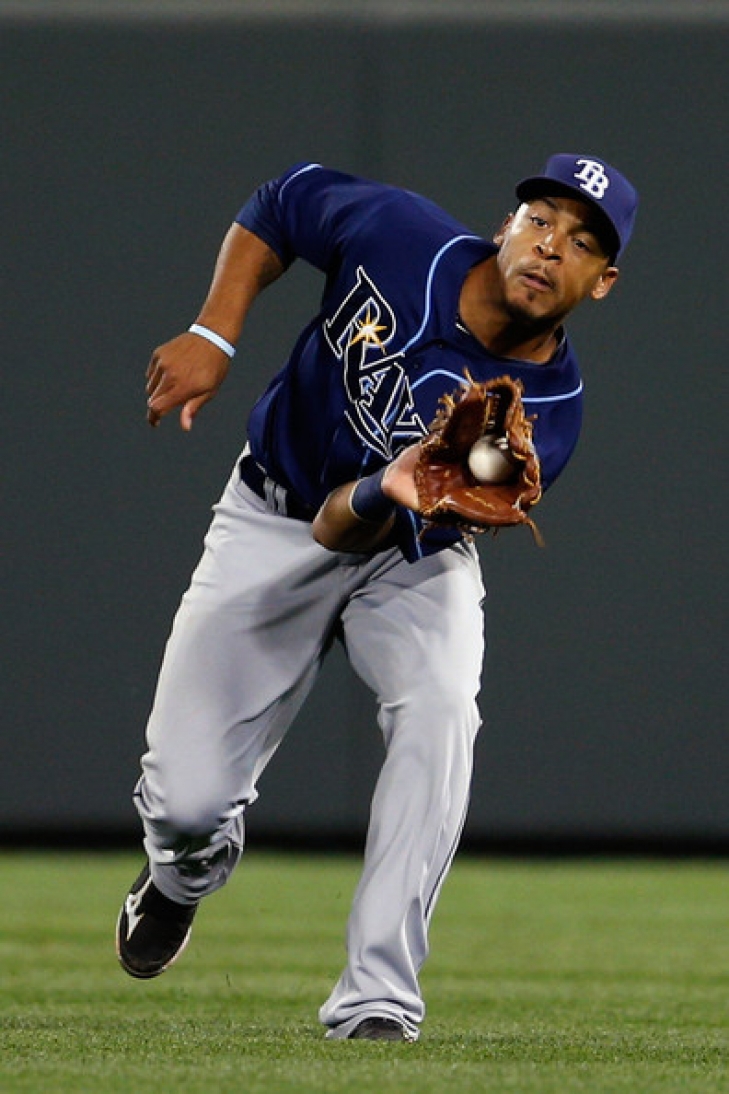
Desmond Jennings entered the Tampa Bay organization burdened by the astronomical expectations that come with being a consensus top-ten prospect in all of baseball. Blessed with breathtaking speed and electric physical tools, he was widely touted by scouts and fans alike as the natural heir apparent to B.J. Upton in center field. When he made his major league debut in the late summer of 2010, the anticipation was palpable, as the front office envisioned Jennings anchoring the premium real estate of the Tropicana Field outfield for the next decade.
The true peak of Jennings’ career materialized across a highly productive three-season window from 2012 through 2014. By 2013, he had firmly secured the everyday starting job in center field, serving as a durable and reliable fixture at the top of Joe Maddon's lineups. During each of those three consecutive campaigns, Jennings eclipsed the 115-hit mark, weaponizing his legs to stretch singles into doubles and turning routine grounders into close plays at first base, providing the Rays with a steady, high-energy presence during a competitive era.
On the defensive side of the ball, Jennings was an asset. While he lacked the theatrical flair of some of his contemporaries, his vast range, exceptional acceleration, and precise route-running allowed him to swallow up fly balls from gap to gap with above-average efficiency. In the cavernous and sometimes unpredictable environment of the Trop, his defensive reliability gave a highly sophisticated Rays pitching staff the ultimate safety net, ensuring that extra-base hits were routinely minimized.
However, while his defense and speed remained elite, Jennings’ overall value was capped by a relatively light bat. He struggled to consistently drive the ball, resulting in an underwhelming career triple-slash line of .245/.322/.393. While he showed occasional pull power, his high strikeout rate and difficulty adjusting to breaking pitches away meant he never truly evolved into the dynamic, top-tier leadoff force the organization had initially projected.
The wheels began to come off physically during the 2015 season, as a frustrating onslaught of knee injuries sapped Jennings of the elite speed that anchored his entire game. Shuffled back and forth from the disabled list, he was never able to recapture his fluid strides or explosive baseline. After a brutal 2016 campaign where his body clearly betrayed him, the cash-conscious Rays made the difficult decision to release him, effectively ending his big-league career at just 29 years old.
Over his career, Jennings collected 508 hits with 95 stolen bases.
14. Aubrey Huff
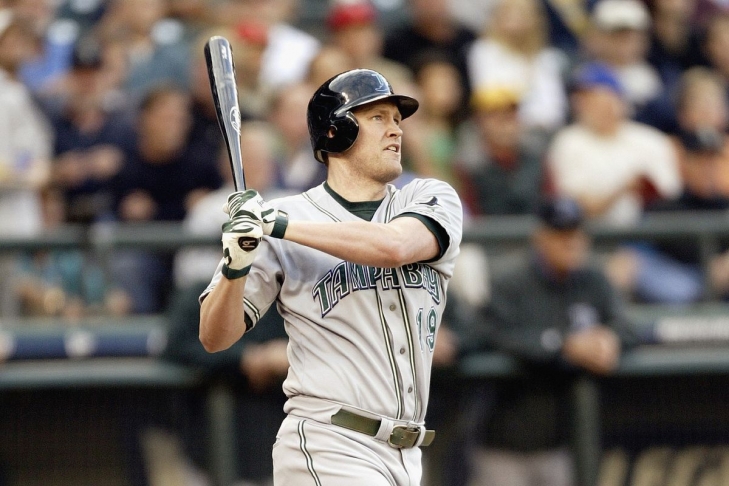
In the early years, the Tampa Bay Devil Rays faced low attendance, many triple-digit loss seasons, and a struggle for a stable homegrown player core. During this challenging period, Aubrey Huff rose from the minor leagues to become the franchise’s first true middle-of-the-order hitter. Debuting in the summer of 2000, this left-handed infielder gained recognition for his smooth, natural swing, which allowed him to excel against major league pitching more effectively than most of his teammates at the time.
By 2002, Huff had emerged as the key player in the Tampa Bay offense. He had a remarkable season, hitting 23 home runs and achieving a career-best .313 batting average, demonstrating his place among top hitters. The following summer, he surpassed these achievements, delivering his most outstanding performance in a Devil Rays uniform. In the 2003 season, Huff was immensely effective at the plate, smashing 34 home runs, driving in 107 RBIs, and maintaining a superb .311 batting average—a bright spot in a year that saw the team lose 99 games.
Despite Huff’s continued offensive productivity with two consecutive 20-home run seasons over the next two years, his overall value was often diminished by his defensive shortcomings. The coaching staff frequently moved him around the field, trying him at third base, first base, and right field. However, he lacked the range, agility, and glove skills necessary to be effective at any of these positions, making him a significant defensive liability whose glove often cost him runs that his bat helped generate.
Beyond just his defensive stats, Huff’s time in St. Petersburg grew marked by a difficult and prickly attitude that began to strain the team. While his reputation as a toxic locker room presence would become more evident later, the signs of discord with teammates and management appeared during his final years in Tampa. As the franchise aimed to build a younger, more disciplined culture, Huff's leadership style and attitude increasingly conflicted with the front office’s long-term goals.
In July 2006, Huff, nearing his fifth consecutive 20-home run season and batting .283 with 128 home runs over six seasons, was traded by the Devil Rays to the Houston Astros for prospect Ben Zobrist. The deal signaled a major shift in Tampa Bay's philosophy as Huff left, leaving his mark on the franchise's early leaderboards.
After leaving the Gulf Coast, Huff would wander through several organizations as a mercenary bat before eventually finding late-career redemption as a key contributor to two World Series championships with the San Francisco Giants.
10. Blake Snell
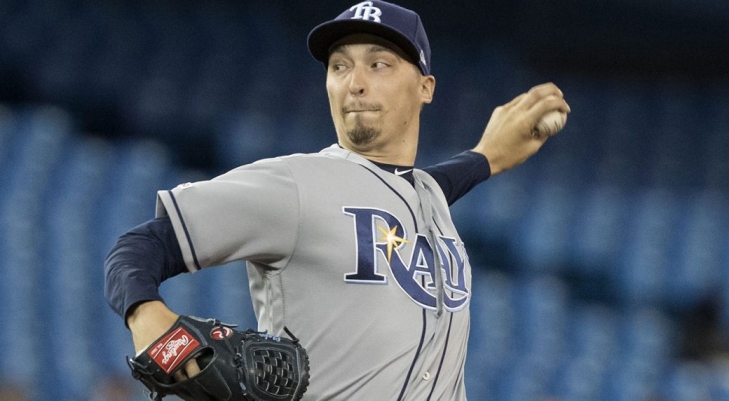
When mapping out the history of modern pitching within the American League East, it becomes evident that the Tampa Bay Rays manage frontline arms in a manner distinct from any other organization in professional baseball. For the Rays, outstanding velocity and award-winning execution are never grounds for abandoning their disciplined, data-driven roster strategy. No single career trajectory exemplifies this analytical approach more than that of left-hander Blake Snell. Selected by the front office in the first round of the 2011 draft, the Seattle-born southpaw possessed an electrifying, high-velocity pitch repertoire featuring a blazing fastball and a penetrating, sharp-breaking curveball. Over five seasons representing the franchise, "Snellzilla" established himself as one of the most exceptional and highly variable strikeout artists of his generation. He demonstrated that when his command was fully optimized, he could attain a peak level of efficiency that nearly transcended the principles of modern pitching.
His initial performances across 2016 and 2017 featured an impressive display of raw talent; however, it was during the 2018 season that everything fully converged to produce a quintessential regular-season performance. Snell consistently dominated junior circuit lineups, transforming them into a routine occurrence. That season, he demonstrated an exemplary level of pitching, leading the American League with a remarkable 21 wins against only 5 losses and an outstanding 1.89 ERA over 31 starts. Advanced analytical metrics substantiate the extraordinary caliber of this peak, as evidenced by his impressive 217 ERA+ and an exceptionally low 5.6 hits allowed per nine innings, securing his first American League Cy Young Award and a top-ten placement in the AL MVP voting.
While his 2019 follow-up campaign was hindered by minor injury-induced leaks and an elevated 4.29 ERA, his value-dense high-leverage profile reached its apex during the pandemic-shortened 2020 regular season. Snell led the pitching staff with a robust 3.24 ERA, guiding the young, ambitious Rays roster to a historic American League pennant.
Yet his entire Tampa legacy is defined by the explosive, controversial milestone that erupted on a national stage during Game 6 of the 2020 World Series against the Los Angeles Dodgers. Dominating the Dodgers' powerhouse lineup, Snell had thrown 5.1 innings of brilliant, one-hit shutout ball, striking out nine on just 73 pitches. Operating under strict, analytical organizational directives to never let a starter face a lineup for a third time, manager Kevin Cash walked to the mound and pulled his cruising ace from the game.
The Dodgers rallied against the Tampa bullpen to win the game and title, creating an emotional moment still felt in baseball. True to their cost-effective approach, the franchise’s front office traded the 28-year-old pennant hero to the Padres in a lopsided, multi-player blockbuster that December, fearing his financial leverage would rise under his contract extension.
