


Site Admin
24. Matt Joyce
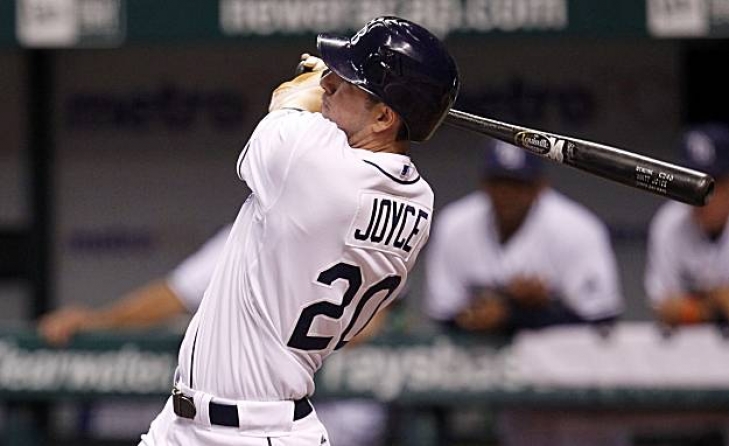
Matt Joyce's move to St. Petersburg before the 2009 season was truly a homecoming. Growing up in Tampa with a single father, he attended Devil Rays games at Tropicana Field and admired Fred McGriff. When Detroit traded him to the Rays for pitcher Edwin Jackson, Joyce realized his dream of playing in Tampa—though his first year mostly involved waiting and improving his swing in Triple-A Durham.
His patience paid off when he secured a starting corner outfield spot in 2010, paving the way for a remarkable, career-best season in 2011. Becoming a dominant force in the first half, Joyce's smooth left-handed swing earned him a spot on the American League All-Star team. Throughout a tense postseason race, he anchored Kevin Cash's lineup, recording 128 hits, 32 doubles, and 19 home runs with a strong batting average of .277.
Although his batting average declined toward his career average over the following summers, Joyce continued to display impressive power and a disciplined eye at the plate. He consistently produced well in the middle of the order, especially against right-handed pitchers, hitting 17 and 18 home runs in 2012 and 2013 respectively. His ability to draw walks and hit deep, clutch drives made him a key figure during a competitive period for the Rays.
Recognizing the escalating cost of arbitration, the front office adhered to its signature blueprint, trading the veteran outfielder to the Los Angeles Angels prior to the 2015 season. As a Ray, Joyce played 633 games, with 484 hits, 75 home runs, and 262 RBIs. He posted a .250/.342/435 slash line and a 118 OPS+.
20. Alex Cobb
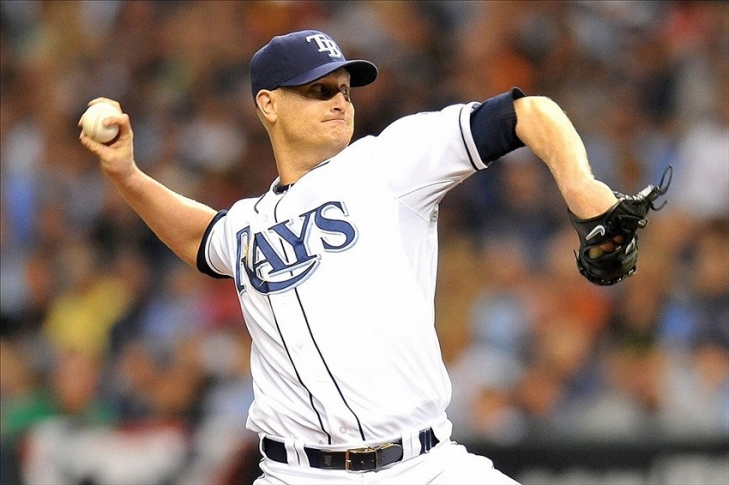
Alex Cobb’s progression through Tampa Bay highlights the organization's talent for spotting and developing overlooked pitching prospects. Drafted in the fourth round of 2006 out of Vero Beach High School, he carefully developed his skills over five minor-league seasons before making a nine-start stint in 2011. Demonstrating he could compete against major-league hitters with composure, Cobb secured a permanent spot in Joe Madden's starting rotation by early 2012, paving the way for a sustained, effective presence as a top pitcher in the American League East.
Cobb proved his status as a key player by recording 11 wins in 2012, a feat he matched in a standout 2013 season. Using a high-spin sinker and a deadly changeup, he completely shut down opposing batters, posting a career-low 2.76 ERA—the best single-season ERA of his major-league career. He continued this excellence in 2014, making 27 starts and going 10–9 with an impressive 2.87 ERA. Although his total wins were affected by limited run support, advanced stats highlighted his dominance, ranking sixth in ERA and tenth in WHIP (1.136) in the American League, showing he could consistently compete with division’s top pitchers.
Just as Cobb positioned himself as a key player, he faced a major setback in Spring Training before the 2015 season. An ulnar collateral ligament tear mandated Tommy John surgery, ending his 2015 season entirely and restricting him to a short, five-start rehabilitation appearance late in 2016.
Displaying remarkable competitive determination, Cobb made a highly successful comeback in the 2017 season by completely changing his pitching approach. He reduced some of his pre-surgery velocity and depended heavily on a new, sharp split-finger fastball to keep hitters off-balance. The change proved very effective; Cobb became the reliable workhorse of the team, pitching a career-high 179.1 innings over 29 starts and ending with a 12–10 record and a 3.66 ERA. This resilient performance also marked the end of his time in St. Petersburg, as the small-market front office allowed him to explore free agency that winter, leading to a four-year contract with division rivals, the Baltimore Orioles.
With Tampa, Cobb went 48-35 over 700 innings and had an ERA of 3.50 with 570 strikeouts.
23. Jason Bartlett
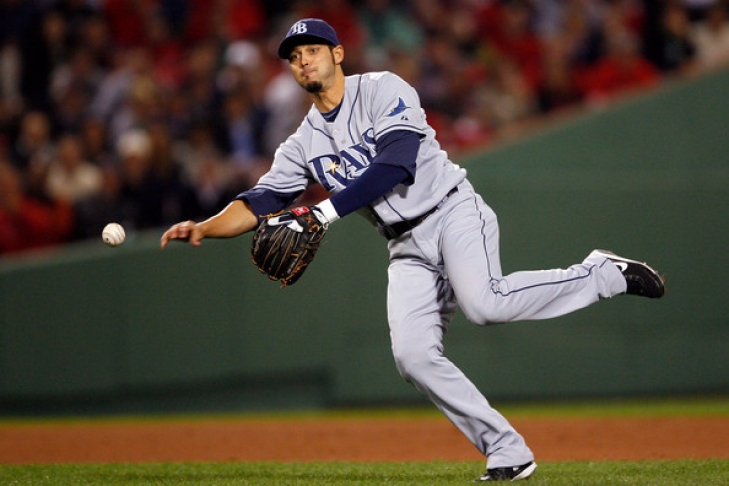
When Jason Bartlett joined St. Petersburg before the 2008 season, his goal was to stabilize an infield known for defensive errors. Traded from Minnesota in a high-profile multi-player deal that also included Matt Garza, the reliable shortstop quickly transformed the middle of the field. His arrival brought a combination of solid defense and subtle leadership that contributed to the franchise's remarkable turnaround from worst to first.
His first year in Tampa Bay showcased consistent reliability under pressure. Bartlett solidified the infield defense and maintained a .286 batting average, leveraging his smart baserunning to energize the lower part of the lineup. This helped the Rays surprise the sports world by winning the 2008 American League pennant.
That outstanding team achievement paved the way for the pinnacle of his career in 2009. Everything aligned perfectly for Bartlett as he crafted an exceptional individual season that earned him his only selection to the American League All-Star team. He dominated opposing pitchers by setting personal bests in various stats, including 160 hits, 14 home runs, and 30 stolen bases. He combined this newfound power with an elite .320/.389/490 slash line, leveraging his speed to score 90 runs and finishing 23rd in the AL MVP voting.
In 2010, the team's offensive output stabilized at a more typical level, yet he remained a resilient, intelligent playmaker, contributing to a team that won 96 games and secured another AL East division title. Seeing potential in a rich supply of young middle-infield prospects, the front office took advantage of his high market value that winter by trading Bartlett to the San Diego Padres.
With Tampa Bay, Bartlett played 413 games with 409 hits, 23 home runs, and 155 RBIs, posting a .288/.358/407 slash line.
26. Fred McGriff

When the Tampa Bay Devil Rays launched their first season in 1998, they needed more than just capable players; they required immediate credibility and star appeal. They achieved this by bringing Fred McGriff, a hometown favorite, back to the team. Left unprotected by Atlanta after 1997, the first baseman quickly gave the young franchise a clear identity. For fans who watched "The Crime Dog" unleash his memorable follow-through at Tropicana Field, his presence became a vital link that helped establish Major League Baseball's legitimacy in the region.
McGriff quickly established himself as a power hitter, providing crucial middle-of-the-order production. In 1998, he hit 19 home runs during the franchise's challenging debut season, setting the stage for an outstanding 1999. That year, he showcased his offensive prowess with a impressive .310/.405/552 batting line, hitting 32 home runs and driving in 104 RBIs. His consistency continued into the next season with another 27 home runs and 106 RBIs. This performance earned him his fifth and final All-Star appearance, making him the first player from the franchise to be selected for the Midsummer Classic.
By mid-2001, the front office realized his market value was at its highest point. Since the rebuilding team was no longer contending, they traded the veteran slugger to the Chicago Cubs before the July deadline, even though he had already hit 19 more home runs before the trade.
Assessing McGriff within this framework involves recognizing his distinctive contribution. Although his tenure in St. Petersburg lasted just under four full active seasons—resulting in a lower total playtime compared to the franchise's long-standing core—his concentrated impact during the early days of the franchise is significant. He provided an expansion team with a powerful, disciplined hitter who amassed 99 home runs and maintained an impressive .380 on-base percentage, serving as a reliable and stabilizing presence that helped establish the young team's foundation.
As a Ray, McGriff blasted 99 home runs with a slash line of .291/.380/.484. In 2023, he was elected to the Baseball Hall of Fame by the Veterans Committee.
