


Site Admin
The Buck Stops Here -- Hall of Fame News -- Season 1 Episode 17
40. Jeremy Hellickson
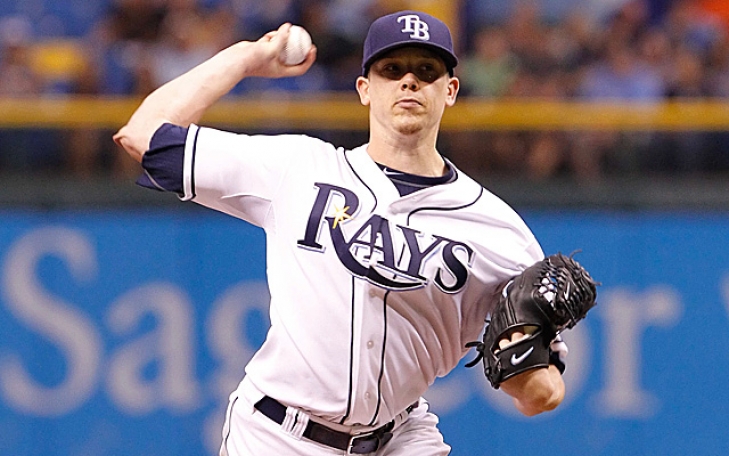
The nickname “Hellboy" suited the pitcher whose arrival in St. Petersburg seemed almost mystical. Drafted in the fourth round of the 2005 amateur draft, Jeremy Hellickson not only met the high expectations of the Rays' pitching development program but may have been its most refined early success story. He initially showcased his talent during a brief 2010 debut, securing all four of his decisions and offering a glimpse of his calm, changeup-oriented pitch style that would soon challenge American League hitters.
His rookie season in 2011 showcased controlled mastery. Unlike some young players who depend on sheer, uncontrolled speed, Hellickson pitched with veteran-like precision. He solidified the team's rotation, finishing with a 13–10 record and a remarkable 2.95 ERA. His performance earned him the American League Jackie Robinson Rookie of the Year Award, making him just the second Ray to receive this honor after Evan Longoria.
Hellickson’s role in the rotation remained pivotal through 2012, when he received a Gold Glove Award for his defensive skills on the mound—highlighting his high baseball IQ. Yet, in 2013, his command noticeably declined, and his ERA increased to 5.17, indicating a tough transition for the once-reliable ace. Injuries then impacted his 2014 season, restricting him to 13 starts, before the organization decided to move on, trading him to the Arizona Diamondbacks that offseason.
With the Rays, Hellickson made 97 appearances (94 starts). He compiled a 40–36 record with a 3.73 ERA and a 1.20 WHIP, logging 540.1 innings and registering 463 strikeouts.
36. Alex Colomé
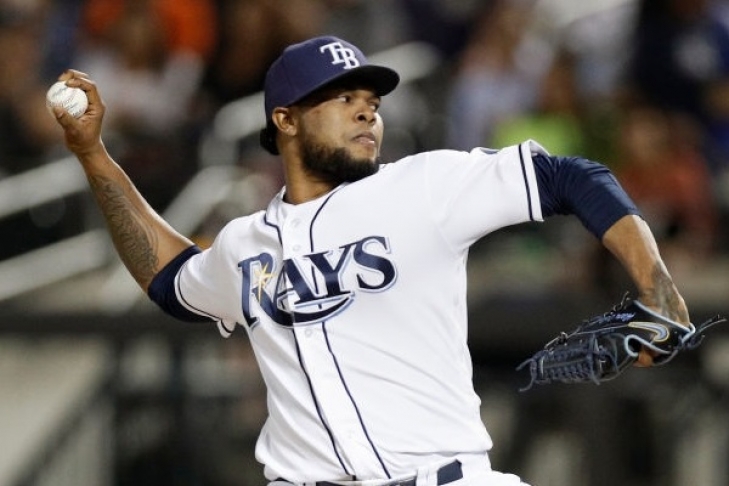
Alex Colomé’s progression within the Tampa Bay organization exemplifies exemplary organizational adaptability. Signed from the Dominican Republic as an 18-year-old amateur free agent in 2007, the right-handed power pitcher was extensively trained as a conventional starting pitcher. When he ultimately secured spots on the major league roster for brief trials in 2013 and 2014, he did so as a central pitcher, demonstrating a high-velocity fastball that suggested a promising future, despite his precise role remaining uncertain.
That significant breakthrough occurred in 2015 when the front office employed him as a versatile swingman. Colomé pitched a total of 109.2 innings over 43 appearances, including 13 starts, achieving a record of 8–5. While his performance in this role was adequate, an injury to closer Brad Boxberger during spring training prior to the 2016 season compelled Kevin Cash to adapt. Colomé was consequently positioned into the ninth-inning role, where he immediately altered the entire dynamic of the Tampa Bay bullpen.
Utilizing a formidable and incisive cutter, Colomé established himself as an exceptional force in the closing role. Throughout the 2016 season, he demonstrated dominance over American League batters, securing 37 saves with an outstanding 1.91 ERA and earning his inaugural selection to the All-Star Game. His significant breakout was reaffirmed in 2017 when he resumed his role as a reliable bullpen staple. Although his ERA increased modestly to a solid 3.24, his consistency in high-pressure situations reached its zenith as he successfully closed the game 47 times, leading Major League Baseball and setting a franchise record as the first pitcher to claim the title of Major League saves leader.
As his salary escalated in arbitration, the hyper-efficient Rays front office capitalized on his massive market value, trading the veteran closer to the Seattle Mariners in May 2018. With the Rays, Colomé appeared in 191 games (19 starts). He compiled a 17–15 record with 95 saves, a 3.14 ERA, and a 1.22 WHIP, registering 255 strikeouts over 273 innings pitched.
35. Charlie Morton
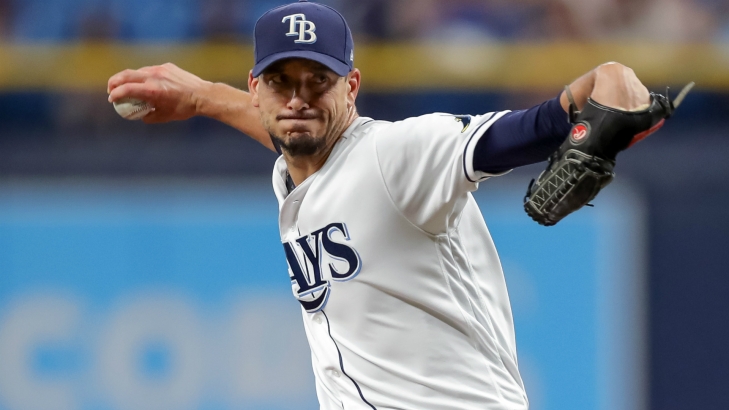
Ranking a starting pitcher based on a mere two-season residency might initially feel unconventional, but our evaluation framework places equal weight on sustained seasonal dominance. When a player anchors a rotation with the kind of high-ceiling impact that fundamentally alters a franchise's trajectory, the brevity of their stay is offset by raw efficiency. Charlie "Uncle Charlie" Morton provided exactly that kind of high-leverage elevation.
Having completed twelve Major League seasons and earned a championship ring with the Houston Astros, the seasoned right-hander joined the Tampa Bay Rays as a free agent prior to the 2019 season. Rather than demonstrating signs of aging, Morton proceeded to craft the pinnacle of his professional career. Equipped with a lethal, high-spin curveball and a mid-90s fastball, he effectively commanded American League lineups to achieve a 16–6 record across 33 starts. He concluded that remarkable summer by finishing third in the American League Cy Young Award voting, ranking third in the league with a 3.05 ERA, and setting a personal best with 240 strikeouts over 194.2 innings pitched. It is highly likely that the Rays would have missed the postseason entirely without his role in stabilizing the front of the rotation, a contribution further demonstrated by winning both of his October appearances.
Although his regular-season statistics were not as remarkable during the pandemic-affected 2020 season, his ability to perform in crucial games continued to be a vital asset. Restricted to nine starts in the regular season due to shoulder inflammation, Morton demonstrated his most exceptional work in the high-pressure environment of October. He emerged as a quintessential postseason closer and starter, achieving a 3–1 record throughout the playoffs, and notably securing two decisive victories in the American League Championship Series against his former team, the Astros, thereby leading the Rays to their second pennant.
The front office let the veteran walk in free agency that winter, leading to his signing with the Atlanta Braves. In his two years with the Rays, Morton compiled an 18–8 record with a 3.33 ERA and a 1.13 WHIP, striking out 282 batters over 232.2 innings pitched.
