Site Admin
3. Roger Clemens
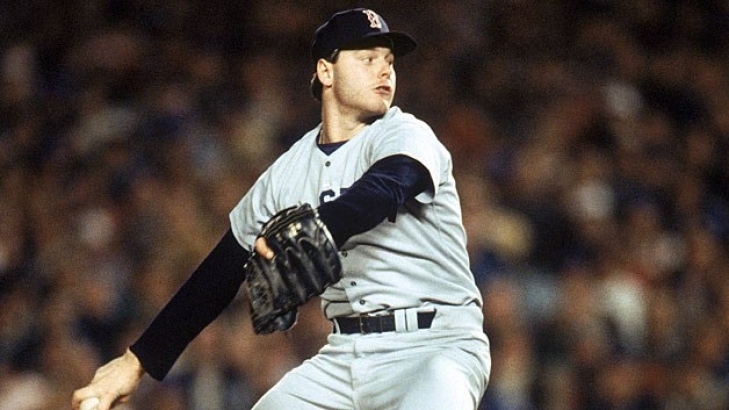
Roger Clemens arrived in Boston in 1984 as a power-pitching revelation, a Texas-sized arm that would redefine the "Rocket" nickname at Fenway Park. While his first two seasons showed glimpses of brilliance, his 1986 campaign was a historic explosion that remains the gold standard for Red Sox pitching. That year, Clemens became the rare pitcher to sweep the AL MVP and Cy Young awards, leading the league in Wins (24), ERA (2.48), and WHIP (0.969) while carrying Boston to the brink of a World Series title.
The “Rockets’" dominance was a nightly attraction. From 1986 to 1992, he was arguably the premier hurler in the game, securing two more Cy Young Awards (1987 & 1991) and authoring a monumental 20-strikeout game that stands as one of the most dominant single-game performances in baseball history. During this stretch, he was an efficiency machine, winning three more ERA titles and two Strikeout crowns, proving that his high-velocity "fuel" was inexhaustible.
Even as injuries slowed his pace in the early 90s, his metrics remained elite. Despite a losing record in 1995, Clemens showcased his enduring power by securing his third Strikeout Title with 257 punchouts. While the Red Sox front office infamously believed his peak was behind him when he departed for Toronto in 1997, his 13 seasons in Boston had already built a resume that remains unmatched in the franchise's modern era.
Clemens left Boston with a staggering record of 192–111, a 3.06 ERA, and 2,590 strikeouts. Though his career remains shadowed by PED suspicions that have barred him from Cooperstown, his place in Boston history was formalized with his induction into the Red Sox Hall of Fame in 2014. He remains the statistical ceiling for Boston pitchers, an anchor who proved that for over a decade, the road to the AL East title went directly through the Rocket's right arm.
While later chapters of his career would bring World Series rings and more hardware in other uniforms, his foundational years at Fenway defined an era of Boston baseball.
2. Carl Yastrzemski
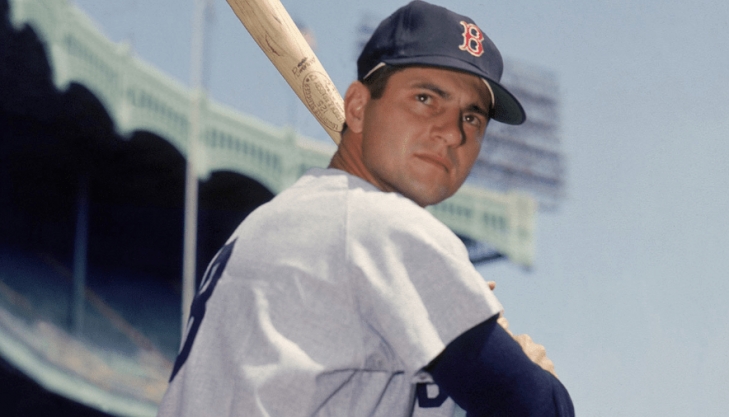
Carl Yastrzemski famously stepped into the vacuum left by Ted Williams in 1961, taking over left field and the mantle of the franchise’s premier hitter. Like his predecessor, Yaz was a "Lifer" who spent his entire 23-season career (1961–1983) with the Red Sox. While he too was unable to secure a World Series ring, his career was a testament to elite consistency and high-stakes production, leading Boston through two of its most iconic "Impossible Dream" eras.
The pinnacle of Yastrzemski’s career arrived in 1967, in an era where pitchers ruled the mound, Yaz authored a Triple Crown masterpiece, leading the American League in Batting Average (.326), Home Runs (44), and RBIs (121). He swept the leaderboards, also topping the AL in Runs Scored, Hits, OBP, and Slugging to easily secure the MVP. It was a season of singular brilliance that single-handedly willed the Red Sox to the 1967 Pennant.
Beyond the power of '67, Yaz was a versatile offensive force, securing Batting Titles in 1963 and 1968 and leading the league in On-Base Percentage five times. While he may not have matched Williams’ pure hitting metrics, he far surpassed him with the leather. An 18-time All-Star, Yaz was a defensive technician, winning 7 Gold Gloves and leading the league in assists 8 times. His five seasons leading AL Left Fielders in Total Zone Runs identify him as a premier two-way outlier.
Yaz's postseason resume proves he was a big-game performer. In 17 high-pressure October games across 1967 and 1975, he posted a staggering .369/.447/.600 slash line with four home runs and 11 RBIs. Though the supporting cast often fell just short of the ultimate prize, Yastrzemski’s personal performance in the clutch was beyond reproach. He was the heartbeat of the '67 "Impossible Dream" and the 1975 squad that participated in arguably the greatest World Series ever played.
By the time he retired after the 1983 season, Yastrzemski had rewritten the Red Sox record books through sheer longevity and talent. He remains the all-time franchise leader in Runs Scored (1,816), Hits (3,419), Doubles (646), and Runs Batted In (1,844). These volume-dense totals make him the absolute anchor for Category 1 in our framework, representing a level of career accumulation that few in the sport's history can rival.
Yastrzemski was a first-ballot Hall of Fame inductee in 1989, the same year the Red Sox retired his legendary Number 8. He was also a foundational member of the inaugural Red Sox Hall of Fame class in 1994. In Fenway, Yaz represents the transition from the individual brilliance of the Williams era to the gritty, all-around excellence that defined the Red Sox for the next quarter-century.
1. Ted Williams
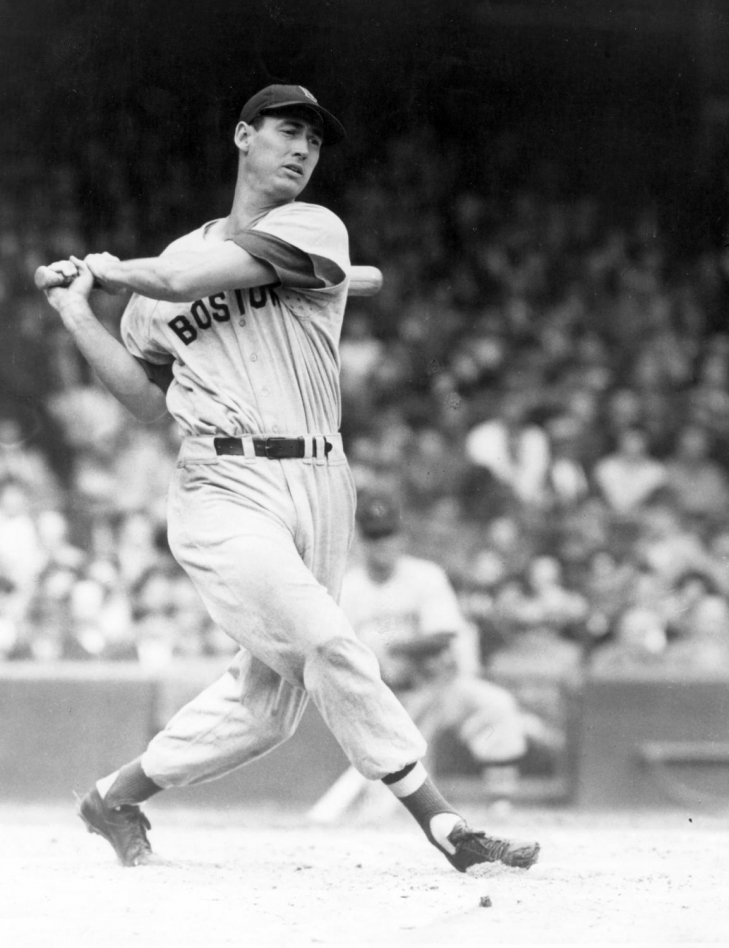
Were you expecting someone else?
As incredible as Ted Williams was, it is a bit lost just how good he was. Part of this is because so much time has passed; part because his Red Sox only won one American League Pennant.
Williams remains the gold standard for hitting, even if the passage of time and the Red Sox's lack of postseason hardware during his era sometimes obscure his true brilliance. Spending his entire 19-season career in Boston (1939–1960), Williams’ tenure was only interrupted by three years of military service during World War II. His rookie season in 1939, where he batted .327 with 31 home runs and a league-leading 145 RBIs, was a perfect showcase of the offensive juggernaut he would become for the next two decades.
Before the war, Williams embarked on a legendary tear, securing three Runs Scored titles, two Batting titles, and leading the league in OBP and Home Runs multiple times. Most notably, his 1941 campaign saw him finish with a .406 average—the last time any player has reached that magical mark. Despite winning the Triple Crown and leading the AL in bWAR in both 1941 and 1942, he was remarkably overlooked for the MVP award both times, finishing as the runner-up to Joe DiMaggio and Joe Gordon as the Yankees claimed the Pennant.
Upon his return in 1946, Williams immediately reclaimed his throne as the game's premier hitter. Between 1946 and 1950, he added two more Batting titles and consistently led the American League in On-Base Percentage and Slugging. It was during this prolific stretch that he earned his two MVP awards (1946 and 1949), and even in the years he didn't win, he was a fixture in the top three of the voting. He continued to be a statistical outlier, securing his final Home Run and RBI titles during this period.
While injuries began to take a toll as he entered his 30s, Williams remained remarkably productive whenever he was in the lineup. He continued to dominate the leaderboards well into the 1950s, winning two more Batting titles in 1957 and 1958 and leading the league in OBP five more times between 1951 and 1958. With the exception of a single down year in 1959, he maintained a batting average over .300 throughout his entire career, proving that his technical mastery of the strike zone was immune to the traditional aging curve.
It is often noted that Williams only led the Red Sox to a single American League Pennant; this is viewed through the lens of his competition. He spent his career battling a Yankee dynasty that featured legends like DiMaggio, Mantle, and Berra. Furthermore, while Williams was never known for his speed or defensive prowess, his offensive contributions were so overwhelming that those shortcomings were largely rendered irrelevant. He concluded his career in 1960 in spectacular fashion, still hitting .316 with 29 home runs in his final season.
Ted Williams retired as the all-time franchise leader in Batting Average, OBP, Slugging, and Home Runs—records that still stand today. His career slash line of .344/.482/.634 is headlined by his .482 On-Base Percentage, which remains the highest in the history of Major League Baseball. Inducted into the Hall of Fame in 1966 on his first ballot, "The Splendid Splinter" remains the benchmark against which all other hitters are measured, a "Lifer" who carried the identity of the Red Sox through two decades of excellence.
How can that ever change?
The Buck Stops Here -- Hall of Fame News -- Season 1 Episode 21