


Committee Chairman
39. Bob Veale
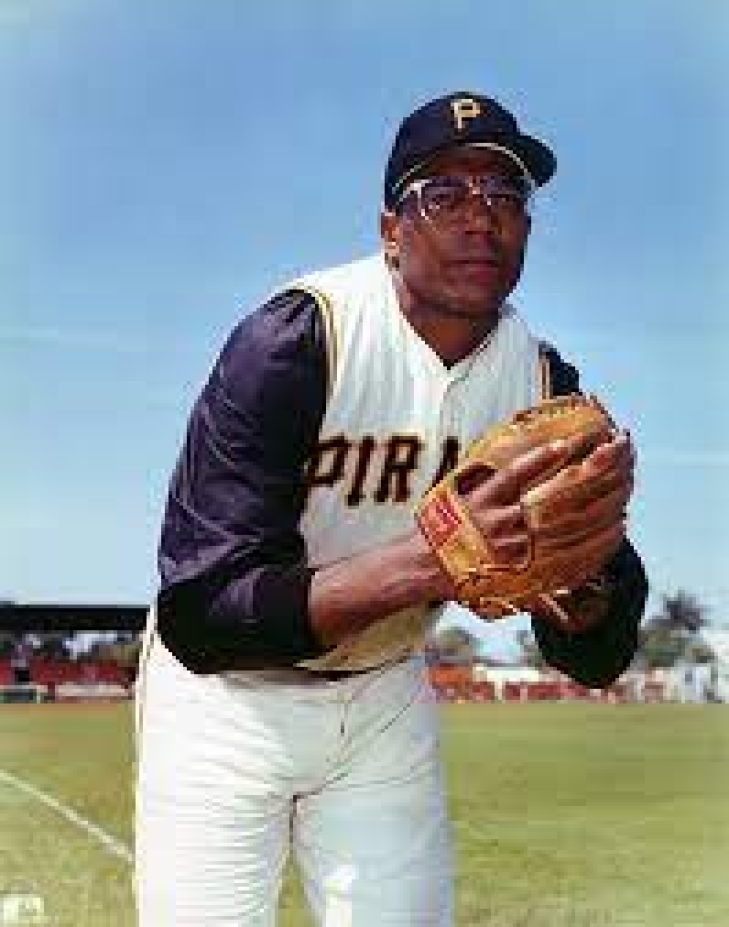
The 1960s are rightly celebrated as a golden age of pitching dominance, marked by legends who intimidated batters through their commanding presence and fast, high-velocity pitches. Bob Veale, a towering 6-foot-6, 230-pound southpaw from Alabama, exemplified this raw physical intimidation. Not only did he throw with formidable power, but his pitches also carried an unpredictable, terrifying movement that visibly unsettled batters. Due to severe Nearsightedness, Veale wore thick-rimmed glasses, which sometimes made it difficult to see the catcher's signs clearly, adding a psychological edge and high-stakes tension for opponents. For seven outstanding years, he was the leading strikeout pitcher in the Pittsburgh rotation.
Veale’s initial appearances were through brief bullpen auditions starting in 1962, but he secured a permanent starting role in 1964. He made a mark with exceptional run prevention and strikeouts, turning that season into a defining one. As a first-time full-time starter, he consistently shut down National League hitters, setting a franchise record with 250 strikeouts and leading the league in punchouts. He finished with an impressive 18–12 record and a low 2.74 ERA, quickly earning recognition as one of the most dominant and unhittable pitchers in the league.
That explosive debut launched a spectacular, volume-dense peak of durability. Veale remained a model of unshakeable consistency for the rest of the decade, rattling off six consecutive summers with at least 200 innings pitched and clearing the 200-strikeout threshold three more times.
His standout individual achievement occurred during the 1965 pennant race, when he used his renowned stamina to pitch a demanding career-high 266 innings, achieve 17 wins, and lead Major League Baseball with 14 complete games. He was selected as an All-Star in both 1965 and 1966, serving as a key figure on the pitching staff alongside young Bob Friend and Vern Law.
However, when evaluated with modern advanced metrics, his overall analytical profile hits a clear ceiling. Despite his strikeout numbers, Veale struggled significantly with command, leading the National League in walks allowed four times. His overly aggressive mound approach often resulted in deep counts, increasing his walk rate and pitch counts. Additionally, as natural aging and shoulder structural issues became apparent around the early 1970s, his raw velocity declined, and he was eventually transitioned to a relief role in the historic 1971 World Championship season.
With his starting days behind him and the club transitioning toward younger arms, the front office officially signaled an exit late in the 1972 schedule, releasing the veteran southpaw so he could latch on with the Boston Red Sox.
Veale had a 116-91 record with 1,652 strikeouts, a 3.06 ERA over 1,894.2 innings as a Pirate.
45. Doug Drabek
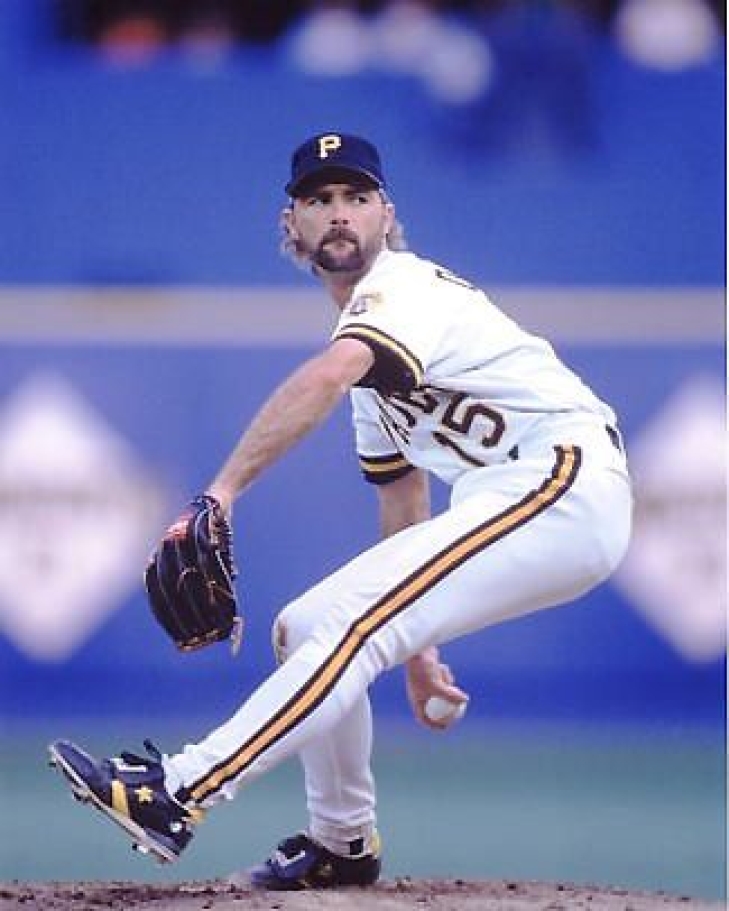
Modern analytics formulas are excellent at analyzing efficiency but sometimes overlook the emotional essence of a franchise's peak years. For example, a sabermetric review of the early 1990s Pittsburgh Pirates might suggest that the team’s core was elsewhere, based on data alone. However, anyone who watched games at Three Rivers Stadium or visited that clubhouse knew otherwise: Doug Drabek was the dominant force on the staff and the driving force behind their three straight appearances in the National League Championship Series.
His path to becoming a regular starter began with a historic trade that changed the landscape. Once a young prospect with the New York Yankees, the right-hander was traded to Pittsburgh before the 1987 season in a major six-player deal that sent Rick Rhoden to the Yankees. The team quickly placed the composed Texan in the starting rotation, and Drabek worked to make durability a consistent part of his season. He carefully improved his control, blending a powerful fastball with an effective slider to build his reputation as a frontline pitcher.
By the late 1980s, his evolution into a premier run-preventer was complete; he broke beneath the sub-3.00 ERA threshold for the first time during a brilliant 1989 showcase, registering a stellar 2.80 mark across 244.1 grueling innings.
His peak of personal and national recognition came during an outstanding 1990 pennant race. Drabek performed exceptionally on the mound, systematically shutting down National League batters to achieve a 22–6 record, his career best. He reduced his ERA to an impressive 2.76, maintained a stellar 1.063 WHIP, and led the Pirates into October. For his versatile dominance, he was awarded the 1990 National League Cy Young Award, establishing himself as the top ace in baseball.
Far from a one-summer wonder, Drabek was a crucial, high-speed contributor for the division-winning teams of 1991 and 1992. He used his remarkable durability to pitch 490 innings across those two summers, earning 30 more wins and ending his tenure with a stellar fifth-place finish in the 1992 Cy Young Award voting. Known for his toughness in critical moments, he notably carried a no-hitter into the ninth inning of the famous Game 7 of the 1992 NLCS, only to see his team's hopes dashed by a bullpen breakdown.
The Pirates imploded after the 1992 Season, essentially disbanding due to cost-cutting. Drabek joined Houston as a Free Agent. With the Pirates, Drabek won 92 games against 62 losses with a 3.20 ERA, a 1.148 WHIP, and 820 strikeouts.
33. Kent Tekulve
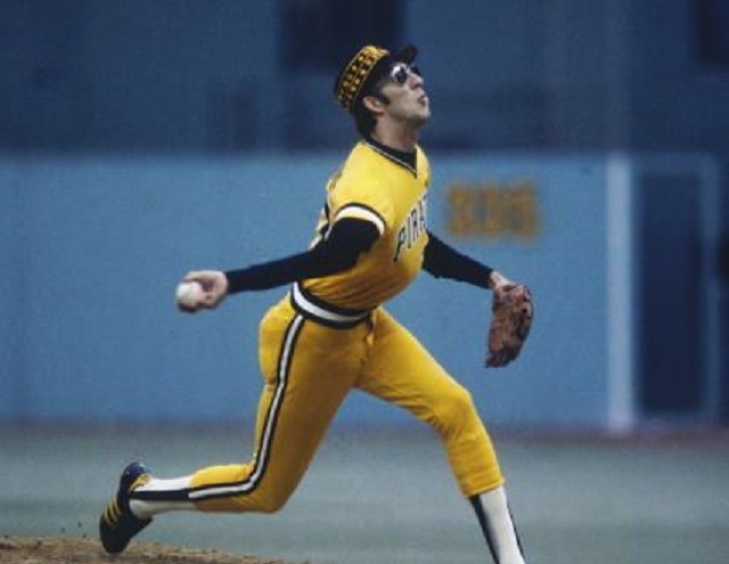
A dominant, high-stakes relief weapon often evokes images of a physically imposing powerhouse throwing fastballs at high velocity. However, for more than ten years as a Pirate, the most feared late-inning escape artist resembled a neighborhood accountant. Slender, bespectacled, and modest at 6-foot-4 and 180 pounds, Kent Tekulve revolutionized run prevention mechanics. Using an extreme, knuckle-scraping submarine delivery, this right-hander released the ball just inches off the ground, producing a devastating late-sinking trajectory that consistently disheartened National League hitters. He didn't just enter challenging situations; he transformed the late innings into his personal arena of precise, low-variance execution.
Signed by the organization in 1969, Tekulve carefully mastered his unique release point before earning a steady spot with the parent club in 1974. Once established in the bullpen, he redefined the role of a reliable workhorse reliever, never once starting a game during his 12 seasons with the team.
His rise to national prominence truly happened during the 1978 season, when he took on the closer role and made pitching a daily habit. Tekulve led the Senior Circuit by pitching 91 games and finishing 70, accumulating 31 saves with a tiny 2.33 ERA. He finished fifth in the Cy Young Award voting, marking a significant achievement.
The peak of his career and a form of lasting legacy came together during the memorable 1979 "We Are Family" world championship run. With 94 regular-season games, he again led the majors in appearances and acted as manager Chuck Tanner's go-to safeguard in high-pressure situations. When the Pirates advanced to the Fall Classic against Baltimore, he put on an absolutely clinical display of bullpen endurance, appearing in five games and locking down three monumental saves, including the historic final three outs of Game 7 to officially secure the world championship banner for the Bucs.
Tekulve was a steady, low-variance asset well into the next decade, consistently leading in volume and high-leverage efficiency. However, as the franchise moved into a cold, small-market rebuild, front-office priorities shifted mid-season in 1985. Management traded the veteran icon to the Philadelphia Phillies to bring in younger talent, ending a historic era of bullpen dominance.
With the Pirates, Tekulve appeared in 722 games, saved 158, and finished 470 with a 2.68 ERA.
Three Players Who Look On Course For Hall of Fame Membership
Membership into the NFL’s Hall of Fame is arguably the greatest honor any player can receive in the NFL. It is recognition for a fantastic career in the league and suggests a player was one of the best in their position during that spell.
Although there is a lot more work to do for these players, before they can reach for the ultimate NFL accolade, here are three stars who are on course to end their career as Hall of Fame hopefuls.
Patrick Mahomes
Since arriving in the NFL in 2017, Patrick Mahomes has created an incredibly high standard for quarterbacks to follow. In his first full season, he won the MVP award for his performances for the Kansas City Chiefs. Mahomes led his team to the Super Bowl in 2020, though 12 months later, his side was beaten by the Tampa Bay Buccaneers at Super Bowl LV.
What makes Mahomes so special, and potentially a future Hall of Famer, is that he can produce quality plays that seemingly no other QB in the NFL can do. He passes from all kinds of angles with great accuracy and the 26-year-old is also a great scrambler, hurting defenses just when they think they have got him.
With the way things are headed, it's very likely that Mahomes could be set for another Super Bowl ring this season. As it stands, the Kansas City Chiefs are currently the favorites to win the Super Bowl LVI on DraftKings, one of the most acclaimed online sports betting sites in Iowa, with odds of +120. Other contenders such as the Tampa Bay Buccaneers are priced at +1000, while the San Francisco 49ers are pegged at +450.
TJ Watt
Outsider linebacker TJ Watt has been in the NFL five years now and in each of those seasons, he has been one of the stand-out defensive players in the league. If it wasn’t for future Hall of Famer Aaron Donald, he would have won at least one NFL Defensive Player of the Year Award by now.
Like his brother JJ, Watt has been so destructive to quarterbacks, regardless of their quality and reputation. He has 72 sacks to his name now since 2017, 22.5 came in 2021 in what was the best year of his career, matching the NFL record which was held by Michael Strahan since 2001.
The Steelers man signed a four-year extension with his franchise last year worth $112 million. $80 million of that money is guaranteed. Steelers are relieved to have locked down their star player for another four years.
Jonathan Taylor
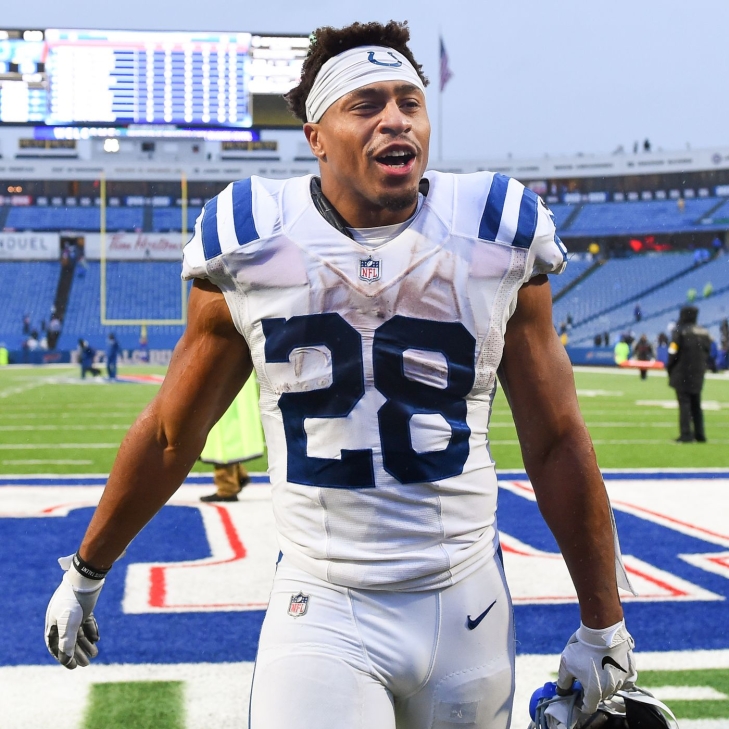
Indianapolis Colts running back Jonathan Taylor quickly made a name for himself in the NFL in his rookie year. He scored 11 touchdowns in 13 games and rushed for over 1,000 yards.
In his second year, Taylor led the league in rushing yards, finishing the campaign with 1,811 yards. Taylor also broke the franchise record for the most rushing yards in a season. If Taylor continues at the rate he is going, he is set to break many records in the league. The biggest threat to the 23-year-old could be injuries. As Derrick Henry and Saquon Barkley have found, the position is tough on the body, and it only takes one tackle to put a player out for a sustained period.
The early signs around Taylor are very good. He is explosive and intelligent. It’s a combination that should lead to him developing into one of the best players in the NFL. There is a long way before the above three players become eligible for the NFL Hall of Fame but their current projections have them on course to get there after they retire.
