


Committee Chairman
The Mark Messier Leadership Award
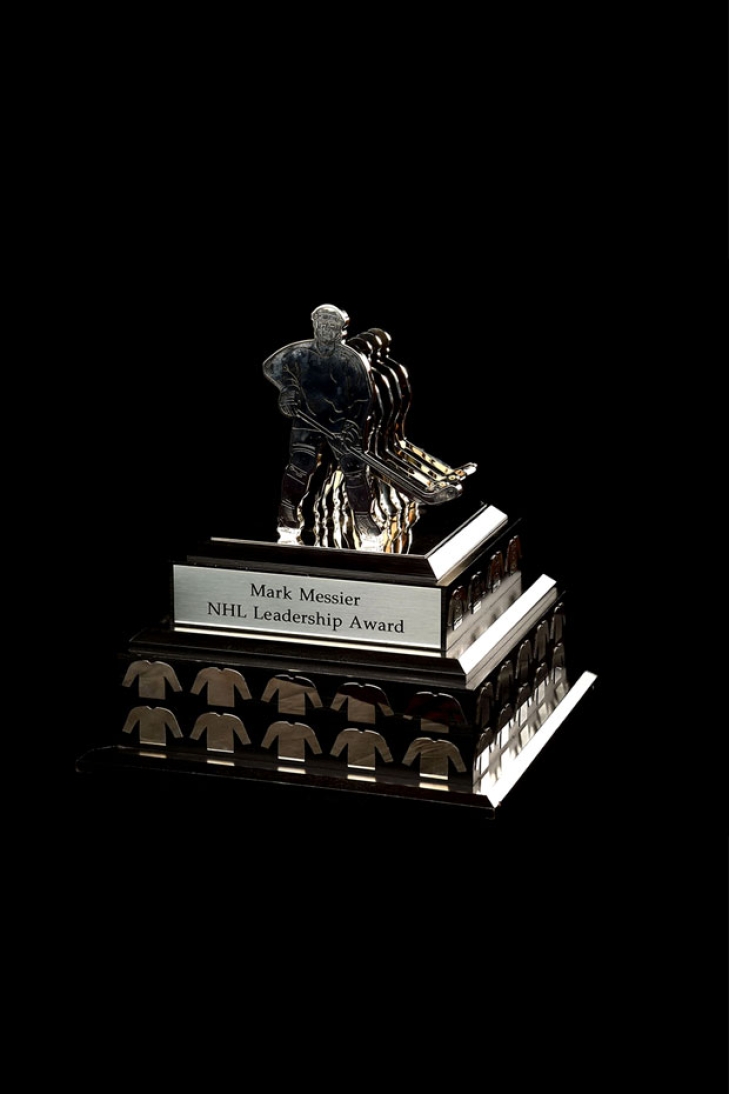
If you had asked us in 2006, we would have said there is no need for another individual hockey award. We were wrong.
In the 2006/07 Season, five players were honored monthly as selected by the NHL based on qualifications, with Mark Messier deciding the recipient of the Mark Messier Leadership Award. Those monthly winners were Brendan Shanahan (New York Rangers), Scott Niedermayer (Anaheim Ducks), Sidney Crosby (Pittsburgh Penguins), Vincent Lecavalier (Tampa Bay Lightning), and Roberto Luongo (Vancouver Canucks). The year after, it was changed to being a yearly award.
There is no better player to name this after than Messier. He is the only player to lead two NHL teams (Edmonton and New York) to a Stanley Cup as their captain.
The results are as follows:
There are currently five former Mark Messier Leadership winners who are Hockey Hall of Fame eligible, with four entering, yielding a percentage of 80.0.
As this award has never been a repeat winner, the percentage by year remains the same.
The following are the past players who have won the NHL Mark Messier Leadership Award and are eligible for the Hockey Hall of Fame, and have been enshrined.
2007: Chris Chelios, Detroit Red Wings, Defense. 0 Goals, 11 Assists, 11 Points, +11, 3.3 Point Shares.
At age 45, Chelios had been a leader for decades, and despite his age, he was in the NHL for three more seasons. The American Defenseman had won three Norris Trophies, was a five-time First Team All-Star, and won three Stanley Cups, one with Montreal and two with Detroit. It is hard to debate that this award did not get off to a perfect start.
Inducted into the Hall of Fame in 2013.
2008: Mats Sundin, Toronto Maple Leafs, Center. 32 Goals, 46 Assists, 78 Points, +17, 9.8 Point Shares.
This was Sundin’s penultimate year in the NHL and his last with the Toronto Maple Leafs. A Maple Leaf since 1994, Sundin was a leader on the ice since day one and was Toronto's best player for over a decade. He had previously been a Second Team All-Star twice.
Inducted into the Hall of Fame in 2012.
2009: Jarome Iginla: Calgary Flames, Right Wing. 35 Goals, 54 Assists, 89 Points, -2, 9.5 Point Shares.
Iginla was not just Calgary's leader but had been the Flames best player for years. This was his third First Team All-Star season, and seven years before, he was the winner of both the Art Ross and Lester B. Pearson Awards. Iginla would later play for Pittsburgh, Boston, Colorado, and Los Angeles.
Inducted into the Hall of Fame in 2020.
2013: Daniel Alfredsson, Ottawa Senators, Right Wing. 10 Goals, 16 Assists, 26 Points, +1. 2.7 Point Shares.
Alfredsson was in his 17th and final year as an Ottawa Senator, and while he couldn't lead them to a Stanley Cup, he was the leader on many good Senator teams. He played one more year in Detroit and scored 1157 career Points.
Inducted into the Hall of Fame in 2022.
The following are the players who have won the NHL Mark Messier Leadership Award who are eligible for the Hockey Hall of Fame and have not been selected:
2012: Shane Doan, Phoenix Coyotes, Right Wing. 22 Goals, 28 Assists, 50 Points, -8, 5.0 Point Shares.
Since the franchise relocated from Winnipeg to Phoenix, Shane Doan was the franchise's best and most important player when they were in Arizona. Doan led the Coyotes to a Conference Final this year, and he was with Phoenix for his entire 21-year career.
Eligible since 2020. Ranked #58 on Notinhalloffame.com.
The following are the players who have won the NHL Mark Messier Leadership Award who have retired but have not met the mandatory years out of the game to qualify for the Hockey Hall of Fame:
2011: Zdeno Chara, Boston Bruins, Defense. 14 Goals, 30 Assists, 44 Points, +33, 10.0 Point Shares.
A Second Team All-Star this year, Chara was the Norris Trophy winner two years previous, and he was a First Team All-Star and Second Team All-Star twice before. Chara led by example, and the Bruins won the Stanley Cup this year, mainly on what the big man did.
Eligible in 2025.
2014: Dustin Brown, Los Angeles Kings, Right Wing. 15 Goals, 12 Assists, 27 Points, +7, 3.1 Point Shares.
Dustin Brown helped lead the Kings to a Stanley Cup in 2012 and did it again this season. Brown was an All-Star in 2009.
Eligible in 2025.
2018: Deryk Engelland, Vegas Golden Knights, Defense. 5 Goals, 18 Assists, 23 Points, +6, 4.5 Point Shares.
For the second year in a row, the Mark Messier Leadership Award winner also won the King Clancy. Engelland was the first Golden Knight to win this trophy, but with all due respect to the former Defenseman, he is the least likely Mark Messier Award winner to enter the Hockey Hall of Fame.
Eligible in 2023.
The following are the players who have won the NHL Mark Messier Leadership Award and are still active.
2010: Sidney Crosby, Pittsburgh Penguins, Center. 51 Goals, 58 Assists, 109 Points, +15, 14.7 Point Shares
At age 23, it will be difficult to envision another Mark Messier Leadership Award winner to be younger than Sidney Crosby. Crosby is a three-time Stanley Cup Champion. This season, Crosby was in his fifth NHL season and was a Second Team All-Star and a Rocket Richard winner. He was already a Hart Trophy winner and would be again four years later.
35 Years Old, Playing for the Pittsburgh Penguins.
2015: Jonathan Toews, Chicago Blackhawks, Center. 28 Goals, 38 Assists, 66 Points, +30, 9.4 Point Shares.
This season Toews led Chicago to their third (and his) Stanley Cup win of the decade. The Center had previously been named a Second Team All-Star (2013), a Conn Smythe winner (2010), and a Frank J. Selke Trophy winner (2013).
35 Years Old, Playing for the Chicago Blackhawks.
2016: Shea Weber, Nashville Predators, Defense. 20 Goals, 31 Assists, 51 Points, -7, 9.5 Point Shares.
Weber had been the core player in Nashville for years by this time, and before this Mark Messier Award, he was twice a First Team All-Star, twice a Second Team All-Star, and had five top-four finishes for the Norris Trophy.
37 Years Old, Playing for the Vegas Golden Knights.
2017: Nick Foligno, Columbus Blue Jackets, Left Wing. 26 Goals, 25 Assists, 51 Points, -4, 5.9 Point Shares.
Foligno also won the King Clancy Award this year, marking the first time a Blue Jacket won.
35 Years Old, Playing for the Boston Bruins.
2019: Wayne Simmonds, Philadelphia Flyers and Nashville Predators, Right Wing. 17 Goals, 13 Assists, 30 Points, -16, 1.9 Point Shares.
This is the first and, to date, only Mark Messier Leadership winner who split his award-winning season between two years. Simmonds was dealt from Philadelphia to Nashville for their playoff run, primarily due to his overall contributions as a Flyer, though do not discount what he did as a Predator.
34 Years Old, Playing for the Toronto Maple Leafs.
2020: Mark Giordano, Calgary Flames, Defense. 5 Goals, 26 Assists, 31 Points, +2, 5.4 Point Shares.
Giordano is a late bloomer, winning his first Norris Trophy at age 35 and setting personal statistical bests. Giordano played most of his career with Calgary and was their leader for years.
39 Years Old, Playing for the Toronto Maple Leafs.
2021: Patrice Bergeron, Boston Bruins, Center. 23 Goals, 25 Assists, 48 Points, +27, 6.9 Point Shares.
Bergeron is one of the best two-way players of his generation (if not the best) and was already a four-time Selke winner (he won a fifth a year after). He won a Cup with the Bruins in 2011 and captured the King Clancy award in 2013.
37 Years Old, Playing for the Boston Bruins.
2022: Anze Kopitar, Los Angeles Kings, Center. 19 Goals, 48 Assists, 67 Points, -6, 5.7 Point Shares.
Kopitar already anchored Los Angeles to two Stanley Cups (2012 & 2014), and the Slovenian Center added to his already ample trophy case (he had two Selkes and a Lady Byng) with the acquisition of the 2022 Mark Messier Leadership Award.
35 Years Old, Playing for the Los Angeles Kings.
The Mark Messier Leadership Award is not exclusive to superstars, but the character requirement is off the chart.
The Maurice "Rocket" Richard Trophy
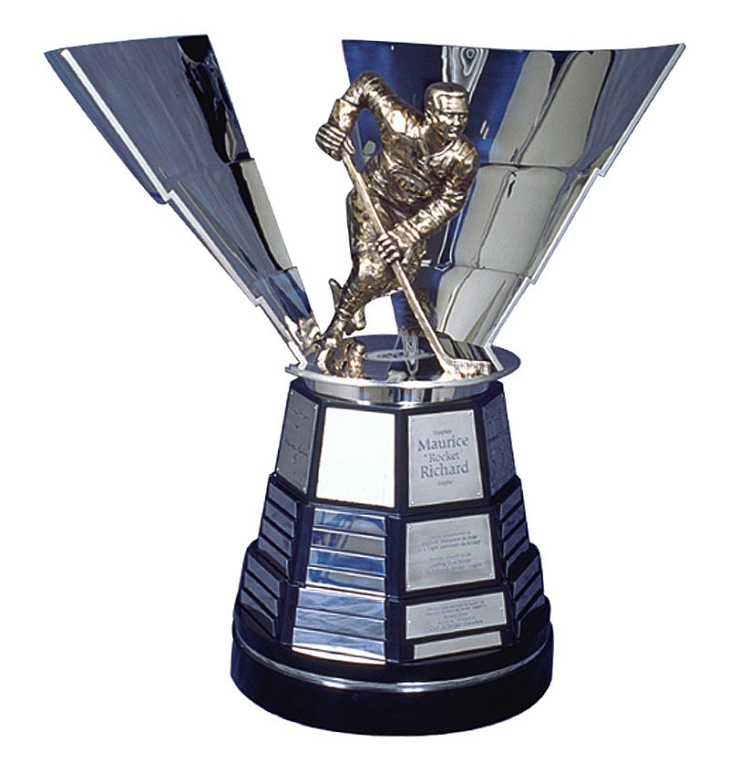
The Maurice "Rocket" Richard Trophy is similar to the Art Ross Trophy in that there is one fixed mathematical perimeter, and it could have existed (albeit under a different name) since the NHL was formed.
The Montreal Canadiens donated the award in honor of Richard, who was the first player to score 50 Goals in an NHL season (which he did in 50 Games) and the first to score 500 in a career. It was first issued in 1999.
The results are as follows:
There are currently 7 former Maurice “Rocket” Richard Trophy winners who are Hockey Hall of Fame eligible, with 3 entering, yielding a percentage of 39.2.
If we go by yearly winners, there is an increase to 9 eligible years, with 5 of them generating a Hockey Hall of Famer. That is a 55.5 Percentage.
The following are the past players who have won the Maurice “Rocket” Richard Trophy, are eligible for the Hockey Hall of Fame, and have been enshrined.
1999: Teemu Selanne, The Mighty Ducks of Anaheim, Right Wing. 47 Goals, 60 Assists, 107 Points, +18, 14.3 Point Shares.
Had the Richard existed earlier, this would be Selanne's third win and a successful defense. As it stands, this was. Selanne's only Richard trophy, in a year where he finished fifth for the Hart, third in Byng voting, and was a Second Team All-Star. Selanne's Hall of Fame career also includes a Calder, a Masterton, and a Stanley Cup with Anaheim in 2007. The "Finnish Flash" lit the lamp 684 times over his career.
Inducted into the Hall of Fame in 2017.
2000: Pavel Bure, Florida Panthers, Right Wing. 58 Goals, 36 Assists, 94 Points, -25, 13.5 Point Shares.
The "Finnish Flash" gave way to the "Russian Rocket," who would have won the award in 1993/94 with 60 Goals. This season, Bure was first in Even Strength Goals (45), Game-Winning Goals (14), and Shots (360), with a Second Team All-Star and a third-place finish in Hart balloting.
Inducted into the Hall of Fame in 2012.
2001 (2): Pavel Bure, Florida Panthers, Right Wing. 59 Goals, 33 Assists, 92 Points, -25, 13.5 Point Shares.
In the third year of the Richard Trophy, we have our first repeat winner in Bure, who was ninth in Hart voting. This was his last monster year, as he was beset with injuries, and he last played in the NHL in 2003, netting 428 Goals over 12 seasons.
Inducted into the Hall of Fame in 2012.
2002: Jarome Iginla, Calgary Flames, Right Wing. 52 Goals, 44 Assists, 96 Points, +27, 14.4 Point Shares.
Iginla was on his way to becoming a superstar, but this was the year he accomplished it. The Calgary Wing also won the Art Ross and the Lester B. Pearson while earning First Team All-Star honors. The runner-up for the Hart was also first in Even Strength Goals (35).
Inducted into the Hall of Fame in 2020.
2004 Co-Winner (2): Jarome Iginla, Calgary Flames, Right Wing. 41 Goals, 32 Assists, 73 Points, +21, 11.1 Point Shares.
This was the first year where there were Rocket Richard had multiple winners, but with all due respect to Rick Nash and Ilya Kovalchuk, Iginla would be the one who historically stood out. Iginla was again the Hart runner-up and the first Richard winner to win the King Clancy Award. He scored 525 Goals over his career.
Inducted into the Hall of Fame in 2020.
The following are the players who have won the Maurice “Rocket” Richard Trophy who are eligible for the Hockey Hall of Fame and have not been selected:
2003: Milan Hejduk, Colorado Avalanche, Right Wing. 50 Goals, 48 Assists, 98 Points, +52, 14.6 Point Shares.
Hejduk played all 14 of his NHL seasons with Colorado, and though he helped take the Avalanche to the Stanley Cup in 2001, this was his best year. The Czech Wing not only led the NHL in Goals, but he was also number one in Even Strength Goals (32) and Plus/Minus (+52) and was a Second Team All-Star. Hejduk scored 375 Goals over his career.
Eligible Since 2016. Ranked #100 on Notinhalloffame.com.
2004 Co-Winner: Rick Nash, Columbus Blue Jackets, Left Wing. 41 Goals, 16 Assists, 57 Points, -35, 7.7 Point Shares.
Statistically, Nash is the most fascinating Richard winner to date, as the 2003/04 co-winner (with Ilya Kovalchuk and Jarome Iginla), and is the only one with a sub -30 Plus/Minus, though, to be fair, Columbus was horrible that the time. This was also Nash's sophomore year, but his last major accolade in the NHL. He did play until 2018, netting 437 Goals.
Eligible Since 2021. Ranked #42 on Notinhalloffame.com.
2006: Jonathan Cheechoo, San Jose Sharks, Right Wing. 56 Goals, 37 Assists, 93 Points, +23, 12.7 Point Shares.
Cheechoo's season exploded when Joe Thornton was traded from Boston to the Sharks, and he became and remains the most unexpended Richard winner in award history. He never had a season like that again and only had 170 Goals over his career.
Eligible Since 2018. Unranked on Notinhalloffame.com.
2007: Vincent Lecavalier, Tampa Bay Lightning, Center. 52 Goals, 56 Assists, 108 Points, +2, 12.7 Point Shares.
Lecavalier was the first Center to win the Richard and was a Second Team All-Star. A Stanley Cup Champion before, Lecavalier was fourth in Hart voting and won the King Clancy the season after. He had 421 career Goals.
Eligible Since 2019. Ranked #23 on Notinhalloffame.com.
The following are the players who have won the NHL Maurice “Rocket” Richard Trophy who have retired but have not met the mandatory years out of the game to qualify for the Hockey Hall of Fame:
2004: Ilya Kovalchuk, Atlanta Thrashers, Left Wing. 41 Goals, 46 Losses, 87 Points, -10, 10.6 Point Shares.
Kovalchuk was one of three winners of the 2004 Rocket Richard award, and unless the Atlanta Thrashers are resurrected from the dead, this will be the only winner from Hotlanta. The Russian star would later have two 50-Goal seasons and scored 328 Goals in the NHL.
Eligible in 2024.
The following are the past players who have won the NHL Maurice “Rocket” Richard Trophy and are eligible for the Hockey Hall of Fame and are still active.
2008: Alex Ovechkin, Washington Capitals, Left Wing. 65 Goals, 47 Assists, 112 Points, +28, 17.2 Point Shares.
Ovechkin was the first Richard winner (though far from the first player) to have a 60-plus Goal season, and he also won the Hart, Lester B. Pearson, and Art Ross and was a First Team All-Star. He was also tops in Even Strength Goals (43), Power Play Goals (22), Game-Winning Goals (11), and Shots (446).
37 Years Old, Playing for the Washington Capitals.
2009 (2): Alex Ovechkin, Washington Capitals, Left Wing. 56 Goals, 54 Assists, 110 Points, +8, 14.5 Point Shares.
Ovechkin was a back-to-back Hart, Pearson, and First Team All-Star, and he was the league leader in Even Strength Goals (36) and Shots (528).
37 Years Old, Playing for the Washington Capitals.
2010 Co-Winner: Sidney Crosby, Pittsburgh Penguins, Center. 51 Goals, 58 Assists, 109 Points, +15, 14.7 Point Shares.
Crosby was only in his early 20s, but before he won his first Richard, he was already a Stanley Cup winner, a Hart winner, and a Ted Lindsay Award winner. He did not win the Hart or Lindsay this season (he was third for the Hart), but "Sid the Kid" won the Mark Messier Leadership Award.
35 Years Old, Playing for the Pittsburgh Penguins.
2010 Co-Winner: Steven Stamkos, Tampa Bay Lightning, Center. 51 Goals, 54 Assists, 95 Points, -2, 12.8 Point Shares.
Stamkos won his first Richard Trophy and also led the NHL in Power Play Goals (24). He was sixth in Hart voting.
32 Years Old, Playing for the Tampa Bay Lightning.
2011: Corey Perry, Anaheim Ducks, Right Wing. 50 Goals, 48 Assists, 98 Points, +9, 13.3 Point Shares.
Perry helped take the Ducks to a Stanley Cup win in 2007, and he not only won the Richard this season, but he was also the Hart Trophy winner. He also topped the NHL in Even Strength Goals (32).
37 Years Old, Playing for the Tampa Bay Lightning.
2012 (2): Steven Stamkos, Tampa Bay Lightning, Center. 60 Goals, 37 Assists, 97 Points, +7, 14.6 Point Shares.
Stamkos joined the 60-Goal club, winning his second Richard in the process. Earning Second Team All-Pro honors and finishing second in for the Hart, Stamkos would later lead the Lightning to two Stanley Cups (2020 & 2021).
32 Years Old, Playing for the Tampa Bay Lightning.
2013 (3): Alex Ovechkin, Washington Capitals, Left Wing. 32 Goals, 24 Assists, 56 Points, +2, 8.0 Point Shares.
Ovechkin became the first man to win three Richard awards, and as he did in the first two, he was also the Hart Trophy winner. He was again first in Even Strength Goals (16) and Shots (220).
37 Years Old, Playing for the Washington Capitals.
2014 (4): Alex Ovechkin, Washington Capitals, Left Wing. 51 Goals, 28 Assists, 79 Points, -35, 10.2 Point Shares.
Now the first four-time Richard winner, Ovechkin failed to win the Hart (he was only 23rd), but he landed another first-place finish in Power Play Goals (24) and Shots (386).
37 Years Old, Playing for the Washington Capitals.
2015 (5): Alex Ovechkin, Washington Capitals, Left Wing. 53 Goals, 28 Assists, 81 Points, +10, 12.6 Point Shares.
Not only did Ovechkin win his fifth Richard Trophy, but he also became the first to win it three years in a row. Ovechkin was also second for the Hart and was the league leader in Power Play Goals (25), Game Winning Goals (11), and Shots (395).
37 Years Old, Playing for the Washington Capitals.
2016 (6): Alex Ovechkin, Washington Capitals, Left Wing. 50 Goals, 21 Assists, 71 Points, +21, 11.7 Point Shares.
Ovechkin secured his sixth Richard and fourth straight Richard while finishing sixth for the Hart. He also was first in Even Strength Goals (31), Power Play Goals (19), and Shots (398).
37 Years Old, Playing for the Washington Capitals.
2017 (2): Sidney Crosby, Pittsburgh Penguins, Center. 44 Goals, 45 Assists, 89 Points, +17, 12.3 Point Shares.
Crosby was the runner-up for the Hart Trophy, but he captured a better one with his third Stanley Cup, a back-to-back win.
35 Years Old, Playing for the Pittsburgh Penguins.
2018 (7): Alex Ovechkin, Washington Capitals, Left Wing. 49 Goals, 38 Assists, 87 Points, +3, 11.2 Point Shares.
A new streak began in 2017/18 for Ovechkin, whose seventh Richard came with a much bigger prize. Ovechkin led Washington to a Stanley Cup win this season while also winning the Conn Smythe.
37 Years Old, Playing for the Washington Capitals.
2019 (8): Alex Ovechkin, Washington Capitals, Left Wing. 51 Goals, 38 Assists, 89 Points, +7, 11.0 Point Shares.
Ovechkin was a First Team All-Star for the seventh time and was seventh in Hart voting.
37 Years Old, Playing for the Washington Capitals.
2020 Co-winner: David Pastrnak, Boston Bruins, Right Wing. 48 Goals, 47 Assists, 95 Points, 21, 13.2 Point Shares.
Pastrnak had his breakout campaign, winning the Richard and securing a First Team All-Star at Right Wing. He was also fourth in Hart voting.
26 Years Old, Playing for the Boston Bruins.
2020 (9) Co-winner: Alex Ovechkin, Washington Capitals, Left Wing. 48 Goals, 19 Assists, 67 Points, -12, 8.7 Point Shares.
Ovechkin won the Richard for the ninth time, and we don't know if we will be alive to see that record fall. We also didn't think that we would be alive to see Wayne Gretzky's all-time goal record eclipsed, but that looks to be Ovechkin's in the future.
37 Years Old, Playing for the Washington Capitals.
2021: Auston Matthews, Toronto Maple Leafs, Center. 41 Goals, 25 Assists, 66 Points, +21, 9.5 Point Shares.
Matthews won the Calder in 2017, and five years later, he won his second major individual award in the Richard. The Leafs Center also led the NHL in Even Strength Goals (31), Game-Winning Goals (12), and Shots (222) while finishing second in Hart voting.
25 Years Old, Playing for the Toronto Maple Leafs.
2022 (2): Auston Matthews, Toronto Maple Leafs, Center. 60 Goals, 46 Assists, 106 Points, +20, 13.8 Point Shares.
Matthews repeated as the Richard winner and became the first Maple Leaf to have a 60-Goal year. He also won the Hart and Ted Lindsay Trophy and was first in Even Strength Goals (44) and Shots (348).
25 Years Old, Playing for the Toronto Maple Leafs.
Like the Art Ross, the Maurice Richard Award is purely based on a statistic but an important one. There might be some unique and surprise winners, but for the most part, this award generates Hall of Famers, and when Ovechkin is available, the winning percentage by year will skyrocket.
The Maurice "Rocket" Richard Trophy is similar to the Art Ross Trophy in that there is one fixed mathematical perimeter, and it could have existed (albeit under a different name) since the NHL was formed.
The Montreal Canadiens donated the award in honor of Richard, who was the first player to score 50 Goals in an NHL season (which he did in 50 Games) and the first to score 500 in a career. It was first issued in 1999.
The results are as follows:
There are currently 7 former Maurice “Rocket” Richard Trophy winners who are Hockey Hall of Fame eligible, with 3 entering, yielding a percentage of 39.2.
If we go by yearly winners, there is an increase to 9 eligible years, with 5 of them generating a Hockey Hall of Famer. That is a 55.5 Percentage.
The following are the past players who have won the Maurice “Rocket” Richard Trophy, are eligible for the Hockey Hall of Fame, and have been enshrined.
1999: Teemu Selanne, The Mighty Ducks of Anaheim, Right Wing. 47 Goals, 60 Assists, 107 Points, +18, 14.3 Point Shares.
Had the Richard existed earlier, this would be Selanne's third win and a successful defense. As it stands, this was. Selanne's only Richard trophy, in a year where he finished fifth for the Hart, third in Byng voting, and was a Second Team All-Star. Selanne's Hall of Fame career also includes a Calder, a Masterton, and a Stanley Cup with Anaheim in 2007. The "Finnish Flash" lit the lamp 684 times over his career.
Inducted into the Hall of Fame in 2017.
2000: Pavel Bure, Florida Panthers, Right Wing. 58 Goals, 36 Assists, 94 Points, -25, 13.5 Point Shares.
The "Finnish Flash" gave way to the "Russian Rocket," who would have won the award in 1993/94 with 60 Goals. This season, Bure was first in Even Strength Goals (45), Game-Winning Goals (14), and Shots (360), with a Second Team All-Star and a third-place finish in Hart balloting.
Inducted into the Hall of Fame in 2012.
2001 (2): Pavel Bure, Florida Panthers, Right Wing. 59 Goals, 33 Assists, 92 Points, -25, 13.5 Point Shares.
In the third year of the Richard Trophy, we have our first repeat winner in Bure, who was ninth in Hart voting. This was his last monster year, as he was beset with injuries, and he last played in the NHL in 2003, netting 428 Goals over 12 seasons.
Inducted into the Hall of Fame in 2012.
2002: Jarome Iginla, Calgary Flames, Right Wing. 52 Goals, 44 Assists, 96 Points, +27, 14.4 Point Shares.
Iginla was on his way to becoming a superstar, but this was the year he accomplished it. The Calgary Wing also won the Art Ross and the Lester B. Pearson while earning First Team All-Star honors. The runner-up for the Hart was also first in Even Strength Goals (35).
Inducted into the Hall of Fame in 2020.
2004 Co-Winner (2): Jarome Iginla, Calgary Flames, Right Wing. 41 Goals, 32 Assists, 73 Points, +21, 11.1 Point Shares.
This was the first year where there were Rocket Richard had multiple winners, but with all due respect to Rick Nash and Ilya Kovalchuk, Iginla would be the one who historically stood out. Iginla was again the Hart runner-up and the first Richard winner to win the King Clancy Award. He scored 525 Goals over his career.
Inducted into the Hall of Fame in 2020.
The following are the players who have won the Maurice “Rocket” Richard Trophy who are eligible for the Hockey Hall of Fame and have not been selected:
2003: Milan Hejduk, Colorado Avalanche, Right Wing. 50 Goals, 48 Assists, 98 Points, +52, 14.6 Point Shares.
Hejduk played all 14 of his NHL seasons with Colorado, and though he helped take the Avalanche to the Stanley Cup in 2001, this was his best year. The Czech Wing not only led the NHL in Goals, but he was also number one in Even Strength Goals (32) and Plus/Minus (+52) and was a Second Team All-Star. Hejduk scored 375 Goals over his career.
Eligible Since 2016. Ranked #100 on Notinhalloffame.com.
2004 Co-Winner: Rick Nash, Columbus Blue Jackets, Left Wing. 41 Goals, 16 Assists, 57 Points, -35, 7.7 Point Shares.
Statistically, Nash is the most fascinating Richard winner to date, as the 2003/04 co-winner (with Ilya Kovalchuk and Jarome Iginla), and is the only one with a sub -30 Plus/Minus, though, to be fair, Columbus was horrible that the time. This was also Nash's sophomore year, but his last major accolade in the NHL. He did play until 2018, netting 437 Goals.
Eligible Since 2021. Ranked #42 on Notinhalloffame.com.
2006: Jonathan Cheechoo, San Jose Sharks, Right Wing. 56 Goals, 37 Assists, 93 Points, +23, 12.7 Point Shares.
Cheechoo's season exploded when Joe Thornton was traded from Boston to the Sharks, and he became and remains the most unexpended Richard winner in award history. He never had a season like that again and only had 170 Goals over his career.
Eligible Since 2018. Unranked on Notinhalloffame.com.
2007: Vincent Lecavalier, Tampa Bay Lightning, Center. 52 Goals, 56 Assists, 108 Points, +2, 12.7 Point Shares.
Lecavalier was the first Center to win the Richard and was a Second Team All-Star. A Stanley Cup Champion before, Lecavalier was fourth in Hart voting and won the King Clancy the season after. He had 421 career Goals.
Eligible Since 2019. Ranked #23 on Notinhalloffame.com.
The following are the players who have won the NHL Maurice “Rocket” Richard Trophy who have retired but have not met the mandatory years out of the game to qualify for the Hockey Hall of Fame:
2004: Ilya Kovalchuk, Atlanta Thrashers, Left Wing. 41 Goals, 46 Losses, 87 Points, -10, 10.6 Point Shares.
Kovalchuk was one of three winners of the 2004 Rocket Richard award, and unless the Atlanta Thrashers are resurrected from the dead, this will be the only winner from Hotlanta. The Russian star would later have two 50-Goal seasons and scored 328 Goals in the NHL.
Eligible in 2024.
The following are the past players who have won the NHL Maurice “Rocket” Richard Trophy and are eligible for the Hockey Hall of Fame and are still active.
2008: Alex Ovechkin, Washington Capitals, Left Wing. 65 Goals, 47 Assists, 112 Points, +28, 17.2 Point Shares.
Ovechkin was the first Richard winner (though far from the first player) to have a 60-plus Goal season, and he also won the Hart, Lester B. Pearson, and Art Ross and was a First Team All-Star. He was also tops in Even Strength Goals (43), Power Play Goals (22), Game-Winning Goals (11), and Shots (446).
37 Years Old, Playing for the Washington Capitals.
2009 (2): Alex Ovechkin, Washington Capitals, Left Wing. 56 Goals, 54 Assists, 110 Points, +8, 14.5 Point Shares.
Ovechkin was a back-to-back Hart, Pearson, and First Team All-Star, and he was the league leader in Even Strength Goals (36) and Shots (528).
37 Years Old, Playing for the Washington Capitals.
2010 Co-Winner: Sidney Crosby, Pittsburgh Penguins, Center. 51 Goals, 58 Assists, 109 Points, +15, 14.7 Point Shares.
Crosby was only in his early 20s, but before he won his first Richard, he was already a Stanley Cup winner, a Hart winner, and a Ted Lindsay Award winner. He did not win the Hart or Lindsay this season (he was third for the Hart), but "Sid the Kid" won the Mark Messier Leadership Award.
35 Years Old, Playing for the Pittsburgh Penguins.
2010 Co-Winner: Steven Stamkos, Tampa Bay Lightning, Center. 51 Goals, 54 Assists, 95 Points, -2, 12.8 Point Shares.
Stamkos won his first Richard Trophy and also led the NHL in Power Play Goals (24). He was sixth in Hart voting.
32 Years Old, Playing for the Tampa Bay Lightning.
2011: Corey Perry, Anaheim Ducks, Right Wing. 50 Goals, 48 Assists, 98 Points, +9, 13.3 Point Shares.
Perry helped take the Ducks to a Stanley Cup win in 2007, and he not only won the Richard this season, but he was also the Hart Trophy winner. He also topped the NHL in Even Strength Goals (32).
37 Years Old, Playing for the Tampa Bay Lightning.
2012 (2): Steven Stamkos, Tampa Bay Lightning, Center. 60 Goals, 37 Assists, 97 Points, +7, 14.6 Point Shares.
Stamkos joined the 60-Goal club, winning his second Richard in the process. Earning Second Team All-Pro honors and finishing second in for the Hart, Stamkos would later lead the Lightning to two Stanley Cups (2020 & 2021).
32 Years Old, Playing for the Tampa Bay Lightning.
2013 (3): Alex Ovechkin, Washington Capitals, Left Wing. 32 Goals, 24 Assists, 56 Points, +2, 8.0 Point Shares.
Ovechkin became the first man to win three Richard awards, and as he did in the first two, he was also the Hart Trophy winner. He was again first in Even Strength Goals (16) and Shots (220).
37 Years Old, Playing for the Washington Capitals.
2014 (4): Alex Ovechkin, Washington Capitals, Left Wing. 51 Goals, 28 Assists, 79 Points, -35, 10.2 Point Shares.
Now the first four-time Richard winner, Ovechkin failed to win the Hart (he was only 23rd), but he landed another first-place finish in Power Play Goals (24) and Shots (386).
37 Years Old, Playing for the Washington Capitals.
2015 (5): Alex Ovechkin, Washington Capitals, Left Wing. 53 Goals, 28 Assists, 81 Points, +10, 12.6 Point Shares.
Not only did Ovechkin win his fifth Richard Trophy, but he also became the first to win it three years in a row. Ovechkin was also second for the Hart and was the league leader in Power Play Goals (25), Game Winning Goals (11), and Shots (395).
37 Years Old, Playing for the Washington Capitals.
2016 (6): Alex Ovechkin, Washington Capitals, Left Wing. 50 Goals, 21 Assists, 71 Points, +21, 11.7 Point Shares.
Ovechkin secured his sixth Richard and fourth straight Richard while finishing sixth for the Hart. He also was first in Even Strength Goals (31), Power Play Goals (19), and Shots (398).
37 Years Old, Playing for the Washington Capitals.
2017 (2): Sidney Crosby, Pittsburgh Penguins, Center. 44 Goals, 45 Assists, 89 Points, +17, 12.3 Point Shares.
Crosby was the runner-up for the Hart Trophy, but he captured a better one with his third Stanley Cup, a back-to-back win.
35 Years Old, Playing for the Pittsburgh Penguins.
2018 (7): Alex Ovechkin, Washington Capitals, Left Wing. 49 Goals, 38 Assists, 87 Points, +3, 11.2 Point Shares.
A new streak began in 2017/18 for Ovechkin, whose seventh Richard came with a much bigger prize. Ovechkin led Washington to a Stanley Cup win this season while also winning the Conn Smythe.
37 Years Old, Playing for the Washington Capitals.
2019 (8): Alex Ovechkin, Washington Capitals, Left Wing. 51 Goals, 38 Assists, 89 Points, +7, 11.0 Point Shares.
Ovechkin was a First Team All-Star for the seventh time and was seventh in Hart voting.
37 Years Old, Playing for the Washington Capitals.
2020 Co-winner: David Pastrnak, Boston Bruins, Right Wing. 48 Goals, 47 Assists, 95 Points, 21, 13.2 Point Shares.
Pastrnak had his breakout campaign, winning the Richard and securing a First Team All-Star at Right Wing. He was also fourth in Hart voting.
26 Years Old, Playing for the Boston Bruins.
2020 (9) Co-winner: Alex Ovechkin, Washington Capitals, Left Wing. 48 Goals, 19 Assists, 67 Points, -12, 8.7 Point Shares.
Ovechkin won the Richard for the ninth time, and we don't know if we will be alive to see that record fall. We also didn't think that we would be alive to see Wayne Gretzky's all-time goal record eclipsed, but that looks to be Ovechkin's in the future.
37 Years Old, Playing for the Washington Capitals.
2021: Auston Matthews, Toronto Maple Leafs, Center. 41 Goals, 25 Assists, 66 Points, +21, 9.5 Point Shares.
Matthews won the Calder in 2017, and five years later, he won his second major individual award in the Richard. The Leafs Center also led the NHL in Even Strength Goals (31), Game-Winning Goals (12), and Shots (222) while finishing second in Hart voting.
25 Years Old, Playing for the Toronto Maple Leafs.
2022 (2): Auston Matthews, Toronto Maple Leafs, Center. 60 Goals, 46 Assists, 106 Points, +20, 13.8 Point Shares.
Matthews repeated as the Richard winner and became the first Maple Leaf to have a 60-Goal year. He also won the Hart and Ted Lindsay Trophy and was first in Even Strength Goals (44) and Shots (348).
25 Years Old, Playing for the Toronto Maple Leafs.
Like the Art Ross, the Maurice Richard Award is purely based on a statistic but an important one. There might be some unique and surprise winners, but for the most part, this award generates Hall of Famers, and when Ovechkin is available, the winning percentage by year will skyrocket.
The Hobbies of Professional Athletes

You’ve got to be pretty special to become a professional athlete. The percentage of athletes that make it to the big leagues is so small that only the best of the best make it through. So, it should perhaps come as no surprise that professional athletes aren’t just handy at their chosen sport, but are just generally talented people. Indeed, take a pro football player, and you’d probably find that they could more than hold their own in any other sport you dropped them into.
And it’s not just on the field that pro athletes perform well. Take a look at some of the hobbies that those famous faces engage in, and you’ll find that they’re more or less good at everything they attempt. Some people have all the luck. Don’t believe us? Let’s explore some common hobbies for professional athletes.
Making Music
There’s always been a big overlap between music and sports. The dressing rooms are alive with music, and many teams celebrate their victories with an anthem. Sometimes those worlds collide in a more direct way, such as when athletes get behind the microphone themselves and record a track or two. The late Kobe Bryant recorded a rap album back in 1999, while Shaquille O’Neal released four albums throughout the same decade. The boxer Manny Pacquiao also released many songs between 2006 and 2013.
Playing Games
You don’t become a pro athlete without being competitive. Sports stars live for competition. Alas, they normally only play one game a week, so what do they do when they’re not on the field? That’s right, they play different types of games. Play a few hands at the best poker sites, and you might just end up playing against an athlete that you normally see on television. Neymar, Boris Becker, and Michael Phelps are all known to be huge poker players.
There are also plenty of athletic video gamers, too. Cam Newton, Paul George, and Eric Berry all say they’re obsessed with video games, especially sporting video games.
The Fashion World
Take a look at many sports stars when they head to a restaurant, and you’ll notice that most of them have a pretty particular fashion sense. They like to stand out. And some athletes are so interested in the fashion world that they even launch their own clothing lines. Some of the biggest sports stars in the world, including Serena Williams, David Beckham, LeBron James, and Cristiano Ronaldo, have created clothing. Who knew that people who are awesome at sports could also live another life as fashion designers? Talent knows no limits!
Traveling the World
Many people love traveling, but not everyone has the time or money to do it. Sports stars usually travel for work purposes when they have to play across the country (or even internationally, during the Olympics), and some athletes even travel for leisure. Floyd Mayweather, LeBron James, Ronda Rousey, and Tom Brady have all expressed a passion for exploring the world. You can only imagine how awesome it must be to travel with their bank balances, too.
NFL Teams That Have Yet to Win a Superbowl
The Super Bowl is the most prestigious event in American football, and every year teams from across the NFL compete for the championship title. However, while some teams have been incredibly successful over the years, a few still have yet to experience victory at this level. From small-market franchises to traditional powerhouses, here's a look at some of the NFL teams that have yet to win a Super Bowl.
Minnesota Vikings
Despite four trips to the Super Bowl in the 1970s, Minnesota's Vikings have yet to earn a championship title. They faced off against Kansas City Chiefs in 1970, Miami Dolphins in 1974, Pittsburgh Steelers in 1975, and Oakland Raiders in 1977, all ending with defeat for the squad. In 2018 they were just one game away from making it back again but unfortunately succumbed 38-7 against Philadelphia Eagles, who went on to claim the victory that year.
Buffalo Bills
The Buffalo Bills experienced a streak of unprecedented dominance from 1990 to 1993, reaching the Super Bowl for four consecutive seasons. Regrettably, their expedition ended in anguish every time - starting with a narrow 20-19 loss against the Giants and then a 37-24 defeat by Washington, followed by back-to-back defeats at the hands of the Dallas Cowboys. The team has not returned since that era but last year made it as far as an AFC Championship game, only to fall again under pressure from Kansas City Chiefs.
Cincinnati Bengals
With three Super Bowl appearances, the Bengals have their sights set on lifting a Lombardi Trophy. Unfortunately, they twice encountered defeat in 1981 and 1988 against San Francisco but were also unfortunate to succumb by a mere 3 points to Los Angeles 23-20 in 2022. But, surely, this is just the beginning of a remarkable journey for Cincinnati, and we eagerly await what's next!
Atlanta Falcons
After 18 years of absence, the Falcons returned to the Super Bowl for a second time in 2017, only to be defeated after an epic comeback from New England. Atlanta had been leading 28-3 in the third quarter before their opponents managed to triumph 34-28 during overtime and secure a historic victory. In 1999, the Broncos were similarly successful as they blew out the Falcons with an impressive 34-19. In addition, according to Super Bowl betting odds, the Atlanta Falcons remain one of the teams most likely to feature in a Super Bowl game.
Carolina Panthers
In 2003, the Panthers came close to claiming their first Super Bowl victory but were ultimately denied by a last-second field goal from Adam Vinatieri that gave the Patriots a 32-29 win. Unfortunately, history repeated itself in 2015 when Denver's defense shut down Carolina's offense and won 24-10 - marking two heartbreaking losses for the franchise during its tenure at the big game.
Arizona Cardinals
In their first Super Bowl appearance in 2009, the Cardinals almost clinched a Lombardi Trophy; unfortunately, they fell to the Steelers 27-23. Despite multiple playoff appearances since then and even making it to the NFC Championship game in 2015, Arizona is still diligently striving for its much sought-after first Super Bowl victory.
Tennessee Titans
In its inaugural year as the Tennessee Titans, the squad made a dramatic run to Super Bowl XXXIV in 1999, only to be thwarted by an agonizingly close 23-16 loss to the Rams. Kevin Dyson's last-second dive for a touchdown proved too little too late, and though they have since reached nine playoff appearances, with two conference championship berths along their way - a return trip to the Big Game has yet eluded them.
Los Angeles Chargers
Even though the Chargers, led by Philip Rivers as their franchise quarterback, never made it to a Super Bowl during his time with them, they could still make history in 1995. Stan Humphries was at the helm of that team and guided them all the way to face off against the 49ers in an epic battle for football supremacy - only to be beaten soundly with a scoreline reading 49-26. Unfortunately, since then, Los Angeles has only been able to reach one AFC Conference Championship game.
Cleveland Browns
The Browns have been deprived of a Super Bowl appearance since the game's inception in 1967. With five conference championship appearances before 1990, they've only made the playoffs three times post-1990 and encountered an abysmal 17-year streak without reaching that level from 2003-2019.
Detroit Lions
Unfortunately, the Detroit Lions are still seeking their first Super Bowl appearance and have had limited success in playoff games. Through 13 postseason appearances since 1991, they have only made it to one conference championship game. Even more disheartening is that despite eight tries since 1992, the team has yet to win a single playoff game.
Jacksonville Jaguars
Despite reaching the conference championship three times in their history, the Jacksonville Jaguars have never quite made it to a Super Bowl. From 2008-2016 was an especially dry spell for them, and when they finally returned to playoff contention in 2017, only be beaten by defending champions New England Patriots 24-20. Since then, Jacksonville has been unable to make playoffs, making fans wonder if this will ever change.
Houston Texans
In two decades as a franchise, the Houston Texans have yet to secure a Super Bowl title or even appear at one - despite making six playoff appearances in their history. Even more dismal is that none of these postseason berths resulted in advancing past the divisional round. To make matters worse, during the first eight seasons since inception, not once did they qualify for playoffs!
