


Committee Chairman
39. Tommy James
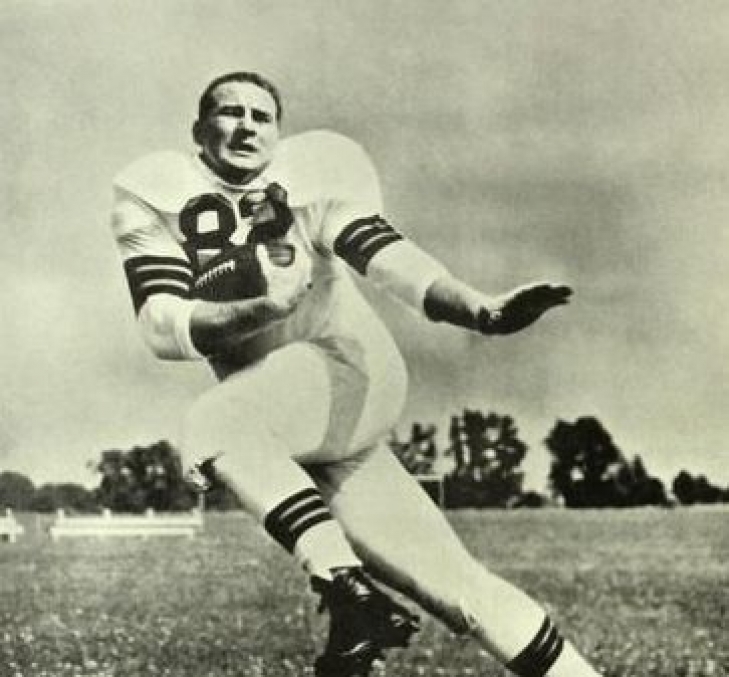
Signing Tommy James after his release from the Detroit Lions turned out to be another masterstroke by Paul Brown. Following an injury-shortened rookie year in Detroit that ended with a broken arm, the former Ohio State defensive back returned to his home state in 1948, quickly earning a starting job in Cleveland's secondary during the final two dominant runs of the All-America Football Conference (AAFC).
James immediately solidified the back end of Paul Brown’s defense. Blending sharp instincts with aggressive, physical coverage, he helped guide Cleveland to back-to-back undefeated and championship AAFC seasons in 1948 and 1949. When the Browns moved to the NFL in 1950, James proved his style translated seamlessly, helping defeat the Los Angeles Rams in the 1950 NFL Championship Game to capture the franchise's third straight league title across two leagues.
His individual production hit its stride in the early 1950s as a focal point of Cleveland’s defense. James earned his lone Pro Bowl selection during the 1953 season, picking off a career-high nine passes and returning them for 164 yards. He went on to help anchor two more championship runs, grabbing back-to-back NFL titles in 1954 and 1955 while regularly shutting down opponents’ downfield passing attacks.
After eight seasons in Cleveland (1948–1955), James spent his final NFL campaign with the Baltimore Colts in 1956 before hanging up his cleats. With the Browns, James played in 94 regular-season games, snatched 34 interceptions, and won five league titles (two AAFC, three NFL). The Browns permanently honored his role as a foundational champion by naming him a Cleveland Browns Legend in 2004.
38. Clarence Scott
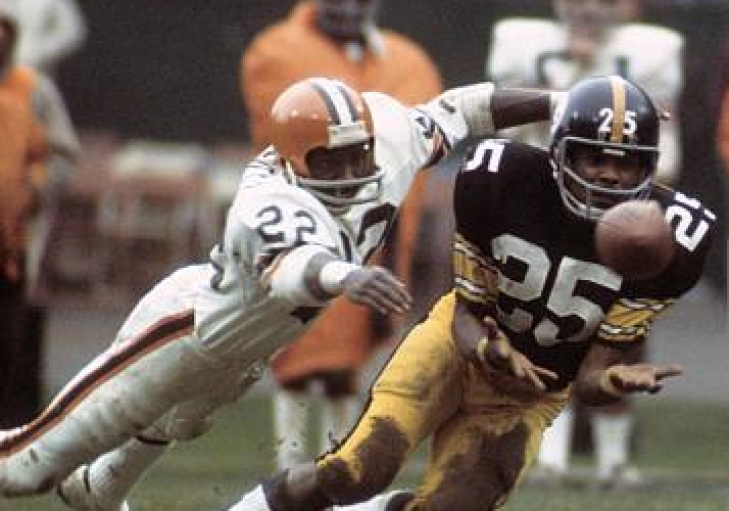
Selecting Clarence Scott with the 14th overall pick in 1971 paid off immediately for a Cleveland defense looking for a blue-chip cornerstone. The consensus All-American out of Kansas State stepped straight onto the field as a rookie starter at cornerback, launching what would become a 13-year career spent entirely in orange and brown.
Scott relied on smooth hips, sharp instincts, and disciplined technique to shut down outer passing lanes. He hauled in four interceptions during his inaugural campaign and hit his individual stride in 1973, picking off five passes to earn a Pro Bowl selection. A model of consistency, Scott snagged at least two interceptions in 12 of his 13 seasons, recording four picks in four separate campaigns while regularly matching up against the opponent's top wideouts.
His durability proved as vital to the Browns as his ball-hawking skills. Over his 13 years with the team, Scott played in 186 regular-season games, including an incredible streak of 178 consecutive appearances. As he entered the second act of his career, he seamlessly transitioned from cornerback to free safety for his final five seasons. The move provided veteran command to the back end of the secondary, helping guide the defensive unit through the high-flying "Kardiac Kids" era and capturing two division titles along the way.
By the time he retired after the 1983 season, Scott had accumulated 39 career interceptions (returning two for touchdowns) and recovered 11 fumbles. The franchise officially enshrined his lifetime of defensive leadership by naming him a Cleveland Browns Legend in 2012.
37. Doug Dieken
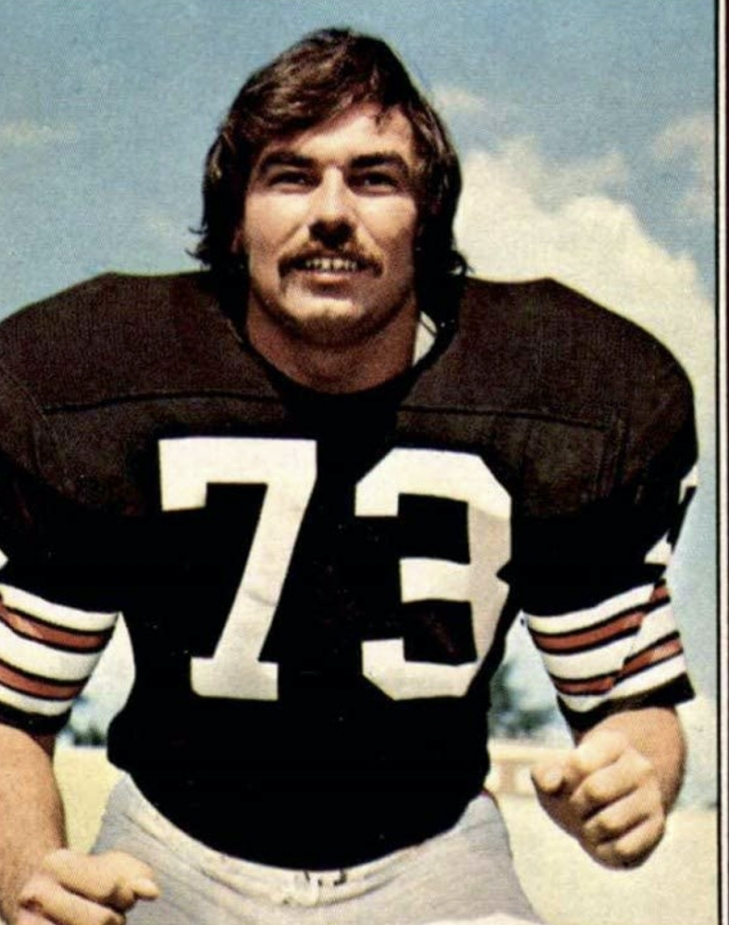
Selected out of Illinois in the sixth round of the 1971 draft, Doug Dieken didn't generate headline noise, but he went on to deliver one of the single best return-on-investment picks in Cleveland football history. Originally a converted tight end, he broke into the lineup at left tackle during his rookie year, starting five games. By 1972, he took total possession of the starting job on the blind side—and didn't let go for well over a decade.
What followed was a remarkable display of durability. Dieken set franchise records by playing in 203 consecutive regular-season games and starting 194 in a row. For 14 straight seasons, he consistently anchored the left side of Cleveland's front line, no matter the opponent or injury, providing dependable pass protection for quarterbacks such as Mike Phipps and Brian Sipe.
His peak individual performance occurred during the historic 1980 "Kardiac Kids" campaign. Dieken was responsible for the most crucial pass-blocking duties, enabling Sipe to secure NFL MVP honors and guiding Cleveland to the AFC Central title. His consistent and clean protection earned him a Pro Bowl selection that season. Additionally, he received widespread acclaim for his leadership, winning the Byron "Whizzer" White NFL Man of the Year Award after the 1982 season.
After ending his playing career in 1984, Dieken stayed with the organization as a radio analyst for the Browns, earning admiration for his wit, line analysis, and institutional knowledge, becoming a beloved figure to fans as both player and broadcaster. Dieken played 203 games, and his unmatched longevity on the field and decades of service earned him induction into the Cleveland Browns Legends in 2006.
35. Greg Pruitt
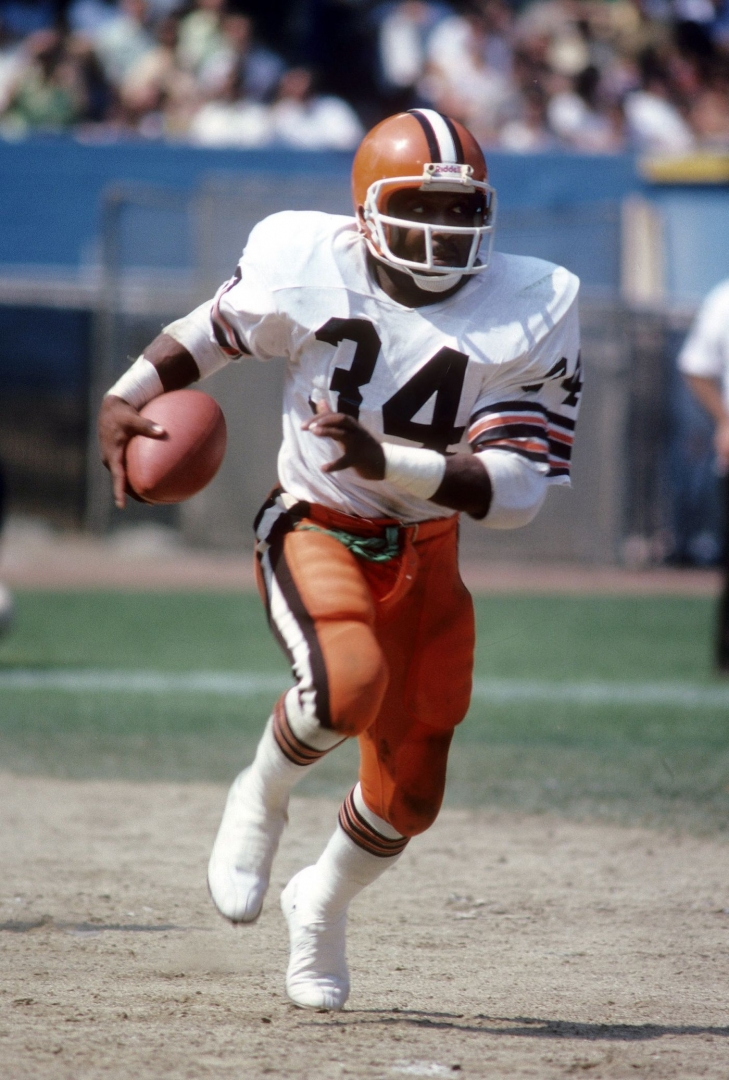
Carrying a frame listed at just 5 feet 10 inches and 180 pounds, Greg Pruitt shattered the misconception that a tailback needed heavy mass to survive the pro game. Fresh off an All-American career at Oklahoma—where he finished as a two-time Heisman Trophy finalist—the Browns spent a second-round pick on him in 1973. Rather than force-feeding him carries right away, Cleveland used his sub-4.4 speed as an open-field return man, earning him a Pro Bowl nod as a rookie.
Pruitt’s role expanded in his second season, setting up a dominant three-year run as Cleveland’s premier offensive threat. From 1975 to 1977, he eclipsed the 1,000-yard rushing mark in three consecutive seasons while operating behind an interior offensive line anchored by Joe DeLamielleure and Gene Hickerson. Known for his signature tear-away jerseys—a tactic designed to prevent tackles that forced the NFL to eventually change its uniform rules—Pruitt earned back-to-back Pro Bowl selections in 1976 and 1977, averaging over 4.5 yards per carry and racking up double-digit touchdowns.
A knee injury in 1979 slowed his raw breakaway gear, forcing him to adapt his game. Instead of fading, Pruitt evolved into a dual-threat weapon out of the backfield for the "Kardiac Kids" era. Over the 1980 and 1981 campaigns, he served as a high-volume safety valve for MVP quarterback Brian Sipe, pulling in a combined 115 receptions as a third-down specialist and perimeter playmaker.
After nine years in Ohio, Pruitt was traded to the Los Angeles Raiders ahead of the 1982 season. He reinvented himself yet again on the West Coast, reinventing his career as an elite punt returner and earning his fifth career Pro Bowl nod in 1983, capped off by a Super Bowl XVIII championship victory over Washington.
Pruitt finished his nine-season tenure in Cleveland (1973–1981) with 5,496 rushing yards, 3,022 receiving yards, and 2,182 return yards, totaling 10,700 all-purpose yards and 42 touchdowns. The organization named him to the inaugural class of the Cleveland Browns Legends in 2001.
