gold star for USAHOF
Committee Chairman

Committee Chairman

Kirk Buchner, "The Committee Chairman", is the owner and operator of the site.  Kirk can be contacted at [email protected] .

5. Lou Groza

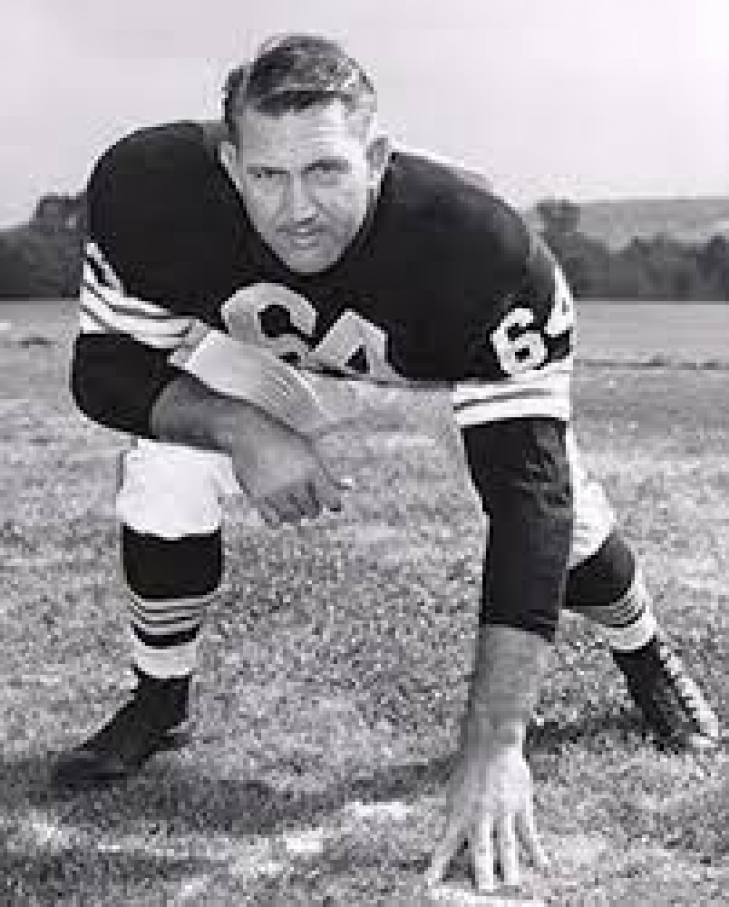
An original Cleveland Brown, Lou Groza was recruited by Paul Brown, primarily to act as the Browns’ Place Kicker.  Groza led the AAFC in Points in his rookie year, and after two seasons, Groza also helped out on Cleveland’s Offensive Line, and he would perform a dual-role for the next twelve seasons.

The Browns won the first four AAFC Championships, and Groza helped them win the 1950, 1954, and 1955 NFL Titles.  Groza evolved into an above-average Left Tackle, but his kicking talents were ahead of its time.  "The Toe" was one of the first Kickers who could regularly get it through the uprights in further distances.  Before Groza, Field Goals beyond 40 Yards were rarely attempted, but a new dynamic was added to the game with Groza as a weapon.  He would be named a First Team All-Pro four years in a row (1952-55) with nine Pro Bowl appearances.  Back issues compounded, and he retired after the 1959 Season.

Groza came out of retirement in 1961, rejoining Cleveland but only as their Kicker.  For the fourth and fifth time, Groza led the NFL in Field Goal Percentage and helped the Browns win the 1964 Championship, making him the only player to win seven titles with Cleveland.  He retired for good after the 1967 Season.

Graham entered the Pro Football Hall of Fame in 1974, and his number 76 is one of five retired by the team.  He was also part of the inaugural Browns Ring of Honor in 2010.  Groza is also a member of the 1950s All-Decade Team.

4. Joe Thomas

Drafted third overall in the 2007 NFL Draft out of Wisconsin—where he captured the 2006 Outland Trophy as college football's premier interior lineman—Joe Thomas arrived in Cleveland as a generational standard at left tackle. Joining a franchise navigating two decades of organizational turbulence, Thomas stood as an unbreakable pillar of perfection, delivering an era of unmatched individual brilliance on the Browns' offensive line.

At 6 feet 6 inches and 312 pounds, Thomas fundamentally reshaped how the offensive tackle position was played in the modern NFL. Eschewing traditional angled kick-slides, he pioneered an elite vertical pass set, getting out of his stance with explosive speed to square his hips pre-snap before defenders could gain leverage. Combined with his signature "shot-put" tight hand punch, Thomas mastered the mechanics of neutralizing power. Whenever pass rushers attempted to bull-rush, he dropped his hips into extreme ankle angles to absorb kinetic energy and lift the defender's center of gravity upright. Across 6,680 career pass-blocking snaps, Thomas allowed a total of just 30 sacks—meaning opposing edge rushers had less than a half-a-percent chance of reaching the quarterback against him.

Thomas joined the starting lineup as a rookie in 2007 and quickly made an impact, earning his first Pro Bowl and All-Rookie honors while protecting a 10-win Cleveland team. He improved in 2008 by earning Second-Team All-Pro recognition, then dominated from 2009 to 2011 with three straight First-Team All-Pro selections.

Despite coaching changes and scheme adjustments around him, Thomas remained completely unfazed. He secured his second Second-Team All-Pro honor in 2012 and then solidified his dominance with three straight First-Team All-Pro selections in 2013, 2014, and 2015. With an additional Pro Bowl appearance in 2016, Thomas uniquely became the only offensive lineman in NFL history to receive 10 consecutive Pro Bowl invites at the start of his career—while pass-blocking for 20 different starting quarterbacks.

Beyond his exceptional technical skills, Thomas created an unrivaled iron-man legacy in professional sports. From his debut snap on September 9, 2007, until October 22, 2017—when a torn triceps against the Tennessee Titans ended his career—he played 10,363 consecutive snaps without missing a single one. He endured torn knee cartilage, high-ankle sprains, and severe joint inflammation, never once stepping off the field.

Thomas retired following the 2017 season, having started 167 consecutive games and accumulating a franchise-leading 108 Approximate Value (AV) during the modern era. The Browns added "10,363" to the stadium honor roll and inducted him into the Cleveland Browns Ring of Honor. The NFL named him to the 2010s All-Decade Team, and in 2023, Thomas was elected to the Pro Football Hall of Fame on his first ballot—becoming the first player drafted by the expansion-era Browns to receive a gold jacket in Canton.

2. Otto Graham

Long before Jim Brown arrived on Lake Erie, Otto Graham established the baseline of excellence for the Cleveland Browns. A multi-sport standout at Northwestern, Graham was named Big Ten Player of the Year in 1943 and finished third in Heisman Trophy voting. While enrolled in Navy flight school at Colgate, he continued to showcase his athletic versatility by playing professional basketball for the Rochester Royals—winning an NBL title in 1946—before legendary coach Paul Brown selected him to be the field general for his new pro football franchise in the All-America Football Conference (AAFC).

Graham possessed pinpoint passing accuracy, supreme poise under pressure, and a deep understanding of Paul Brown’s revolutionary, structured passing offense. Operating under center, "Automatic Otto" possessed a quick release, deadly deep-ball placement, and the mobility to run for clutch third-downs or short-yardage touchdowns. He set a standard for efficiency that fundamentally shifted professional football from a run-heavy league to a passing-dominated sport.

What truly defined Graham’s playing style was his ahead-of-his-time mastery of pocket mechanics and intermediate field vision. In an era when quarterbacks rarely had structured pass protection, Graham navigated collapsing pockets with light, rhythmic footwork, never taking his eyes off downfield coverage. He threw with exquisite touch, effortlessly dropping deep corner routes over tight coverage or driving fastballs into tight windows on comeback routes. His quick decision-making allowed Paul Brown’s scripted timing offense to operate with surgical precision, rarely giving pass rushers a chance to strike.

Graham's skills extended beyond his arm, as he brought a tough, gritty physicality to the quarterback role. With a background as a collegiate single-wing tailback, he served as a powerful goal-line runner, executing handoffs on bootlegs or sneaks into the end zone. A fearless leader, he embraced the rough physicality of 1950s football, often playing through severe injuries, and his steady, composed presence in fourth-quarter drives earned the complete trust of his teammates in the Cleveland huddle.

Since the franchise's inception in 1946, Graham transformed the AAFC into his personal domain. He led the Browns to win all four AAFC Championship Games (1946–1949) and topped the league in passing yards in the last three seasons before the league dissolved.

Throughout that four-year period, Graham was awarded three AAFC Most Valuable Player honors. Following the dissolution of the AAFC after the 1949 season and the subsequent merger of the Browns into the National Football League, critics anticipated that Cleveland’s expansive passing offense would falter against the seasoned defenses of the NFL.

Graham quickly silenced all skeptics in his 1950 NFL debut season. In the season opener against the reigning NFL champion Philadelphia Eagles—a game dubbed the "World Series of Football"—he shredded the Eagles for 346 passing yards and three touchdowns in a 35–10 rout. He capped the year by leading the Browns to the 1950 NFL Championship Game, throwing four touchdown passes and engineering a game-winning fourth-quarter drive in a 30–28 victory over the Los Angeles Rams, securing five consecutive league titles for Cleveland.

Over the subsequent three seasons, Graham remained the unequivocal benchmark at the quarterback position. He was awarded the UPI NFL Most Valuable Player accolade in 1951, guiding Cleveland to the championship game. In 1952, he led the NFL in completions with 181 and passing yards totaling 2,816. In 1953, he achieved a personal statistical zenith, earning his second NFL MVP award while leading the league in completion percentage (64.7%), passing yards (2,722), and attaining an impressive 10.55 yards per pass attempt.

Graham's career concluded with back-to-back championship masterclasses. In the 1954 NFL Championship Game, he delivered an all-time performance against the Detroit Lions, throwing for three touchdowns and rushing for three more in a 56–10 blowout win. Though he initially planned to retire, Paul Brown coaxed him back for one final season in 1955. Graham responded by earning his third NFL MVP award and leading the Browns back to the title game against the Rams, where he ran for two touchdowns and threw for two more in a 38–14 victory before walking off into retirement to a standing ovation.

Graham played in 126 regular-season games, compiling a staggering 105–17–4 record as a starter and leading the Browns to the league championship game in every season of his career. He threw for 23,584 yards and 174 touchdowns, adding 44 rushing touchdowns. His career average of 8.63 yards per pass attempt remains the highest mark in NFL history.

In 1965, Graham took his rightful place in Canton with his induction into the Pro Football Hall of Fame. The Browns retired his iconic No. 14 jersey, enshrined him in the inaugural class of the Cleveland Browns Ring of Honor in 2010, and commemorated his impact with a bronze statue outside Huntington Bank Field. He was also selected to the NFL 1950s All-Decade Team as well as the NFL's 75th and 100th Anniversary All-Time Teams.

1. Jim Brown

Jim Brown is a football god.  

We could end it here, but out of deference to the man we think is not only the most outstanding rusher in the history of the game but the best offensive player ever, we will go through all the reasons why Jim Brown is the best player in franchise history, and arguably the greatest all-time player of any NFL franchise.

Before ever stepping foot on an NFL field, Jim Brown had already built a mythical reputation at Syracuse University as one of the greatest all-around collegiate athletes in American history. A dominant multi-sport phenom who starred in basketball and track and field and earned All-American honors in lacrosse, Brown’s primary playground remained the gridiron. His collegiate curtain call came in the 1957 Cotton Bowl, where he delivered a breathtaking 21-point performance against TCU—rushing for 132 yards, scoring three touchdowns, and kicking three extra points. Yet despite his overwhelming power, track-star speed, and peerless resume, five NFL teams somehow passed on him in the 1957 NFL Draft. Cleveland seized the opportunity at sixth overall, bringing an absolute force of nature to Lake Erie.

Sixth overall, and it was still a steal.

Brown was built like a modern edge rusher, yet he operated in a 1950s backfield. He possessed an extraordinary balance of crushing inner power and electric open-field speed. Rather than avoiding contact, Brown violently punished would-be tacklers with a legendary stiff-arm, leaving defenders dazed in his wake before pulling away into the secondary.

What truly set Brown’s playing style apart was his blend of supreme physical dominance and calculating tactical patience. He did not simply run over defenders; he probed defensive fronts with high-knee, gliding footwork before exploding through the hole at top speed. When contact came, Brown lowered his shoulders, drove through multiple defenders, and delivered a violent, stiff-arm that routinely knocked tacklers off their feet. Equally famous was his demeanor after the whistle: Brown was notorious for getting up from the turf in painful slow motion, dragging himself back to the huddle as if utterly exhausted, only to take the very next handoff and sprint 70 yards downfield past an already demoralized defense.

Brown made a remarkable rookie debut in 1957, quickly establishing himself in the league. He led the NFL with 942 rushing yards and nine touchdowns, earning both NFL Offensive Rookie of the Year and AP NFL MVP awards early in his career while guiding Cleveland to the NFL Championship Game. His standout moment came on November 24 against the Los Angeles Rams, when he broke the single-game rushing record with 237 yards and four touchdowns. This record remained unbroken for 14 years.

Entering his second season in 1958, expectations were extremely high, but Brown exceeded all of them. In only 12 games, he broke the NFL single-season rushing record with 1,527 yards and scored a personal best of 17 rushing touchdowns. He averaged an impressive 127.3 yards per game and 5.9 yards per carry, earning his second straight MVP award and cementing his position as the most dominant athlete in team sports.

Throughout three seasons, the league consistently sought strategies to limit number 32. Brown earned three straight rushing titles, with 1,329 yards in 1959, 1,257 yards in 1960, and 1,408 yards in 1961. Night after night, defensive coordinators would pack the box with eight or nine players, yet Brown consistently broke through the line, forcing defenders past it. 

The only season Brown did not win the league rushing title was 1962, but he still displayed his versatile excellence. He finished second in rushing with 996 yards and significantly contributed to the passing game, setting personal records with 47 receptions for 517 yards and five touchdowns. That year, he amassed over 1,500 yards from scrimmage, proving he was equally dangerous in space as he was between the tackles.

Brown reached a legendary peak in 1963, putting together what remains one of the greatest rushing campaigns ever put on tape. He shredded opposing fronts for a mind-boggling 1,863 rushing yards and 12 touchdowns across 14 games, averaging an incredible 6.4 yards per carry. That historic campaign broke his own single-season record and established a new gold standard for backfield dominance that endured for a decade.

Brown’s team achievements peaked in 1964 when he led the league with 1,446 rushing yards and scored seven touchdowns. He played a key role in Cleveland's dynamic offense, which advanced to the championship game. In the 1964 NFL Championship facing the strong Baltimore Colts, Brown gained 114 yards on 27 carries, helping Cleveland secure a historic 27–0 shutout victory and claim the title for Ohio.

In 1965, Brown delivered a final masterclass that marked the pinnacle of his legendary career. He amassed 1,544 rushing yards and topped the league with 21 total touchdowns (17 rushing, 4 receiving), guiding Cleveland to yet another NFL Championship Game. For his outstanding performance, Brown was awarded his third AP NFL MVP title, ending his career at the peak of his athletic abilities.

At just 29 years old and coming off an MVP season, Brown shocked the sports world during the summer of 1966 by announcing his retirement from professional football while on the set of The Dirty Dozen. He left the game with 12,313 career rushing yards and 106 rushing touchdowns, holding every major career ground record by a massive margin. While other legends have since passed his total yardage marks, none matched his blistering pace or his career average of 104.3 rushing yards per game.

The sheer efficiency of Brown’s career remains unmatched. Across 118 regular-season games, he accumulated a career Approximate Value (AV) of 122—an astonishing figure considering AV was not retroactively calculated for his first three seasons (1957–1959), meaning that 122 AV was produced across just 82 recorded games.

He played nine seasons in the NFL, earned nine Pro Bowl selections, won eight rushing titles, and was named a First-Team All-Pro eight times. In nine years, he never missed a single game. Brown entered the Pro Football Hall of Fame in 1971 and was named to the 1960s All-Decade Team and the 50th-, 75th-, and 100th-Anniversary Teams.  Brown's number 32 was retired by the team, and he was named to their Ring of Honor as part of the first group in 2010.

We will finish with one word…

Legend.