Site Admin
3. Don Hutson
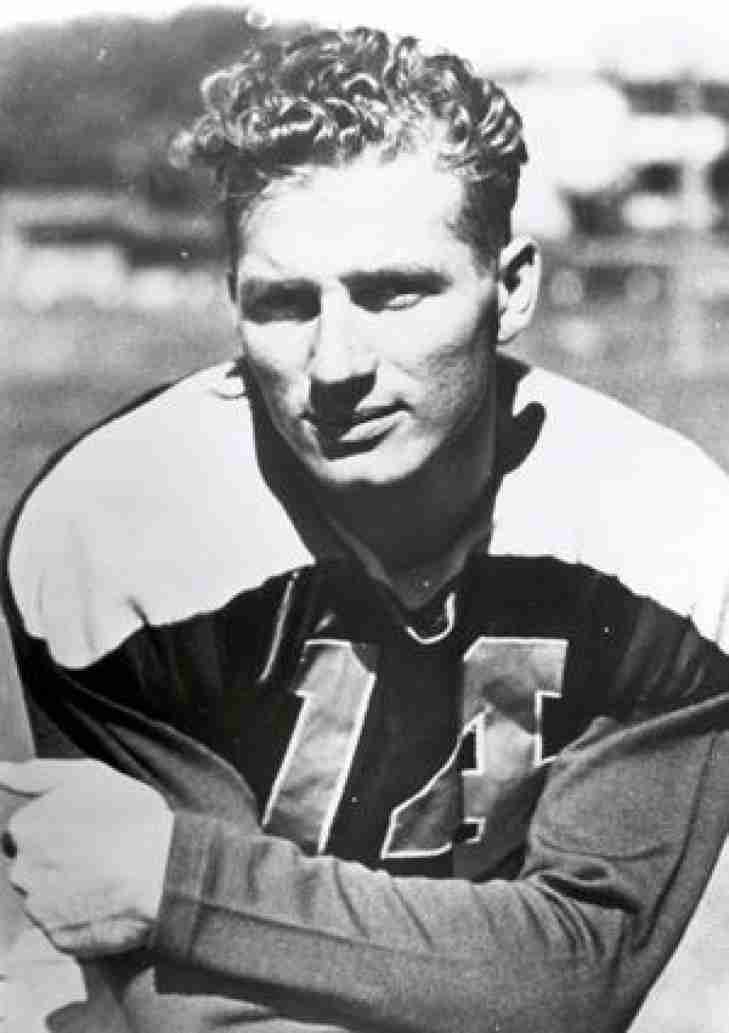
Signing with Green Bay in 1935 out of Alabama, Don Hutson would single-handedly revolutionize offensive football. At a time when teams viewed the pass as a desperate last resort, head coach Curly Lambeau paired the lightning-quick end with passers Arnie Herber and Cecil Isbell, creating a vertical attack that caught the entire league flat-footed. Hutson invented the modern route tree—perfecting precise Z-outs, post patterns, and sudden double-moves that left defensive backs grasping at air. On the first play of his second career game, he caught an 83-yard touchdown pass against the Chicago Bears, setting the standard for a career defined by instant, explosive production.
Nicknamed "The Alabama Antelope" for his gliding, 9.7-second 100-yard dash speed, Hutson did not merely lead the league; he completely eclipsed his contemporaries. Over an 11-year run, he topped the NFL in receptions eight times, receiving yards seven times, and receiving touchdowns nine times—including an extraordinary stretch from 1941 to 1944 where he swept all three categories annually. In 1942, he became the first player in pro football history to break the 1,000-yard receiving barrier, catching 74 passes for 1,211 yards and 17 touchdowns in just 11 games—a statistical margin over his peers that remains unmatched in sports history.
His supreme individual brilliance drove Green Bay to three NFL Championships (1936, 1939, and 1944). Hutson’s dominance was so total that he captured back-to-back Joe F. Carr Trophies as the NFL MVP in 1941 and 1942, standing as one of the few receivers ever to earn the league's top individual honor. In a 1945 matchup against Detroit, he showcased his explosive scoring capability by racking up an absurd 29 points in a single quarter—catching four touchdown passes and kicking five extra points.
Operating in the two-way, ironman era of football, Hutson was far more than an offensive weapon. Playing safety on defense, he used his instincts and speed to intercept 30 passes over his final six seasons, even leading the entire NFL with six interceptions in 1940. He also doubled as the team's primary placekicker, converting 172 extra points and seven field goals. When he retired following the 1945 season, he held 18 major NFL records, including 99 career touchdown catches—a mark that stood untouched for 44 years until Steve Largent finally broke it in 1989.
Hutson played his entire career with the Packers, appearing in 116 games with 488 receptions, 7,991 yards, and 105 touchdowns. An eight-time First-Team All-Pro, he was named to the NFL 1930s All-Decade Team and the NFL's 50th, 75th, and 100th Anniversary All-Time Teams. In 1951, the Packers retired his No. 14 jersey, making him the first in franchise history, and he was inducted into the Pro Football Hall of Fame in 1963.
5. Bart Starr
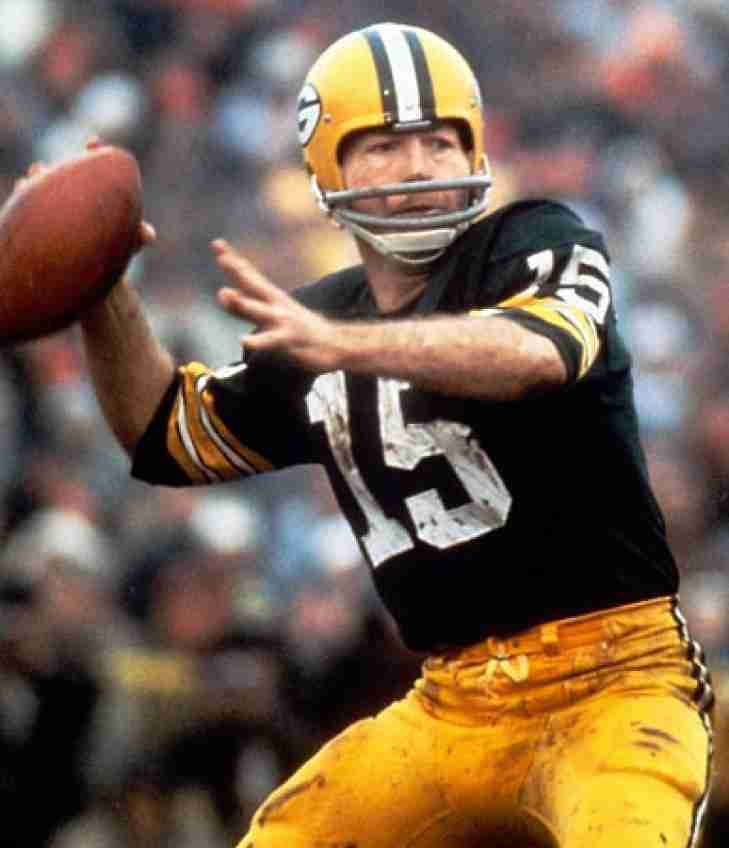
Can we begin by saying that Bart Starr is one of the greatest athlete names ever?
With the 200th overall pick of the 1956 NFL Draft out of Alabama, Bart Starr quietly went from an afterthought depth piece before transforming into the ultimate field general of pro football's grandest dynasty. He spent his early years splitting time in a struggling offense, but everything shifted with the 1959 arrival of head coach Vince Lombardi. Recognizing Starr's elite preparation, unflappable composure, and sharp decision-making, Lombardi handed him full control of the offense, setting off a golden era in Titletown.
Starr was the ultimate master of field position, running Lombardi's offense with a calculating mindset that prized efficiency over raw volume. In an era when quarterbacks routinely threw nearly as many interceptions as touchdowns, Starr treated turnover avoidance like a religion. He set a then-NFL record by throwing 294 consecutive passes without an interception across the 1964 and 1965 seasons, demonstrating an ability to read coverage and protect the football that was decades ahead of its time.
His accuracy in executing Green Bay's iconic power sweep compelled opposing safeties to step up towards the line of scrimmage, creating dangerous play-action passing chances. Starr led the NFL in completion percentage four times (1962, 1966, 1968, 1969) and in passer rating four times, consistently outperforming opposing secondary schemes with precise timing. His 1966 season remains a benchmark for quarterback mastery: throwing 14 touchdowns with only three interceptions, guiding the Packers to a 12–2 record, winning the AP NFL MVP award, and earning Super Bowl I MVP honors.
When the stakes were highest, Starr possessed a unique, ice-cold clarity that defined his big-game brilliance. He orchestrated back-to-back world titles in 1961 and 1962, dismantling the New York Giants in consecutive NFL Championship Games. In the 1961 title matchup, he threw three touchdown passes in a 37–0 rout, proving that Green Bay's offense could flex its passing muscles whenever teams stacked the box against the run.
That clutch DNA reached its legendary apex in the 1967 NFL Championship Game—the iconic "Ice Bowl" against the Dallas Cowboys. Trailing 17–14 in minus-13-degree temperatures with 16 seconds left and no timeouts, Starr called his own number on third-and-goal. After Jerry Kramer's famous block on Jethro Pugh, Starr lunged over the goal line for the game-winning touchdown sneak, securing Green Bay's third consecutive league title and cementing his reputation as the most clutch quarterback to ever play on the gridiron.
Starr’s postseason metrics remain mind-boggling in historical context. He compiled an astonishing 9–1 postseason record, throwing 15 touchdown passes and just three interceptions. His career postseason passer rating of 104.8 stood as an NFL record for decades, serving as definitive mathematical proof that no quarterback in history elevated his game in the playoffs more consistently than No. 15.
With the Packers, Starr played 196 games, completing 1,808 passes for 24,718 yards and 152 touchdowns. A four-time Pro Bowler and on the NFL 1960s All-Decade Team, his No. 15 jersey was retired in 1973. Enshrined in the Pro Football Hall of Fame and Packers Hall of Fame in 1977, he is regarded as the ultimate winning quarterback in pro football history.
2. Brett Favre
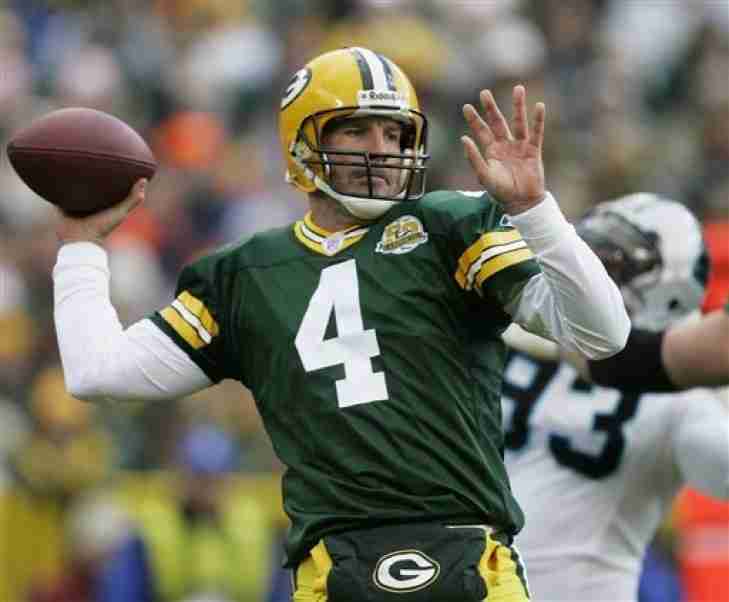
Drafted in the second round of the 1991 NFL Draft by the Atlanta Falcons, Brett Favre spent his rookie season buried on the depth chart—completing zero passes and throwing two interceptions—before Green Bay general manager Ron Wolf surrendered a first-round pick to acquire him in 1992. When Don Majkowski suffered an ankle injury in Week 3 against Cincinnati, Favre stepped off the bench and engineered a dramatic, game-winning drive capped by a touchdown pass to Kitrick Taylor, seizing a starting job he would not relinquish for the next 16 years.
That incredible comeback sparked one of the longest and most resilient careers in professional sports history. Favre emerged as the ultimate ironman, enduring broken bones, sprains, and intense wear-and-tear to start 253 consecutive regular-season games for Green Bay—an extraordinary streak that epitomized his relentless determination. With a cannon arm and a playful approach to the game, he played with pure joy, often throwing sidearm passes, celebrating with offensive linemen, and attempting risky throws into double coverage that only his raw arm talent could pull off.
Favre’s definitive peak was a three-year period from 1995 to 1997, becoming the first—and remains the only—NFL player to win three consecutive AP NFL MVP awards. In 1995, he threw for 4,413 yards and 38 touchdowns, guiding Green Bay to its first NFC Championship Game in over twenty years. He continued to elevate his performance in 1996, throwing 39 touchdown passes to lead the NFL's best offense and helping Green Bay defeat the New England Patriots in Super Bowl XXXI for the franchise's first Lombardi Trophy in 29 years.
His legendary status in Titletown was solidified by his bold approach, risking everything for victory and adopting a gunslinger persona. He led the NFL in touchdown passes for three consecutive seasons (1995–1997) and guided Green Bay back to a second straight Super Bowl XXXII appearance. Although his aggressive playstyle resulted in a high number of turnovers—eventually making him the NFL's all-time leader in career interceptions—his teammates consistently supported his fearless attitude, transforming the Packers into regular contenders during the 1990s and early 2000s.
Yet, for all his on-field heroism, the latter portion of Favre's tenure in Green Bay became increasingly complicated by high-profile off-field personal struggles and offseason drama. Early in his Packers career, he publicly battled a severe addiction to the painkiller Vicodin, entering a rehabilitation facility in 1996 before courageously returning to lead Green Bay to a world championship that very same season. Later in his career, his annual public indecision regarding retirement turned every offseason into a media circus, straining his relationship with head coach Mike McCarthy and general manager Ted Thompson.
The long-simmering friction reached a bitter breaking point in the summer of 2008. After formally announcing his retirement in March, Favre had a change of heart months later and demanded his starting job back over young successor Aaron Rodgers. The front office stood firm, leading to an acrimonious split and a trade to the New York Jets. The feud intensified the following year when Favre signed with Green Bay's bitter division rival, the Minnesota Vikings, leading them to a division sweep over the Packers in 2009 in front of an enraged Lambeau Field crowd.
His post-football legacy took further damage and public scrutiny because of serious civil litigation over his involvement in the Mississippi welfare funds scandal, along with past league investigations into inappropriate workplace conduct during his time in New York. While these off-field issues permanently tarnished his standing with many fans, time eventually softened the competitive wounds between the franchise and its most charismatic quarterback.
The fences were officially mended in July 2015 when Favre returned to a packed Lambeau Field to have his iconic No. 4 jersey retired and his name enshrined on the stadium facade alongside the franchise's greatest legends. With the Packers, Favre appeared in 255 regular-season games, compiling 61,655 passing yards and 442 touchdown passes while winning 160 games as a starter. A three-time NFL MVP, three-time First-Team All-Pro, nine-time Pro Bowler in Green Bay, and member of the NFL 1990s All-Decade Team, Favre was enshrined in the Pro Football Hall of Fame in his first year of eligibility in 2016.
380. Selenia Iaacchelli