


Site Admin
30. Adam Vinatieri
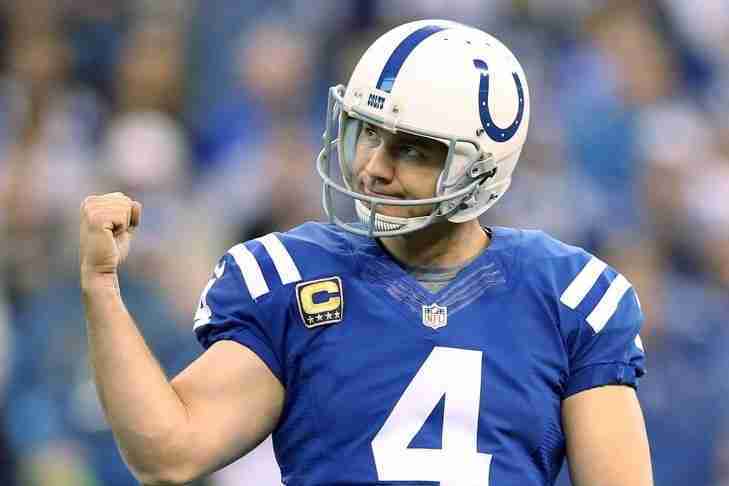
Drafted by no one in 1996 out of South Dakota State, Adam Vinatieri had already etched his name into NFL mythology long before stepping foot in Indianapolis. After spending his first decade in New England delivering ice-in-his-veins heroics—including immortal blizzard kicks and two game-winning Super Bowl boots—the free agent joined the Colts in 2006. While national fans wondered if his prime was behind him, Vinatieri quickly proved that his leg was as lethal in horseshoe blue as it ever was in red, white, and blue.
His introductory season in Indy immediately dispelled any doubts. Vinatieri produced a masterclass 2006 postseason, connecting on 14 of 15 field goal attempts—including five in a 15–6 divisional win over Baltimore—to propel the Colts to the title game. In Super Bowl XLI, he kicked three field goals in slick rain to secure a 29–17 victory over Chicago, capturing his fourth career ring and bringing a championship trophy back to Indianapolis.
Competing inside the controlled conditions of Lucas Oil Stadium, Vinatieri maintained astonishing technical precision throughout his thirties and forties. In 2014, at age 42, he put together one of the most accurate seasons in kicking history, converting 30 of 31 field goals (96.8%) while going a perfect 3-for-3 from 50-plus yards to earn First-Team AP All-Pro and Pro Bowl honors. From 2015 to 2016, he set an NFL record by converting 44 consecutive field-goal attempts, proving age was powerless against his smooth, repeatable stroke.
As the years rolled on, Vinatieri rewrote the league's history books right in front of Indy fans. In 2018, he passed Morten Andersen to become the NFL’s all-time career scoring leader, later becoming the only player in NFL history to score 1,000 or more points for two separate franchises. Whether drilling long-distance game-winners or executing automatic extra points, his steady presence steadied the franchise through both the Peyton Manning and Andrew Luck eras across 14 seasons.
Injuries finally caught up to the legendary specialist during the 2019 season, leading to knee surgery and his eventual release before he formally announced his retirement in 2021 at age 48.
For the shoe, Vinatieri had 336 field goals made on 394 attempts (85.3%), 507 extra points made on 524 attempts (96.8%), with 1,515 total points scored. In 2026, earned induction into the Pro Football Hall of Fame in Canton and as the 21st Indianapolis Colts Ring of Honor member.
40. Dallas Clark
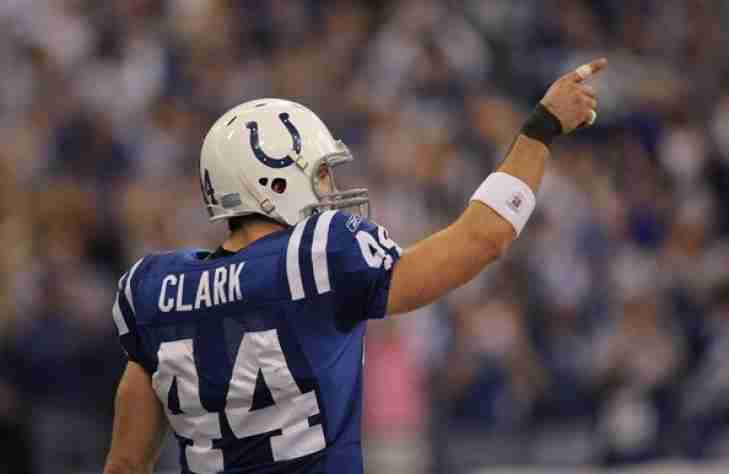
When Tom Moore and Peyton Manning sat down to design the most lethal hurry-up offense of the modern era, they needed a tight end who moved like a slot receiver and ran routes with surgical precision. Enter Dallas Clark. Drafted 24th overall out of Iowa in 2003, Clark arrived in Indianapolis perfectly tailored for the Colts' No-Huddle attack, flexing out into the slot or lining up in the inline seam to create immediate nightmares for opposing linebackers and safeties.
Clark’s tactical value exploded during the 2006 postseason run. Shifting seamlessly between tight end and slot wideout, he became Manning's primary chain-mover, hauling in 21 receptions for 317 yards across four playoff games. His clutch grabs in the AFC Championship Game against New England paved the way for Indianapolis' historic comeback, culminating in a dominant performance in the rain at Super Bowl XLI to claim the Lombardi Trophy over Chicago.
His individual peak arrived in 2009, when Clark authored one of the most statistically explosive seasons ever recorded by a tight end. Snagging 100 receptions for 1,106 yards and 10 touchdowns, he became just the second tight end in NFL history to break the century mark in catches in a single season. That masterclass earned him First-Team AP All-Pro honors and a Pro Bowl selection as the Colts captured their second AFC pennant in four years.
After a severe wrist injury in 2010 and the franchise's 2012 transition, Clark played one season each with Tampa Bay and Baltimore before signing a one-day contract in Indianapolis to retire as a Colt in 2014. In nine seasons with the Colts, he set franchise tight-end records for receptions (427), receiving yards (4,887), and touchdowns (46), becoming one of Manning's most trusted targets on third downs and in the red zone.
32. Tom Matte
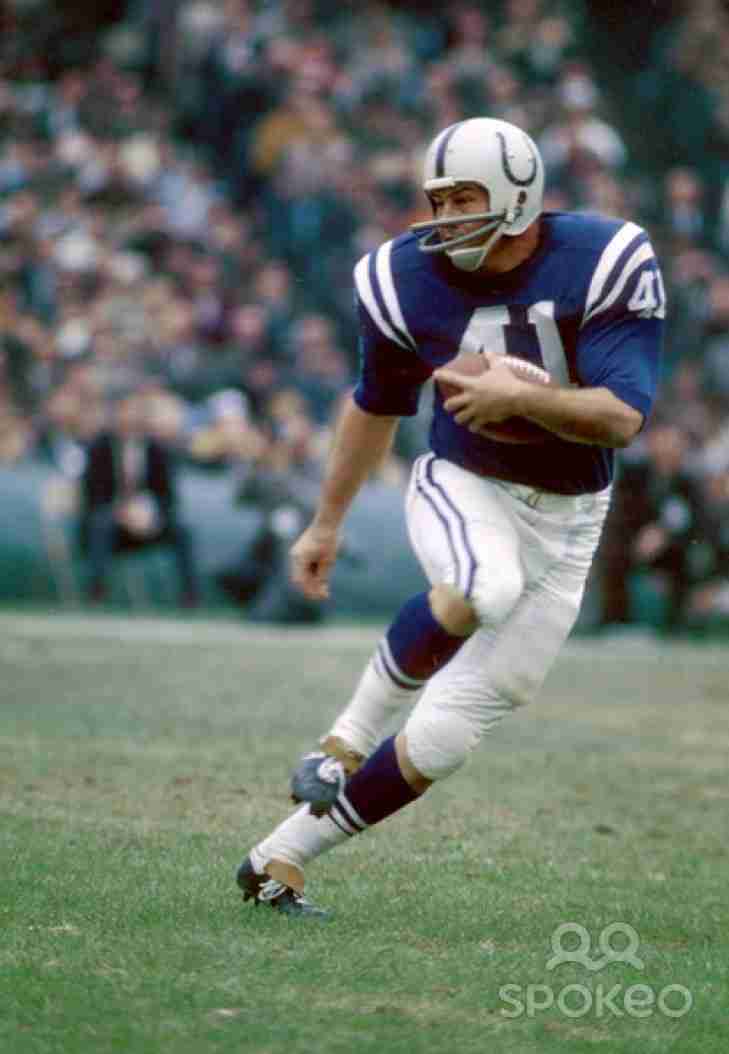
Before he ever topped the NFL in all-purpose yardage or hoisted a Super Bowl trophy, Tom Matte etched his name into pro football folklore as the ultimate utility man who stepped up when disaster struck. Arriving in Baltimore as a first-round pick out of Ohio State in 1961, Matte immediately made his mark with power running and soft hands, but it was his willingness to adapt—and famously wear a play-sheet taped to his wrist as an emergency quarterback—that proved he was the heartbeat of Don Shula’s backfield.
Matte earned legendary gridiron status during the 1965 season through one of the most famous emergency performances in pro football history. When injuries knocked out starting quarterbacks Johnny Unitas and Gary Cuozzo, Shula tapped Matte to start at quarterback for the regular-season finale and the Western Conference playoff game against Green Bay. Wearing a now-famous wristband with handwritten plays taped to his forearm—a strategic innovation that reshaped modern football communication—Matte managed the offense with courage and poise, leading Baltimore to a 20–0 victory over Los Angeles and pushing the Packers to overtime.
Returning to his primary halfback role, Matte produced his individual statistical masterpiece during the late 1960s. He earned back-to-back Pro Bowl selections in 1968 and 1969, serving as the offensive focal point alongside Earl Morrall and Unitas. In 1968, he rushed for 662 yards and ten touchdowns to power Baltimore to the 1968 NFL Championship. He followed up in 1969 with a First-Team AP All-Pro campaign, pacing the entire National Football League with 1,420 all-purpose yards and 11 total touchdowns while averaging 5.0 yards per carry.
Matte's dual-threat versatility proved essential during Baltimore's championship run in Super Bowl V. Contributing as both a runner and receiving outlet, he helped the Colts secure a 16–13 victory over the Dallas Cowboys to bring the Vince Lombardi Trophy to Baltimore.
Retiring after the 1972 season, Matte had 4,646 rushing yards, 45 rushing touchdowns, 249 receptions for 2,869 yards and 12 touchdown catches, and 8,882 total all-purpose yards.
28. Rick Volk
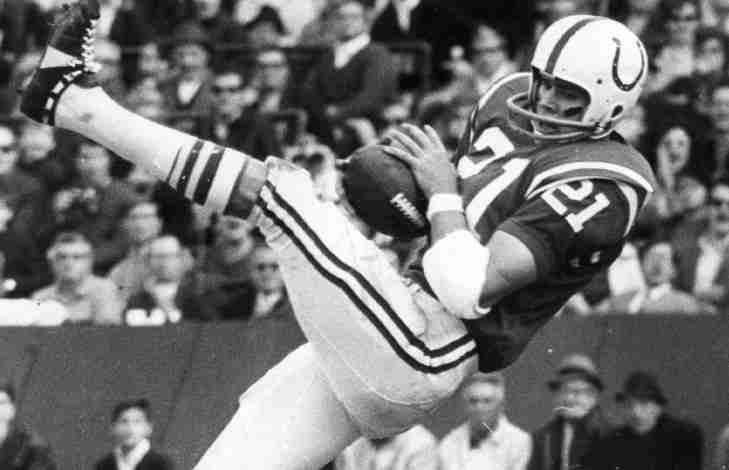
Selected in the second round (45th overall) of the 1967 NFL Draft out of Michigan, Rick Volk completed a rare football progression by transitioning straight from a Rose Bowl appearance with the Wolverines to starting in the NFL as a rookie. Arriving in Baltimore, the tough, cerebral safety immediately won the starting free safety job, bringing instincts, sharp tackling, and ball-hawking range to the back end of the Baltimore secondary.
Volk's impact was immediate, helping propel Baltimore to a 11–1–2 record as a rookie in 1967 while earning his first career Pro Bowl selection and First-Team AP All-Pro honors. The following season, he helped lead the Colts to the NFL Championship and an appearance in Super Bowl III. However, that championship clash turned tragic for Volk when he suffered a severe concussion in a collision in the second half, forcing him to be hospitalized while Baltimore suffered a shocking upset loss to the New York Jets.
Redemption arrived two years later in Super Bowl V against the Dallas Cowboys. Playing with a shoulder harness and relentless determination, Volk made one of the game's defining plays in the fourth quarter. Snagging a critical interception off Cowboys quarterback Craig Morton, he returned it 30 yards to the Dallas 2-yard line, setting up Tom Nowatzke’s game-tying touchdown run and paving the way for Baltimore's 16–13 victory to claim the Lombardi Trophy.
By the time his tenure with the franchise concluded after the 1975 season, Volk had intercepted 31 passes in a Colts uniform—ranking among the top marks in franchise history. He closed out his career with brief stints in New York (Giants) and Miami, but his legacy was permanently established in Baltimore as a big-game playmaker.
