


Site Admin
11. Alex Gordon
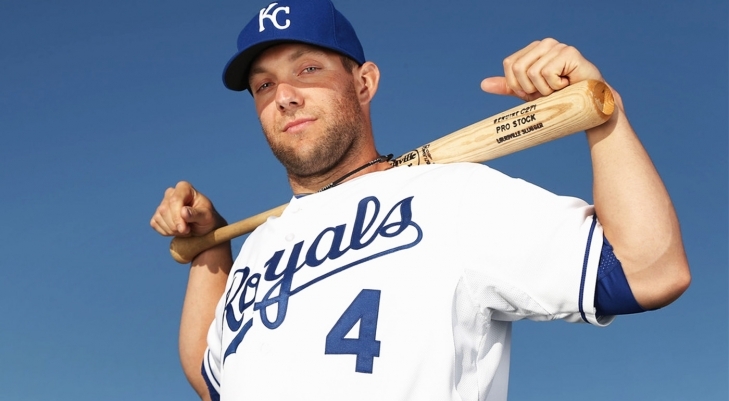
Alex Gordon arrived in Kansas City with the immense weight of being the second overall pick and the consensus best amateur player in the country. While the early chapters of his career were defined by a difficult search for an identity at third base, his transition to the outfield transformed him into the defensive heartbeat of the franchise. For fourteen seasons, Gordon embodied a blue-collar resilience that resonated in the Heartland.
After a few inconsistent seasons in the infield, he reached a career-defining pivot in 2011. Moving permanently to left field, he combined a newfound defensive comfort with a violent, gap-to-gap swing, batting a career-high .303 and launching 23 home runs. He followed this with a relentless run of production in 2012, leading the American League with 51 doubles. He wasn't just a solid contributor anymore; he was a model of two-way efficiency who provided the steady-state reliability the Royals needed to climb out of the division basement.
The middle of his tenure saw him reach an unrivaled gear of defensive dominance. Between 2011 and 2014, Gordon captured four consecutive Gold Gloves, proving that his range and arm strength were the gold standard of the league. He reached a professional high point during the 2014 and 2015 postseason runs, where his focused intensity and a flair for the dramatic, highlighted by his game-tying home run in the 9th inning of Game 1 of the 2015 World Series, anchored the Royals' first championship in thirty years. He showed the organization that a player could become a franchise pillar through sheer grit and a refusal to let a ball drop in the gap, eventually earning a Platinum Glove as the league’s best overall defender.
The final chapters of his story were marked by a veteran-like poise as he mentored a younger generation of Royals. While his offensive numbers reached a natural plateau in his mid-30s, his craftsmanship in the field never wavered, as he added three more Gold Gloves to his trophy case between 2017 and 2020. He remained the emotional anchor of the clubhouse through the rebuilding years, choosing to stay in Kansas City as a lifer rather than chasing a ring elsewhere. He eventually retired after the 2020 season, leaving the diamond with 1,643 hits and 190 home runs.
10. Hal McRae
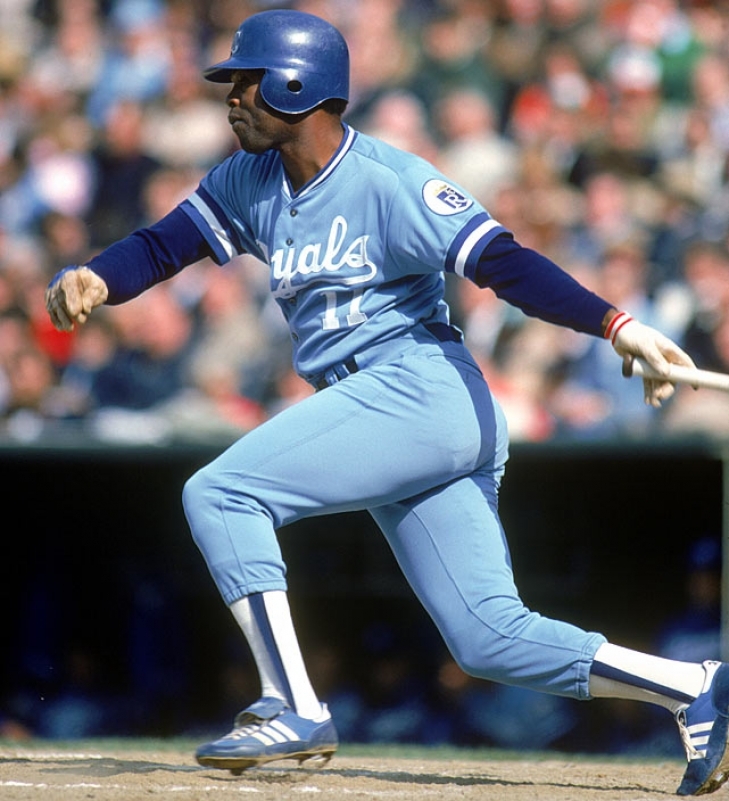
Hal McRae was the definitive prototype for the modern designated hitter, a man who transformed a newly created rule into a specialized art form. When he arrived in Kansas City in 1973 via a trade with the Reds, the Royals weren't just acquiring a bat; they were securing the competitive heartbeat of their franchise for the next fifteen seasons. McRae didn't let his defensive limitations define him; instead, he focused his intensity entirely on the batter's box, proving that a player could become a franchise pillar by mastering the psychological and tactical demands of the DH role.
McRae’s ascent in Kansas City began with an immediate high-frequency impact, hitting over .300 in his first two full seasons with the club. He reached an unrivaled gear in 1976, a season that served as a career-defining peak for his efficiency at the plate. That summer, he battled teammate George Brett for the batting title until the final day, finishing with a .332 average and leading the American League in both on-base percentage (.407) and OPS (.868). He finished fourth in the MVP voting, signaling a transition from a productive hitter to one of the most feared outliers in the game. He wasn't just a "solid contributor"; he was a model of focused aggression, specializing in the "hard slide" and the RBI knock.
The middle of his tenure was marked by a relentless, steady-state excellence as the Royals emerged as a perennial powerhouse. Between 1974 and 1982, McRae exceeded the .300 mark six times, earning three All-Star nods and becoming the first player to win the Designated Hitter of the Year award three times. He reached a new level of run production in 1982, at age 36. That season, he led the American League with 133 RBIs and secured his first Silver Slugger Award, again finishing fourth in the MVP race. He showed the organization that a veteran-like poise and a violent, line-drive swing could defy the standard aging curve, providing the middle-order muscle that fueled multiple postseason runs.
Everything culminated in the 1985 championship season, where McRae served as the elder statesman of the clubhouse. While his playing time had reached a natural plateau, his presence was a deterrent that helped steady a young Royals squad during their comeback in the "I-70 Series." He finished his Kansas City story with 1,924 hits and 1,012 RBIs, leaving the diamond as the gold standard for every designated hitter who followed.
In 1989, the Royals inducted him into their Hall of Fame.
9. Mark Gubicza
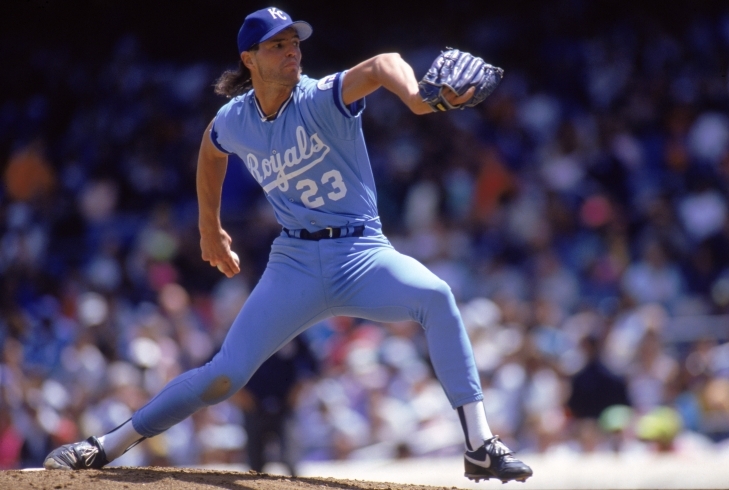
Mark Gubicza, affectionately known as "Goobie," was the definition of a workhorse for the Kansas City Royals. While he often pitched in the shadows of Cy Young winners like Bret Saberhagen, Gubicza was a high-frequency anchor who combined a fierce competitiveness with a specialized ability to keep the ball in the yard. For over a decade, he transitioned through every role in the rotation, eventually leaving the diamond as the franchise's all-time strikeout leader and a pillar of their 1980s glory.
Gubicza’s ascent in Kansas City began as a 21-year-old in 1984, but during the 1985 championship run. As a sophomore, he provided the specialized durability the Royals needed, winning 14 games and pitching 177 innings to help secure the AL West. His most iconic moment of that run came in the ALCS against Toronto; with the Royals facing elimination in Game 6, Gubicza delivered a gutsy start to earn the win and force a Game 7. While he didn't appear in the World Series as the team moved to a shorter rotation, his regular-season volume was a primary engine in getting them there.
The center of his residency was defined by a two-year stretch of elite dominance in the late 1980s. In 1988, Gubicza became a 20-game winner and finished third in the AL Cy Young voting. He was a model of efficiency that season, leading the league in pitching bWAR (8.0) while pitching a massive 269.2 innings. He followed this with another All-Star campaign in 1989, proving his craftsmanship by leading the league in starts (36). During this peak, he joined the legendary Walter Johnson as one of the few pitchers to lead the league in HR/9 three times, a testament to his specialized ability to suppress power hitters.
The final chapters of his story in Kansas City showcased a remarkable professional resilience. Following a series of arm injuries and a brief move to the bullpen in 1993, Gubicza refused to settle into a declining plateau. He successfully transitioned back into the starting rotation, even leading the American League in starts again in 1995. By the time he was traded to the Angels in 1997, he had amassed 132 wins and 1,366 strikeouts in a Royals uniform, setting a franchise record for punchouts that would stand for years.
The story in Kansas City reached its final punctuation in 2006 when the Royals inducted him into their Hall of Fame.
7. Frank White
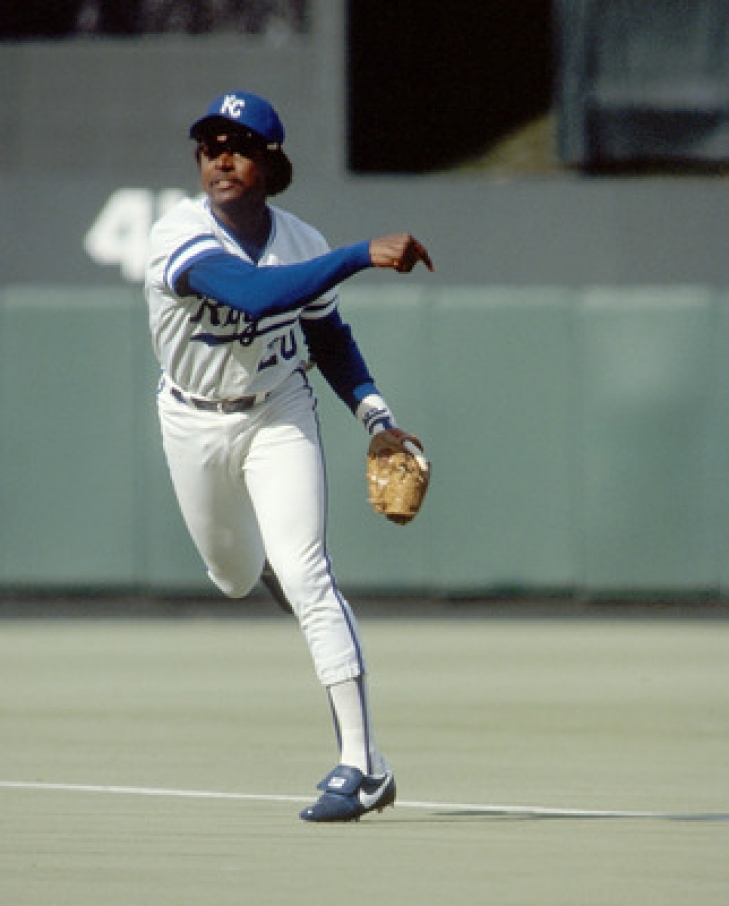
While George Brett was the thunder of the Kansas City dynasty, Frank White was the lightning-quick glove that held the infield together. A local product who literally helped build the stadium where he eventually became a star, White spent eighteen seasons as the gold standard for defensive excellence at second base.
White’s tenure in the Midwest was defined by a surgical, high-frequency brilliance in the field. His defensive command was on full display by capturing eight Gold Gloves, a total that solidified his reputation as the premier vacuum of the American League. Nicknamed "Hoover" for his specialized ability to inhale anything hit in his direction, he was a model of technical craftsmanship, consistently ranking among the league leaders in double plays turned and total zone runs. He possessed a rare, explosive athleticism that allowed him to turn routine grounders into spectacular outs, providing the steady-state reliability that anchored the Royals' championship rotations.
Offensively, White reached an unexpected surge of power during the mid-1980s. While he struggled with a career on-base percentage that dipped below the .300 mark—a specialized limitation that restricted his overall statistical value—he found his stroke during the club's most critical runs. He produced back-to-back 20-home run seasons in 1985 and 1986, proving he could provide the high-leverage pop needed to support a championship lineup. His professional resilience was never more evident than in the 1980 ALCS, where he hit .545 and earned MVP honors to help Kansas City finally slay the Yankees and reach the World Series for the first time.
His presence in the organization was defined by an unwavering loyalty and a workmanlike approach that endeared him to the Kansas City faithful. Whether he was famously using his elite range to preserve a lead or providing the veteran-like poise needed to guide the club through the 1985 "I-70 Series" triumph, he competed with an energy that was woven into the fabric of the city.
As a Royal, White compiled 2,006 hits and 160 home runs while securing eight Gold Gloves and a World Series ring, and in 1995, he was bestowed a spot in the Royals Hall of Fame.
