


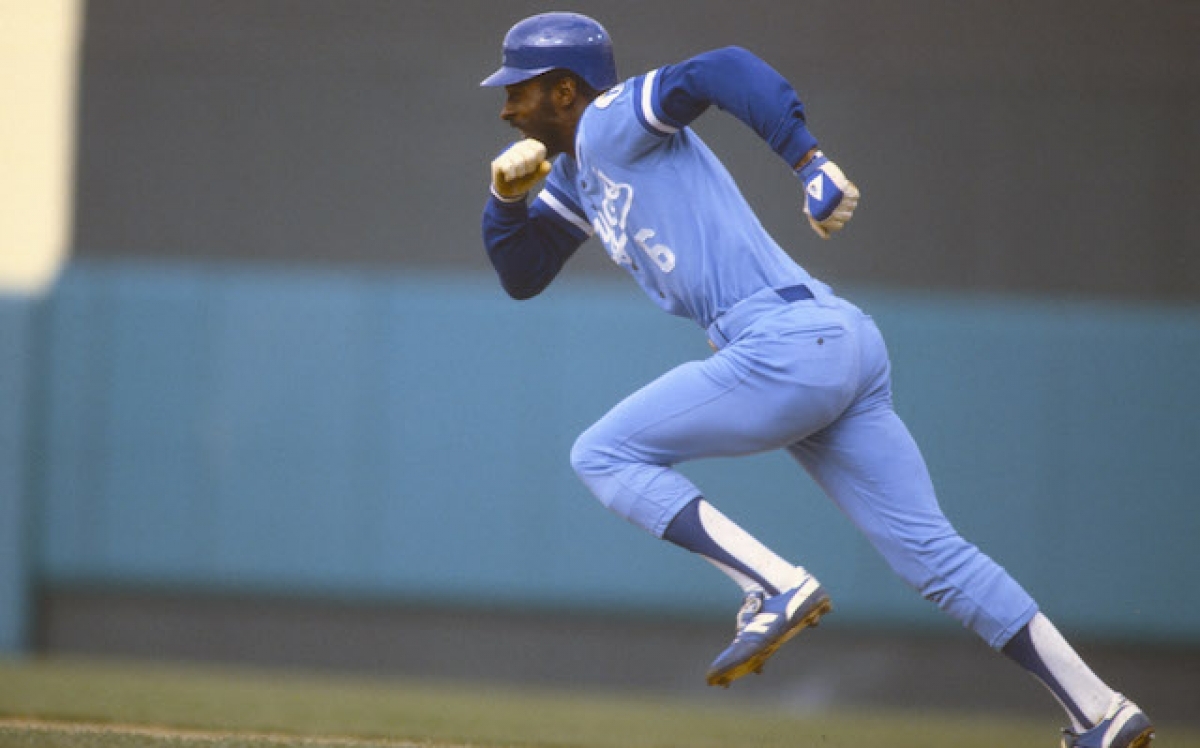


If George Brett was the foundation of the Kansas City Royals, Willie Wilson was the high-octane fuel that made the machine run. A first-round draft pick with world-class speed, Wilson transformed the leadoff spot into a theater of the frantic, forcing opposing pitchers into a state of permanent anxiety the moment he stepped into the box. While his career is occasionally shadowed by a difficult chapter in 1983, his legacy in the Heartland is defined by a decade and a half of pure, unadulterated athleticism that helped propel the franchise to the peak of the baseball world.
Wilson’s tenure in Kansas City served as a definitive study in utilizing speed as a primary offensive weapon. He had a special campaign in 1980, where he became only the second player in history to record 100 hits from each side of the plate. That summer, he led the American League in hits (230), runs (133), and triples (15) while setting a then-major league record with 705 at-bats. He was a model of specialized efficiency, capturing a Gold Glove and a Silver Slugger while finishing fourth in the MVP race. It was a performance that proved he was more than just a sprinter; he was a complete, high-frequency contributor who could dominate a game without ever leaving the infield.
Wilson was a perennial fixture on the triples leaderboard, leading the American League in that category five separate times as a Royal, including a career-high 21 triples during the 1985 championship season. He possessed a professional resilience that allowed him to bounce back from a disappointing 1980 World Series to become a postseason hero five years later. During the 1985 Fall Classic against St. Louis, Wilson hit a blistering .367, providing the high-leverage spark needed to fuel the Royals' historic comeback from a 3-1 series deficit.
While his on-base percentage fluctuated, his ability to put the ball in play and pressure defenses was unrivaled; he eclipsed the 30-stolen-base mark in 11 consecutive seasons for Kansas City, eventually amassing a franchise-record 612 steals. He proved that a player could become a franchise pillar by mastering the specialized "small ball" game,
In 1990, Wilson departed for Oakland, but he left as the organization's all-time king of the basepaths. He finished his Royals journey with 1,968 hits and a reputation as the fastest man to ever wear the uniform. His work was immortalized in 2000, when the Royals inducted Wilson into their Hall of Fame.








Comments powered by CComment